
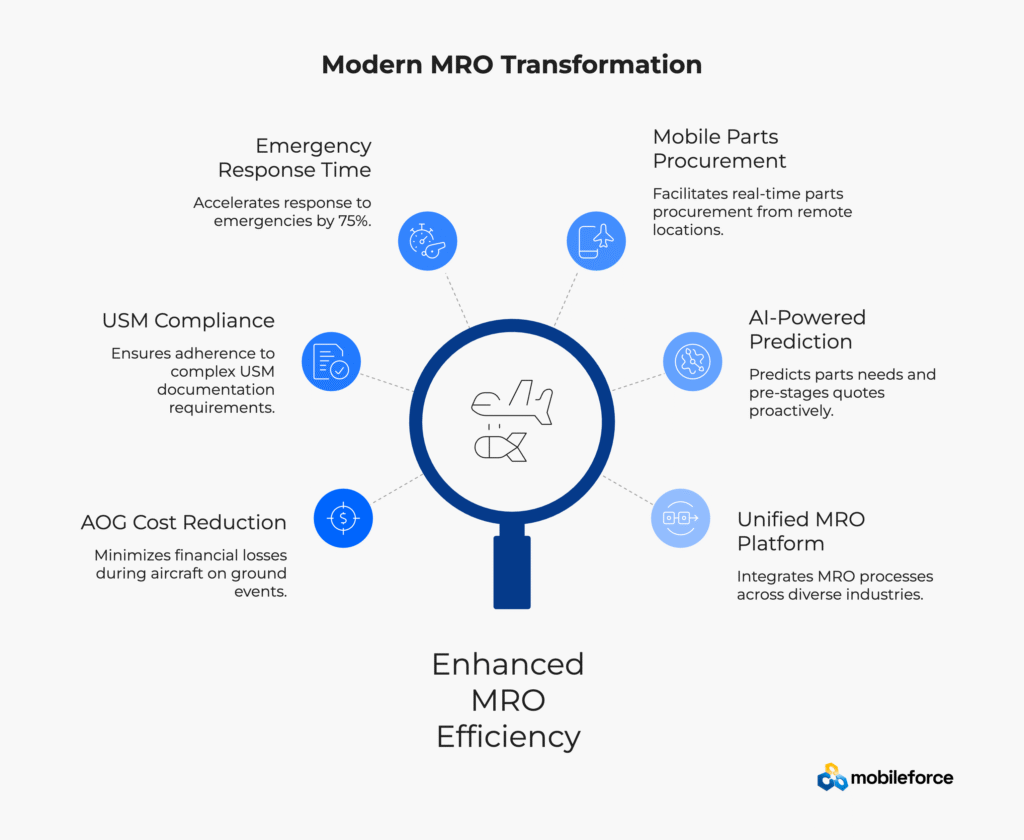
Enterprise MRO operations across industries face critical challenges managing emergency response while ensuring parts compliance in complex supply chains. Every minute of equipment downtime costs thousands in revenue, yet traditional procurement processes create dangerous delays during emergencies. Modern MRO-focused CPQ platforms can accelerate parts sourcing while automating documentation processes that typically consume hours during time-critical situations.
It’s 2:17 AM at Dubai International Airport. A Boeing 737 MAX bound for London Heathrow sits motionless on the tarmac, its passengers sleeping in nearby hotels while a single failed avionics component has triggered an Aircraft on Ground (AOG) emergency. The maintenance crew has six hours to locate a certified replacement part, verify its Used Serviceable Material (USM) compliance with EASA regulations, complete the installation, and generate proper documentation—or face cascading costs that can exceed $100,000.
This exact scenario occurs 50+ times daily across the global aviation network. The challenge isn’t just sourcing parts quickly—it’s managing the complex intersection of emergency response, regulatory compliance, and cost optimization that defines modern aviation maintenance. As the $90.85 billion aviation MRO market projected to reach $120.96 billion by 2030 faces increasing pressure from aging fleets and supply chain disruptions, smart operators are discovering that the solution lies in intelligent enterprise CPQ software solutions that can automate the entire AOG response workflow.
Industry data from Allied Market Research confirms the scale: global air transport MRO reached $86.5 billion in 2023, with ARSA reporting that U.S. operations account for 60%+ of world maintenance revenue. The stakes continue rising as 35% of the global commercial fleet exceeds 15 years in age, driving higher maintenance requirements and emergency response frequency.
Aircraft downtime creates exponential cost escalation that traditional maintenance systems can’t handle effectively. A grounded narrowbody loses $8,000-$10,000 per hour in direct revenue, but AOG situations trigger cascading expenses that multiply rapidly: passenger rebooking fees, crew repositioning costs, gate conflicts, and regulatory penalties that can reach $100,000+ for extended delays.
The mathematics become punishing when regulatory compliance enters the emergency equation. With 35% of aviation maintenance workforce approaching retirement, fewer experienced technicians means greater dependence on documented processes exactly when speed matters most. This workforce crisis coincides with fleet expansion—Oliver Wyman research projects global commercial aircraft growth from 28,400 in 2024 to 36,400 by 2034, a 28% increase driving maintenance demand.
The automation imperative becomes clear: AI-powered sales solutions that address manual quoting challenges are essential for aviation MRO operations facing skilled technician shortages and growing fleet maintenance requirements.
Used Serviceable Material offers compelling economics—60-80% cost savings versus OEM new parts in a market growing to $11.14 billion by 2032. But these savings evaporate during AOG emergencies when compliance documentation becomes the critical bottleneck.
Every USM component requires comprehensive certification that traditional manual quoting systems handle poorly under pressure:
Recent industry incidents underscore the stakes. The 2023 AOG Technics fraud case revealed how compliance shortcuts during pressure situations create catastrophic risks, with counterfeit parts infiltrating major airline supply chains discovered only after extensive regulatory audits. These incidents highlight why automated compliance systems become mission-critical for aviation MRO procurement automation.
Traditional AOG Response Timeline:
This timeline transforms cost-effective USM into operational disasters. The solution requires enterprise software platforms that can compress these steps into minutes while ensuring 100% regulatory compliance through automated aerospace supply chain management.
Modern Configure, Price, Quote (CPQ) platforms—evolved from complex manufacturing configuration systems across multiple industries—solve the AOG-USM dilemma through intelligent automation that compresses hour-long emergency processes into minutes. Aviation represents the most demanding application of MRO CPQ capabilities, where regulatory requirements, time pressure, and safety criticality create the ultimate test environment.
Discover how unified revenue operations platforms streamline aircraft maintenance emergency response while ensuring comprehensive regulatory compliance.
When technicians identify failed components, AI-powered quote configuration systems instantly present compatible replacement options with real-time availability, pricing, and compliance status from multiple suppliers. Machine learning algorithms consider aircraft model, serial numbers, configuration requirements, and maintenance history to recommend optimal solutions in seconds—eliminating manual catalog searches that consume 15-30 minutes during emergencies.
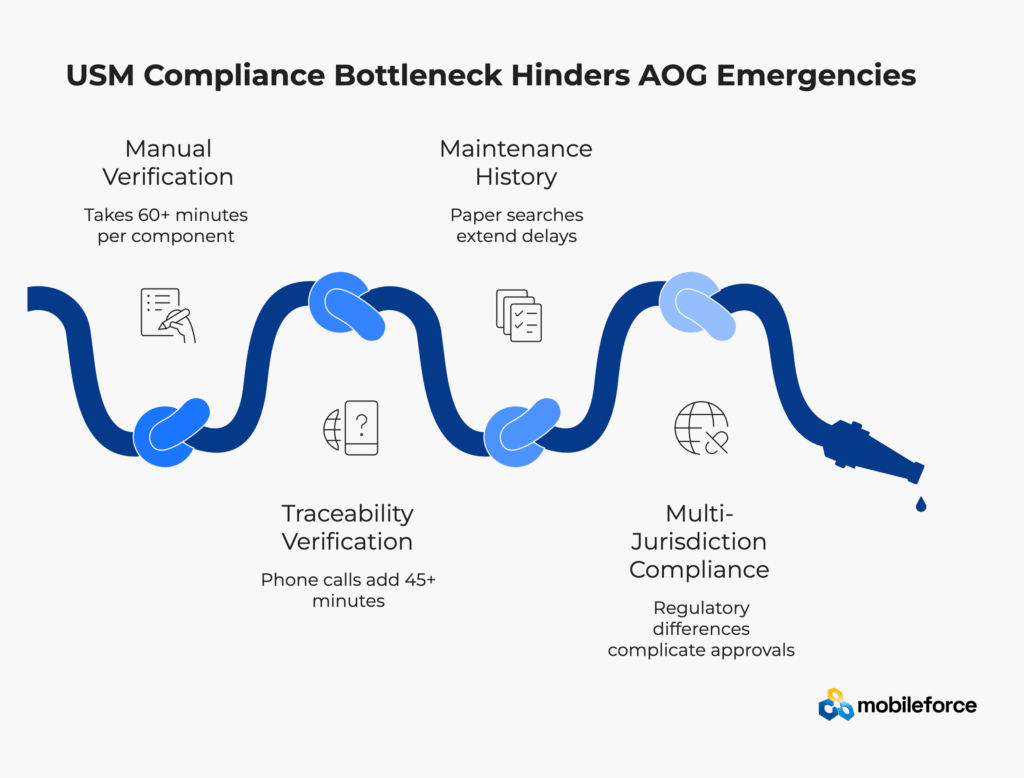
Instead of manual form completion during high-pressure situations, no-code configuration platforms auto-generate complete compliance packages. EASA Form 1, FAA Form 8130-3, and equivalent certifications populate automatically from verified supplier data and transaction records, reducing documentation time from 60+ minutes to under 5 minutes.
Aviation maintenance occurs globally at airports with varying infrastructure quality. Mobile-optimized sales platforms enable technicians to access parts catalogs, submit emergency procurement requests, and process approvals directly from any device, regardless of location or connectivity quality. Offline-capable systems ensure continuous operation even at remote airports with unreliable connectivity.
Ready to eliminate AOG delays? Schedule your aviation MRO demo to see how intelligent automation reduces emergency response times by 75% while maintaining 100% regulatory compliance.
Emergency Response Comparison | Traditional Process | MRO CPQ Platform |
Parts identification & sourcing | 15-30 minutes | 30-60 seconds |
Supplier verification & availability | 45+ minutes | 2-5 minutes |
USM compliance documentation | 60+ minutes | 2-5 minutes |
Approval workflow completion | 30+ minutes | 5-10 minutes |
Total AOG Response Time | 2-4 hours | 15-30 minutes |
This compression directly translates to cost avoidance. A 2-hour reduction in AOG response saves $16,000-$20,000 in direct revenue loss alone, before considering cascade effects and penalty avoidance.
Need to eliminate AOG delays? See how unified MRO platforms can transform your emergency response capabilities.

Mobileforce’s Revenue Operations Cloud serves as a comprehensive quote-to-service platform designed for modern sales, service, and operations teams. The platform’s no-code approach simplifies complex quoting while streamlining scheduling, dispatch, and CRM integration—all without the friction of siloed legacy tools.
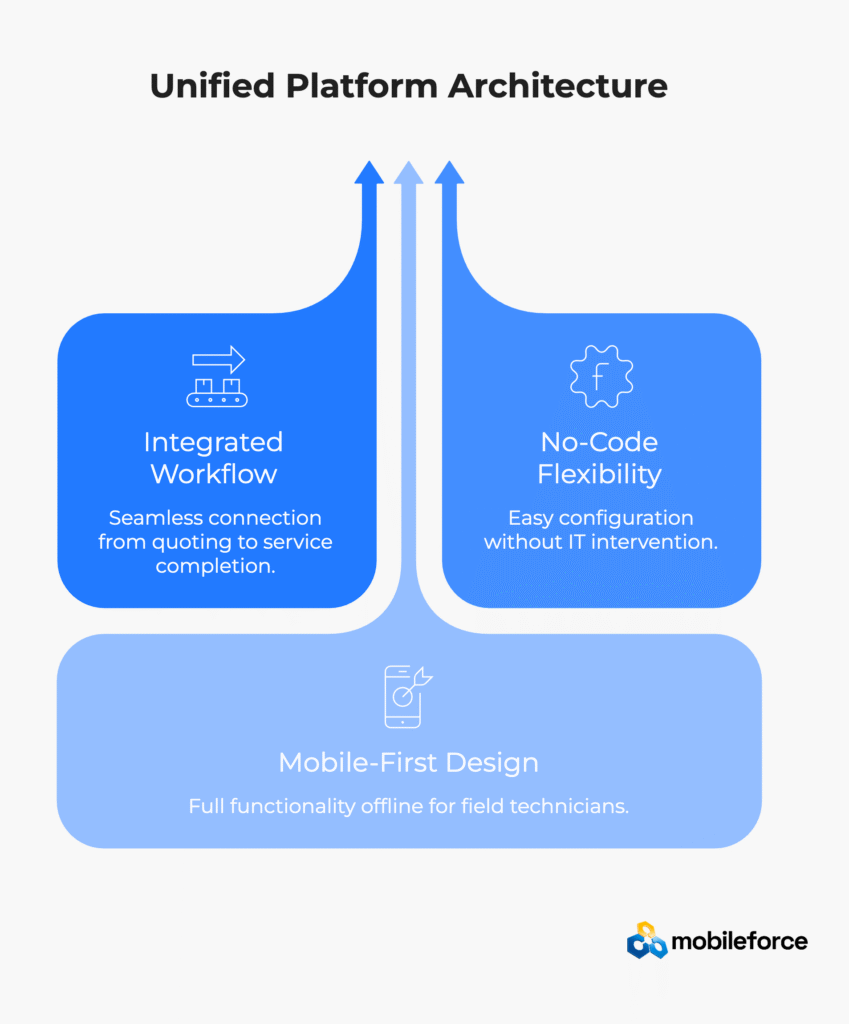
Mobileforce’s unified approach provides several key advantages for maintenance operations:
Integrated Quote-to-Service Workflow: Rather than managing separate systems for quoting, scheduling, and service delivery, the platform connects the entire revenue operation from initial inquiry through service completion.
No-Code Flexibility: Maintenance teams can configure pricing rules, approval workflows, and compliance processes without IT intervention—crucial when operational requirements change rapidly during emergency situations.
Mobile-First Design: Field technicians access complete functionality whether connected or offline, ensuring operations continue regardless of location or connectivity quality.
This unified platform foundation means organizations get the benefit of proven capabilities refined across demanding operational requirements—eliminating the complexity of managing multiple disparate systems.
Mobileforce’s AskCPQ AI agent specifically addresses the cognitive load problem during AOG situations. Instead of complex catalog navigation under pressure, technicians describe needs in natural language: “Need hydraulic actuator for grounded 737-800, USM acceptable with EASA compliance.” The AI-powered automation system delivers instant, accurate quotations with availability and regulatory status, reducing operator error during high-stress situations.
This artificial intelligence capability becomes mission-critical when experienced technicians are unavailable—allowing junior staff to access expert-level parts knowledge instantly during critical AOG scenarios. The system also provides predictive analytics capabilities that anticipate parts needs based on maintenance patterns and aircraft age, enabling proactive inventory management.
Struggling with manual quoting delays during emergencies? Discover how AI automation can provide instant expert-level parts recommendations and compliance validation.
The platform’s no-code environment enables aviation teams to configure USM compliance workflows without IT intervention. A maintenance organization operating across EASA and FAA jurisdictions configures distinct approval processes for each regulatory environment while maintaining unified audit trails. When AOG situations demand immediate response, the system automatically applies appropriate compliance procedures based on aircraft registration and operational location.
This no-code approach eliminates the traditional development bottlenecks that prevent rapid configuration changes during regulatory updates. Aviation teams can modify approval workflows, update compliance templates, and adjust documentation requirements without waiting for IT resources—crucial when regulatory requirements change or new jurisdictions are added to operations.
The platform’s configuration flexibility extends to multi-currency operations common in international aviation, automatically handling currency conversions and pricing adjustments across different regulatory zones while maintaining compliance accuracy.
Ready to streamline your compliance workflows? See how no-code configuration eliminates IT bottlenecks while ensuring regulatory accuracy.
Aviation maintenance spans global time zones with varying infrastructure quality. Mobileforce’s offline-first design ensures critical operations continue at remote airports with unreliable connectivity—automatic synchronization occurs when network access returns. This reliability prevents communication failures that could extend AOG delays at challenging locations.
As a HubSpot Platinum Partner with proven integrations across Salesforce, Microsoft Dynamics, and other enterprise systems, the platform eliminates data silos between maintenance teams, procurement departments, airline operations, and parts suppliers—unified communication prevents information gaps that extend emergency response times.
Critical Capability | Traditional CPQ | Mobileforce Advantage | AOG Impact |
Emergency Response | Manual catalog navigation, phone-based supplier contact | AskCPQ AI natural language, automated supplier integration | 75% faster response time |
Mobile Operations | Web-based access requiring constant connectivity | Offline-first with automatic sync | Reliable operation at remote airports |
Compliance Automation | Manual form completion for each transaction | Pre-configured EASA/FAA templates with auto-population | 90% reduction in documentation errors |
Multi-Industry Experience | Aviation-only or single-industry focus | Cross-industry MRO expertise from energy, medical, manufacturing | Battle-tested under diverse regulatory pressures |
Integration Architecture | Bolt-on approach requiring custom development | Native CRM integrations with API-first design | Seamless data flow prevents communication gaps |
Configuration Flexibility | IT-dependent customizations with long lead times | No-code configuration by maintenance teams | Rapid adaptation to changing compliance requirements |
This comparison highlights why aviation MRO leaders increasingly choose platforms with proven multi-industry experience over aviation-only solutions—broader expertise delivers more robust capabilities for handling complex emergency scenarios.
Experience cross-industry MRO expertise: Schedule your aviation platform demo to see how multi-industry learnings accelerate AOG response.

Aviation MRO organizations typically achieve 75% reduction in AOG response times within 60-90 days of CPQ implementation. The transformation follows a focused approach designed to minimize operational disruption while maximizing emergency response improvements:
Emergency Response Assessment
Organizational Readiness Evaluation
Focused Deployment Strategy
Performance Monitoring
Enterprise-Wide Deployment
Ready to transform your AOG response capabilities? Schedule your aviation MRO consultation to develop a customized implementation roadmap for your organization.
Before beginning CPQ implementation, aviation organizations should evaluate their readiness across key operational and technical dimensions:
Assessment Category | Current State Indicators | Implementation Prerequisites | Success Factors |
AOG Response Process | Average response time >2 hours, manual documentation | Documented baseline metrics, identified bottlenecks | Clear ROI targets, executive sponsorship |
Technical Infrastructure | Legacy systems, limited mobile capability | API access, mobile device management | IT team engagement, integration planning |
Regulatory Compliance | Manual EASA/FAA form completion | Current compliance workflows documented | Regulatory team involvement, audit trail requirements |
Staff Technical Skills | Limited technology adoption | Training budget allocated | Change management support, pilot user champions |
Supplier Integration | Phone/email-based communication | Supplier API capabilities assessed | Digital supplier onboarding plan |
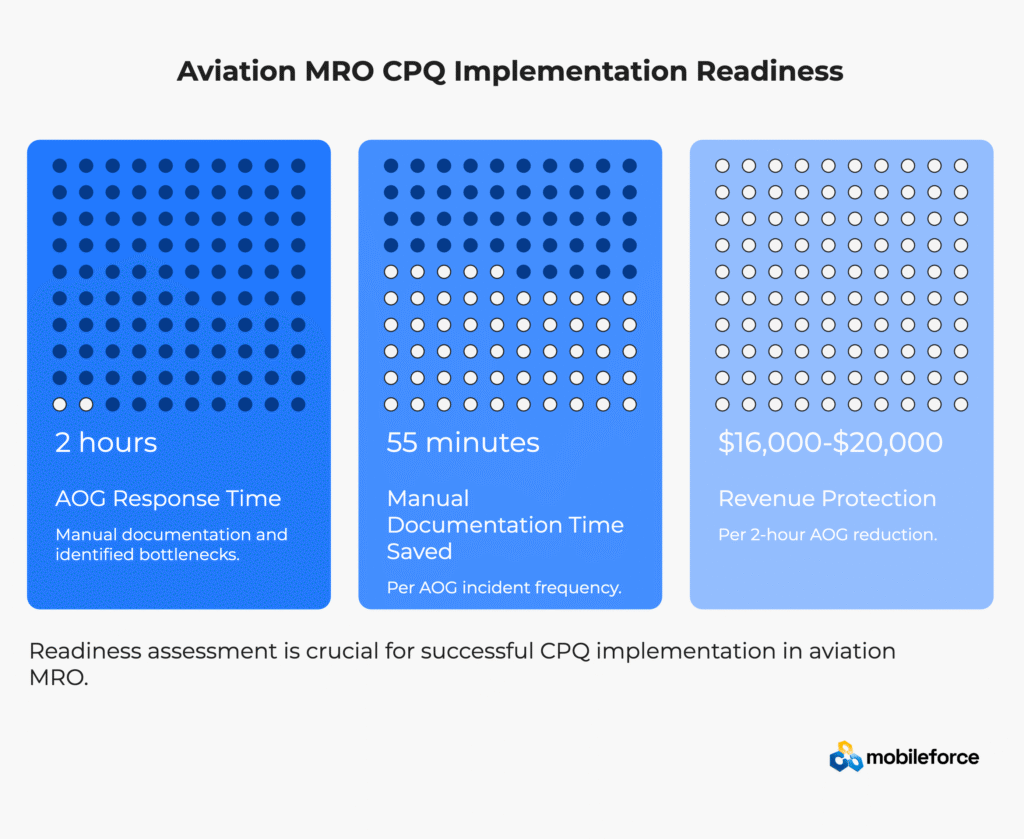
This assessment framework helps aviation MRO leaders identify potential implementation challenges and develop mitigation strategies before beginning platform deployment—ensuring successful adoption and rapid ROI realization.
Compliance Automation ROI Calculator:
Need help evaluating your organization’s readiness for aviation MRO transformation? Contact our implementation specialists for a comprehensive assessment and customized deployment strategy.
The investment delivers immediate impact: each prevented 4-hour AOG event saves $40,000-$60,000 in direct costs, while automated USM compliance eliminates 90% of documentation delays that extend emergency response times.
Readiness Factor | Low Readiness | Medium Readiness | High Readiness | Mobileforce Advantage |
AOG Event Frequency | <2 events/month | 2-5 events/month | >5 events/month | Greatest ROI for high-frequency AOG operations |
USM Parts Usage | <20% of procurement | 20-40% of procurement | >40% of procurement | Specialized USM compliance automation |
Multi-Jurisdiction Operations | Single regulatory environment | 2-3 jurisdictions | Global operations | No-code configuration for multiple regulatory frameworks |
Mobile Workforce | Hangar-based only | Mixed hangar/field | Primarily field operations | Offline-first architecture designed for remote operations |
Current Integration Complexity | Standalone systems | Basic ERP integration | Complex multi-system environment | Native CRM integrations reduce implementation complexity |
Compliance Documentation Load | Manual acceptable | Increasing pressure | Critical bottleneck | AI-powered automation eliminates manual documentation |
Organizations scoring “High Readiness” in 3+ categories typically see ROI within 6-9 months, while those with mixed readiness still achieve positive returns through targeted AOG response improvements.
Ready to transform AOG response? Schedule your demo to see how unified MRO platforms reduce emergency response from hours to minutes.
The Used Serviceable Material market continues evolving rapidly, driven by economic pressures and sustainability initiatives. With market value projected to reach $11.14 billion by 2032, USM represents a critical component of aviation parts procurement that demands sophisticated management systems.
Recent regulatory developments emphasize traceability and authenticity verification. The 2023 AOG Technics incident, where fraudulent parts entered major airline supply chains, demonstrated the critical importance of rigorous verification processes. Modern CPQ systems address this challenge through blockchain-based traceability and AI-powered authenticity verification.

Leading MRO CPQ platforms incorporate digital technology to create comprehensive parts history records. Each component receives a digital record that tracks its complete lifecycle: original installation, operational history, removal circumstances, inspection results, and certification status.
This technology particularly benefits emergency response by providing:
Advanced CPQ platforms leverage machine learning to optimize parts procurement decisions based on historical failure patterns, operational data, and market conditions. For AOG response, this capability provides:
Failure Prediction Modeling: Analysis of maintenance records identifies components likely to fail, enabling proactive procurement of replacement parts before AOG situations occur—transforming reactive emergencies into planned maintenance.
Dynamic USM Sourcing: Real-time market analysis identifies optimal USM suppliers and pricing during emergencies, ensuring fastest procurement at best available terms.
Supplier Performance Analytics: Continuous monitoring of supplier reliability and delivery performance enables informed sourcing decisions during high-pressure AOG situations.
Advanced CPQ platforms provide comprehensive capabilities that transform traditional reactive maintenance into intelligent operational management.
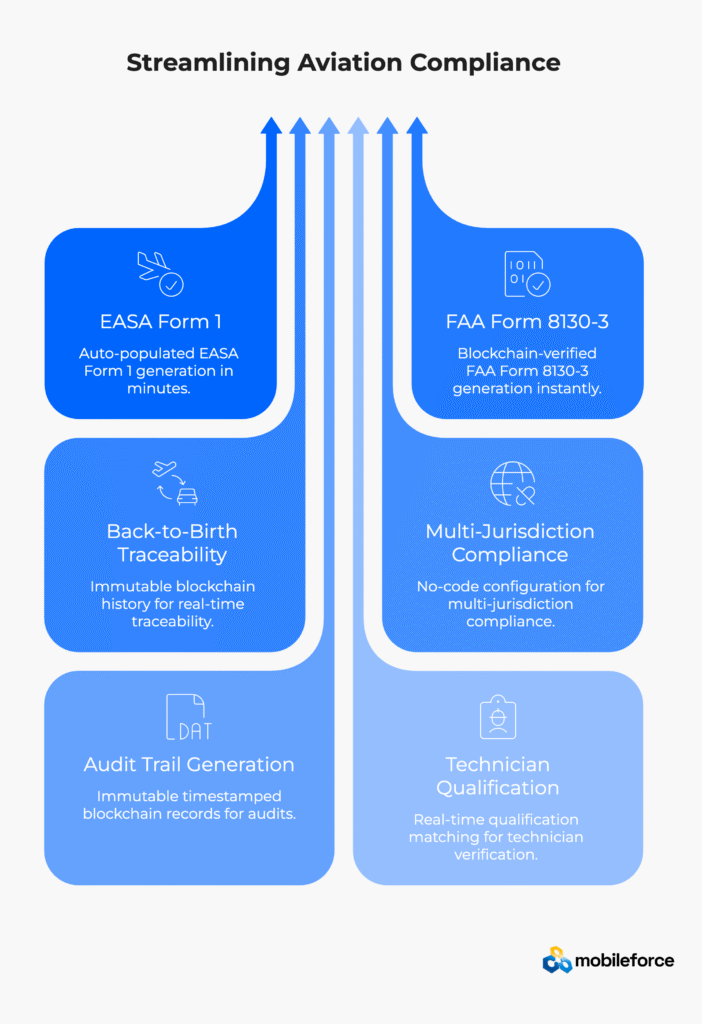
Compliance Requirement | Manual Process | Traditional CPQ | Mobileforce Platform | Emergency Scenario Benefit |
EASA Form 1 Generation | 60-90 min manual completion | Template-based (30-45 min) | Auto-populated from transaction data (2-5 min) | Eliminates documentation bottleneck during AOG |
FAA Form 8130-3 | 45-60 min with verification calls | Semi-automated (20-30 min) | Blockchain-verified instant generation | Immediate compliance for urgent USM needs |
Back-to-Birth Traceability | Phone calls + paper records (hours) | Database lookup (15-30 min) | Blockchain immutable history (seconds) | Real-time authenticity verification |
Multi-Jurisdiction Compliance | Separate processes per region | Limited jurisdiction support | No-code configuration per regulatory framework | Automatic compliance based on aircraft location |
Audit Trail Generation | Manual record compilation | Basic digital records | Immutable timestamped blockchain records | Regulatory-grade documentation for all transactions |
Technician Qualification Verification | Manual certificate checks | Basic validation | Real-time qualification matching | Prevents compliance violations during emergencies |
This compliance automation becomes mission-critical during AOG situations where manual processes could extend aircraft downtime by hours—automated compliance enables rapid response without regulatory risk.
Aviation authorities worldwide recognize digital systems’ growing importance in maintenance operations. EASA’s Part-145 regulations and FAA’s Part 43 requirements explicitly address electronic documentation and digital workflow approval, provided systems maintain proper audit trails and data integrity. With global aircraft MRO market reaching $104 billion annually and digital transformation accelerating across all industries, regulatory frameworks increasingly support technology-enabled compliance processes.
Modern enterprise CPQ platforms support AOG response and USM compliance through comprehensive digital capabilities:
Immutable Emergency Audit Trails: Every AOG transaction, approval, and modification is permanently recorded with timestamps and user identification, meeting regulatory requirements even during high-pressure emergency situations. This capability aligns with revenue operations best practices for maintaining complete visibility across complex processes.
Digital Signature Integration: Electronic approval workflows maintain legal validity while providing superior traceability during emergency procurement—critical when traditional paper-based approvals could extend AOG delays. Advanced workflow automation ensures compliance without sacrificing speed.
Real-Time Compliance Validation: Systems validate parts eligibility, technician qualifications, and regulatory requirements instantly, preventing compliance violations that could extend AOG situations or trigger regulatory penalties. This automation becomes essential as industry data shows 35% of aviation maintenance workforce approaching retirement, requiring systems that support less-experienced technicians.
Multi-Jurisdictional Emergency Support: Platforms accommodate different regulatory frameworks simultaneously, ensuring proper compliance procedures whether an AOG occurs in EASA, FAA, or other international jurisdictions. Multi-currency and multi-jurisdiction capabilities become essential for global aviation operations.
Understanding that the FAA’s aging fleet data shows 35% of commercial aircraft exceed 15 years, regulatory compliance automation becomes increasingly critical as older aircraft require more frequent maintenance and emergency response situations.
Operational Scenario | Connectivity Challenge | Traditional System Response | Mobileforce Solution | Business Impact |
Remote Airport AOG | Limited/unreliable internet | System unavailable, manual fallback | Offline-first operation with auto-sync | Prevents 2-4 hour delays from connectivity issues |
International Line Maintenance | Varying network quality across regions | Inconsistent access, lost transactions | Seamless operation regardless of connection | Maintains global operational consistency |
Overnight Maintenance Shift | Reduced IT support availability | System issues cause delays | Self-sufficient mobile operation | 24/7 operational capability |
Multiple Aircraft AOG | High system load during crisis | Performance degradation | Distributed architecture maintains performance | Handles simultaneous emergency responses |
Regulatory Audit at Remote Location | Need immediate documentation access | Paper-based backup required | Complete digital records accessible offline | Real-time audit compliance anywhere |
Emergency Parts Sourcing | Need rapid supplier communication | Phone/email communication delays | Mobile-integrated supplier workflows | Accelerated procurement during crises |
Aviation’s global, 24/7 operational reality demands mobile-first platforms that function reliably regardless of location or infrastructure quality—traditional web-based systems fail when connectivity becomes unreliable at critical moments.
Transform your aviation MRO operations with intelligent quote-to-service automation. Schedule your demo today to discover how unified platforms can reduce your AOG response times while ensuring complete regulatory compliance.

How does CPQ specifically address AOG emergency situations in aviation MRO?
CPQ platforms for aviation MRO accelerate AOG response through three primary capabilities:
When technicians identify failed components, the system instantly presents compatible replacement options with availability and pricing from multiple sources. Mobile applications enable immediate procurement approval and work order generation, reducing typical AOG response from hours to minutes. AI-powered automation systems can even predict likely parts needs based on failure symptoms, pre-staging quotes before formal requests.
This comprehensive approach delivers 75% reduction in emergency response times while maintaining 100% regulatory compliance—essential for aviation operations where every minute of aircraft downtime costs $8,000-$10,000 in direct revenue.
What regulatory compliance features are essential for aviation MRO CPQ systems?
Aviation MRO CPQ systems must support key regulatory requirements:
Essential features include immutable audit trails, digital signature integration, multi-jurisdictional compliance templates, and blockchain-based parts traceability. The system should validate technician qualifications, parts eligibility, and regulatory requirements in real-time while maintaining complete documentation for regulatory audits.
Advanced compliance automation becomes critical as EASA Part-145 requirements and FAA regulations increasingly recognize digital documentation systems. No-code configuration capabilities enable rapid adaptation to evolving regulatory requirements without IT intervention.
How do modern CPQ platforms handle USM parts verification and compliance?
Modern aviation MRO CPQ systems handle USM (Used Serviceable Material) verification through four integrated technologies:
Advanced CPQ systems integrate with USM databases to verify parts authenticity, airworthiness status, and remaining service life automatically. Blockchain technology creates immutable parts history records, while AI algorithms detect potential counterfeit components based on documentation patterns and supplier behavior.
The system validates complete back-to-birth traceability and generates required compliance documentation automatically, reducing USM verification from hours to minutes while ensuring regulatory compliance. Enterprise platforms provide the processing power needed for real-time verification of complex USM certification chains during high-pressure AOG situations.
What integration capabilities are required for aviation MRO CPQ implementation?
Successful aviation MRO CPQ requires comprehensive integration across multiple systems:
Core System Integrations:
Technical Architecture Requirements:
Comprehensive integration guidance ensures seamless data flow across maintenance teams, procurement departments, and supplier networks. Modern CRM integration approaches eliminate data silos that could delay AOG response at remote airports with limited connectivity.
The platform’s Field Service Management capabilities coordinate seamlessly with aviation maintenance workflows, supporting both emergency response and planned maintenance operations.
How quickly can aviation MRO organizations see ROI from CPQ implementation?
Aviation MRO organizations typically achieve positive ROI within 12-18 months through:
Immediate Benefits (60-90 days):
Full ROI Realization (12-16 weeks):
Long-term Value Acceleration:
Financial Impact Metrics:
What training and change management strategies ensure successful CPQ adoption?
Successful CPQ adoption requires comprehensive change management:
Phase-Based Training Programs:
Organizational Success Factors:
Training Content Focus:
Change management becomes especially critical in aviation where safety-first culture requires thorough validation of new processes before adoption during mission-critical situations.
How do CPQ platforms ensure data security and regulatory compliance for sensitive aviation information?
Aviation CPQ platforms implement comprehensive security measures addressing industry-specific requirements:
Enterprise-Grade Security Architecture:
Aviation-Specific Security Features:
Regulatory Compliance Integration:
Enterprise security frameworks become essential when handling sensitive aviation data including aircraft configuration details, maintenance history, and operational performance metrics. The platform’s multi-jurisdiction capabilities ensure security compliance across different international regulatory environments.
Security architecture must support offline operations while maintaining data integrity and audit trails when connectivity returns—critical for aviation’s global operational requirements.
What mobile capabilities are essential for aviation MRO field operations?
Aviation MRO mobile applications require specialized capabilities for challenging operational environments:
Core Mobile Requirements:
Rugged Environment Support:
Aviation-Specific Mobile Features:
Performance Requirements:
The mobile-first architecture becomes essential when aviation maintenance occurs at remote airports where traditional web-based systems become unusable due to connectivity limitations. Field service management integration ensures mobile capabilities support both emergency response and planned maintenance workflows seamlessly.