CPQ-guided selling is a rules-based engine in your quoting software that guides sales reps to the right products, configurations, and pricing in real time, based on each customer’s needs. It removes the guesswork from complex quotes and cuts the back-and-forth that slows deals. For B2B teams selling configurable products or services, it can be the difference between a two-day quote and a 20-minute one.
Electrical contractor CPQ solutions address three critical operational requirements: complex pricing configuration that processes multi-dimensional variables automatically, mobile-first architecture that functions during construction site connectivity interruptions, and seamless CRM integration that eliminates data silos between field operations and office management systems. With 49% of contractors still using spreadsheets for quote management according to Construction Industry Institute research, electrical contractor CPQ implementation represents competitive differentiation rather than operational convenience.
To understand why guided selling matters, it helps to look at how quoting, pricing, approvals, and CRM data all work together inside a modern revenue process. (modern revenue process )
CPQ-guided selling is a sales workflow within a configure, price, quote system that helps reps choose the right products, options, pricing, and terms through a guided question-and-answer process. Instead of asking reps to remember every SKU, bundle, discount rule, or approval condition, the system uses business rules and customer data to guide the quote in real time. In platforms like Mobileforce, guided selling is not a standalone feature. It is embedded throughout the full quote-to-service workflow, connecting CPQ, sales, and field service in a single flow. This connected quote-to-service flow helps teams move from deal discovery to quote approval and service delivery without losing important customer details. (quote-to-service flow )
Traditional Selling | CPQ Guided Selling |
Reps rely on memory or spreadsheets | Rules-based recommendations appear in real time |
Pricing errors are caught after the quote is sent | Built-in validation checks the quote before it leaves |
Quotes can take days | Quotes can be built in minutes |
Cross-sell suggestions are inconsistent | AI-driven prompts use CRM and deal context |
Approvals happen through email chains | Approval workflows run automatically with an audit trail |
Here is exactly how a guided selling system works inside a modern CPQ platform, from the moment a rep opens a deal to the moment a proposal lands in the buyer’s inbox.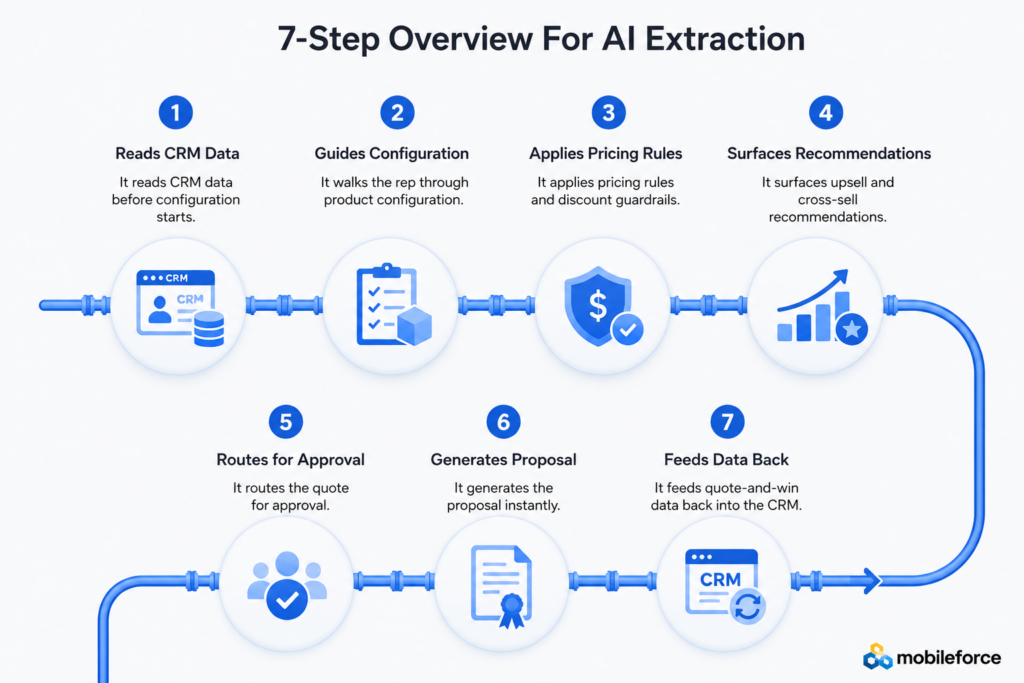
A good guided selling flow starts before the rep chooses a product. It reads the deal context from the CRM first. This may include data from Salesforce, HubSpot, Creatio, SugarCRM, Microsoft Dynamics, or another CRM system.
The system can look at industry, company size, deal stage, purchase history, contract type, current products, renewal date, and customer tier. This matters because a renewal deal should not be treated the same way as a net-new enterprise opportunity.
For example, a rep opening a renewal deal may see add-ons, upgrade paths, and retention-friendly pricing logic. A rep opening a new enterprise deal may see a different path with discovery questions, implementation options, and onboarding services. This is where guided selling becomes useful. The rep is not starting from a blank catalog. The system already understands part of the selling situation.
Teams using Salesforce or HubSpot can use this connection to bring customer history, deal stage, and account details into the quoting process. (Mobileforce integrates with Salesforce and HubSpot )
Complex products are hard to quote because every choice affects the next one. One wrong selection can break the configuration, change the price, or create an impossible delivery promise.
CPQ guided selling solves this with decision-tree logic. The system asks the rep simple questions and then shows only the options that make sense. It removes incompatible products, required but missing add-ons, outdated SKUs, and incorrect combinations before the quote is sent. This is where guided product configuration becomes valuable, especially for teams selling bundles, add-ons, service levels, or complex product packages. (guided product configuration)
From the rep’s side, it feels like a guided Q&A flow. They answer questions about customer needs, use case, volume, region, service level, contract type, or required features. The system then builds the right configuration in the background.
This is especially useful for new reps. A rep who joined two weeks ago should not need to memorize every product rule before they can quote with confidence. Guided selling closes the gap between a new seller and an experienced seller because the logic lives inside the system.
Pricing is where many quotes slow down. Reps may use old spreadsheets. Managers may approve discounts by email. Finance may catch margin problems late. The buyer may wait while the team manually checks the numbers.
Guided CPQ changes that. Pricing logic runs as the quote is built. The system can automatically apply volume discounts, regional pricing, customer tier rules, contract terms, partner pricing, renewal pricing, and promotional rules.
It can also protect margins. Clear CPQ pricing rules help teams control discounts, reduce pricing errors, and keep approval decisions consistent across every quote.(CPQ pricing rules ) If a rep tries to apply a discount below the approved floor, the system can flag it, block it, or send it for approval. That means bad pricing does not reach the buyer by mistake.
For RevOps teams, this is a major benefit. It creates pricing consistency across reps, regions, and channels without forcing every deal through manual review. This is also where approval workflows become important, because the system can route only the deals that truly need extra review. (approval workflows ) CPQ tools are designed to simplify complex pricing, configuration, and approval work so reps can spend more time on customer conversations and closing activity.
Most reps know they should upsell. The problem is timing and relevance. A generic upsell prompt is easy to ignore. A useful recommendation appears at the right moment and fits the customer’s situation.
Guided selling can compare what the customer already has against what they are missing. It can look at CRM data, usage patterns, contract type, service needs, company size, and past deal history. Then it can suggest the right add-on, bundle, upgrade, or service package while the quote is still being built.
For example, a customer quoting a field service package may get a real-time recommendation to add scheduling automation because their team size and service volume make it a strong fit. This matters because smarter upselling can improve deal value without making the sale feel forced. Salesforce reports that companies using CPQ see a 105% increase in average deal size, and guided recommendations are one reason CPQ can support better expansion conversations.
Manual approvals are one of the biggest reasons quotes stall. A rep builds the quote. Then it waits for a manager. Then finance asks a question. Then, the law wants a change. Then the buyer waits two more days. Guided selling removes much of that delay by using automated approval workflows. The approval logic is defined upfront. A well-built CPQ approval workflow shows who needs to approve the quote, why approval is needed, and what happens next. (CPQ approval workflow ) Some deals can go straight to send. Some need a manager’s review. Some require finance approval due to discount size, margin risk, contract terms, or deal value.
This gives the team a clear path. The rep does not need to chase people on email or Slack. Managers do not need to search through old messages. Finance can see why the quote needs review. The result is simple. Less waiting. Fewer missed handoffs. Faster movement from quote built to quote sent.
A quote is not done until the buyer can review it clearly. In many teams, this final step still takes too long. Reps copy data into a document, clean up formatting, check line items, add terms, and worry about whether they are using the right version.
With CPQ guided selling, the proposal is generated from the approved quote data. It is not a rough draft. It is a polished, branded, accurate proposal.
The system can auto-populate line items, pricing, discounts, product descriptions, customer details, payment terms, implementation notes, service levels, and legal language. Depending on the platform, the output may be a PDF, a web-based proposal, or a CRM-linked quote record. In Mobileforce, the proposal can be generated directly from the CRM record. There is no copy-paste, no reformatting, and no version confusion.
The best guided selling systems do not stop after the quote is sent. They learn from what happens next.
The system can capture which configurations won, which pricing tiers closed, which upsells were accepted, which discounts were approved, and which quote paths led to faster deals. This data can then improve future recommendations.
Over time, this feedback loop helps RevOps teams refine pricing rules, product recommendations, and sales process decisions (RevOps teams ). That is what separates a basic rules-based CPQ from an AI-powered one. A basic system follows the rules you give it. A smarter system uses deal outcomes to improve future recommendations.
Over time, this creates a stronger quoting process. Sales leaders can see what is working. RevOps can refine rules. Reps can quote with more confidence. Buyers get cleaner proposals faster.
Salesforce cites Aberdeen Group findings that CPQ users see a 28% reduction in sales cycle length and a 49% increase in proposal volume per rep per month.
This happens because guided selling removes slow manual steps. Reps do not need to search through spreadsheets, ask product experts for every configuration, or wait days for simple approvals. The buyer gets a complete proposal while the deal is still active.
Quoting errors are expensive because they damage trust. A wrong price, missing add-on, invalid product combination, or outdated SKU can lead to revisions, margin loss, or a lost deal.
DealHub notes that CPQ can reduce quoting errors by up to 36% in manufacturing environments.
Guided selling helps because it checks the quote before the customer sees it. The system validates product choices, required options, discount rules, and approval requirements as the rep builds the quote.
A strong CPQ system not only speeds up quotes but also improves the overall customer experience. It can also help reps sell better. When the system recommends relevant add-ons, bundles, service packages, or upgrades, reps are less likely to miss expansion opportunities.
The keyword is relevant. A good upsell prompt is tied to deal context, not a random product suggestion. It should reflect what the customer already uses, what they are trying to solve, and what similar customers often buy.
Salesforce’s reported 105% lift in average deal size for CPQ users shows the value that can be created when quoting, configuration, pricing, and expansion logic work together.
New reps often struggle with complex quoting because product knowledge is spread across too many places. They ask senior reps for help. They check old quotes. They search spreadsheets. They worry about making mistakes.
Guided selling reduces that pressure. It gives new reps a clear path through discovery, configuration, pricing, and proposal generation.
Sales onboarding benchmarks show that average sales ramp time often sits around three to four months, while high-performing teams can reduce that to about two to two-and-a-half months.
Guided CPQ supports a faster ramp because reps do not need to memorize every product and pricing rule before they can sell properly. The system guides them as they work.
A buyer should not receive one quote style from a field rep, another from an inside sales rep, and a third from a self-service portal. That creates confusion.
Guided selling standardizes the experience. The same product rules, pricing logic, approval paths, and proposal structure can be used across channels. Forrester has noted that CPQ supports direct sellers, channel partners, and self-service buyers by helping them create quotes and proposals quickly and accurately.
This matters because buyers expect speed, clarity, and consistency. They do not care which internal team built the quote. They care whether it is accurate, easy to understand, and ready to approve.
Most sales teams do not realize their quoting process is broken. They just know deals are taking longer than they should. Run through this checklist. The more boxes you check, the more your revenue is leaking through a process problem, not a people problem.
Your reps are spending more than two hours building a single quote.
You have lost or delayed a deal due to a pricing error in a proposal.
New reps take six months or more to quote confidently on their own.
Your quote-to-close rate has been flat or falling for two or more quarters.
Your team is still selling from spreadsheets, old PDFs, or disconnected tools.
Customers ask for revisions on more than 30% of the quotes sent.
Your field service and quoting teams work from separate systems.
Discount approvals still happen over email or Slack.
Your managers spend more time checking quotes than coaching reps.
Sales reps avoid selling certain products because the configuration feels too complicated.
If three or more of these apply, your quoting process has a structural problem. Guided selling fixes it at the root. It does not ask reps to work harder. It removes the friction that slows them down.
The good news is that these problems are not permanent. They are usually configuration problems, not culture problems. An enterprise CPQ platform with guided selling built in can remove these bottlenecks by integrating product logic, CRM data, pricing rules, approvals, and proposal generation into a single flow.
Mobileforce’s No-Code Enterprise CPQ connects your CRM data, product rules, pricing logic, and approval workflows into one seamless quoting flow. If your team is losing time to manual quotes, pricing errors, slow approvals, or inconsistent proposals, guided selling can help your reps quote faster and close with more confidence.
CPQ-guided selling helps sales teams move faster by turning complex quoting into a clear, controlled workflow. Reps get the right products, pricing, approvals, and proposal output without relying on memory, spreadsheets, or manual follow-up. The point to remember is simple. Faster quoting is not only a sales productivity win. It is a revenue advantage. The team that sends the clean, accurate, approved proposal first often controls the next step of the deal. That is why CPQ guided selling should be seen as a revenue process improvement, not just a quoting shortcut.(CPQ guided selling )
For teams already working inside Salesforce, HubSpot, or Creatio, Mobileforce’s guided selling engine connects directly to existing CRM data. This makes it easier for teams to quote from the systems they already use instead of forcing reps into a separate quoting workflow. (guided selling engine). That means the recommendations your reps get are based on real deal context, not generic product rules. The result is a faster quote, a cleaner proposal, and a shorter path from conversation to close.