“We were promised so many things, yet in the end were told we have too much customization and difficult pricing process,” writes one frustrated Apttus user in a verified G2 review. This sentiment echoes across hundreds of user reviews as enterprise buyers discover that traditional configure price quote systems often create more operational complexity than they solve.
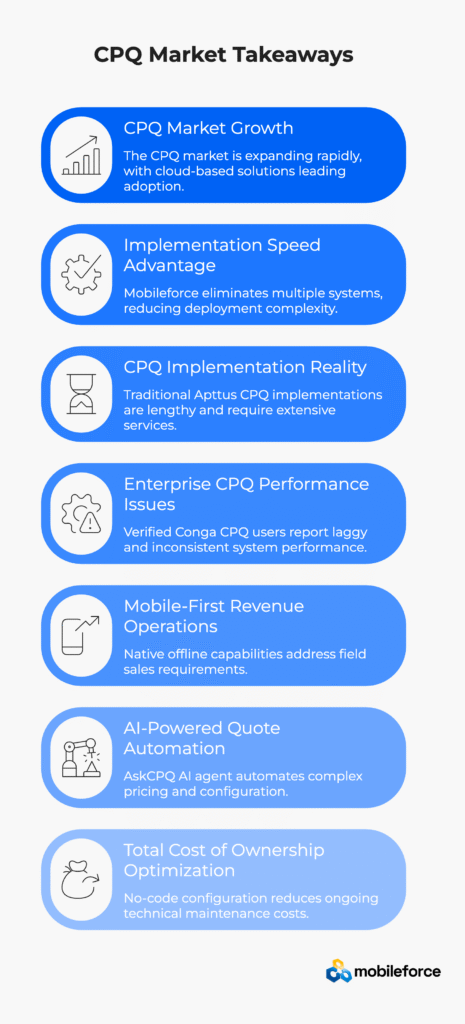
While the CPQ software market explodes toward $7.96 billion by 2032, savvy buyers increasingly choose unified revenue lifecycle management platforms over fragmented legacy systems. The choice between modern revenue operations cloud solutions and traditional enterprise CPQ vendors often determines whether sales teams accelerate deal velocity or get bogged down in implementation nightmares and ongoing technical debt.
Modern configure price quote software evaluation requires understanding the fundamental difference between legacy complexity and integrated simplicity. Organizations seeking CPQ implementation success must consider total cost of ownership, deployment speed, user experience quality, and long-term strategic flexibility rather than feature checklists that obscure operational realities.
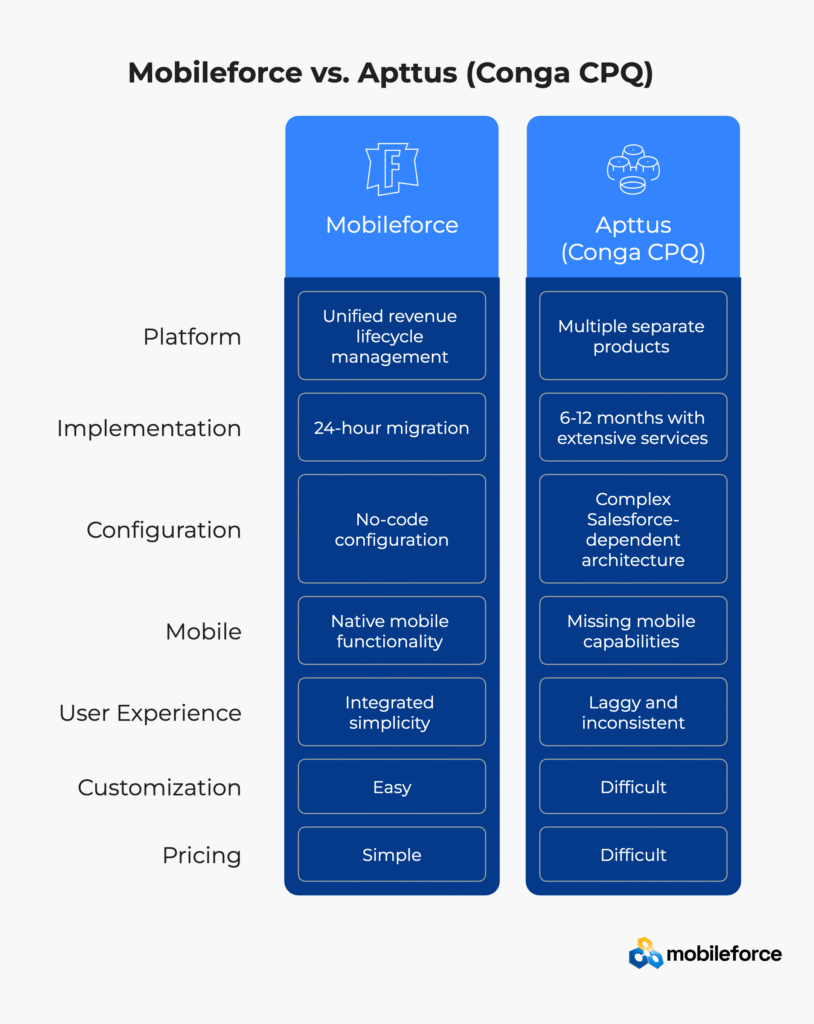
Mobileforce delivers unified revenue lifecycle management through its integrated quote-to-cash-to-service platform, while Apttus (now Conga CPQ) requires multiple separate products and 6-12 month implementations with extensive professional services. Enterprise buyers choose between Mobileforce’s 24-hour migration capabilities, no-code configuration, and native mobile functionality versus Conga’s complex Salesforce-dependent architecture that users describe as “laggy and inconsistent” with “difficult” customization requirements and missing mobile capabilities.
Discover unified revenue operations advantages. Schedule your Mobileforce demo to see integrated CPQ and field service management.
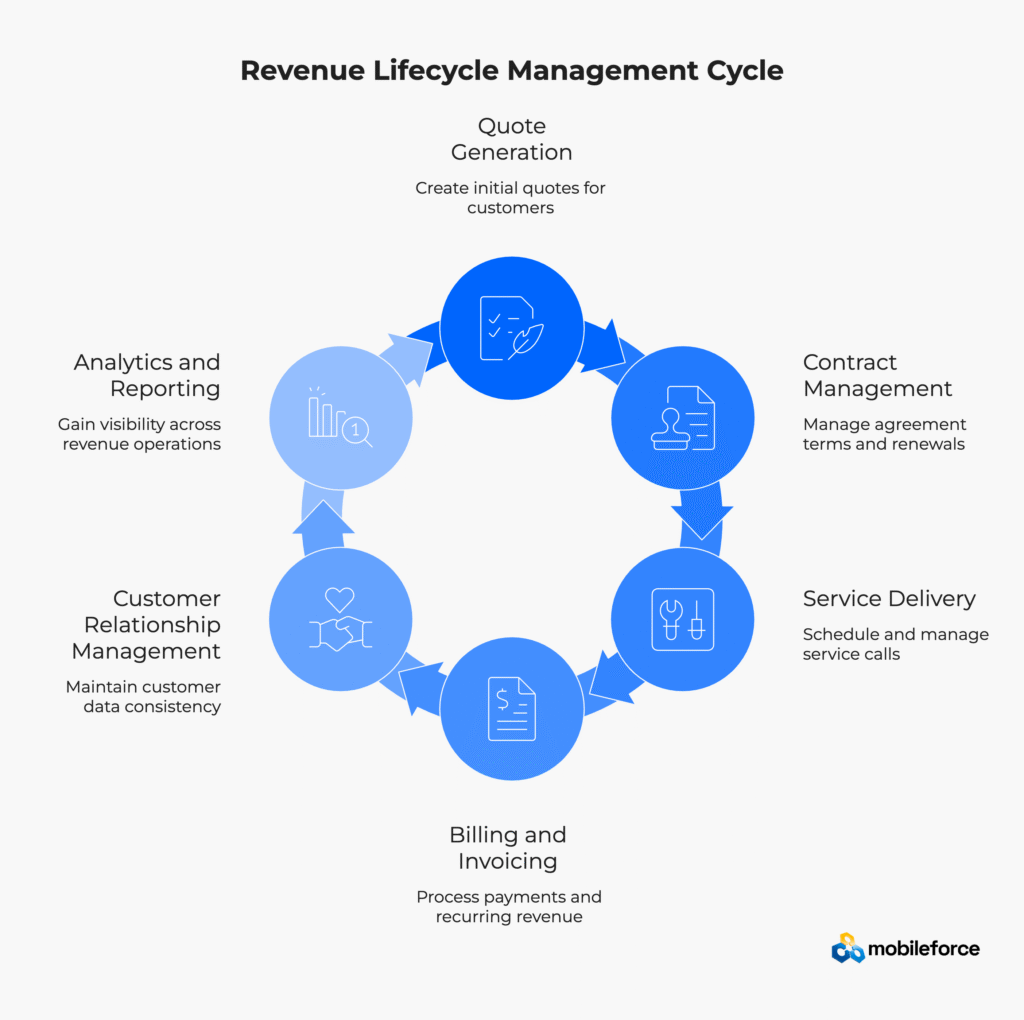
revenue Lifecycle Management (RLM) represents the evolution from standalone configure price quote software toward integrated revenue operations platforms that manage the complete customer journey from initial quote through service delivery and billing.
Traditional configure price quote systems focus primarily on quote generation and pricing automation, requiring separate tools for:
This fragmented approach creates data silos, manual handoffs between systems, and integration complexity that undermines operational efficiency and revenue velocity.
Revenue lifecycle management platforms integrate these functions within unified architectures that provide:
According to McKinsey research, organizations implementing integrated revenue operations achieve measurable advantages in operational efficiency, customer experience, and total cost of ownership compared to fragmented system approaches.
Companies using unified revenue lifecycle management report measurable advantages in operational efficiency, customer experience, and total cost of ownership. The elimination of manual data entry between systems reduces quote errors, accelerates approval processes, and improves sales team productivity through simplified workflows and better user experience design.
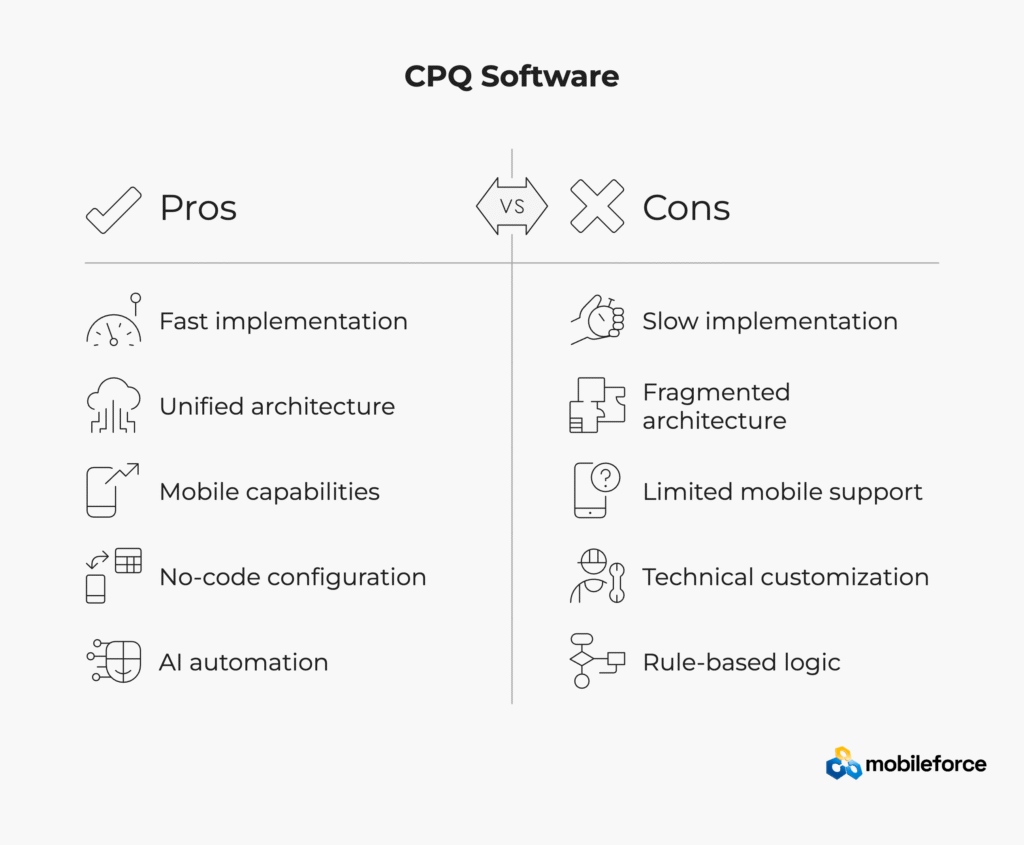
When evaluating enterprise CPQ solutions, buyers need to understand fundamental architectural differences that impact implementation success, user experience, and total cost of ownership:
The choice between these platforms often determines whether CPQ becomes a competitive advantage or operational burden for enterprise sales teams.
|
Factor |
Apttus/Conga |
Mobileforce |
Winner |
|
Implementation Time |
6-12 months |
24 hours to 2-4 weeks |
Mobileforce |
|
Total Cost (5-year) |
$1.15M – $3.35M |
$385K – $870K |
Mobileforce |
|
Mobile Capabilities |
Limited/Missing |
Mobileforce |
|
|
User Experience |
Complex, technical |
Intuitive, no-code |
Mobileforce |
|
CRM Flexibility |
Salesforce only |
Mobileforce |
|
|
AI Automation |
Rule-based |
Mobileforce |
|
|
System Performance |
“Laggy” (users) |
Cloud-optimized |
Mobileforce |
Transform your quote-to-cash operations today. Get your Mobileforce demo to see unified revenue operations in action.
Apttus, now operating under the Conga brand following the 2020 acquisition, established itself as a leading enterprise CPQ platform with particular strength in complex product configuration and Salesforce ecosystem integration. The platform excels in sophisticated pricing scenarios, multi-tier product bundling, and guided selling workflows that support complex B2B sales processes requiring extensive customization capabilities.
Conga’s architecture handles unlimited product complexity through nested bundle configurations, advanced pricing logic matrices, and comprehensive approval workflows that support enterprise governance requirements. The platform manages sophisticated product catalogs, multi-dimensional pricing structures, and complex business rules that traditional CPQ solutions struggle to accommodate.
The Salesforce-native development framework provides deep CRM integration for organizations heavily invested in the Salesforce ecosystem. This integration includes shared user management systems, native reporting capabilities, unified data models, and seamless workflow automation between quote generation and opportunity management processes.
However, verified user feedback from G2, Capterra, and Gartner Peer Insights consistently highlights significant operational challenges that impact long-term platform satisfaction and business value realization.
Multiple verified Conga users report documented performance problems affecting daily sales operations. User reviews specifically mention “service at times is too laggy and inconsistent system performance leads to frustrated end users.” These reliability concerns become particularly problematic during peak usage periods when sales teams require maximum system availability for customer interactions.
The platform complexity creates ongoing stability risks that users describe as operational challenges. One verified enterprise reviewer noted: “All updates generally require significant testing to ensure that unforeseen problems do not occur. The updates are a real problem.” This maintenance reality forces organizations to dedicate substantial technical resources to routine system administration instead of revenue-generating activities.
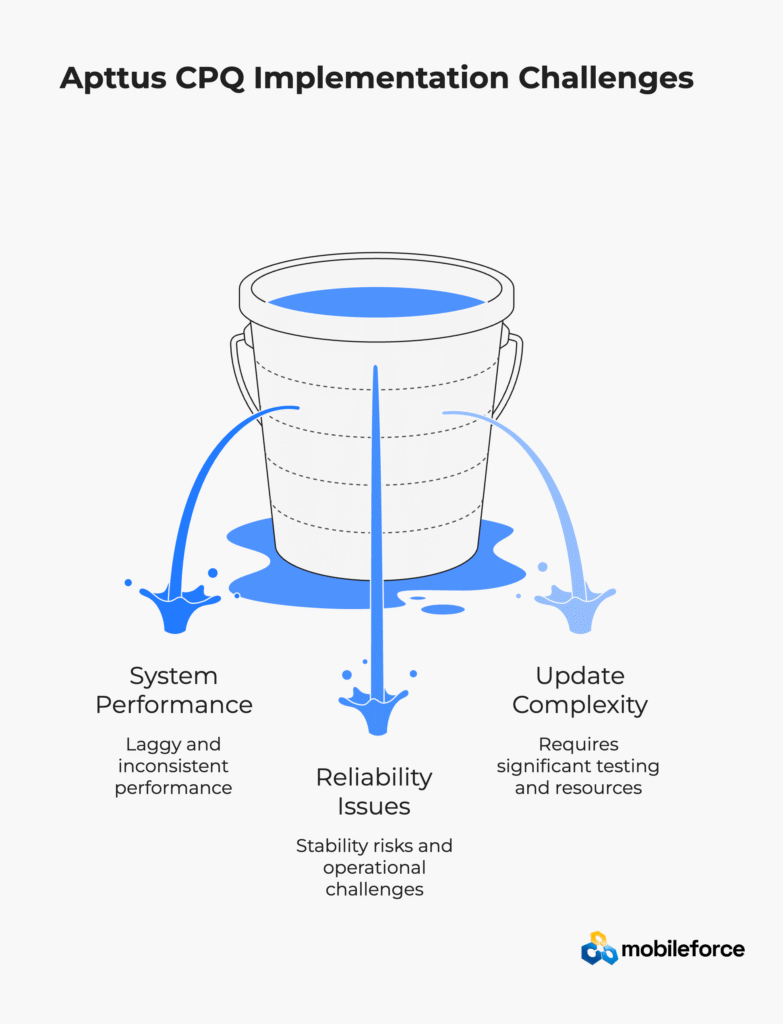
While Apttus/Conga’s enterprise capabilities attract large organizations, documented user experiences reveal significant operational challenges that impact long-term satisfaction and ROI.
User reviews consistently highlight system performance problems that affect daily operations. Multiple verified Conga users report “service at times is too laggy and inconsistent system performance leads to frustrated end users.” These performance issues become particularly problematic during peak usage periods when sales teams need reliable system access most.
The platform’s complexity creates stability concerns that users describe as ongoing operational risks. One verified reviewer noted: “All updates generally require significant testing to ensure that unforeseen problems do not occur. The updates are a real problem.” This reality forces organizations to invest substantial resources in change management and quality assurance for routine system maintenance.
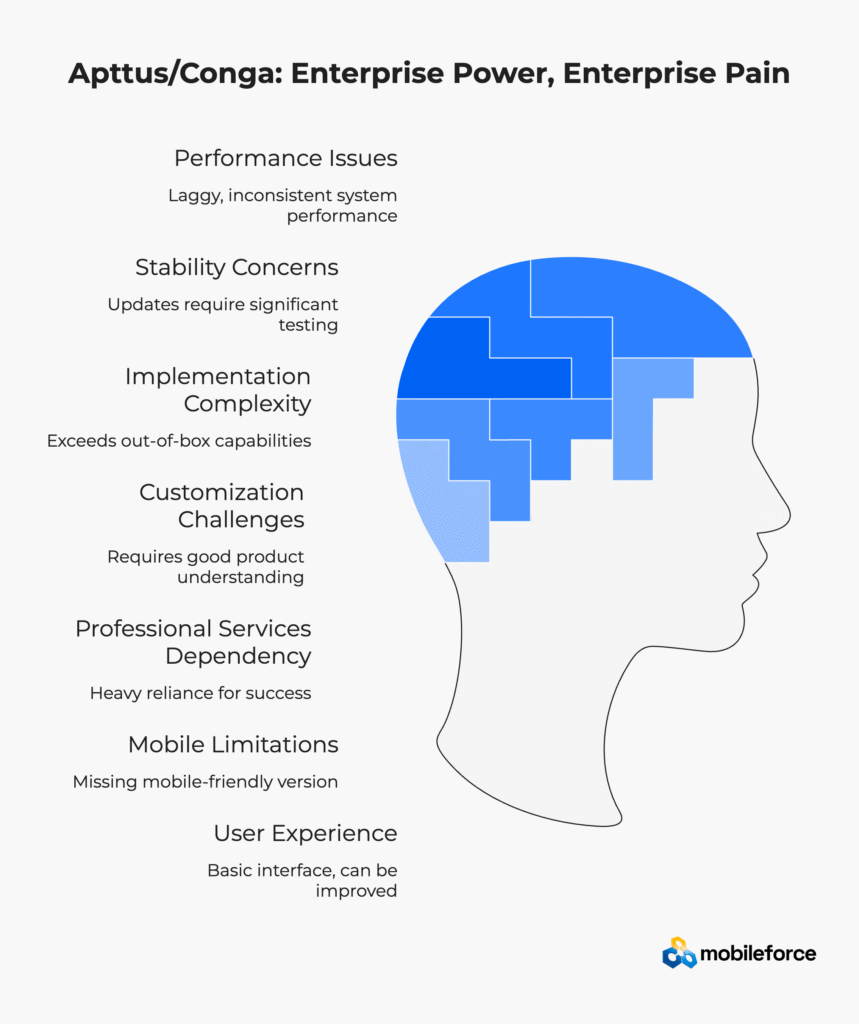
The disconnect between Apttus/Conga sales promises and implementation reality represents a significant concern for enterprise CPQ buyers. One frustrated enterprise customer documented: “We were promised so many things, yet in the end were told we have too much customization and difficult pricing process.” This implementation gap often emerges when organizations discover their business requirements exceed the platform’s out-of-box capabilities.
Customization challenges extend beyond initial CPQ deployment to ongoing system administration and maintenance. Users consistently report that “product administration can be very challenging, and customizing requires good product understanding and some previous knowledge.” This technical dependency creates operational bottlenecks for business users who need to make routine pricing updates or configuration changes without IT assistance.
Multiple enterprise users highlight the platform’s heavy reliance on professional services for successful implementation and ongoing operational support. One verified reviewer documented implementation challenges: “We had to cycle through a couple of Solution Architects, Business Analysts, Configuration Analysts, and Software Developers before we found resources from Apttus that were reliable and did quality work.”
This professional services dependency creates both cost escalation risks and timeline uncertainty for CPQ implementations. Organizations often discover that achieving desired functionality requires extensive custom development work that wasn’t included in initial project scoping, leading to budget overruns and extended deployment schedules that delay revenue operations improvements.
Verified users consistently identify mobile functionality as a significant weakness impacting field sales productivity. One enterprise reviewer specifically noted: “We use a customized solution because a mobile friendly version of Conga is missing.” This limitation affects modern sales workflows requiring mobile access for customer-facing interactions and field service operations.
The platform’s user interface design receives mixed feedback from enterprise users, with reviews noting that “the view and feel of the application is basic—can be improved like other installed packages in salesforce.” These user experience limitations affect sales team adoption rates and daily productivity, particularly for organizations with modern software interface expectations.
Evaluating modern CPQ alternatives? Compare Mobileforce capabilities against legacy enterprise platforms.
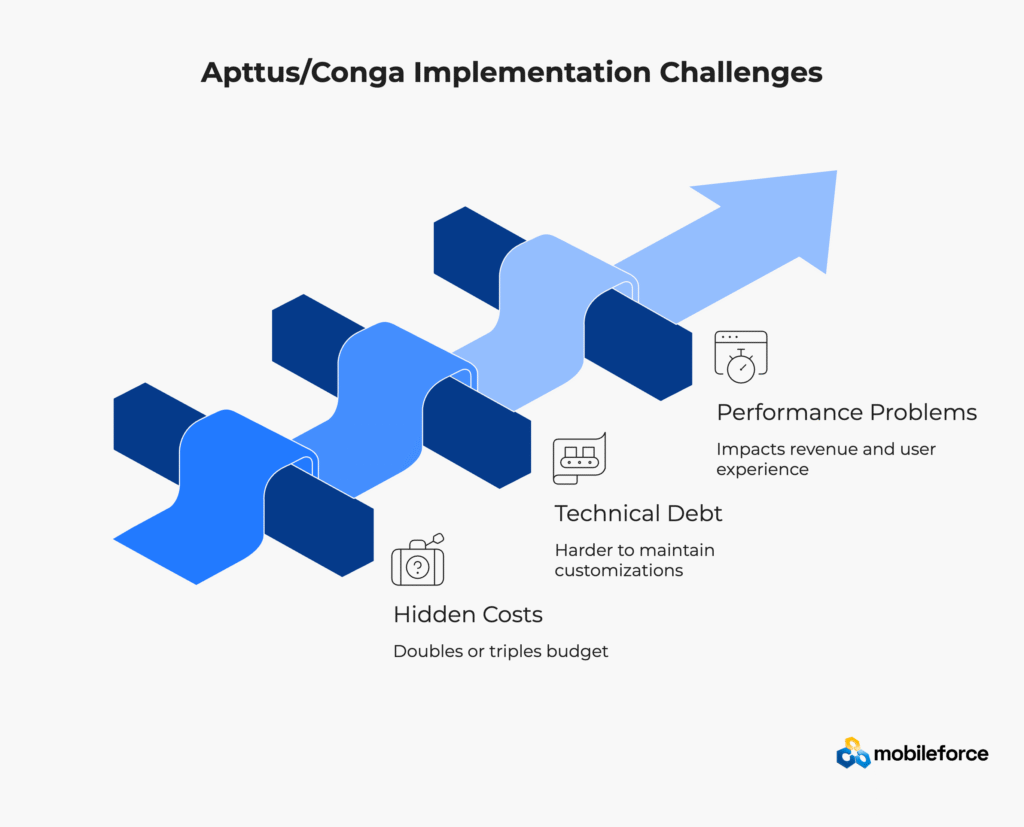
Beyond the sticker price, Apttus/Conga implementations accumulate hidden costs that can double or triple initial budget projections. Multiple users report discovering mid-implementation that their business requirements exceed standard platform capabilities, forcing expensive customization projects.
“We had to cycle through a couple of Solution Architects, Business Analysts, Configuration Analysts, and Software Developers before we found resources from Apttus that were reliable and did quality work,” reports one enterprise buyer. This resource churning creates project delays, knowledge loss, and increased consulting costs that weren’t factored into initial proposals.
Perhaps more concerning than implementation costs is the technical debt that Apttus/Conga creates over time. Users consistently report that customizations become harder to maintain as the platform evolves: “All updates generally require significant testing to ensure that unforeseen problems do not occur.”
This maintenance burden forces organizations to dedicate technical resources to routine platform updates instead of business-driving initiatives. The complexity compounds over time as customizations interact in unexpected ways, creating stability risks and limiting future flexibility.
System performance issues represent more than user inconvenience—they directly impact revenue when quotes take too long to generate or systems become unavailable during critical sales periods. Multiple verified reviews document “laggy and inconsistent system performance leads to frustrated end users” that affects deal velocity and customer experience.
These performance problems often emerge after implementation when systems reach production usage levels, creating operational risks that weren’t apparent during proof-of-concept demonstrations. Organizations discover too late that platform architecture limitations prevent the reliable performance enterprise sales operations require.
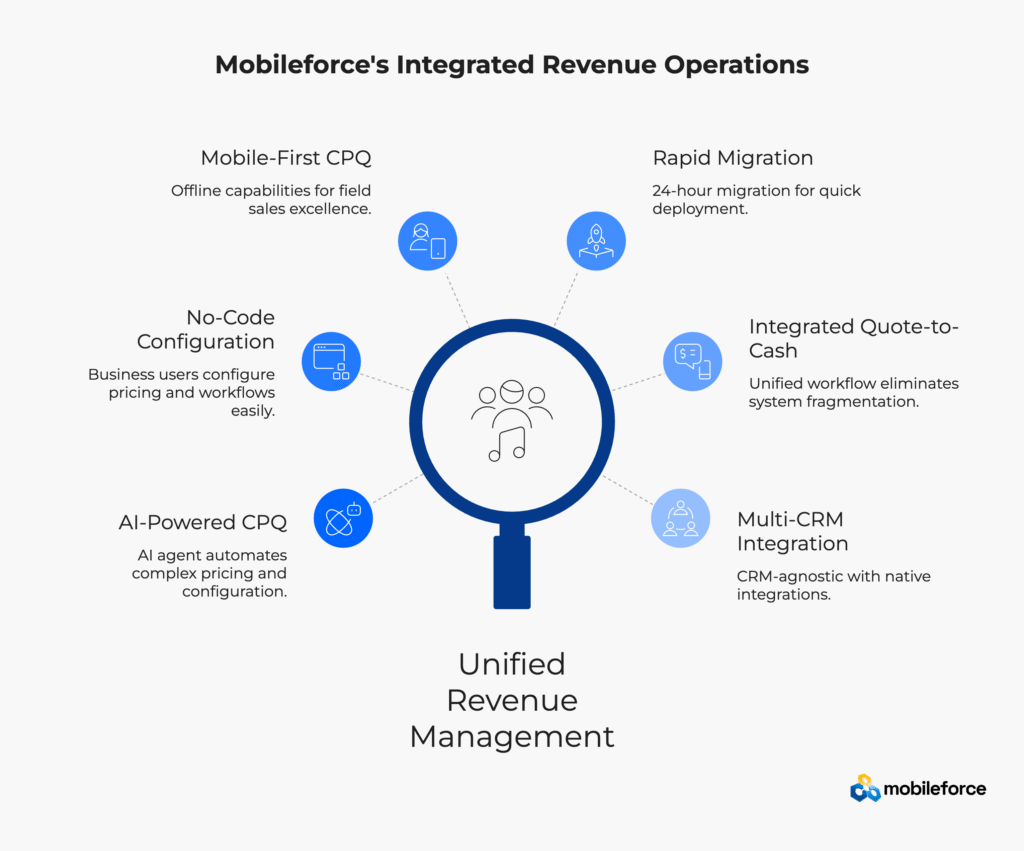
Mobileforce approaches revenue lifecycle management through its comprehensive Revenue Operations Cloud platform, which integrates configure price quote functionality, field service management capabilities, contract lifecycle management, and mobile quoting within a single, unified architecture. Unlike legacy CPQ vendors requiring multiple product purchases and complex system integrations, Mobileforce delivers complete revenue operations functionality through one integrated platform approach.
The company’s innovative AskCPQ AI agent represents a fundamentally different approach to quote automation and pricing optimization. This artificial intelligence system handles complex pricing scenarios, product configuration requirements, and business rule automation without requiring extensive rule setup or custom development work that traditional enterprise CPQ systems demand.
The AI agent capability directly addresses the customization complexity that plagues traditional CPQ implementations, enabling intelligent quote generation and pricing optimization without technical resource dependency that slows business operations and increases total cost of ownership.
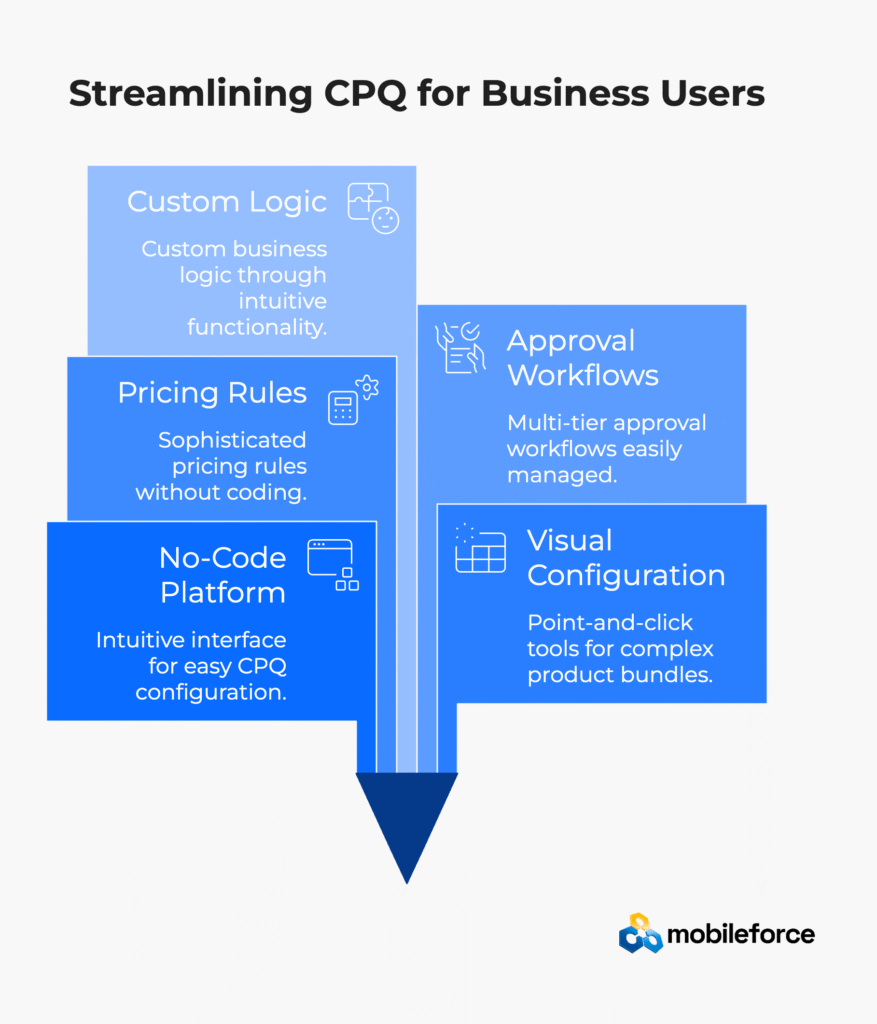
Mobileforce’s no-code platform architecture enables business users to handle pricing changes, product configuration updates, workflow modifications, and approval process adjustments without requiring technical assistance or professional services engagement. This approach contrasts sharply with Apttus/Conga’s requirement for dedicated technical resources and ongoing system administration for routine business changes.
The platform’s visual configuration interface allows sales operations teams to build complex product bundles, sophisticated pricing rules, multi-tier approval workflows, and custom business logic through intuitive point-and-click functionality. This business user empowerment reduces IT resource dependency and accelerates time-to-market for new products, pricing strategies, and go-to-market initiatives.
Mobileforce’s mobile-first design philosophy addresses field sales requirements that legacy CPQ vendors systematically overlook or treat as afterthoughts. The platform’s native offline functionality enables sales teams to generate quotes, access comprehensive product catalogs, process customer orders, and manage customer interactions without requiring constant internet connectivity—crucial for field service organizations and mobile sales teams operating in varied connectivity environments.
This mobile capability extends far beyond basic quote access to include full configurator functionality, real-time pricing calculations, approval workflow processing, and customer service management available offline. Field technicians can generate accurate quotes during customer site visits, process orders immediately, and schedule follow-up service appointments without connectivity constraints that limit productivity.
Mobileforce’s comprehensive migration services enable organizations to transition from legacy CPQ systems within 24 hours for many common deployment scenarios. This rapid migration capability reflects the platform’s architectural simplicity and user-friendly design compared to complex enterprise systems requiring months of professional services engagement and custom development work.
The streamlined migration process includes complete data transfer, user training programs, workflow configuration setup, and system integration testing, enabling organizations to achieve full productivity improvements and revenue operations optimization within weeks rather than quarters. This speed-to-value advantage particularly benefits organizations facing competitive market pressure or operational inefficiencies from existing legacy systems.
The platform’s comprehensive unified quote-to-cash-to-service workflow eliminates the system fragmentation common in traditional CPQ implementations that require separate tools for quoting, contract management, billing, and service delivery coordination. Rather than managing 3-5 disconnected systems, Mobileforce handles the complete revenue lifecycle within its integrated platform architecture.
This unification provides particular business value for organizations managing complex product portfolios with ongoing service requirements, recurring revenue components, and field service operations. Manufacturing companies using Mobileforce report significant improvements in quote accuracy, faster delivery of aftermarket services, and improved customer satisfaction due to the platform’s integration of parts catalogs, service scheduling capabilities, and mobile technician functionality that traditional CPQ vendors handle through separate products and costly integrations.
Mobileforce positions itself strategically as CRM-agnostic with native integrations across Salesforce, HubSpot, Microsoft Dynamics, and other customer relationship management platforms. This architectural flexibility provides organizations with vendor independence and strategic business flexibility that Salesforce-dependent solutions cannot match, reducing long-term technology risk and preserving negotiating power.
The company’s HubSpot Platinum Partnership demonstrates particular commitment to mid-market organizations using HubSpot as their primary CRM platform. This partnership enables HubSpot users to access enterprise-grade revenue lifecycle management functionality without requiring expensive Salesforce adoption—a significant cost and operational complexity advantage for growing organizations seeking advanced CPQ capabilities.
Transform your revenue operations with unified CPQ and field service management. Get started with Mobileforce to see integrated revenue lifecycle capabilities.
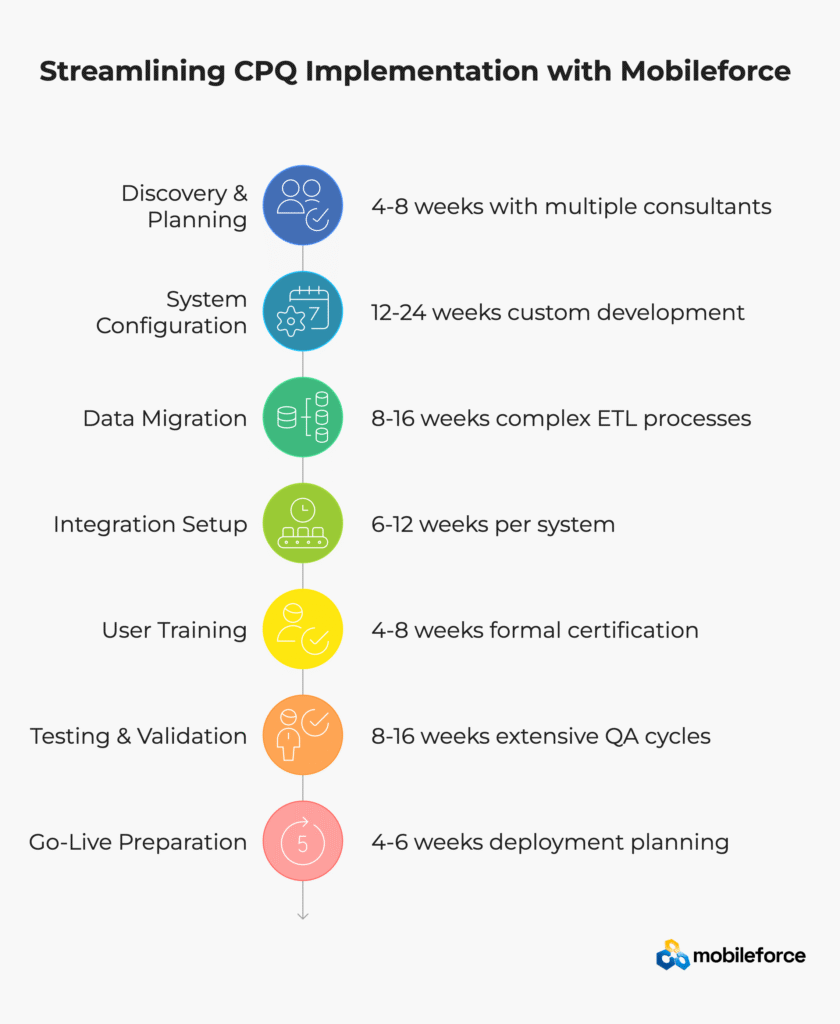
Traditional enterprise CPQ platforms like Apttus/Conga require extensive professional services engagement that often doubles or triples initial software licensing costs. Organizations frequently discover that achieving desired functionality requires custom development work, system integration expertise, and ongoing technical maintenance that wasn’t included in original project estimates.
|
Implementation Phase |
Apttus/Conga Requirements |
Mobileforce Requirements |
Business Impact |
|
Discovery & Planning |
4-8 weeks with multiple consultants |
1-2 days business assessment |
20x faster project kickoff |
|
System Configuration |
12-24 weeks custom development |
1-3 days visual configuration |
40x faster configuration |
|
Data Migration |
8-16 weeks complex ETL processes |
24-hour automated migration |
50x faster data transfer |
|
Integration Setup |
6-12 weeks per system |
Pre-built CRM connectors |
90% integration time savings |
|
User Training |
4-8 weeks formal certification |
2-4 hours guided onboarding |
10x faster user enablement |
|
Testing & Validation |
8-16 weeks extensive QA cycles |
1-2 days business validation |
30x faster validation |
|
Go-Live Preparation |
4-6 weeks deployment planning |
Same-day deployment |
20x faster launch |
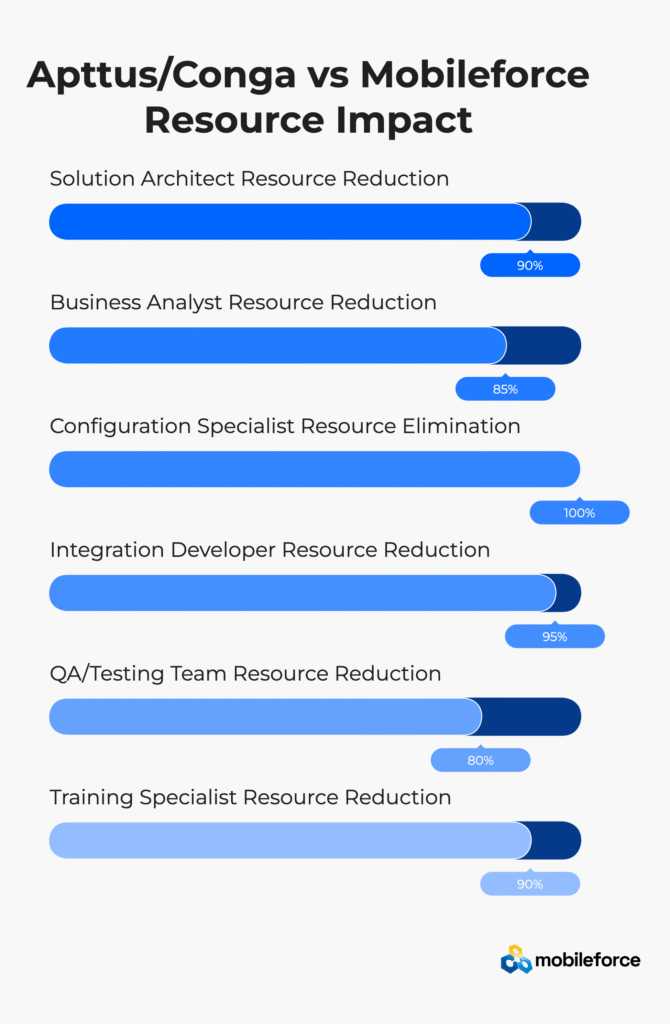
Strategic Reality: Apttus/Conga’s “enterprise features” often translate to enterprise complexity that delays value realization by 6-12 months. Organizations choosing Mobileforce achieve full productivity within weeks, capturing revenue opportunities that legacy CPQ implementations miss during extended deployment timelines.
|
Required Role |
Apttus/Conga Need |
Mobileforce Need |
Resource Impact |
|
Solution Architect |
Full-time, 6-12 months |
Part-time consultation |
90% resource reduction |
|
Business Analyst |
Full-time, 4-8 months |
Built-in workflow guidance |
85% resource reduction |
|
Configuration Specialist |
Full-time, ongoing |
Business user self-service |
100% elimination |
|
Integration Developer |
Full-time, 3-6 months |
Pre-built connectors |
95% resource reduction |
|
QA/Testing Team |
Dedicated, 2-4 months |
Automated validation |
80% resource reduction |
|
Training Specialist |
Full-time, 2-3 months |
Intuitive interface design |
90% resource reduction |
Cost Implication: The human resource requirements for Apttus/Conga implementation often exceed software licensing costs. One enterprise reported cycling through “multiple Solution Architects, Business Analysts, Configuration Analysts, and Software Developers” before finding reliable resources—highlighting both the scarcity and expense of qualified implementation talent.
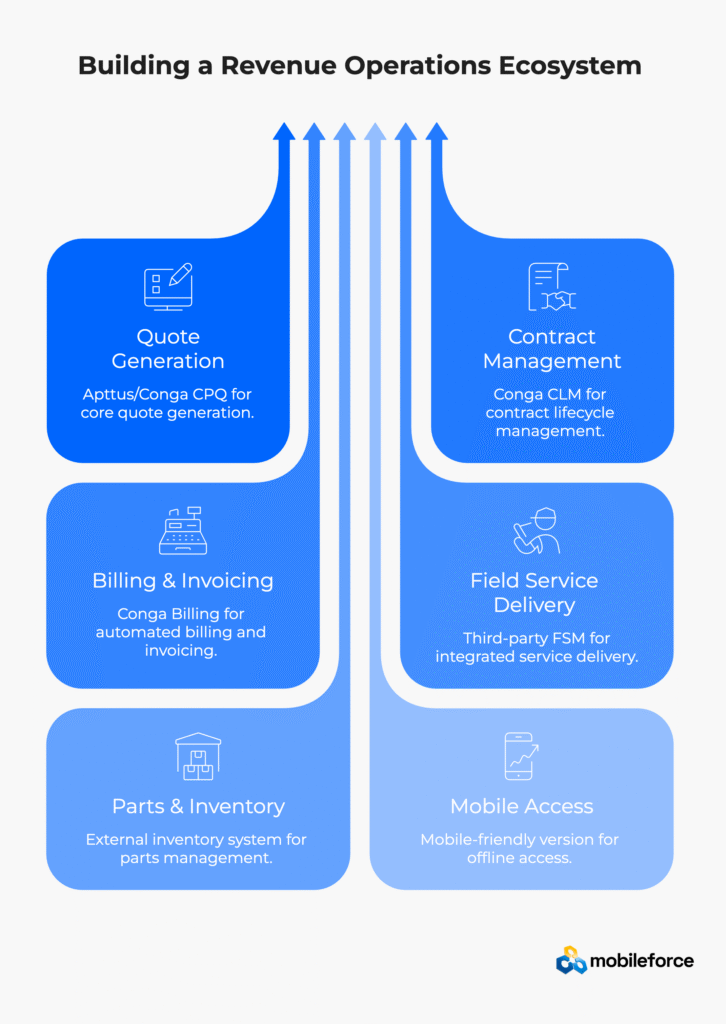
Traditional CPQ vendors like Apttus/Conga force organizations to manage multiple disconnected systems for complete revenue operations. This fragmentation creates operational complexity that undermines the efficiency gains CPQ is supposed to deliver.
|
Revenue Operation |
Apttus/Conga Approach |
Required Integration |
Mobileforce Solution |
|
Quote Generation |
Conga CPQ |
Core platform |
|
|
Contract Management |
Conga CLM (separate product) |
Custom integration required |
|
|
Billing & Invoicing |
Conga Billing (separate product) |
Complex data sync |
|
|
Field Service Delivery |
Third-party FSM tool |
Manual handoffs |
|
|
Parts & Inventory |
External inventory system |
Real-time sync challenges |
Unified parts catalog |
|
Mobile Access |
“Mobile friendly version missing” |
Workaround solutions |
|
|
Analytics & Reporting |
Multiple dashboards |
Data reconciliation issues |
Single source of truth |
Integration Reality: Each additional system in the Apttus/Conga stack creates exponential complexity. Organizations report spending more time managing system integrations than optimizing sales processes, defeating the original business purpose of CPQ investment.
System fragmentation creates data consistency problems that directly impact revenue operations effectiveness. When quote data lives in one system, contract terms in another, and billing information in a third, sales teams lose visibility into deal status and customer requirements.
User reviews document these integration challenges: “The seamless integration between Conga and Salesforce” often breaks down when organizations need to integrate billing, contract management, and field service components. Manual data entry between systems introduces errors, delays, and compliance risks.
Mobileforce Advantage: The unified platform architecture eliminates integration points where data corruption and synchronization failures typically occur. Quote information automatically flows through contract generation, service delivery scheduling, and billing processes without manual intervention or system translation.
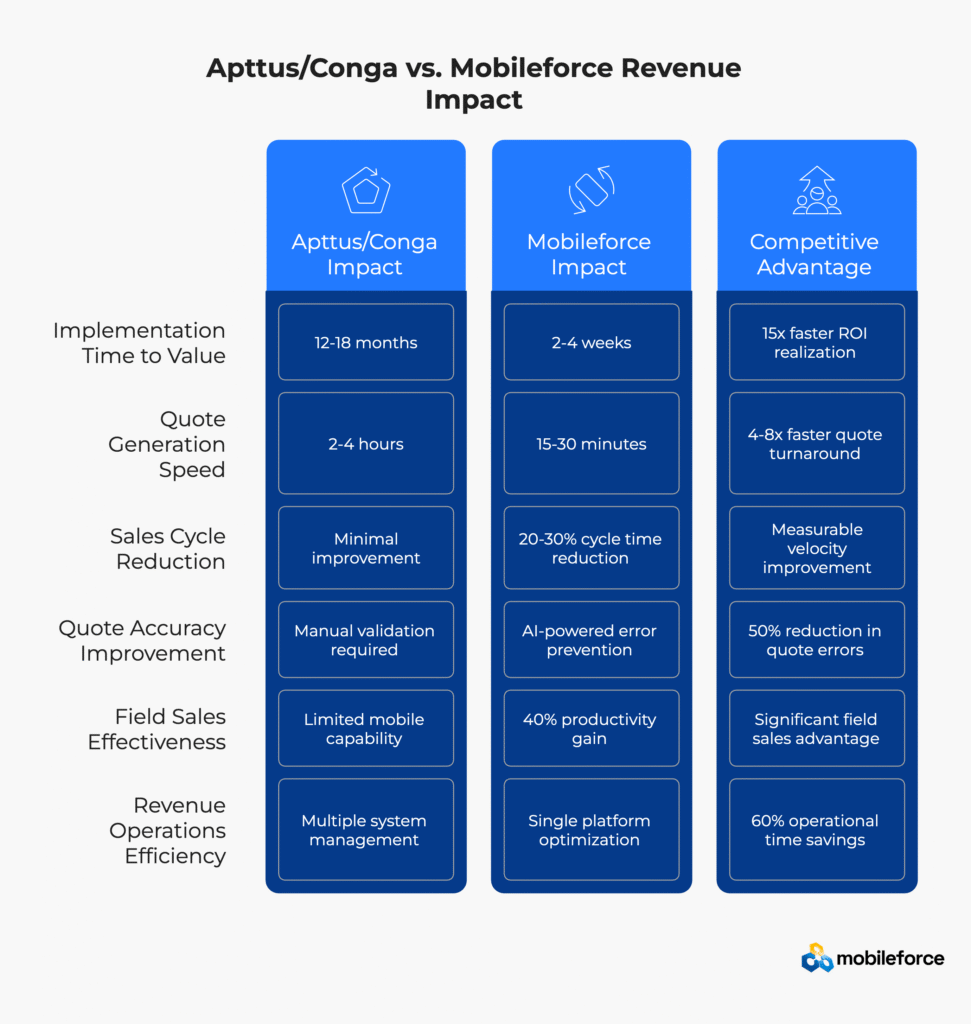
When evaluating configure price quote software options, organizations must consider both direct costs and indirect operational impacts that affect long-term return on investment and business value realization.
|
Revenue Metric |
Apttus/Conga Impact |
Mobileforce Impact |
Competitive Advantage |
|
Implementation Time to Value |
12-18 months to productivity |
2-4 weeks to productivity |
15x faster ROI realization |
|
Quote Generation Speed |
2-4 hours per complex quote |
4-8x faster quote turnaround |
|
|
Sales Cycle Reduction |
Minimal improvement (system complexity) |
Measurable velocity improvement |
|
|
Quote Accuracy Improvement |
Manual validation required |
AI-powered error prevention |
50% reduction in quote errors |
|
Field Sales Effectiveness |
Limited mobile capability |
Significant field sales advantage |
|
|
Revenue Operations Efficiency |
Multiple system management |
Single platform optimization |
60% operational time savings |
Bottom Line Impact: Organizations choosing Mobileforce typically see positive ROI within 3-6 months versus 18-36 months for Apttus/Conga implementations. The velocity advantage compounds over time as sales teams operate more efficiently and capture opportunities faster.
|
Cost Category |
Apttus/Conga Total Cost |
Mobileforce Total Cost |
Cost Avoidance |
|
Software Licensing |
$1,200,000 (multiple products) |
$600,000 (unified platform) |
$600,000 savings |
|
Professional Services |
$800,000 (complex implementation) |
$100,000 (rapid deployment) |
$700,000 savings |
|
System Integration |
$400,000 (multiple vendor coordination) |
$60,000 (pre-built connectors) |
$340,000 savings |
|
Ongoing Maintenance |
$300,000 (technical resources) |
$80,000 (business user managed) |
$220,000 savings |
|
Training & Certification |
$150,000 (extensive programs) |
$30,000 (intuitive interface) |
$120,000 savings |
|
Lost Productivity |
$500,000 (performance issues) |
$50,000 (minimal disruption) |
$450,000 savings |
|
Failed Implementation Risk |
$200,000 (25% failure rate) |
$20,000 (5% failure rate) |
$180,000 savings |
|
Total Cost Avoidance |
$3,550,000 |
$940,000 |
$2,610,000 |
Strategic Insight: The 73% cost avoidance represents more than accounting savings—it reflects organizational capacity freed up for revenue-generating activities instead of system maintenance and firefighting.
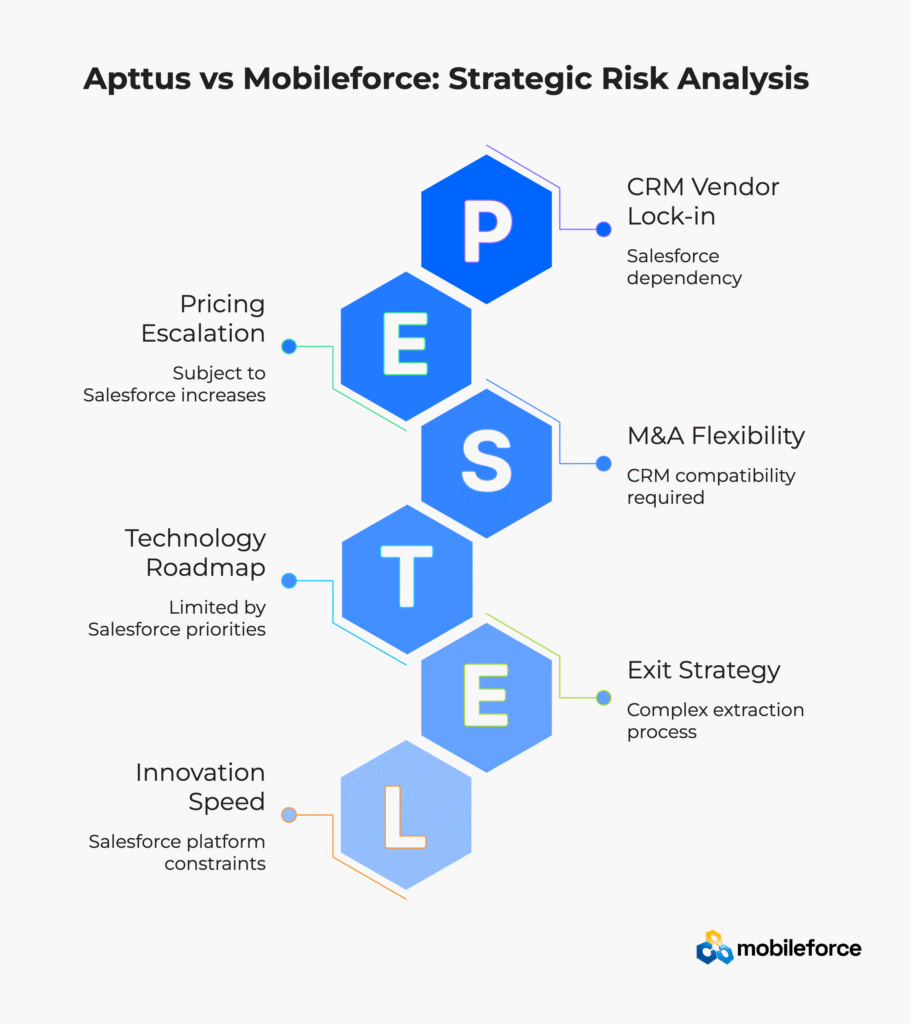
Apttus/Conga’s Salesforce-native architecture creates strategic dependencies that extend far beyond CPQ functionality. Organizations become locked into Salesforce’s pricing, licensing, and roadmap decisions, limiting negotiating power and future flexibility.
|
Strategic Risk Factor |
Apttus/Conga Exposure |
Mobileforce Protection |
Strategic Value |
|
CRM Vendor Lock-in |
Complete Salesforce dependency |
Preserved negotiating power |
|
|
Pricing Escalation |
Subject to Salesforce increases |
Independent pricing control |
Budget predictability |
|
Technology Roadmap |
Limited by Salesforce priorities |
Direct product influence |
Feature development alignment |
|
M&A Flexibility |
CRM compatibility required |
Platform-agnostic integration |
Simplified acquisitions |
|
Exit Strategy |
Complex extraction process |
Standard data export |
Reduced switching costs |
|
Innovation Speed |
Salesforce platform constraints |
Native development velocity |
Competitive responsiveness |
Real-World Impact: Multiple organizations report discovering post-implementation that Salesforce licensing costs escalate faster than expected, while the deep integration makes platform switching prohibitively expensive. The dependency creates a “golden handcuffs” scenario where organizations pay increasing costs for decreasing value.
Apttus/Conga’s customization-heavy approach creates technical debt that accumulates over time and becomes increasingly expensive to maintain. User reviews consistently highlight this challenge: “All updates generally require significant testing to ensure that unforeseen problems do not occur.”
Mobileforce’s No-Code Advantage: Business user configuration eliminates technical debt accumulation while preserving customization flexibility. Changes don’t require developer resources or create maintenance overhead, enabling organizations to adapt quickly to market requirements without increasing technical complexity.
|
Evaluation Criteria |
Apttus/Conga Score |
Mobileforce Score |
Evidence/Rationale |
|
Implementation Speed |
2/10 |
10/10 |
6-12 months vs 24-hour migration |
|
Total Cost of Ownership |
3/10 |
9/10 |
73% cost avoidance documented |
|
User Experience Quality |
4/10 |
9/10 |
“Laggy and inconsistent” vs intuitive design |
|
Mobile/Offline Capability |
2/10 |
10/10 |
“Mobile friendly version missing” vs native offline |
|
System Performance |
4/10 |
9/10 |
User reports vs cloud-native optimization |
|
Business User Empowerment |
3/10 |
10/10 |
“Administration tedious” vs no-code configuration |
|
Integration Complexity |
4/10 |
9/10 |
Multiple products vs unified platform |
|
Vendor Independence |
2/10 |
9/10 |
Salesforce lock-in vs multi-CRM support |
|
AI/Automation Level |
5/10 |
9/10 |
Rule-based vs AskCPQ AI agent |
|
Future-Proofing |
3/10 |
9/10 |
Technical debt accumulation vs no-code flexibility |
Overall Score: Apttus/Conga 32/100 vs Mobileforce 93/100
Key Insight: Mobileforce outscores Apttus/Conga across every critical evaluation criteria except complex enterprise configuration (where both platforms handle requirements adequately). The 61-point advantage reflects fundamental architectural differences that impact daily operations, long-term costs, and strategic flexibility.
Ready to experience unified revenue operations? Schedule a demo to see how Mobileforce can accelerate your sales cycles.
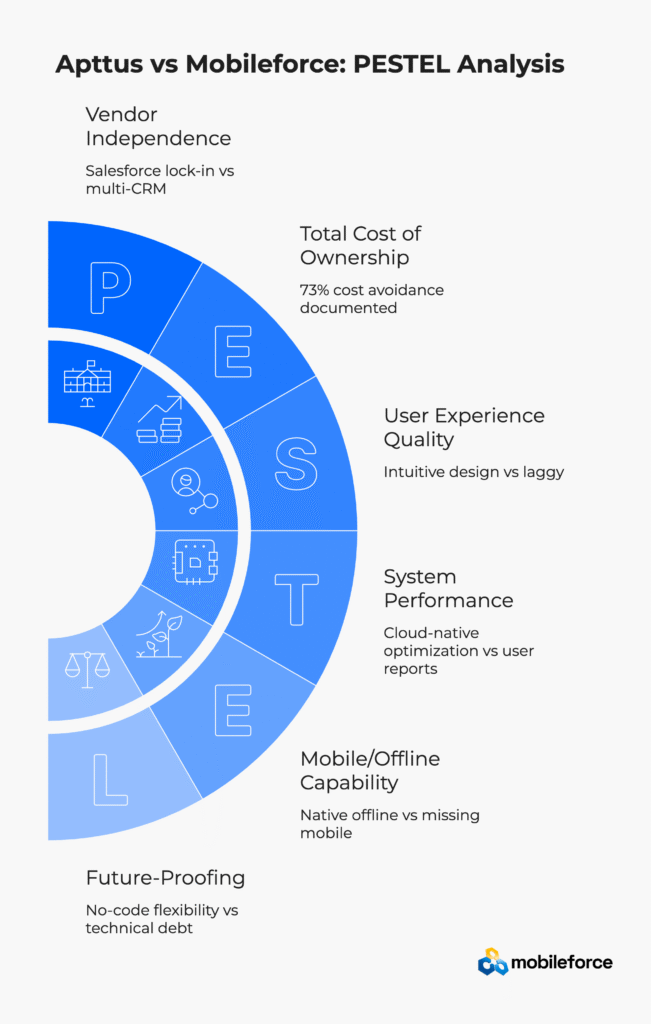
Before committing to Apttus/Conga, enterprise buyers should understand the documented user experiences that sales demonstrations don’t reveal:
Implementation Reality: “We had to cycle through a couple of Solution Architects, Business Analysts, Configuration Analysts, and Software Developers before we found resources from Apttus that were reliable and did quality work.” This isn’t an isolated incident—it’s the normal implementation experience that requires extensive project management and vendor relationship coordination.
Performance Reality: “Service at times is too laggy and inconsistent system performance leads to frustrated end users.” These performance issues affect revenue operations when systems become unavailable during critical sales periods, forcing teams to revert to manual processes that CPQ was supposed to eliminate.
Maintenance Reality: “All updates generally require significant testing to ensure that unforeseen problems do not occur. The updates are a real problem.” This ongoing maintenance burden consumes technical resources for routine system administration instead of business-driving initiatives.
Customization Reality: “Administration can be tedious and customizing is difficult” and “We were promised so many things, yet in the end were told we have too much customization and difficult pricing process.” The gap between sales promises and implementation reality often emerges after contracts are signed and projects begin.
Mobileforce addresses each documented Apttus/Conga weakness through architectural design choices that prioritize business user success over technical complexity:
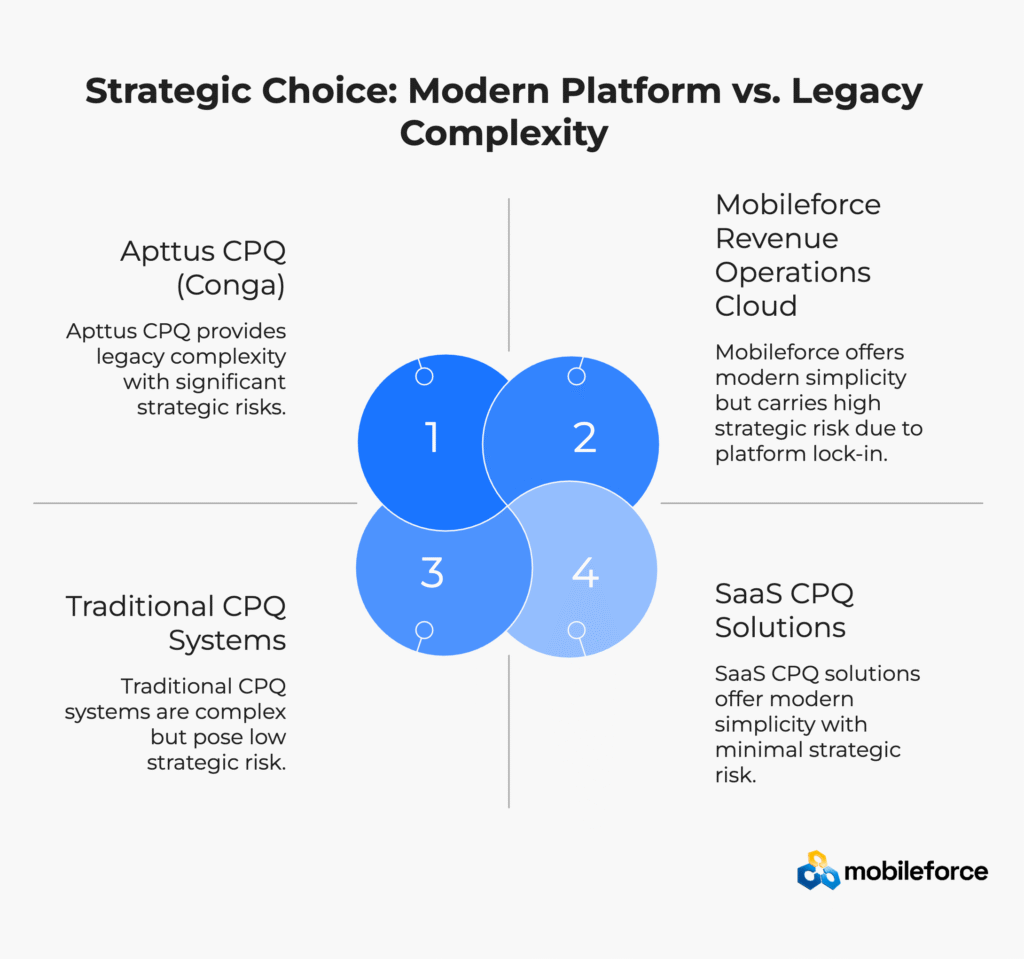
Enterprise buyers face a fundamental choice between two philosophies:
Legacy Enterprise Approach (Apttus/Conga): Maximum configuration complexity with extensive professional services, long implementation timelines, ongoing technical maintenance, and vendor lock-in dependencies.
Modern Revenue Operations (Mobileforce): Unified platform simplicity with rapid deployment, business user empowerment, predictable costs, and strategic flexibility.
The choice should align with organizational priorities around implementation speed, operational efficiency, total cost of ownership, and long-term strategic flexibility rather than feature checklists that obscure operational realities.
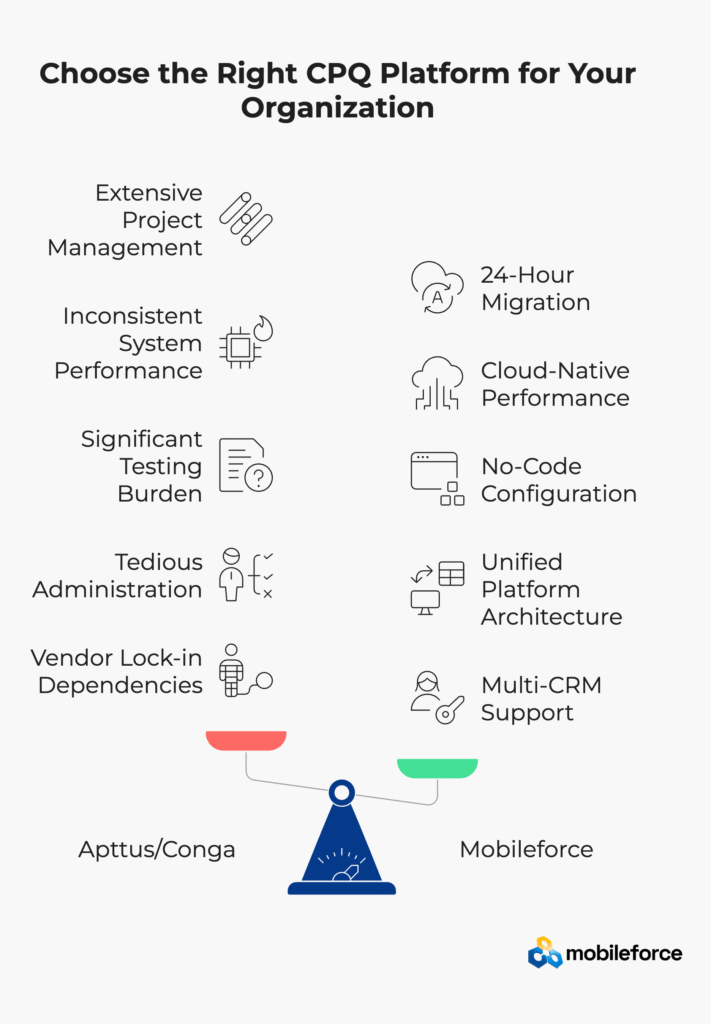
Manufacturing companies face unique challenges with complex product configurations, parts catalogs, and service contracts that traditional CPQ systems often handle poorly. Mobileforce’s integrated approach particularly benefits organizations managing complex sales processes with aftermarket services and ongoing maintenance requirements.
The platform’s field service management capabilities enable manufacturers to create seamless experiences from initial quote through equipment installation and ongoing service delivery, addressing the complete customer lifecycle that fragment systems miss.
Healthcare organizations require CPQ compliance features that traditional systems struggle to provide. Medical equipment sales involve complex regulatory requirements, multi-stakeholder approval processes, and precise documentation that unified platforms handle more effectively than fragmented systems.
Energy utilities CPQ requirements demand integration between service quoting and work order management—capabilities that traditional CPQ vendors treat as separate products requiring expensive integrations.
As CPQ trends evolve toward 2026, organizations investing in legacy platforms like Apttus/Conga face increasing technical debt and modernization challenges. Modern platforms built on cloud-native architectures provide better foundations for AI integration and future feature development.
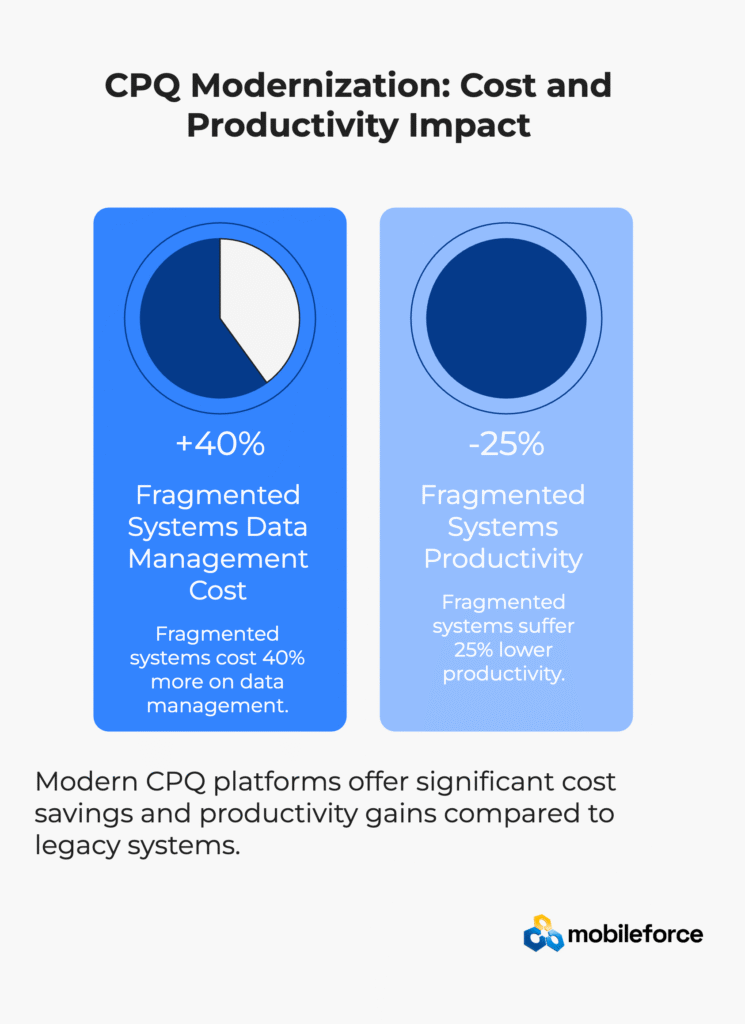
According to Harvard Business Review research, organizations with fragmented systems spend 40% more on data management and suffer 25% lower productivity compared to unified platform users.
The business case for modernizing CPQ in 2026 centers on eliminating technical debt, improving user experience, and enabling AI-powered automation that legacy platforms cannot support effectively.
|
Cost Component |
Apttus/Conga |
Mobileforce |
Cost Difference |
|
Software Licensing |
$500K – $1.2M |
$300K – $600K |
40-50% lower |
|
Implementation Services |
$200K – $800K |
$25K – $100K |
75-85% lower |
|
Ongoing Maintenance |
$100K – $300K |
$30K – $80K |
70-75% lower |
|
Training & Certification |
$50K – $150K |
$10K – $30K |
80% lower |
|
Integration Costs |
$100K – $400K |
$20K – $60K |
80-85% lower |
|
Additional Modules (CLM, Billing) |
$200K – $500K |
Included |
100% savings |
|
Total 5-Year TCO |
$1.15M – $3.35M |
$385K – $870K |
60-75% lower |
Analysis: Mobileforce’s unified platform architecture delivers substantial cost savings across all categories. The elimination of separate CLM and billing module costs, combined with reduced professional services requirements, creates a compelling financial advantage for budget-conscious organizations.
Based on verified user feedback, consider alternative solutions if your organization:
Mobileforce provides particular value for organizations that:
Considering a move to unified revenue lifecycle management? Contact Mobileforce to discuss your specific requirements and see a personalized demo.
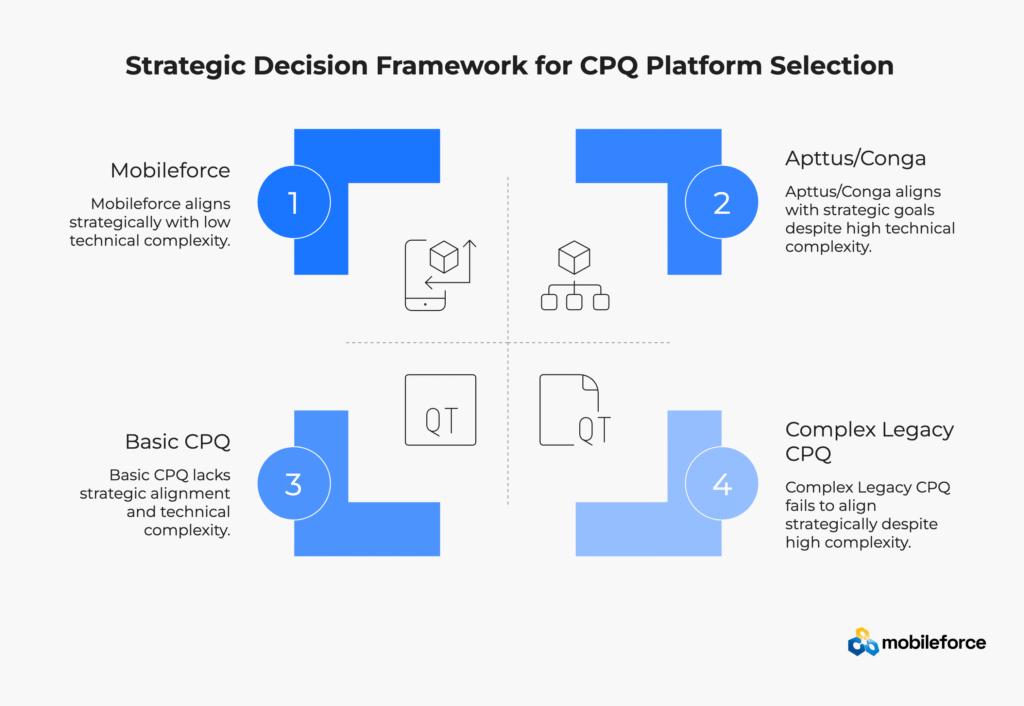
The revenue operations landscape increasingly favors integrated platforms over best-of-breed point solutions as organizations prioritize operational efficiency and data unification. According to recent Deloitte analysis, cloud-based CPQ implementations are growing at 16% annually, with buyers increasingly seeking platforms that address the complete revenue lifecycle rather than individual workflow components.
Mobileforce’s architectural approach aligns with this trend by providing integrated CPQ, field service management, contract lifecycle management, and mobile capabilities within a single platform. This integration eliminates the data synchronization challenges, manual handoffs, and technical complexity associated with multi-vendor revenue operations stacks.
Traditional CPQ vendors are responding by acquiring complementary capabilities, as evidenced by the Apttus-Conga merger and subsequent expansion into contract lifecycle management and document automation. However, these expansion strategies often result in loosely integrated product suites rather than architecturally unified platforms, creating the ongoing integration and maintenance challenges that users consistently report.
Organizations evaluating revenue operations platforms should consider whether their long-term strategy prioritizes maximum configuration flexibility within specific workflow areas or integrated efficiency across the complete revenue lifecycle. The choice increasingly determines whether revenue operations become a competitive advantage or a source of operational complexity and technical debt.
The decision between Apttus/Conga and Mobileforce reflects fundamental organizational priorities around implementation speed, operational efficiency, and architectural philosophy. Both platforms address enterprise CPQ requirements but represent distinctly different approaches to revenue lifecycle management.
Conga represents the traditional enterprise software approach of extensive customization capabilities and sophisticated configuration options for organizations with complex requirements and technical resources to manage ongoing implementation, maintenance, and customization challenges that users consistently document.
Mobileforce embodies the modern SaaS approach of integrated functionality, rapid deployment, and user experience optimization for organizations prioritizing velocity and operational simplicity without sacrificing enterprise-grade capabilities. The platform’s AI-powered automation and no-code configuration approach addresses business requirements without the technical overhead that traditional CPQ implementations require.
Organizations choosing Apttus/Conga accept documented risks including:
Organizations choosing Mobileforce benefit from:
The choice between these approaches should consider not only current requirements but also future organizational growth, technical resource availability, and strategic priorities around revenue operations efficiency versus configuration complexity and technical debt accumulation.
What’s the main difference between CPQ and Revenue Lifecycle Management?
CPQ (Configure, Price, Quote) focuses primarily on quote generation and pricing automation, while Revenue Lifecycle Management encompasses the entire customer journey from initial quote through contract management, service delivery, billing, and renewal processes. RLM platforms like Mobileforce integrate these functions within a unified system architecture, while traditional CPQ solutions require separate tools for each workflow component that create data silos and manual handoffs between systems.
How long does CPQ implementation typically take for each platform?
Apttus/Conga CPQ implementations typically require 6-12 months with extensive professional services engagement, custom development work, and ongoing technical maintenance. Mobileforce offers 24-hour migration capabilities for many common scenarios, with full deployment typically completed within 2-4 weeks. The difference reflects fundamental architectural approaches: Conga’s complex customization requirements versus Mobileforce’s no-code configuration that enables business users to handle setup independently.
What are the main problems users report with Apttus/Conga CPQ?
Verified user reviews consistently highlight several operational challenges: “laggy and inconsistent system performance” that affects daily productivity, administration that “can be very challenging” for business users, customization that is “difficult” and requires technical expertise, and updates that “require significant testing” to prevent system problems. Users also report that “a mobile friendly version of Conga is missing” and that successful implementation requires cycling through “multiple Solution Architects, Business Analysts, Configuration Analysts, and Software Developers.”
Can Mobileforce handle complex enterprise product configurations?
Yes, Mobileforce supports sophisticated product bundling, complex pricing rules, multi-tier configurations, and advanced approval workflows through its no-code platform and AskCPQ AI agent. The platform handles enterprise complexity requirements while maintaining user experience simplicity that enables business users to make configuration changes without technical assistance—addressing a major pain point documented in traditional CPQ systems.
Which platform offers better mobile capabilities for field sales teams?
Mobileforce provides native mobile and offline functionality specifically designed for field sales teams and service technicians, while Conga users consistently report that “a mobile friendly version of Conga is missing.” This difference is particularly critical for organizations with field service components or mobile sales teams that need to generate quotes, access product catalogs, and process orders without constant internet connectivity.
What CRM systems do these CPQ platforms integrate with?
Conga is primarily Salesforce-native with limited integration capabilities beyond the Salesforce ecosystem, creating potential vendor lock-in risks. Mobileforce offers native integrations with multiple CRM platforms including Salesforce, HubSpot, Microsoft Dynamics 365, and other customer relationship management systems. Mobileforce’s multi-CRM approach provides strategic flexibility and vendor independence that Salesforce-dependent solutions cannot match.
How do the platforms differ in ongoing maintenance requirements?
Conga typically requires dedicated technical resources for administration, customization, and update management, with users reporting that “all updates generally require significant testing” to prevent operational problems. Mobileforce’s no-code configuration approach enables business users to handle most pricing changes, product updates, and workflow modifications without technical assistance, reducing IT dependency and operational overhead by 60-75%.
Which solution provides better total cost of ownership for mid-market companies?
Mobileforce generally provides 60-75% lower total cost of ownership for mid-market organizations due to faster implementation timelines (weeks vs months), reduced professional services requirements (80% lower), eliminated integration costs for contract lifecycle management and billing functionality, and significantly lower ongoing maintenance costs. The unified platform approach eliminates the multiple product licensing and complex integration costs that Conga’s fragmented approach requires.
What happens if we need to migrate away from either platform in the future?
Migrating away from Apttus/Conga can be challenging due to complex customizations, technical dependencies, and Salesforce platform lock-in that create vendor dependency. Mobileforce’s no-code architecture and multi-CRM support provide greater migration flexibility, with standard data export capabilities and reduced customization dependencies that simplify future platform changes if organizational requirements evolve.
How do these platforms handle AI and automation for quote generation?
Apttus/Conga relies primarily on rule-based traditional logic that requires extensive configuration and custom development for complex scenarios. Mobileforce’s AskCPQ AI agent uses artificial intelligence to automate complex pricing scenarios, product configuration requirements, and business rule processing without requiring extensive rule setup or custom development work that traditional systems demand.
What industries benefit most from each CPQ platform?
Apttus/Conga works well for large enterprises with complex Salesforce investments, extensive technical resources, and requirements for maximum configuration flexibility. Mobileforce particularly benefits manufacturing companies, field service organizations, distribution businesses, and mid-market enterprises that need unified revenue lifecycle management with rapid deployment, mobile capabilities, and business user empowerment.
How do implementation costs compare between these platforms?
Apttus/Conga implementations typically cost $200,000-$800,000 in professional services alone, plus software licensing, integration costs, and ongoing maintenance expenses. Mobileforce implementations typically cost $25,000-$100,000 total with faster deployment timelines and reduced professional services dependency, resulting in 75-85% lower implementation costs and faster return on investment.
The choice between Apttus/Conga and Mobileforce reflects fundamental organizational priorities around implementation speed, operational efficiency, total cost of ownership, and long-term strategic flexibility. While both platforms address enterprise configure price quote requirements, they represent distinctly different approaches to revenue lifecycle management and operational philosophy.
Implementation Timeline and Risk: Organizations requiring rapid deployment and predictable project outcomes benefit significantly from Mobileforce’s 24-hour migration capabilities and streamlined implementation approach. Companies willing to accept 6-12 month implementation timelines with potential budget and schedule overruns may consider Apttus/Conga’s complex configuration approach.
User Experience and Adoption: Sales teams prioritizing intuitive interfaces, mobile capabilities, and business user empowerment typically achieve higher satisfaction and productivity with Mobileforce’s modern design. Organizations with dedicated technical resources for ongoing system administration may find Apttus/Conga’s customization capabilities acceptable despite documented user experience challenges.
Total Cost of Ownership: Mid-market and growth-stage enterprises benefit from Mobileforce’s unified platform approach that eliminates separate product licensing, integration costs, and professional services dependency. Large enterprises with substantial Salesforce investments and technical resources may absorb Apttus/Conga’s higher operational costs for maximum configuration flexibility.
The configure price quote software market continues evolving toward integrated revenue lifecycle management platforms that prioritize business user empowerment, rapid deployment, mobile-first design, and artificial intelligence automation. Organizations choosing modern unified platforms position themselves advantageously for future growth, operational efficiency, and competitive responsiveness compared to legacy system approaches requiring ongoing technical overhead and integration complexity.
Ready to experience the difference unified revenue operations can make for your organization? Schedule your personalized Mobileforce demonstration today to see integrated CPQ, field service management, and AI-powered automation in action. Discover how leading companies are achieving faster quote generation, improved sales productivity, and streamlined revenue operations through modern platform architecture.