
After-hours MRO revenue models are structured pricing frameworks that capture premium value from emergency maintenance services delivered outside standard business hours. These models transform costly 24/7 service operations into profitable revenue streams through subscription pricing, usage-based billing, and performance-based contracts.
After-hours MRO operations represent a massive untapped revenue opportunity in the $765.55 billion global maintenance market. With unplanned downtime costing manufacturing facilities $500,000 to $2 million per hour, smart MRO service providers are restructuring emergency response operations around mobile-first technology, automated pricing systems, and guaranteed service delivery windows. This comprehensive guide explores subscription-based pricing models, usage-based emergency billing, SLA-linked performance contracts, and the integrated CPQ field service management platforms required for successful implementation.

Ready to transform emergency service calls into predictable revenue streams? Get a demo of Mobileforce’s mobile-first Revenue Operations Cloud to see automated after-hours pricing in action.
After-hours MRO service costs vary significantly based on urgency level, response time commitments, and service complexity. Industry benchmarks show:
According to AI Smart Factory research on key maintenance statistics, the global MRO market is projected to reach $842.6 billion by 2033, with 57% of major maintenance service providers planning to incorporate AI and IoT by 2026. The research shows that predictive maintenance market growth is fueled by AI, machine learning, and IoT adoption, enabling precise failure predictions and reducing emergency service dependencies. This creates substantial willingness to pay emergency service premiums that exceed hourly downtime costs, particularly when coupled with automated billing systems that eliminate manual pricing errors during complex emergency scenarios.
Optimize your emergency service pricing strategy with automated CPQ calculations. Schedule a consultation to explore profitable after-hours revenue models.
Industry Metric | Current Market Data | Growth Trajectory | Revenue Impact |
Global MRO Market Size | $970.45 billion by 2035 | 2.4% CAGR | |
Emergency Service Premium | 50-200% over standard rates | Increasing with downtime costs | $2,000-$15,000 call-out fees |
Downtime Cost Impact | $500K-$2M per hour (manufacturing) | Rising with automation complexity | Drives premium pricing acceptance |
Predictive Maintenance Adoption | 62% of manufacturers (2025) | 85% projected by 2030 | Shifts to proactive revenue models |
Mobile Technology Adoption | 73% field service organizations | 95% projected by 2027 | Enables offline revenue capture |
After-Hours Revenue Share | 15-25% typical providers | 30-40% optimized providers | Premium pricing opportunity |

Market Intelligence: Manufacturing facility downtime costs continue escalating due to increased automation complexity and just-in-time production requirements. According to Deloitte’s 2025 Aerospace & Defense Industry Outlook, 81% of aerospace and defense companies are using or planning to implement AI and machine learning technologies, with predictive maintenance adoption accelerating across industrial sectors. This creates expanding willingness to pay premium rates for guaranteed emergency response capabilities, particularly in automotive, semiconductor, and pharmaceutical production environments where manufacturing CPQ solutions enable rapid emergency pricing decisions.
Technology Trend Impact: The shift toward mobile-first field service management platforms reflects the reality that emergency maintenance occurs in environments with poor connectivity, demanding offline-capable CPQ systems for revenue capture and customer communication during critical scenarios. AI-powered pricing engines further optimize emergency response by automatically calculating complexity-based markups and resource availability premiums in real-time.
Successful 24/7 MRO revenue generation requires three foundational operational capabilities that justify premium emergency service pricing:
After-hours service pricing complexity—including time-based surcharges, travel distance premiums, parts availability markups, and SLA compliance calculations—demands automated pricing engines. Manual emergency quote generation leads to revenue leakage and customer billing disputes when invoices arrive weeks after service completion. No-code configuration platforms enable rapid pricing rule adjustments without IT involvement, essential for emergency scenarios where parts availability and technician coverage create frequent pricing changes.
The global MRO services market, valued at $765.55 billion in 2025 and projected to reach $970.45 billion by 2035, increasingly rewards maintenance service providers who excel operationally while capturing premium revenue from guaranteed 24/7 equipment availability commitments.
Operational Capability | Basic Implementation | Advanced Implementation | Premium Implementation | Required Technology Platform |
Emergency Dispatch Optimization | Phone-based technician assignment | GPS-enabled route optimization | AI-powered dispatch automation | Real-time location tracking, predictive routing algorithms |
Mobile Quote Generation | Email quotes from back office | Basic mobile form completion | Offline CPQ with sync capabilities | Mobile-first configure price quote software |
Parts Inventory Management | Manual supplier phone calls | Real-time availability checking | Predictive inventory optimization | Integrated supplier networks, automated purchase order generation |
Emergency Billing Automation | Manual invoice creation post-service | Basic job completion triggers | Real-time revenue capture workflows | Native CPQ field service management integration |
Customer Status Communication | Reactive phone call updates | Automated SMS notifications | Real-time customer portal access | Integrated customer communication platforms |
Technology Selection Framework: This assessment matrix helps MRO service providers evaluate current operational capabilities against technology requirements needed for different emergency service pricing tiers. Most providers begin with basic implementation but require advanced mobile-first capabilities to justify premium after-hours rate structures.
Transform emergency maintenance operations into profit centers with mobile-first technology. Book your demo to see automated emergency pricing and dispatch optimization.

The most successful after-hours MRO revenue models align pricing structures with operational delivery capabilities while maximizing customer value perception during emergency scenarios. Each model requires specific technology infrastructure and operational maturity levels.
Monthly retainer pricing transforms sporadic emergency maintenance calls into predictable recurring revenue while guaranteeing specific operational performance commitments to industrial customers. Subscription billing platforms enable automated monthly invoicing and usage tracking, while professional services CPQ capabilities handle complex time-based pricing calculations for emergency response scenarios.
How Subscription Models Work:
Operational Requirements for Success:
Technology Platform Requirements: Mobile-first CPQ field service management platforms prove essential for subscription model execution. Maintenance technicians require offline-capable quote generation systems and parts ordering workflows to maintain service level commitments regardless of cellular connectivity failures common in industrial facility environments. Mobileforce’s mobile CPQ capabilities ensure continuous quote generation and emergency service delivery even when networks fail during critical equipment outages.
Subscription Pricing Framework Examples:
Hybrid pricing combines monthly access fees with per-incident emergency service charges, enabling revenue scalability for both high-frequency and low-frequency emergency maintenance customers while maintaining operational cost coverage.
How Usage-Based Models Work:
Operational Requirements for Success:

Technology Platform Requirements: Complex usage-based emergency pricing requires sophisticated automation through no-code CPQ configuration platforms. Pricing rule engines must automatically adjust rates based on real-time market conditions, parts availability, and technician scheduling constraints. No-code CPQ configuration enables rapid pricing rule modifications as emergency response costs and market dynamics change, while native field service management integration ensures accurate billing data capture from field operations.
Advanced pricing models tie emergency service costs directly to measurable performance outcomes, enabling premium rate justification through guaranteed results while sharing performance risks between service providers and industrial customers.
How SLA-Linked Models Work:
Operational Requirements for Success:
Technology Platform Requirements: SLA-linked pricing models demand integrated data flows between equipment monitoring systems, emergency dispatch platforms, and automated billing engines. Mobileforce’s unified Revenue Operations Cloud architecture eliminates data silos that compromise performance tracking accuracy and revenue calculation precision during complex emergency scenarios.
Automate complex emergency pricing scenarios with unified CPQ field service technology. Request a demo to explore SLA-linked revenue models.

Emergency MRO service pricing requires balancing operational complexity costs with customer value perception during critical equipment failure scenarios. This strategic framework connects operational delivery capabilities to specific pricing structures while maximizing revenue capture.
Service Tier | Response Time Guarantee | Operational Requirements | Monthly Base Fee | Per-Incident Premium | Typical Customer Applications |
Standard Emergency | 8-24 hours | Regular business hours coverage, standard parts sourcing | $2,500 | +25% over base rates | Non-critical support equipment, planned maintenance windows |
Priority Emergency | 4-8 hours | Extended coverage windows, expedited parts sourcing capabilities | $5,500 | +50% over base rates | Production support systems, quality control equipment |
Critical Emergency | 2-4 hours | 24/7 technician availability, pre-positioned parts inventory | $8,500 | +75% over base rates | Critical production lines, safety-related systems |
Mission-Critical | 1-2 hours | Dedicated technician coverage, on-site parts inventory management | $15,000 | +100% over base rates | Main production equipment, complete facility shutdown prevention |
Each emergency service pricing tier demands corresponding mobile technology sophistication to deliver promised operational performance levels:
Mobileforce’s mobile-first CPQ architecture delivers consistent performance across all emergency service tiers, with offline capabilities that maintain quote generation and service delivery workflows when network connectivity fails during industrial facility emergencies.
Optimize emergency service pricing with mobile-first revenue operations. Schedule your consultation to see automated after-hours billing in action.
After-hours MRO revenue management requires integrated software platforms that combine configure price quote (CPQ) capabilities with field service management (FSM) functionality and mobile-first architecture. Essential software components include native CRM integrations that synchronize emergency service data across customer management workflows and data migration capabilities that preserve historical emergency service patterns when upgrading platforms.

Successful after-hours revenue management demands native software integration rather than bolt-on solutions. Separate CPQ and FSM systems create data synchronization failures that compromise billing accuracy and customer communication during emergency scenarios. Mobileforce’s integrated platform eliminates these integration challenges through unified data architecture and mobile-first design principles.
Discover integrated CPQ field service technology for seamless emergency operations. Book your demo to see unified revenue management in action.
Model Type | Revenue Predictability | Customer Appeal | Implementation Risk | Technology Complexity | Profit Margin Potential | Best Market Conditions |
Subscription-Based | High (85-95%) | High – budget certainty | Low | Medium | Medium (40-60% margins) | Stable customer relationships |
Usage-Based Hybrid | Medium (60-80%) | Medium – pay-for-value | Medium | High | High (60-80% margins) | Variable demand patterns |
SLA-Linked Pricing | Medium (70-85%) | High – guaranteed outcomes | High | Very High | Very High (80-100% margins) | Performance-focused customers |
Outcome-Based | Very High (90%+) | Very High – shared success | Very High | Extreme | Extreme (100%+ margins) | Strategic partnerships |
Selection Criteria Analysis:
Choose Subscription Models When:
Choose Usage-Based Models When:
Choose SLA-Linked Models When:
Choose Outcome-Based Models When:
Strategic Commentary: Most successful MRO providers implement multiple models simultaneously—subscription for baseline customers, usage-based for variable demand segments, and outcome-based for strategic accounts. This portfolio approach maximizes revenue while minimizing implementation risk across different customer segments.
Different revenue approaches demand corresponding technology sophistication. This framework helps assess your current capabilities against model requirements:
Revenue Model | Core Technology Needs | Advanced Features | Integration Requirements | Mobile Capabilities | Implementation Timeline |
Subscription-Based | Basic CPQ pricing rules, customer management | SLA tracking, automated billing | CRM integration, accounting sync | Offline quote access | 2-3 months |
Usage-Based Hybrid | Real-time billing, usage tracking | Dynamic pricing engine | ERP integration, inventory management | Field data capture, parts ordering | 3-4 months |
SLA-Linked Pricing | Performance monitoring, analytics dashboard | Predictive alerts, penalty calculations | IoT sensors, monitoring systems | Real-time status updates | 4-6 months |
Outcome-Based | Advanced analytics, predictive maintenance | AI-powered insights, risk modeling | Full enterprise integration | Comprehensive mobile workflows | 6-12 months |
Strategic Commentary: Start with your current technology baseline. Subscription models require the least technical complexity and can often be implemented using existing systems with minor enhancements. Usage-based models need real-time data capture capabilities that many legacy systems lack. SLA-linked and outcome-based models require significant technology investment but offer the highest revenue potential for organizations with mature operational capabilities.
This progression aligns perfectly with Mobileforce’s native architecture—unlike bolt-on solutions, the integrated platform supports all model types from a single technology foundation, enabling evolution from basic subscription to sophisticated outcome-based contracts without system replacement.

Different MRO sectors demand tailored operational approaches that influence revenue model selection and implementation complexity.
Manufacturing MRO operations face the highest downtime costs, making premium service models economically viable when supported by robust operational capabilities.
Critical Operational Requirements:
Revenue Model Alignment: Manufacturing environments typically support platinum-tier subscription models ($15,000+/month) due to extreme downtime costs. However, operational complexity requires sophisticated resource management and compliance tracking that manual systems cannot handle effectively.
Aircraft-on-ground (AOG) and power generation emergencies represent the highest-value scenarios in after-hours MRO, but operational requirements are correspondingly complex.
Specialized Operations:
Technology Requirements: These sectors demand bulletproof mobile systems that function in remote locations without reliable connectivity. Offline quote generation and data synchronization capabilities become essential rather than convenient features.
Different MRO sectors have varying tolerance for complexity, technology adoption, and pricing models. This framework matches revenue approaches to industry characteristics:
Industry Sector | Preferred Revenue Model | Typical Contract Length | Technology Readiness | Price Sensitivity | Emergency Frequency | Recommended Starting Point |
Manufacturing | SLA-Linked + Usage-Based | 12-36 months | High | Medium | Daily | Usage-based with SLA premiums |
Aviation/Aerospace | Outcome-Based | 24-60 months | Very High | Low | Weekly | Direct to outcome-based models |
Energy/Utilities | Subscription + SLA | 36-60 months | Medium | Low | Monthly | Subscription with performance tiers |
Food Processing | Subscription-Based | 12-24 months | Medium | High | Weekly | Tiered subscription approach |
Chemical Processing | SLA-Linked | 24-48 months | High | Low | Monthly | SLA-focused with safety premiums |
Automotive | Usage-Based | 12-36 months | Very High | Medium | Daily | Hybrid usage + subscription |
Industry Commentary:

Strategic Insight: Match your revenue model to industry norms initially, then differentiate through superior execution rather than novel pricing approaches. Customers in regulated industries (aviation, energy, chemical) typically have budget approval processes that favor predictable subscription models, while manufacturing often prefers usage-based pricing that scales with production demands.
Successful after-hours pricing balances operational complexity with customer value perception. This framework connects the operational capabilities discussed earlier to specific pricing structures.
Service Level | Response Time | Operational Requirements | Base Monthly Fee | Per-Incident Premium | Typical Use Cases |
Standard | 8-24 hours | Regular business hours support, standard parts inventory | $2,500 | +25% | Non-critical equipment, planned maintenance windows |
Priority | 4-8 hours | Extended coverage, expedited parts sourcing | $5,500 | +50% | Production support equipment, quality control systems |
Emergency | 2-4 hours | 24/7 technician availability, pre-positioned parts | $8,500 | +75% | Critical production lines, safety systems |
Critical | 1-2 hours | Dedicated technician, on-site parts inventory | $15,000 | +100% | Main production equipment, complete facility shutdown scenarios |
Each service tier demands corresponding technology sophistication to deliver promised operational performance:
Standard Level: Basic mobile access to work orders and customer information Priority Level: Mobile quote generation and parts ordering capabilities
Emergency Level: Offline-capable systems for service delivery in any conditions Critical Level: Real-time monitoring integration and predictive failure alerts
Mobileforce’s mobile-first architecture ensures consistent performance across all service tiers, with offline capabilities that maintain operations when network connectivity fails during emergency scenarios.
Transform service calls into strategic revenue opportunities with operationally-backed pricing confidence. Schedule a demo to see how Mobileforce’s mobile-first platform supports sophisticated after-hours revenue models.
Use this self-diagnostic tool to determine your organization’s readiness for different after-hours revenue models:
Operational Capability | Current State Assessment | Required for Subscription | Required for Usage-Based | Required for SLA-Linked | Required for Outcome-Based |
Response Time Consistency | Can you meet 4-hour commitments 95% of the time? | ✓ Basic reliability | ✓ Proven consistency | ✓✓ Documented excellence | ✓✓✓ Guaranteed performance |
Mobile Technology Adoption | Do technicians have reliable mobile access to systems? | ✓ Basic mobile access | ✓✓ Offline capabilities | ✓✓ Real-time integration | ✓✓✓ Full mobile workflows |
Parts Inventory Management | Can you source emergency parts within SLA windows? | ✓ Standard suppliers | ✓✓ Expedited sourcing | ✓✓ Guaranteed availability | ✓✓✓ Predictive inventory |
Billing System Integration | How accurately do you capture and bill service time? | ✓ Manual reconciliation OK | ✓✓ Automated time tracking | ✓✓ Real-time billing | ✓✓✓ Performance-based billing |
Customer Communication | Can you provide proactive status updates during emergencies? | ✓ Basic phone/email | ✓✓ Automated notifications | ✓✓ Real-time dashboards | ✓✓✓ Predictive communication |
Assessment Scoring:

Strategic Commentary: Total your capability scores across all categories. Scores of 5-7 indicate readiness for subscription models, 8-12 for usage-based models, and 13-15 for advanced SLA or outcome-based approaches. Don’t attempt revenue models that exceed your operational maturity—customer dissatisfaction will damage long-term revenue potential more than conservative initial pricing.
After-hours revenue models succeed only when supported by operational systems that consistently deliver promised service levels. Technology integration determines whether premium pricing can be sustained long-term.
Unified Data Architecture Emergency situations demand instant access to customer history, equipment specifications, parts availability, and technician locations. Fragmented systems that require multiple logins and data reconciliation create delays that undermine premium service promises. Integrated Revenue Operations platforms eliminate these data silos by providing unified quote-to-cash workflows that synchronize emergency service delivery with billing automation.
Mobile-First Field Operations
After-hours technicians operate in challenging environments—remote locations, poor connectivity, time pressure. Systems designed for office use fail when technicians need to generate quotes, order parts, or update job status from industrial facilities at 2 AM. Modern CPQ software with mobile-first architecture ensures consistent performance regardless of field conditions.
Automated Revenue Capture Complex after-hours pricing—emergency surcharges, travel time, parts markups—must be calculated automatically. Manual processes introduce errors and delays that damage both profitability and customer relationships. Automated billing systems integrated with CRM platforms like SugarCRM and Creatio ensure emergency service revenue is captured accurately without manual intervention.
Organizations implementing sophisticated after-hours revenue models track specific operational metrics that correlate with revenue performance:
Rate your organization’s current capabilities (1-5 scale) to determine optimal revenue model starting point:
Operational Area | Assessment Questions | Score (1-5) | Required for Subscription | Required for Usage-Based | Required for SLA-Based | Required for Outcome-Based |
Response Reliability | Do you meet promised response times 95%+ consistently? | ___ | 3+ | 4+ | 4+ | 5 |
Mobile Technology | Can technicians generate quotes and complete jobs without office support? | ___ | 2+ | 3+ | 4+ | 5 |
Billing Accuracy | Are emergency service bills accurate without manual adjustment? | ___ | 2+ | 4+ | 4+ | 5 |
Parts Availability | Can you source emergency parts within committed timeframes? | ___ | 3+ | 3+ | 4+ | 5 |
Customer Communication | Do you proactively update customers during emergency service? | ___ | 2+ | 3+ | 4+ | 5 |
Performance Monitoring | Can you measure and report service performance metrics? | ___ | 2+ | 3+ | 4+ | 5 |
Technician Skills | Are your technicians cross-trained for various emergency scenarios? | ___ | 3+ | 3+ | 4+ | 5 |
Financial Systems | Do your billing systems handle complex pricing automatically? | ___ | 2+ | 4+ | 4+ | 5 |
Scoring Interpretation:

Gap Analysis Strategy: Identify your lowest-scoring areas and prioritize improvement before advancing to complex revenue models. For example, if mobile technology scores low (2/5) but billing accuracy is high (4/5), focus on mobile platform investment before implementing usage-based pricing that demands field data accuracy.
Implementation Readiness Checklist:
Strategic Insight: Organizations often overestimate their readiness for complex revenue models. This assessment prevents costly implementations that fail due to operational gaps rather than market rejection.
Track different KPIs depending on your revenue approach. This framework ensures you’re measuring what drives success for your specific model:
Metric Category | Subscription Models | Usage-Based Models | SLA-Linked Models | Outcome-Based Models |
Financial Performance | Monthly recurring revenue growth, customer retention rate | Revenue per incident, utilization rates | SLA compliance costs vs. premiums | Total cost of ownership reduction, shared savings |
Operational Excellence | Response time consistency, technician utilization | Billing accuracy, parts markup optimization | Performance penalty frequency, uptime achievement | Equipment reliability improvement, predictive accuracy |
Customer Success | Service tier adoption rates, contract renewal rates | Emergency call frequency trends, satisfaction scores | SLA satisfaction ratings, relationship depth | Partnership expansion, strategic value recognition |
Technology Performance | Mobile system uptime, quote generation speed | Real-time billing accuracy, inventory integration | Monitoring system reliability, alert accuracy | Predictive model precision, automation effectiveness |
Benchmark Targets by Model:
Subscription Models:
Usage-Based Models:
SLA-Linked Models:
Outcome-Based Models:

Commentary: Start by establishing baseline performance in simpler models before advancing to complex outcome-based approaches. Each progression requires higher operational standards—subscription models can tolerate 95% response compliance, but outcome-based contracts demand 99%+ reliability. Technology capabilities must evolve correspondingly, with mobile-first platforms providing the flexibility to support multiple model types simultaneously.
See how industry leaders achieve 99%+ response time compliance with mobile-first operations. Book your Mobileforce demo to explore integrated CPQ+FSM for after-hours revenue optimization.
Phase | Subscription Model (3-6 months) | Usage-Based Model (6-9 months) | SLA-Based Model (9-12 months) | Outcome-Based Model (12-18 months) |
Month 1-2: Foundation | Technology selection, pricing design | Advanced CPQ implementation, billing system integration | Performance monitoring setup, SLA framework design | Comprehensive platform implementation, predictive analytics setup |
Month 3-4: Pilot | 5-10 customer pilot, basic service tiers | Real-time billing testing, dynamic pricing validation | Performance tracking validation, penalty calculation testing | Customer partnership negotiations, risk-sharing model design |
Month 5-6: Launch | Market rollout, customer communication | Full market launch, complex pricing scenarios | SLA compliance monitoring, performance optimization | Limited strategic customer deployment |
Month 7-9: Scale | Customer tier optimization | Usage pattern analysis, margin optimization | Geographic expansion, advanced SLA offerings | Partnership model refinement |
Month 10-12: Optimize | – | Advanced analytics, predictive pricing | Performance-based pricing refinement | Full market expansion |
Month 13-18: Advanced | – | – | Outcome-based transition planning | Continuous optimization, expansion |
Critical Dependencies by Model:
Subscription Models:
Usage-Based Models:
SLA-Based Models:
Outcome-Based Models:

Success Milestones Tracking: Each model progression includes specific checkpoints to ensure readiness before advancing to the next phase. Failed milestones indicate need for operational improvement before revenue model implementation.
This framework helps prioritize which revenue models to pursue based on your organization’s risk tolerance and growth objectives:
Revenue Model | Implementation Complexity | Technology Investment | Revenue Potential | Time to ROI | Risk Level | Best For Organizations With |
Tiered Subscription | Low | $25K-75K | Medium ($50K-200K annual uplift) | 3-6 months | Low | Stable customer base, basic technology |
Usage-Based Hybrid | Medium | $75K-150K | Medium-High ($100K-500K annual uplift) | 6-12 months | Medium | Variable demand, good billing systems |
SLA-Linked Pricing | High | $150K-300K | High ($200K-1M annual uplift) | 12-18 months | Medium-High | High-performance operations, monitoring capabilities |
Outcome-Based | Very High | $300K-500K | Very High ($500K-2M annual uplift) | 18-24 months | High | Advanced technology, strategic partnerships |
Strategic Decision Guidelines:
Start with Subscription Models if:
Advance to Usage-Based Models if:
Progress to SLA-Linked Models if:
Pursue Outcome-Based Models if:
Commentary: This matrix reveals why many organizations fail at advanced revenue models—they attempt outcome-based pricing without operational excellence foundation. Success requires systematic progression through complexity levels, building capabilities and customer confidence before advancing to higher-risk, higher-reward approaches.

Successful after-hours revenue model implementation requires systematic approach that aligns technology capabilities with operational requirements and customer expectations.
Technology Platform Selection
Resource Allocation
Limited Market Testing
Technology Optimization
Geographic and Service Expansion
Continuous Improvement
Revenue Model | Initial Investment | Annual Revenue Uplift | Payback Period | 3-Year ROI | Key Financial Drivers |
Subscription-Based | $50K-100K | $200K-500K | 6-12 months | 300-600% | Customer retention, tier adoption rates |
Usage-Based Hybrid | $100K-200K | $300K-800K | 8-15 months | 400-800% | Utilization optimization, margin improvement |
SLA-Linked Pricing | $200K-400K | $500K-1.5M | 12-18 months | 500-1000% | Performance premiums, penalty avoidance |
Outcome-Based | $400K-800K | $1M-3M | 18-24 months | 600-1200% | Shared value creation, partnership expansion |
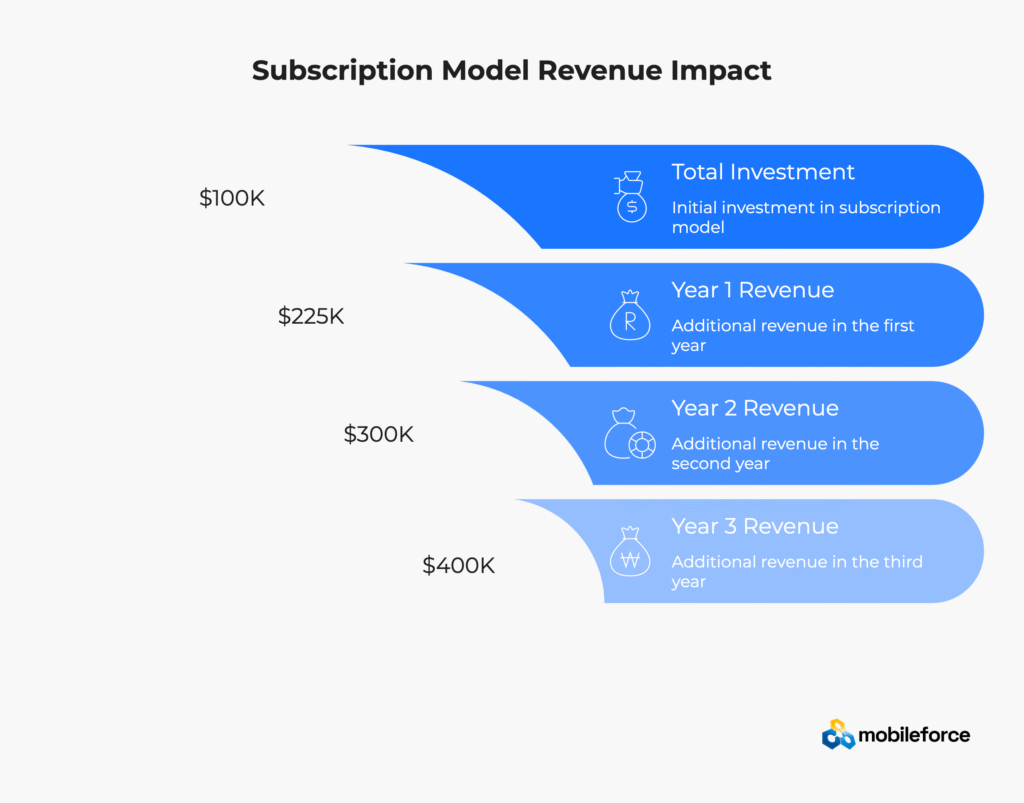
Financial Calculation Example (Mid-Market MRO Provider):
Baseline Scenario (Traditional Break-Fix):
Subscription Model Implementation:
Year 1 Results:
3-Year Projection:
Key Financial Success Factors:
Investment Prioritization Guidelines: Start with models that match your financial capacity and risk tolerance. Subscription models offer fastest payback with lowest risk, while outcome-based models provide highest returns but require significant upfront investment and operational maturity.
Q: What is the average cost of after-hours MRO services? A: After-hours MRO services typically cost 25-200% more than standard rates, with emergency call-out fees ranging from $2,000-$15,000+ depending on response time guarantees. Standard after-hours service commands 25-50% premiums ($150-225/hour), while critical emergency response with 1-2 hour guarantees can cost $350-500/hour plus expedited parts markups.
Q: How do mobile-first CPQ systems improve after-hours revenue capture compared to traditional platforms? A: Mobile-first CPQ platforms enable offline quote generation, real-time parts ordering, and automated emergency billing even during connectivity failures common in industrial facilities. Traditional office-based systems leave maintenance technicians unable to capture revenue when cellular networks fail, particularly problematic during midnight emergencies in remote manufacturing locations.
Q: What operational metrics indicate readiness for premium after-hours pricing models? A: Key readiness indicators include 95%+ response time compliance during regular business hours, first-call resolution rates above 80%, billing accuracy requiring less than 5% manual adjustment, and mobile system uptime above 99%. These operational fundamentals must be established before implementing complex after-hours revenue models with premium pricing structures.
Q: How does no-code CPQ configuration benefit emergency MRO operations? A: No-code CPQ platforms enable rapid pricing rule adjustments without IT department involvement, essential for emergency scenarios where parts availability, technician coverage, and seasonal demand create frequent pricing changes. Emergency pricing rules can be modified in real-time to maintain profitability as market conditions evolve throughout different operational periods.
Q: What is the biggest operational challenge when implementing subscription-based after-hours models? A: Maintaining consistent response time performance across all service tiers while managing technician fatigue and coverage gaps represents the primary challenge. Successful MRO providers use predictive scheduling algorithms and automated dispatch optimization to balance resource allocation while protecting service level commitments and technician work-life balance.
Q: How do you price emergency parts procurement when suppliers have limited after-hours availability? A: Emergency parts pricing includes base component costs plus sourcing difficulty premiums (25-150% markup), expedited shipping charges, supplier contact fees, and availability scarcity adjustments. Automated pricing systems adjust markups based on real-time supplier inventory data, emergency sourcing requirements, and delivery time window constraints.
Q: What integration capabilities are essential for after-hours revenue operations? A: Native CPQ field service management integration eliminates data synchronization delays between pricing systems, emergency dispatch platforms, and automated billing workflows. Real-time data sharing ensures accurate revenue capture and seamless customer communication throughout complex emergency service scenarios requiring multiple technician dispatches and parts ordering.
Q: How do you measure the operational success of after-hours revenue programs? A: Track response time compliance rates by service tier (target: 95%+), mobile system uptime during field operations (target: 99%+), automated billing accuracy without manual adjustment (target: 97%+), customer satisfaction scores for emergency vs. standard service (target: 90%+), and revenue per emergency incident trends over time.
Q: What role does artificial intelligence play in optimizing after-hours service operations? A: AI automates emergency request intake processing, matches technician skills to specific equipment repair requirements, predicts parts needs based on historical equipment failure patterns, and optimizes dispatch routing for minimum response time achievement. This operational intelligence enables premium pricing justification through superior emergency service delivery performance.
Q: How much can MRO providers increase revenue with optimized after-hours models? A: Industry benchmarks show 25-35% total revenue increases when after-hours services represent 20-30% of overall business volume. Subscription-based models typically generate $200K-$500K annual revenue uplifts, while outcome-based contracts can produce $1M-$3M increases for providers with advanced operational capabilities and strategic customer partnerships.
Ready to implement profitable after-hours revenue models? Schedule your consultation to explore CPQ field service integration for emergency operations.
Ready to implement profitable after-hours revenue models? Schedule your consultation to explore CPQ field service integration for emergency operations.
After-hours MRO operations represent strategic revenue opportunities that reward operational excellence with premium pricing power and predictable cash flow generation. Success depends on mobile-first technology platforms that deliver consistent service quality regardless of field conditions, automated pricing systems that eliminate revenue leakage during complex emergency scenarios, and integrated CPQ field service management platforms that connect service delivery performance to financial results optimization.
The MRO service providers generating sustainable profits from 24/7 operations in 2026 have systematized their emergency response workflows around predictable operational processes, intelligent pricing automation, and mobile-enabled field teams that maintain service level commitments regardless of timing, location, or connectivity challenges. According to Advanced Tech’s analysis of MRO trends, smart equipment technology using IoT sensors is revolutionizing maintenance operations, with predictive algorithms enabling cost-effective and efficient MRO operations. They have evolved beyond reactive emergency response to proactive revenue generation through subscription-based pricing models, usage-based billing optimization, SLA-linked performance contracts, and outcome-focused customer partnerships.
Your after-hours revenue potential is directly correlated to your operational capabilities and technology platform sophistication. Organizations with basic operational maturity can implement subscription-based models for predictable revenue generation, while those with advanced capabilities can pursue outcome-based contracts with strategic customers for maximum profitability achievement.
Key Success Factors for After-Hours Revenue Growth:
The global MRO services market continues expanding toward $970.45 billion by 2035, increasingly rewarding providers who excel at operational execution while capturing maximum value from 24/7 equipment availability commitments. Organizations that master after-hours revenue generation will build sustainable competitive advantages through superior customer relationships and premium pricing power.
Transform your emergency maintenance operations into predictable profit centers with proven revenue models and mobile-first technology platforms. Schedule your Mobileforce demo to discover how industry leaders automate after-hours revenue capture through integrated CPQ field service management solutions designed specifically for complex MRO operations.