
What is CPQ Vendor Selection? CPQ vendor selection is the systematic process of evaluating and choosing configure price quote software that automates sales quotation, pricing optimization, and product configuration for manufacturing, MRO (Maintenance, Repair, and Operations), and field service organizations. The best cpq software combines sales automation, revenue operations, and customer relationship management capabilities to streamline quote-to-cash processes.
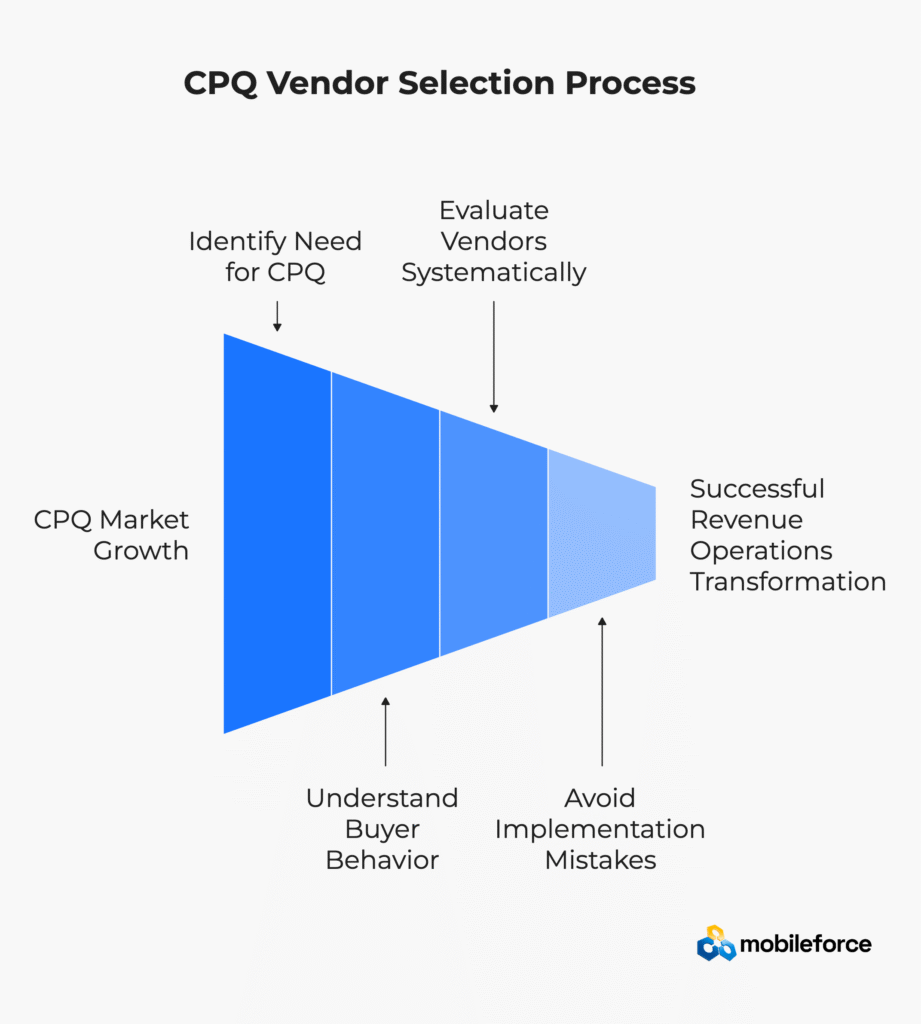
The CPQ market is reaching $5.8 billion by 2026, yet 54% of manufacturing plants still use paper and spreadsheets for operations management including quoting. With 81% of B2B buyers selecting preferred vendors before first sales contact, companies need systematic cpq software evaluation beyond feature checklists. This comprehensive guide provides a proven 5-phase cpq evaluation framework to select vendors confidently, avoid costly implementation mistakes, and ensure successful revenue operations transformation.
Ready to begin your cpq software selection process? Get your personalized evaluation demo to see industry-specific capabilities for manufacturing, MRO, and field service operations.
How does CPQ vendor selection impact business performance?
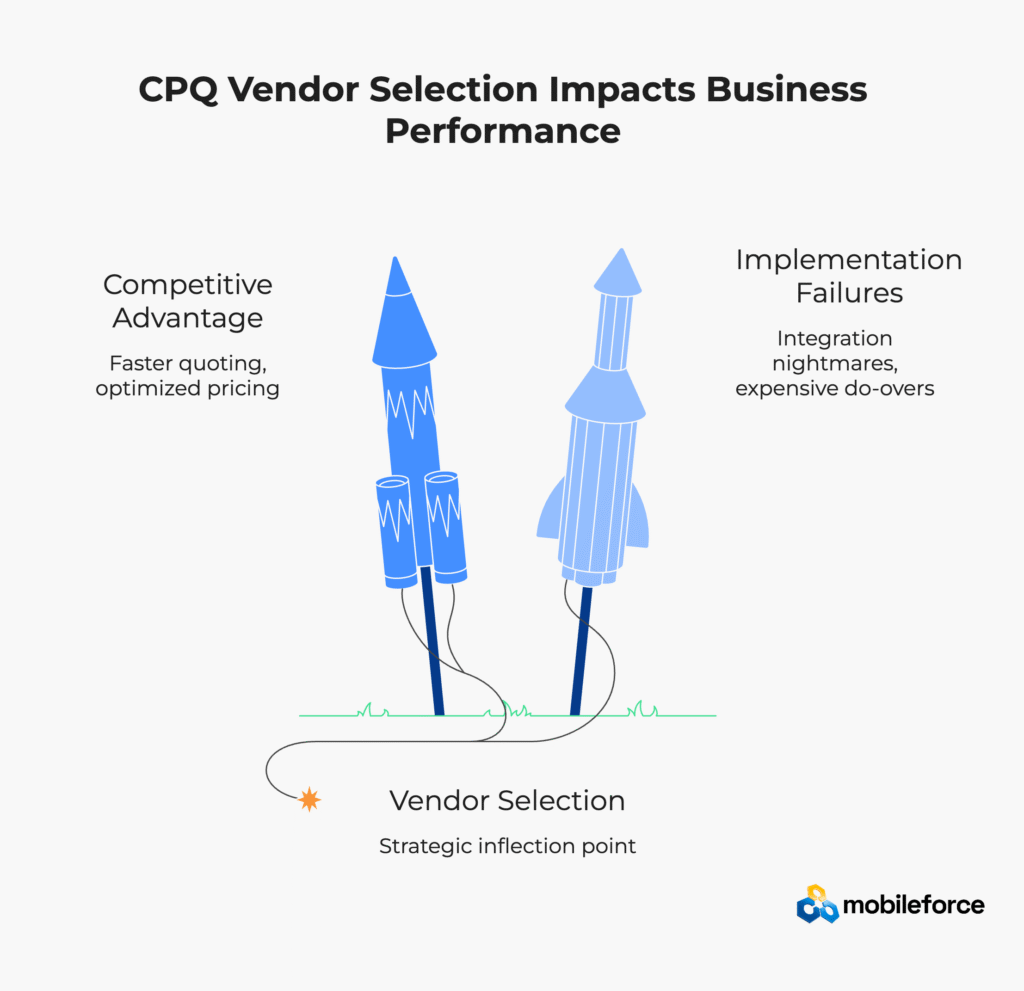
CPQ vendor selection represents a strategic inflection point for manufacturing, MRO, and field service revenue operations. Choose correctly, and your organization gains competitive advantage through faster quoting, improved pricing optimization, and enhanced customer experience. Choose poorly, and you’ll face implementation failures, integration nightmares, and expensive do-overs that can cost 200-300% of initial software licensing fees.
The challenge extends beyond technology evaluation into broader sales enablement strategy. Manual processes continue dominating industrial operations—54% of manufacturing plants still use paper and spreadsheets for operations management—specifically because companies selected cpq platforms that couldn’t scale with business complexity or integrate with existing sales automation systems.
Key Statistics:
Modern buyers expect speed and accuracy in quote management systems. Organizations that delay modernization face “revenue leakage that erodes competitiveness” as competitors leverage automated quoting for faster response times and consistent pricing optimization. The window for maintaining manual processes is closing rapidly.
Concerned about implementation risks? Schedule a risk assessment consultation to evaluate your specific requirements.
How to evaluate CPQ vendors systematically:
This industry-focused cpq software comparison framework provides structured methodology for selecting the best cpq platform based on manufacturing, MRO, and field service requirements rather than generic enterprise software evaluation criteria.
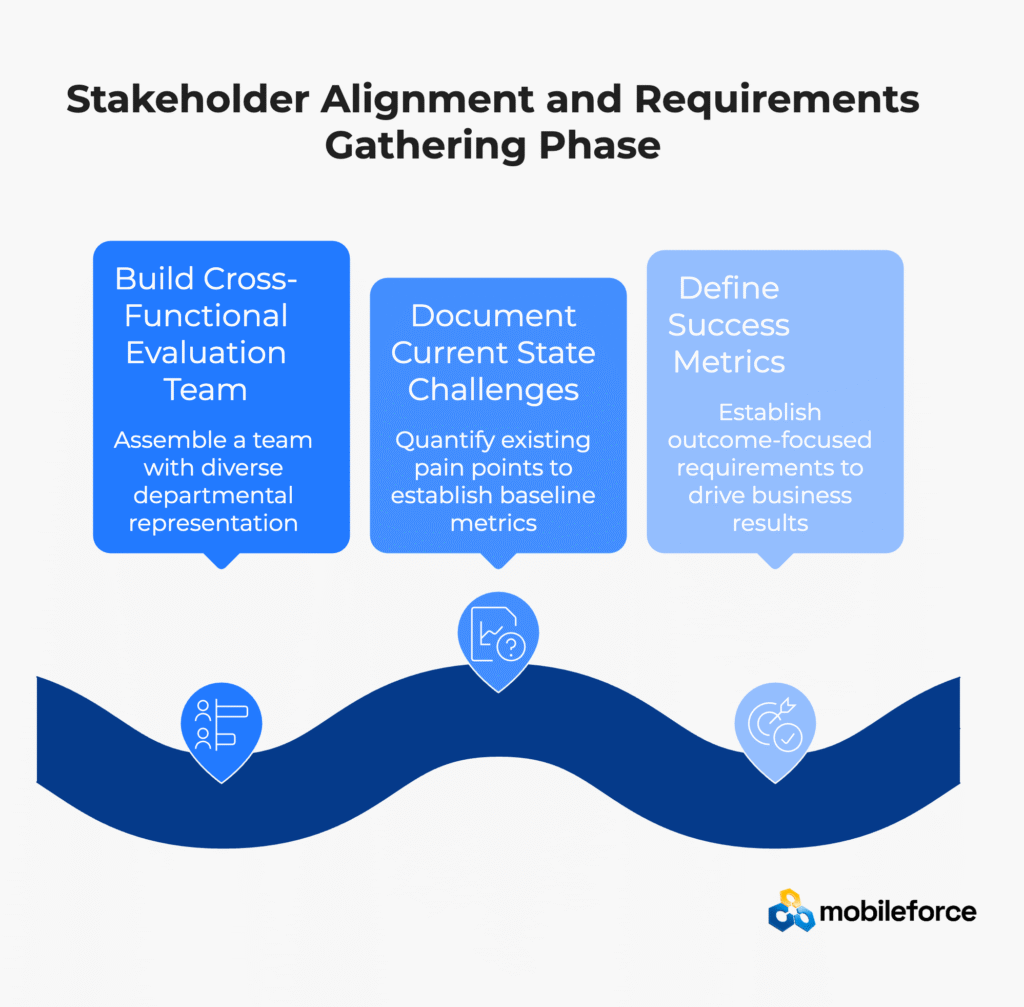
Step 1: Build Cross-Functional Evaluation Team
Successful cpq implementation requires representation from multiple departments with different evaluation priorities:
Step 2: Document Current State Challenges
Quantify existing pain points to establish baseline metrics for cpq software evaluation:
Step 3: Define Success Metrics for Revenue Operations
Move beyond feature wish lists to outcome-focused requirements that drive business results:
Need help defining your specific requirements? Get expert consultation on industry-specific cpq evaluation criteria.
How to research cpq vendors effectively:
Look Beyond Analyst Reports for Industry-Specific Needs
While Gartner’s Magic Quadrant for CPQ Applications provides baseline market positioning, analyst evaluations focus on “Ability to Execute” and “Completeness of Vision” across all industries. This methodology often favors large enterprise cpq solutions serving horizontal markets over specialized platforms designed for manufacturing, MRO, and field service complexity.
Many companies achieve better outcomes with cpq vendors who aren’t Magic Quadrant Leaders but deliver superior results for industry-specific requirements. Focus your cpq software research on operational capabilities rather than overall market positioning.
Industry-Focused CPQ Evaluation Criteria
Essential questions for manufacturing, MRO, and field service cpq software comparison:
Industry Specialization vs. Market Size
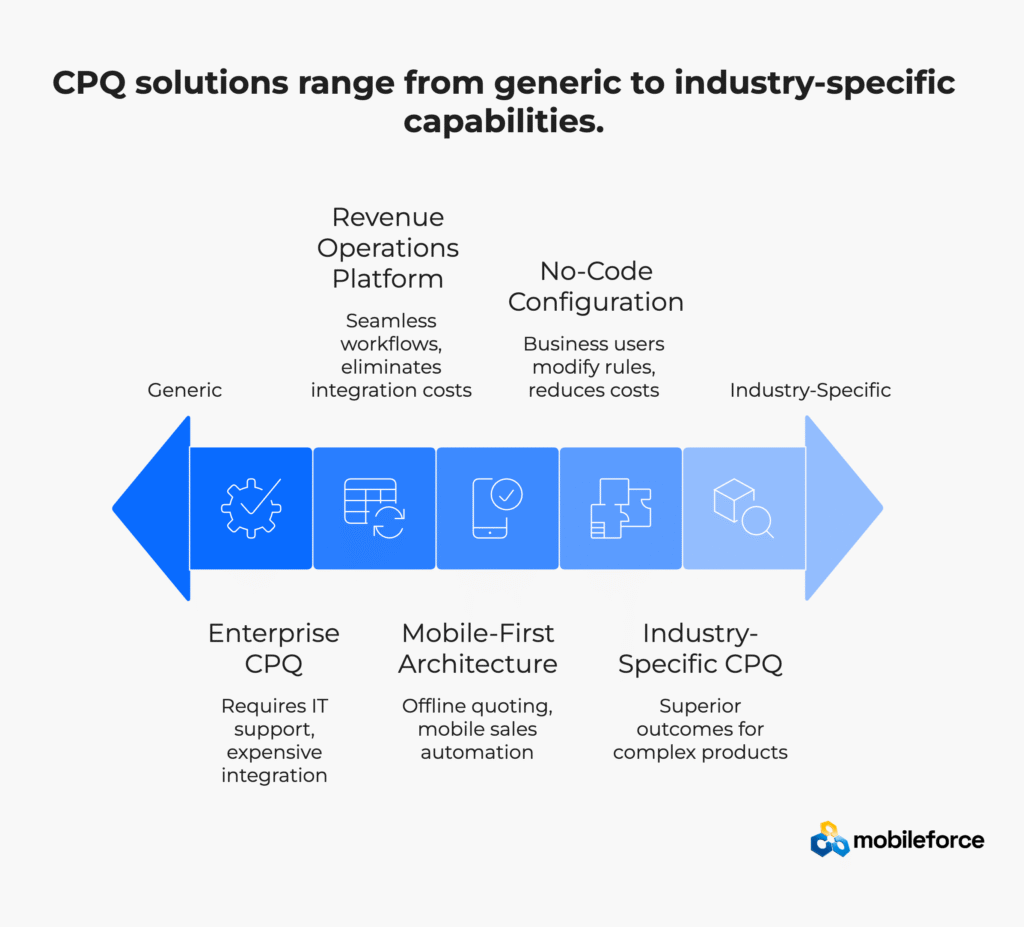
Manufacturing, MRO, and field service operations require fundamentally different sales automation capabilities than software, services, or horizontal commerce platforms. Evaluate cpq vendors on industry-specific strengths:
Complex Product Configuration Requirements:
Revenue Operations Integration Benefits:
Rather than standalone cpq tools, modern industrial companies need unified quote-to-cash-to-service platforms that connect sales automation, operations management, and field service workflows seamlessly.
For instance, when conducting industry-focused cpq software comparison between Mobileforce and enterprise platforms, consider that purpose-built design delivers capabilities like mobile field quoting, AI-powered configuration assistance, and no-code business user control – features that enterprise cpq solutions often require extensive customization to achieve.
Peer Reference Strategy for CPQ Selection
82% of buyers rely on peer experiences, but focus on references from companies with similar operational complexity rather than general customer counts. A cpq vendor with 50 successful industrial implementations often delivers better outcomes than one with 500 horizontal deployments across various industries.
Ready to identify the right cpq vendors for your manufacturing requirements? Start your evaluation process with industry-specific assessment.
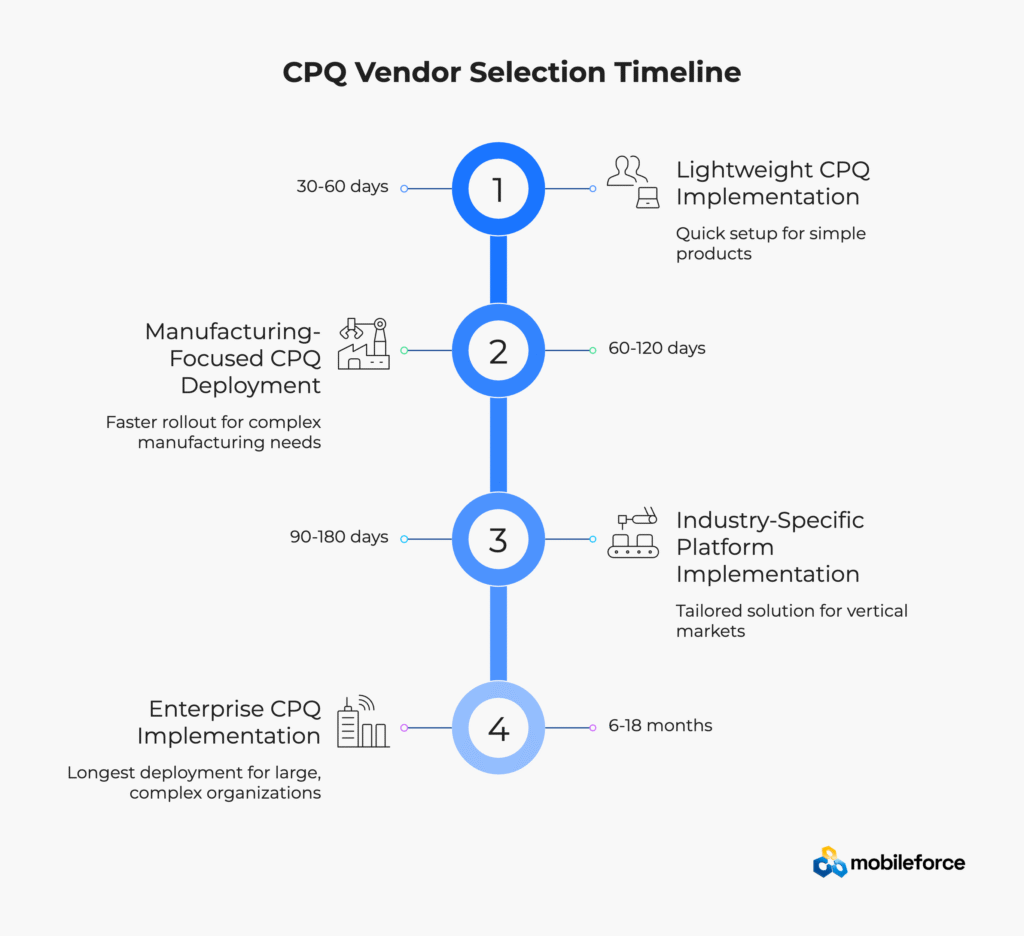
CPQ Vendor Categories Summary Table
Vendor Type | Best For | Typical Timeline | Key Advantages | Primary Limitations |
Enterprise CPQ Solutions | Large organizations with complex enterprise architecture | 6-18 months | Horizontal scalability, extensive features | Requires customization for manufacturing |
Manufacturing-Focused CPQ | Companies with complex products, field service | 60-120 days | Native manufacturing capabilities, faster deployment | May lack some enterprise features |
Industry-Specific Platforms | Vertical markets (automotive, medical devices) | 90-180 days | Deep industry knowledge | Limited cross-industry applicability |
Lightweight CPQ Tools | Simple products, basic pricing | 30-60 days | Quick implementation, lower cost | Limited configuration complexity |
How to evaluate cpq platforms systematically:
Manufacturing CPQ Software Comparison Framework
Core Capability | Enterprise CPQ Platform Approach | Manufacturing-Focused Platform Advantage | Impact on Revenue Operations |
Product Configuration | Generic rules engine requiring customization | Purpose-built constraint solving for complex BOMs | 60-80% faster configuration time |
Field Service Integration | Separate modules requiring middleware integration | Native quote-to-service workflow | 40% higher service revenue capture |
Mobile Capabilities | Responsive web interface adaptation | True offline functionality with sync | 25% improvement in field productivity |
User Control | Developer-dependent configuration | No-code business user empowerment | 70% reduction in IT support tickets |
Manufacturing increasingly competes through field service delivery and distributed sales teams. Evaluate cpq vendors on mobile sales automation capabilities:
Critical Mobile CPQ Features:
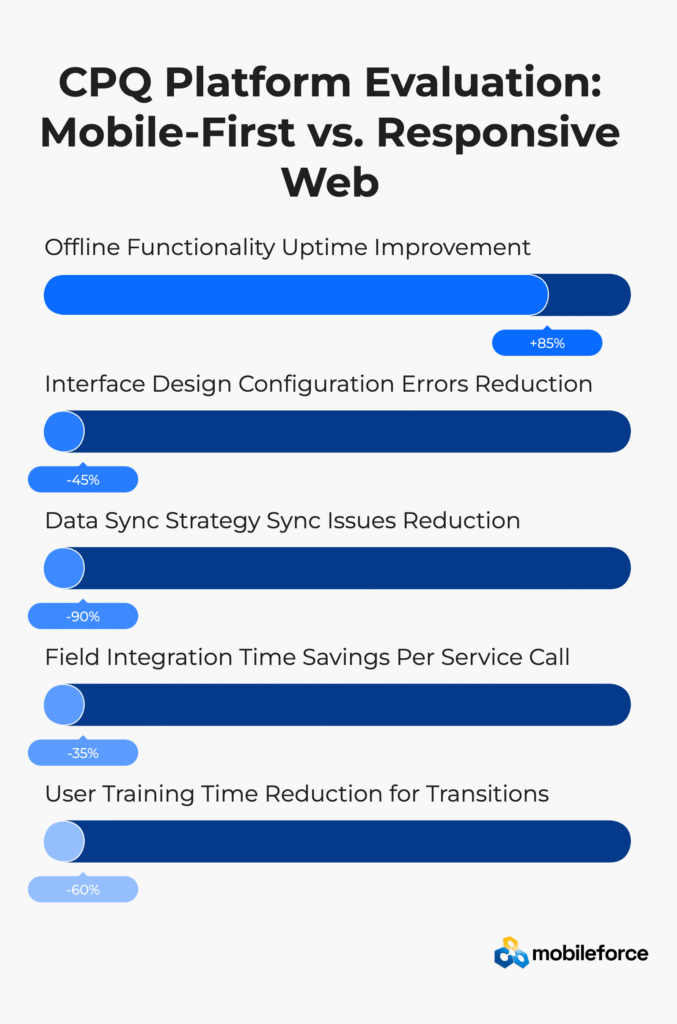
Mobile Capability Assessment Matrix
Evaluation Criteria | Responsive Web Platform | Mobile-First CPQ Platform | Manufacturing Business Impact |
Offline Functionality | Limited or none | Full configuration capability | Field teams work in areas with poor connectivity – 85% uptime improvement |
Interface Design | Desktop UI adapted for mobile | Purpose-built for mobile workflows | Reduces configuration errors by 45% and improves field productivity |
Data Sync Strategy | Manual sync required | Automatic bi-directional sync | Prevents lost quotes and data conflicts – 90% reduction in sync issues |
Field Integration | Separate app for field service | Unified quote-to-service workflow | Eliminates duplicate data entry – 35% time savings per service call |
Complex Configuration | Difficult on small screens | Touch-optimized for complex products | Enables accurate field quotes for complex equipment – $50K average deal size |
User Training | Desktop users struggle mobile | Intuitive mobile-first design | Reduces training time by 60% for field service transitions |
Traditional enterprise cpq solutions often struggle with these requirements because they’re designed for inside sales teams rather than field operations. Manufacturing companies increasingly find that mobile capability differences directly impact field service revenue and customer experience. When evaluating sales automation demos, insist on seeing actual field scenarios with complex products configured offline, then synced when connectivity returns.
What is AI-powered CPQ software?
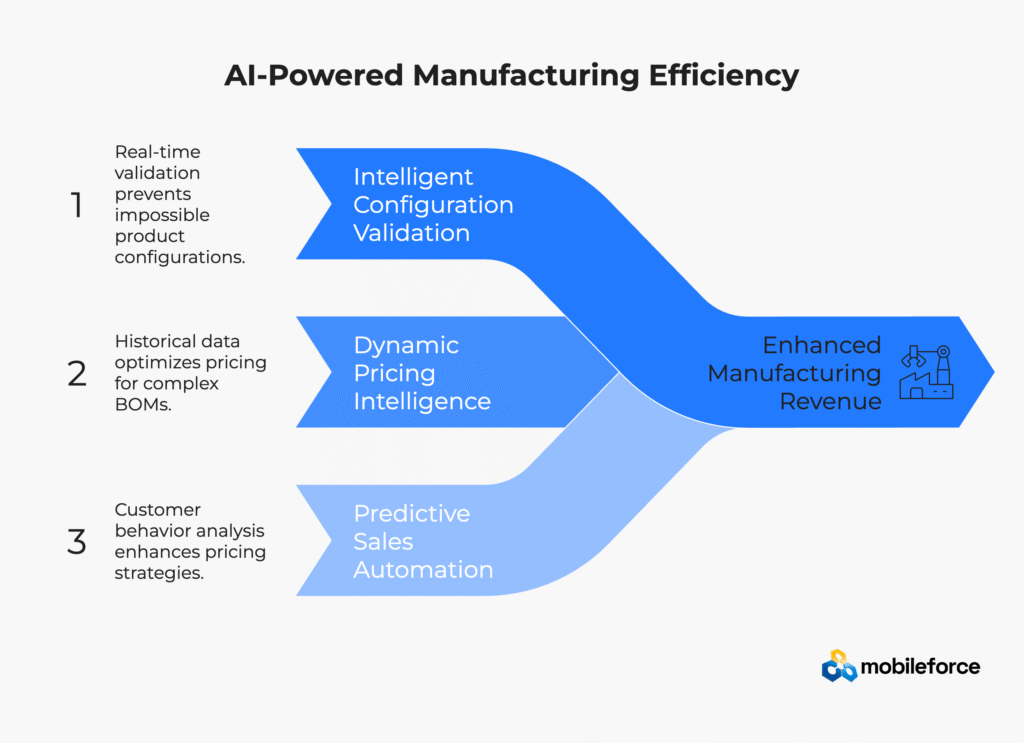
AI-powered cpq software uses machine learning algorithms to provide intelligent pricing optimization, configuration validation, and sales automation recommendations based on historical data patterns, manufacturing constraints, and revenue operations analytics.
Modern manufacturing cpq platforms need intelligent guidance beyond basic sales automation. Evaluate AI capabilities for quote management systems:
Manufacturing-Specific AI Intelligence Comparison
AI Capability | Generic CPQ Automation | Manufacturing-Specific AI Intelligence | Revenue Operations Impact |
Configuration Validation | Basic rules checking after creation | Real-time constraint solving during build | Prevents 85% of configuration errors, saves 2-3 hours per complex quote |
Pricing Optimization | Static price rules application | Dynamic pricing based on BOMs, capacity, inventory | 15-25% margin improvement through intelligent pricing recommendations |
Product Recommendations | Generic upselling suggestions | Engineering-informed alternatives and service bundles | 35% increase in average deal size through relevant cross-selling |
Error Prevention | Flags errors after quote generation | Prevents errors during configuration process | Eliminates 90% of quote rework, improves customer experience |
Historical Learning | Basic reporting on quote patterns | Learns from manufacturing-specific pricing decisions | Continuous improvement in pricing accuracy and margin optimization |
Integration Intelligence | Siloed within cpq system | Connects quote, service, and parts data for insights | Complete customer lifecycle visibility for revenue operations |
Advanced AI Features for Manufacturing:
The difference between generic automation and manufacturing-specific AI becomes critical during actual revenue operations. Generic cpq platforms often apply basic rules that flag conflicts after quotes are built, requiring costly rework. Manufacturing-focused AI like Mobileforce’s AskCPQ AI agent provides intelligent guidance within the workflow – eliminating errors before they reach customers rather than flagging them after creation like traditional validation approaches.
Want to see AI-powered cpq intelligence in action? Experience intelligent configuration designed for manufacturing complexity.
What is no-code CPQ configuration?
No-code cpq configuration enables business users to create, modify, and manage product rules, pricing optimization logic, and approval workflows through visual interfaces without requiring developer resources or technical programming skills.
Manufacturing agility depends on business users controlling quote management systems without IT bottlenecks. Evaluate cpq platforms on business empowerment capabilities:
No-Code Business Control Assessment:
Business Impact of No-Code Capabilities:
This capability represents a fundamental architectural difference between enterprise cpq solutions and manufacturing-focused platforms. Platforms like Mobileforce’s no-code configuration approach enable manufacturing teams to respond rapidly to market changes, while enterprise solutions often require developer resources for basic modifications, creating bottlenecks that slow business response times.
Manufacturing operates across multiple systems requiring seamless sales automation connectivity. Evaluate cpq vendors on integration capabilities that support unified revenue operations:
Critical Integration Assessment for Manufacturing CPQ:
System Category | Integration Requirements | Success Indicators | Business Impact |
CRM Integration | Bidirectional sync, real-time updates | 40% improvement in sales pipeline accuracy | |
ERP Connectivity | Order handoff, inventory validation, fulfillment automation | Automated data flow, error handling | 60% reduction in order processing time |
Field Service Management | Work order creation, parts management, service scheduling | Mobile quoting, offline capability | 25% increase in field service revenue |
Business Intelligence | Revenue operations analytics, pricing optimization insights | Real-time dashboards, predictive analytics | 20% improvement in margin optimization |

Integration Red Flags to Avoid:
Warning Sign | Enterprise Platform Risk | Manufacturing-Focused Advantage |
“We integrate with everything” claims | Generic APIs requiring extensive customization | Native connectors for manufacturing systems |
Middleware requirements for basic functions | Additional integration costs and complexity | Direct system connectivity |
Manual data transfer processes | Error-prone operations, lost productivity |
Manufacturing CPQ Vendor Risk Assessment Framework
Beyond sales automation functionality, evaluate these critical success factors for cpq software implementation:
□ Manufacturing Industry Expertise: Does cpq vendor understand complex product environments, engineering workflows, and field service operations?
□ Implementation Methodology: Do they provide structured change management specifically for manufacturing teams and revenue operations?
□ Customer Reference Quality: Can they provide references from similar manufacturing complexity, product types, and quote management system requirements?
□ Platform Scalability: Will quote management system architecture support growth without major reinvestment or performance degradation?
□ Support Structure: Do they understand manufacturing urgency, uptime requirements, seasonal demands, and production scheduling constraints?
□ Financial Stability: Is the cpq vendor financially stable with sustainable business model and ongoing product development investment?
Need to validate vendor capabilities and reduce implementation risk? Schedule a comprehensive vendor assessment to review your specific manufacturing requirements.
What is CPQ total cost of ownership?
CPQ total cost of ownership includes all direct and indirect costs associated with cpq software selection, implementation, customization, training, maintenance, and ongoing operations over the platform’s useful life, typically 3-5 years for manufacturing organizations.
Enterprise cpq platforms often appear less expensive during initial cpq software evaluation until hidden costs emerge:
Hidden Cost Categories:
Manufacturing-focused cpq platforms may have higher upfront software licensing costs but deliver better ROI through faster implementation, minimal customization requirements, and business user empowerment reducing ongoing IT dependencies.
Implementation Timeline & Cost Reality Framework
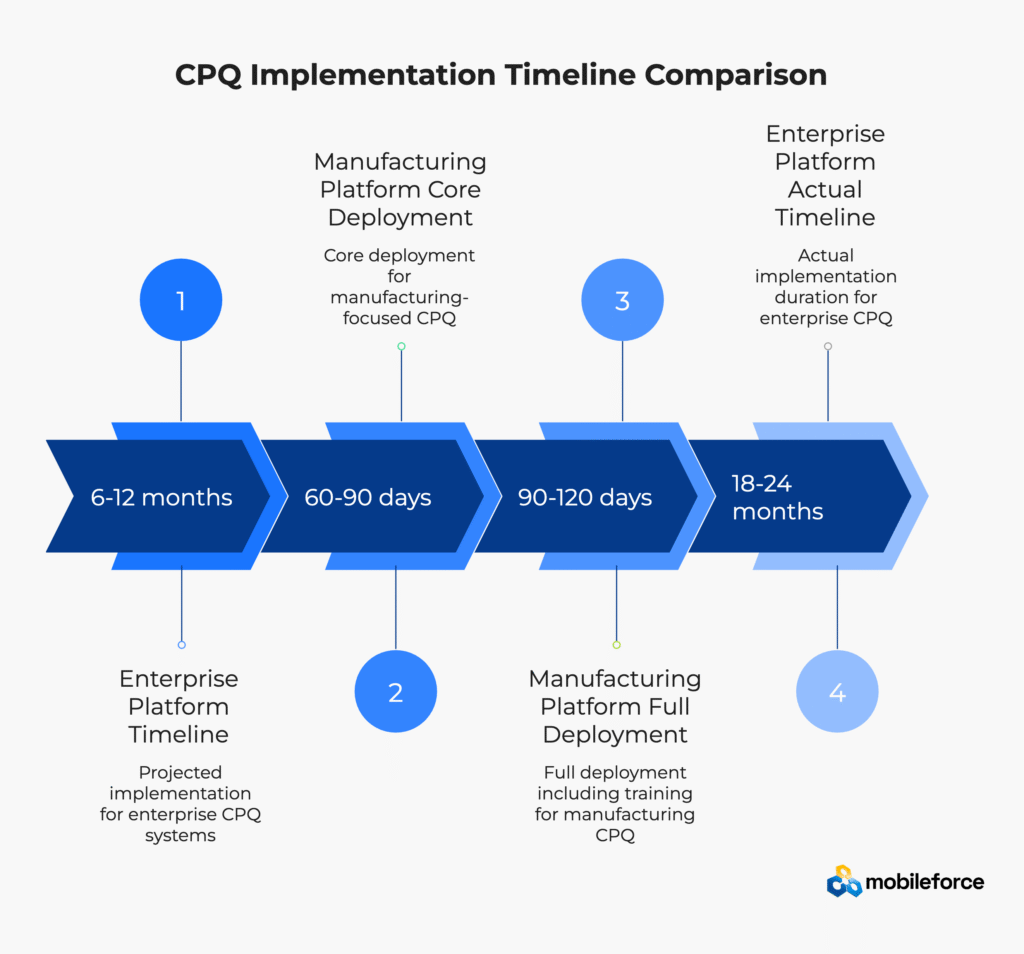
Implementation Factor | Enterprise Platform Approach | Manufacturing-Focused Platform | Cost & Risk Impact |
Initial Timeline | 6-12 months projected | 60-90 days for core deployment | 50-75% faster time-to-value |
Actual Timeline | Often extends to 18-24 months | 90-120 days including training | Reduced opportunity cost |
Customization Costs | 50-200% of license cost | Minimal – native functionality | Significant TCO reduction |
Developer Resources | Required for basic configuration | Business users control changes | Lower ongoing costs |
Integration Complexity | Custom middleware often needed | Native connectors available | Reduced technical debt |
User Training | Extensive due to complexity | Intuitive mobile-first design | Faster adoption rates |
Ongoing Maintenance | IT-dependent updates | Business user self-service | Operational efficiency |
Risk of Failure | Higher due to customization | Lower due to native fit | Project success probability |
The hidden cost trap catches many manufacturing companies off guard during cpq vendor selection. Enterprise platforms appear attractive during initial budgeting, but customization requirements for manufacturing complexity often double or triple total costs. Additionally, developer dependencies create ongoing operational costs that manufacturing-focused platforms eliminate through business user empowerment. When building your business case, factor in the true cost of enterprise platform customization versus the premium for manufacturing-specific native functionality.
Want to understand the real total cost of ownership for your cpq implementation? Get a detailed TCO analysis comparing enterprise vs. manufacturing-focused approaches.
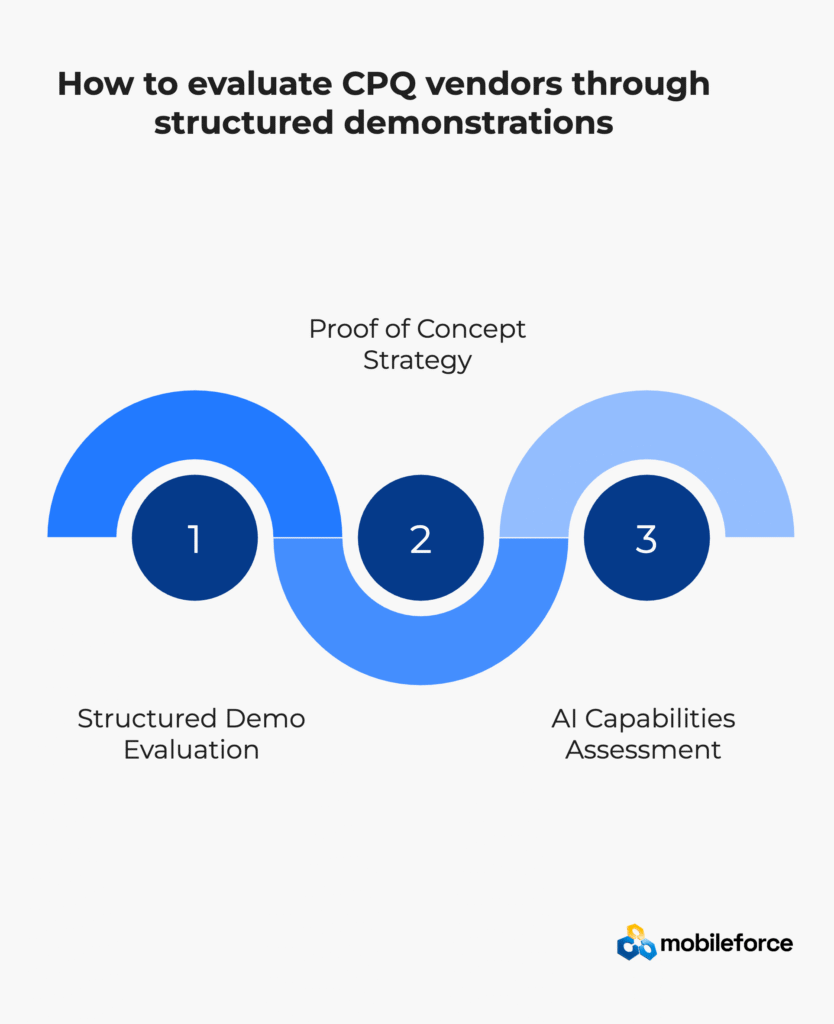
How to evaluate CPQ vendors through structured demonstrations:
Structured Demo Evaluation Prepare realistic scenarios reflecting your product complexity, pricing challenges, and approval requirements. Generic demonstrations provide limited insight – request demos using actual product data when possible.
Proof of Concept Strategy Focus POC scope on highest-risk capabilities: complex product configuration, integration performance, and mobile workflow efficiency. Establish clear success criteria before launch and measure both quantitative outcomes and user feedback.
AI Capabilities Assessment Modern cpq platforms provide intelligent guidance beyond basic automation. Evaluate AI features like:
Mobileforce’s AskCPQ AI agent demonstrates these capabilities by providing real-time pricing guidance and configuration validation within the quoting workflow – eliminating common errors before they reach customers.
Weighted Scoring Model
Evaluation Criteria | Weight | Key Questions |
Functional Fit | 25% | Does platform handle our product complexity without customization? |
Integration Capabilities | 20% | Can we achieve seamless data flow across existing systems? |
Vendor Stability | 15% | Is vendor financially stable with clear product roadmap? |
Implementation Support | 15% | Does vendor provide proven methodology and change management? |
Total Cost of Ownership | 15% | What are true costs including implementation and maintenance? |
User Experience | 10% | Will our sales teams adopt and use effectively? |
Implementation Readiness Assessment Evaluate vendor implementation methodology, timeline commitments, and post-launch support. Organizations achieving best results choose vendors offering structured change management, not just technology deployment.
Success Metrics Framework Define measurable outcomes before vendor selection:
Ready to see how a systematic evaluation reveals Mobileforce’s advantages? Schedule your personalized demo to experience our unified quote-to-cash platform.
The Enterprise Platform Trap Magic Quadrant Leaders excel at horizontal scalability and general business functionality, but manufacturing success requires fundamentally different capabilities. Enterprise platforms often:
Hidden Costs of “Best-in-Class” Selection Organizations choosing Magic Quadrant Leaders for manufacturing often discover:
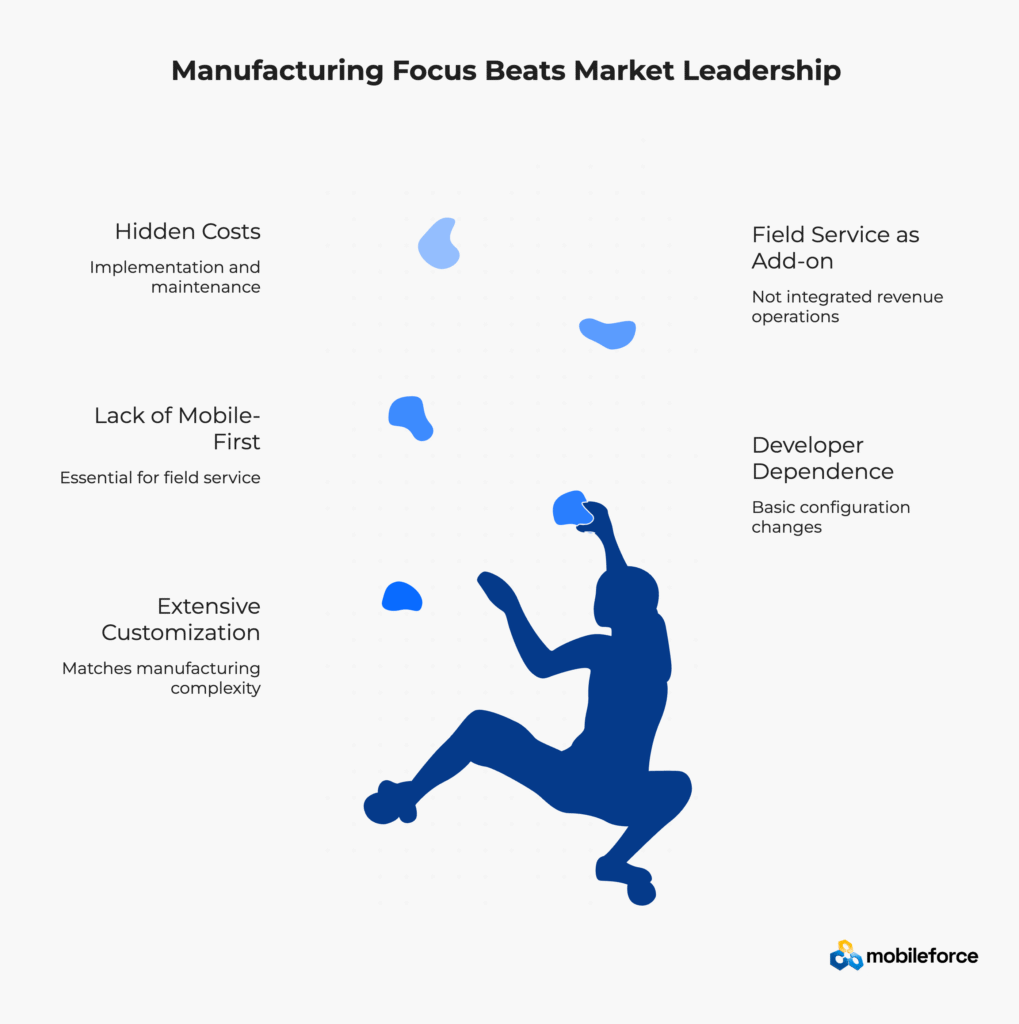
When Specialized Platforms Deliver Superior ROI:
Unified Quote-to-Cash-to-Service Operations Unlike enterprise CPQ platforms that require separate field service solutions, Mobileforce delivers integrated quote-to-cash-to-service operations from a single platform. This eliminates data silos and provides complete visibility across the customer lifecycle.
True Mobile-First Architecture Field service organizations need offline quoting capabilities and mobile-optimized workflows. Mobileforce’s mobile-first design enables accurate quoting regardless of connectivity – a capability that enterprise platforms often struggle to deliver effectively.
AI-Powered Manufacturing Intelligence AskCPQ AI agent provides real-time pricing guidance and configuration validation specifically designed for manufacturing complexity. This goes beyond basic automation to deliver intelligent recommendations that improve margins and reduce errors.
No-Code Business Empowerment Manufacturing teams need agility to respond to market changes. Mobileforce’s no-code configuration enables business users to modify product rules, pricing logic, and workflows without IT dependencies – reducing time-to-market for new products and pricing strategies.
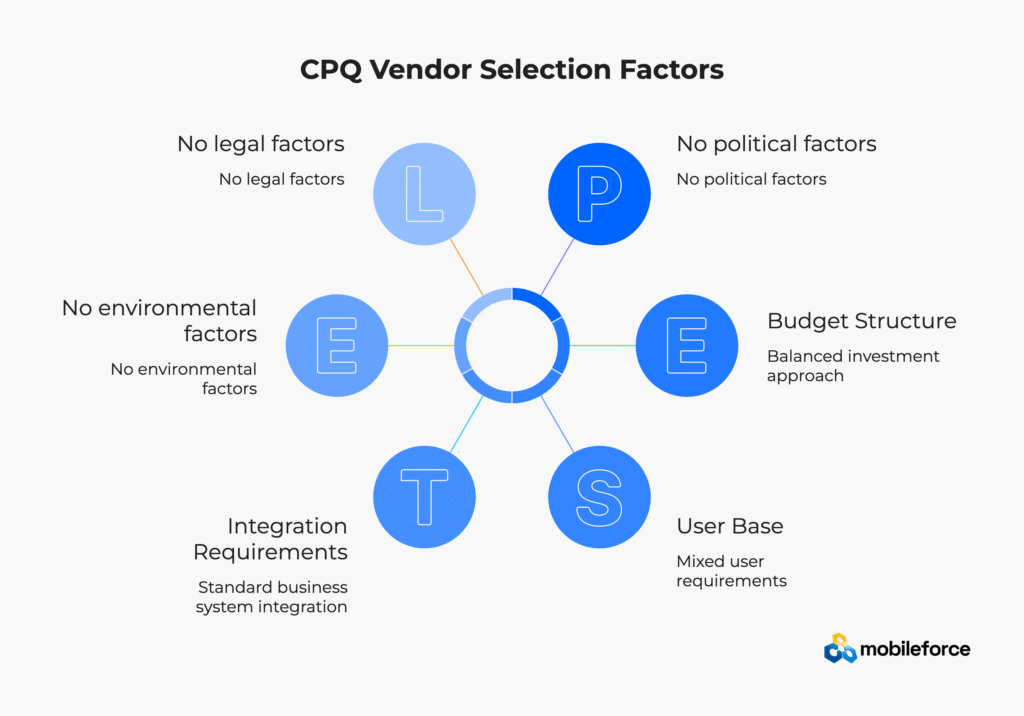
Vendor Type Selection Decision Matrix
Your Business Context | Enterprise Platform Choice | Manufacturing-Focused Choice | Hybrid Approach |
Product Complexity | Simple configurations, basic BOMs | Complex engineer-to-order, multi-level BOMs | Moderate complexity with growth plans |
Field Service Importance | Minimal field operations | Core revenue driver, mobile teams | Growing field service component |
Implementation Urgency | 12+ months acceptable | Need results in 90 days | Phased approach over 6 months |
IT Resources Available | Dedicated development team | Limited IT, need business user control | Mixed – some technical capability |
Integration Requirements | Complex enterprise architecture | CRM, ERP, field service focused | Standard business system integration |
Budget Structure | Large upfront, predictable ongoing | Moderate upfront, lower TCO | Balanced investment approach |
Customization Tolerance | Comfortable with extensive customization | Need native functionality | Limited customization acceptable |
User Base | Primarily inside sales | Field service + inside sales | Mixed user requirements |
Growth Plans | Horizontal expansion across industries | Vertical growth within manufacturing | Mixed growth strategy |
Choose Manufacturing-Specific Platforms When:
Consider Enterprise Platforms When:
Commentary: This matrix helps clarify when manufacturing specialization delivers better outcomes than enterprise scale. Many buyers assume Magic Quadrant Leaders are automatically the right choice, but manufacturing success often requires capabilities that enterprise platforms accommodate through expensive customization. Use this framework during stakeholder alignment to build consensus around platform selection criteria that match your operational reality.
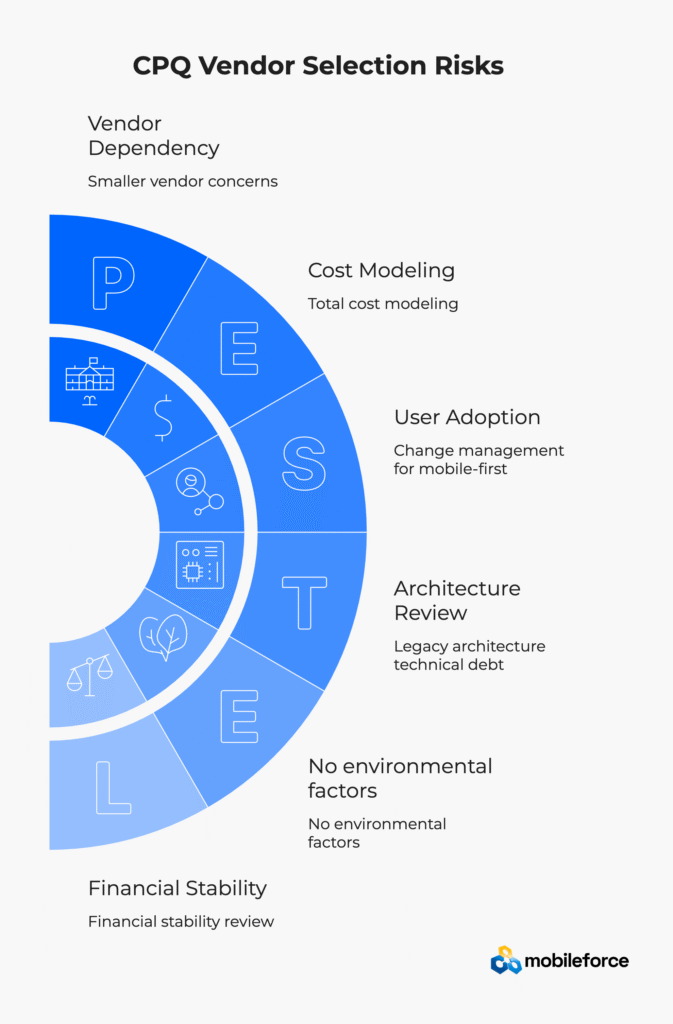
Risk Assessment and Mitigation Framework
Risk Category | Enterprise Platform Risks | Manufacturing-Focused Platform Risks | Mitigation Strategies |
Implementation Risk | Customization complexity extends timeline | Limited enterprise features may require workarounds | Detailed requirements validation, phased deployment |
Integration Risk | Multiple systems require complex middleware | Fewer pre-built enterprise connectors | API assessment, integration testing during POC |
Scalability Risk | Over-engineered for current needs | May need enhancement for massive scale | Growth planning, vendor roadmap alignment |
Vendor Risk | Large vendor may not prioritize your account | Smaller vendor dependency concerns | Financial stability review, reference validation |
User Adoption Risk | Complex interface requires extensive training | Change management for mobile-first workflows | User experience evaluation, pilot program |
Cost Risk | Hidden customization and maintenance costs | Higher upfront investment | Total cost modeling, ROI validation |
Technology Risk | Legacy architecture technical debt | Newer platform maturity concerns | Architecture review, technical due diligence |
Business Risk | Generic solution may not deliver competitive advantage | Industry-specific limitations for edge cases | Competitive analysis, differentiation validation |
Organizations Achieving Best Manufacturing CPQ Outcomes:
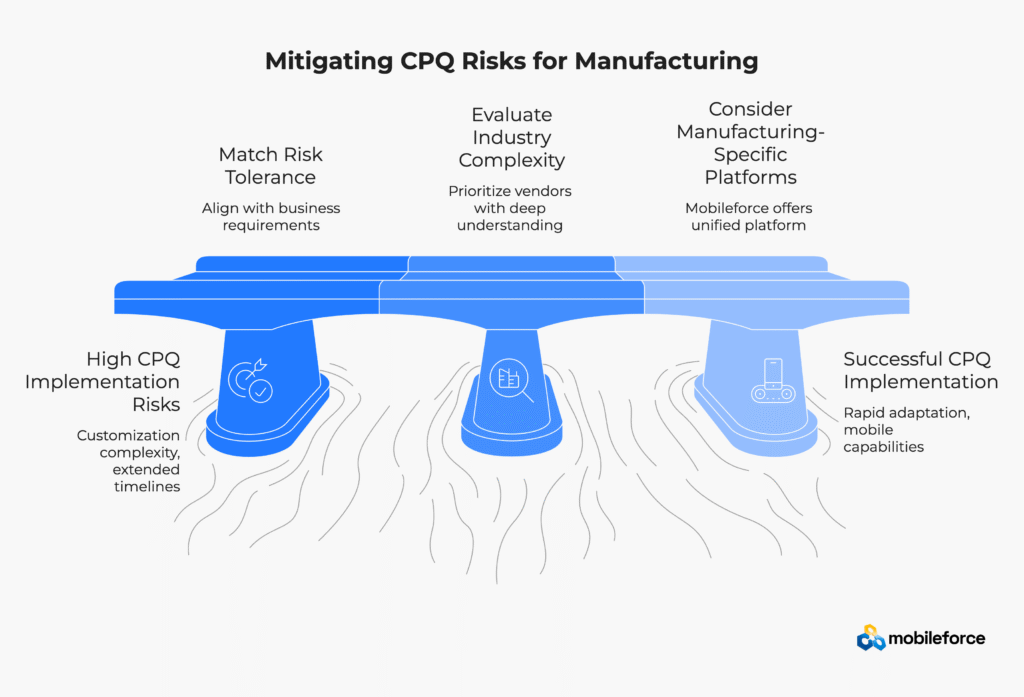
Commentary: Risk mitigation starts during vendor selection, not implementation. Enterprise platforms carry customization and complexity risks, while manufacturing-focused platforms carry scale and enterprise integration risks. The key is matching risk tolerance to business requirements. Manufacturing companies often find that industry-specific risks (like needing additional enterprise features) are easier to manage than implementation risks (like extensive customization and extended timelines). Use this framework to build contingency plans for your chosen approach.
The most successful manufacturing CPQ implementations often come from vendors who understand industry complexity deeply rather than those serving broad horizontal markets. While enterprise platforms excel in many contexts, manufacturing-specific platforms like Mobileforce frequently deliver superior outcomes for complex product environments requiring mobile field capabilities and rapid business adaptation.
Evaluate whether Mobileforce’s manufacturing-first approach aligns with your operational requirements and strategic objectives. Schedule your assessment demo to see our unified platform designed specifically for manufacturing excellence.
Use these targeted questions to validate capabilities that matter most for manufacturing success:
Manufacturing-Specific Capability Validation:
Revenue Operations Integration:
Business Agility Assessment:
Implementation and Support Validation:
Competitive Differentiation Questions:
Total Cost Reality Check:
AI and Automation Focus:
Demo Evaluation Scorecard
Use this framework to consistently evaluate vendor demonstrations:
Evaluation Area | Specific Test | Enterprise Platform Response | Manufacturing Platform Response | Your Score (1-5) |
Complex Configuration | Configure your most complex ETO product | Often requires customization discussion | Native configuration workflow | ___/5 |
Mobile Field Scenario | Quote complex product offline, sync later | May struggle or require workarounds | Seamless offline-to-sync workflow | ___/5 |
Business User Control | Modify product rule without developer | Technical discussion about customization | Business user demonstrates change | ___/5 |
Integration Flow | Show real-time CRM/ERP data sync | Generic demo data or future capability | Live integration demonstration | ___/5 |
AI Intelligence | Demonstrate pricing optimization for complex BOM | Basic rules or generic recommendations | Manufacturing-specific intelligent guidance | ___/5 |
Field Service Connection | Create work order from quote | Separate platform or manual process | Native quote-to-service workflow | ___/5 |
Commentary: Structured demo evaluation prevents vendors from avoiding their weak areas through generic presentations. Manufacturing-focused platforms should excel in complex configuration, mobile workflows, and field service integration, while enterprise platforms may compensate with broader feature sets. Score each area honestly – a platform that scores poorly in critical areas for your business will likely disappoint during implementation.
Ready to validate Mobileforce’s manufacturing-first advantages through detailed evaluation? Schedule your comprehensive demo to see our unified platform tackle your specific requirements.
How important are analyst reports like Gartner’s Magic Quadrant when selecting CPQ vendors? Analyst reports provide valuable market overview but focus on horizontal capabilities across all industries. For manufacturing companies, industry-specific expertise often matters more than Magic Quadrant positioning. Many successful manufacturing cpq implementations come from specialized vendors who understand complex product environments better than enterprise platforms serving broad markets.
Should I prioritize Magic Quadrant Leaders over manufacturing-focused platforms? Magic Quadrant Leaders excel at enterprise scale and horizontal functionality, but often require extensive customization for manufacturing complexity. Specialized platforms like Mobileforce’s manufacturing-focused approach deliver native capabilities (mobile field quoting, complex BOMs, service integration) that enterprise solutions accommodate through expensive customization.
What’s the difference between enterprise CPQ and manufacturing-specific platforms? Enterprise CPQ handles generic sales processes but requires significant customization for manufacturing requirements like engineering integration, field service workflows, and complex product configuration. Manufacturing-specific platforms provide these capabilities natively, reducing implementation risk, timeline, and total cost of ownership.
How do I evaluate integration capabilities for manufacturing environments? Focus on native connectivity rather than “we integrate with everything” claims. Manufacturing requires seamless CRM, ERP, and field service integration. Evaluate API quality, pre-built connectors, and proven integration examples with similar manufacturing complexity. Poor integration often emerges as the biggest implementation challenge.
What are the biggest red flags during manufacturing CPQ vendor evaluation? Warning signs include vendors requiring extensive customization for basic manufacturing functionality, lack of true mobile-first architecture, developer dependence for configuration changes, and implementation partners without manufacturing industry experience. Also avoid vendors with limited field service experience if that’s critical to your business model.
How important is mobile functionality for manufacturing CPQ? Mobile capabilities are essential for field service organizations and distributed manufacturing teams. Modern manufacturing competes on service delivery, requiring field quoting and offline functionality. Evaluate true mobile-first design versus responsive web interfaces – the difference becomes critical during actual field deployment.
What implementation approach should I expect from quality manufacturing CPQ vendors? Quality manufacturing-focused vendors provide structured implementation frameworks including manufacturing-specific change management, field user training, and phased deployment strategies. They understand manufacturing uptime requirements and business cycle timing. Organizations achieving best results choose vendors with proven manufacturing methodology, not just technology features.
How do I justify choosing a specialized platform over a “market leader” to executives? Focus on manufacturing-specific ROI: faster implementation due to native functionality, lower total cost through reduced customization, better user adoption via mobile-first design, and superior field service integration. Present case studies from similar manufacturing companies and emphasize reduced risk versus extensive enterprise platform customization.
What’s the real difference between AI features in different CPQ platforms? Generic CPQ platforms often provide basic rules-based validation, while manufacturing-specific platforms like Mobileforce offer AI-powered intelligence designed for complex product environments. Look for AI that understands manufacturing constraints, provides margin optimization for multi-level BOMs, and offers intelligent pricing recommendations based on industry-specific data patterns.
The CPQ vendor selection process for manufacturing companies requires different evaluation criteria than generic software purchases. While analyst reports provide market context, manufacturing success often comes from vendors who understand industry complexity deeply rather than those serving broad horizontal markets.
Ready to experience manufacturing-focused CPQ designed for your operational requirements? Mobileforce’s unified quote-to-cash-to-service platform delivers the industry-specific capabilities, mobile architecture, and AI intelligence that modern manufacturers need to compete effectively.
Schedule your personalized demo to see how manufacturing specialization delivers better outcomes than enterprise platform customization.