
Industry analysis reveals that configure price quote software directly impacts revenue growth for the majority of organizations, making platform selection critical for competitive advantage. When evaluating enterprise cpq solutions, the choice between Epicor CPQ and Mobileforce represents two fundamentally different approaches to revenue operations optimization.
TL;DR: Epicor CPQ delivers manufacturing-focused visual configuration with deep ERP integration, while Mobileforce provides a complete revenue operations platform combining CPQ, field service, and CRM workflows with rapid deployment and no-code administration.
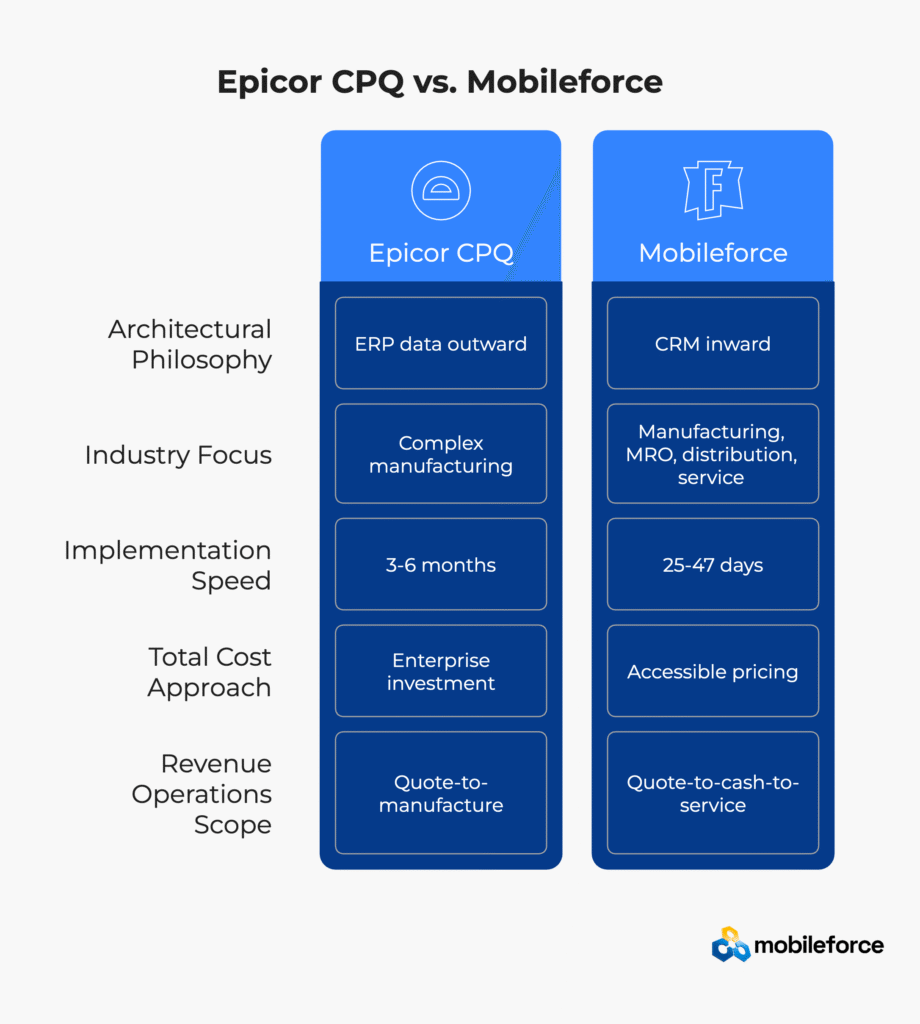
The choice between Epicor CPQ and Mobileforce reflects a fundamental strategic decision: Do you need manufacturing-optimized quoting integrated with ERP systems, or complete revenue operations that unify customer relationships from first quote through ongoing service delivery?
Epicor’s ERP-Embedded Approach: Epicor CPQ emerged from manufacturing ERP environments, prioritizing deep integration with production systems, inventory management, and engineering workflows. This sales quoting software approach excels when your primary challenge involves complex product configuration requiring CAD automation, bill of materials generation, and seamless handoffs to manufacturing teams.
However, this ERP dependency creates several operational challenges. User reviews consistently mention system performance issues including screen freezing, glitches during heavy usage, and slow response times that impact sales productivity. The platform’s complexity often requires extensive technical training and ongoing IT support for basic workflow modifications.
Implementation and Maintenance Burden: Epicor CPQ implementations frequently exceed planned timelines due to integration complexity and custom development requirements. Organizations report needing dedicated technical resources for system administration, with business users unable to modify workflows independently. This technical dependency increases long-term operational costs and reduces organizational agility when business requirements change.
Industry research consistently shows that traditional CPQ platform implementations frequently face timeline delays, with manufacturing-focused solutions experiencing higher complexity rates than cloud-native alternatives due to ERP integration requirements.
Mobileforce’s Standalone Revenue Operations: Mobileforce built a unified platform that connects quoting, sales, and field service without depending on existing ERP infrastructure. This independence enables comprehensive revenue optimization across customer lifecycles, from initial quotes through ongoing service relationships, particularly valuable for MRO companies, distributors, and service-intensive businesses.
The architectural difference impacts everything from implementation complexity to long-term operational flexibility. Companies with established manufacturing ERP systems benefit from Epicor’s deep integration, while organizations prioritizing customer relationship optimization and service delivery coordination find Mobileforce’s unified approach more strategic.
Ready to explore unified revenue operations that grow with your business? Schedule a Mobileforce demonstration to see how quote-to-service integration accelerates your revenue cycle.
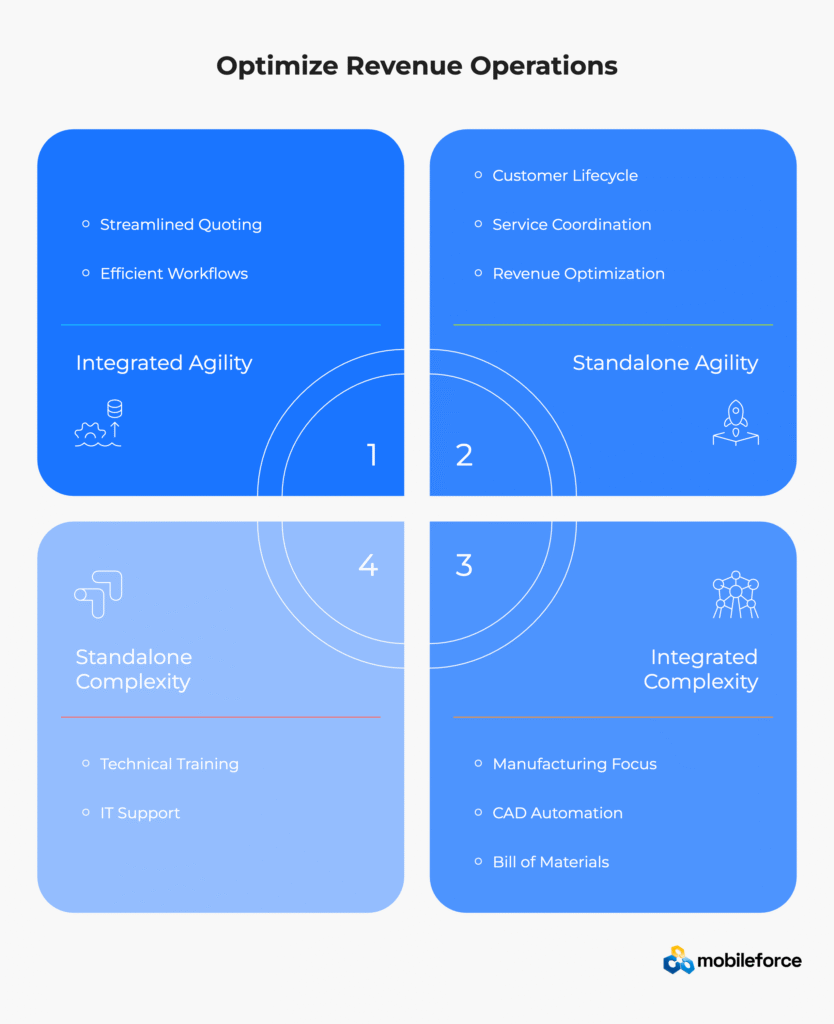
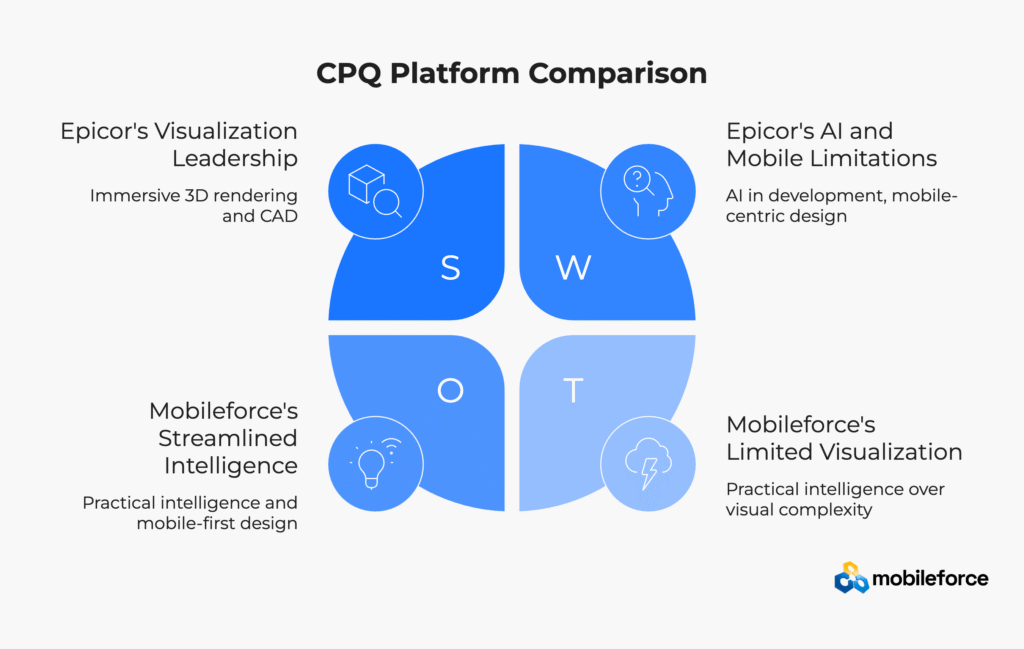
Epicor’s Manufacturing Visualization Strength: Epicor CPQ has established market leadership in complex product configuration, offering gaming-quality 3D rendering, augmented reality configuration, and virtual reality product experiences. These capabilities excel for companies selling highly customized manufacturing equipment where customers need immersive visualization before committing to significant purchases.
The platform automatically generates CAD drawings, bills of materials, and engineering documentation directly from customer configurations. This seamless integration eliminates traditional handoff delays between sales teams and engineering departments, particularly valuable for engineer-to-order manufacturers dealing with complex product specifications.
Research from Aberdeen Group indicates that companies using visual product configurators achieve 23% faster sales cycles and 17% higher average order values compared to traditional quote management systems.
AI Roadmap vs. Current Reality: While Epicor presents ambitious AI capabilities including natural language processing and generative design, many advanced features remain in development rather than production deployment. Current AI implementations focus primarily on guided selling recommendations, leaving organizations waiting for promised conversational interfaces and autonomous task management capabilities.
Mobile and Accessibility Limitations: Epicor CPQ’s desktop-centric design limits field sales effectiveness and remote team productivity. The platform requires stable internet connectivity for full functionality, creating challenges for organizations with distributed sales teams or field service operations. Complex user interfaces demand extensive training, reducing adoption rates among non-technical sales personnel.
Mobileforce’s Streamlined Intelligence Approach: Mobileforce prioritizes practical intelligence over visual complexity. The AskCPQ AI agent enables sales teams to generate complex quotes using natural language prompts, transforming customer requirements into accurate configurations without technical training. Sales representatives simply describe customer needs in everyday language, and the system interprets these requests into precise product configurations and competitive pricing.
This practical approach extends throughout the platform’s intelligence capabilities. Smart pricing algorithms analyze market conditions, customer history, and competitive data to optimize deal value automatically. The system identifies upselling opportunities and protects profit margins without requiring extensive user training or complex configuration processes.
For MRO companies, distributors, and service organizations, this streamlined intelligence delivers immediate business value without the complexity overhead that manufacturing-focused visualization requires.
Mobile-First Architecture for Field Teams: Mobileforce’s mobile-first design enables field sales and service teams to create quotes, modify configurations, and access customer data from any location. This capability proves essential for companies with distributed sales teams or field service operations requiring on-site quoting capabilities.
The platform’s offline-first architecture ensures quote generation continues even without internet connectivity, automatically synchronizing data when connections restore. This reliability advantage particularly benefits MRO companies and service providers operating in remote locations or facilities with limited connectivity.
|
Feature Category |
Epicor CPQ Status |
Mobileforce Status |
Business Impact |
|
AI & Automation |
|||
|
Natural Language Quoting |
🔄 Development |
✅ Production Ready |
Immediate sales productivity gains |
|
Intelligent Pricing |
⚠️ Basic Rules |
✅ Advanced Analytics |
Better margin protection |
|
Conversational Interface |
🔄 Roadmap |
✅ AskCPQ Available |
Faster user adoption |
|
Mobile & Accessibility |
|||
|
Mobile Quote Generation |
⚠️ Limited |
✅ Full Featured |
Field sales effectiveness |
|
Offline Functionality |
❌ Not Available |
✅ Native Support |
Remote operation capability |
|
User Interface Simplicity |
⚠️ Complex |
✅ Intuitive |
Reduced training needs |
|
Customer Engagement |
|||
|
Customer Portals |
❌ Not Available |
✅ Native Portals |
Self-service efficiency |
|
Self-Service Configuration |
❌ Not Available |
✅ Full Support |
Reduced sales admin burden |
|
Order Tracking |
⚠️ Basic |
✅ Comprehensive |
Enhanced customer experience |
|
Integration & Deployment |
|||
|
No-Code Administration |
❌ IT Required |
✅ Business User |
Operational agility |
|
Rapid Implementation |
❌ 3-6 Months |
✅ 25-47 Days |
Faster time to value |
|
Field Service Integration |
❌ Separate Systems |
✅ Native Unity |
Unified workflows |
Legend: ✅ Full Production / ⚠️ Limited/Basic / 🔄 In Development / ❌ Not Available
Strategic Insight: This readiness comparison reveals why organizations choose Mobileforce for immediate business impact, while Epicor appeals to companies willing to invest in complex implementations for future manufacturing capabilities. Consider your timeline for ROI realization when weighing current capabilities against future promises.
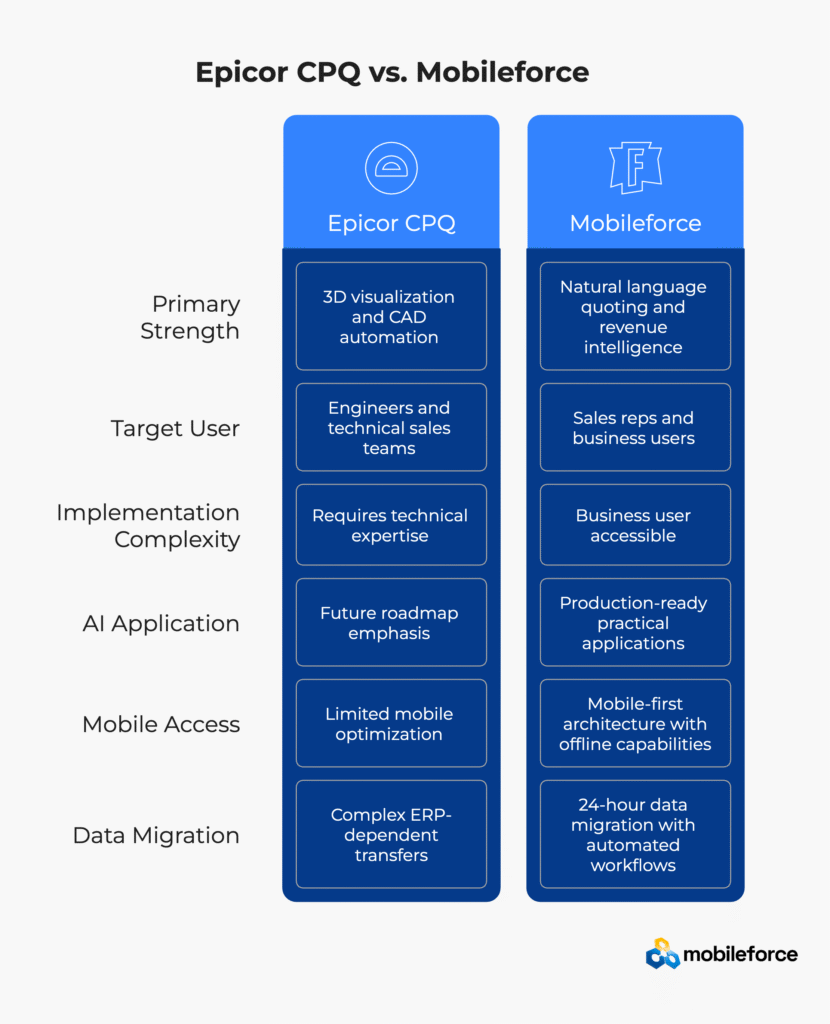
Organizations evaluating enterprise quote software should consider these critical factors:
According to Forrester research, companies using unified revenue operations platforms report 32% faster sales cycle completion and 28% improvement in customer satisfaction scores compared to fragmented quote management systems.
|
Capability Focus |
Epicor CPQ |
Mobileforce |
|
Primary Strength |
3D visualization and CAD automation |
Natural language quoting and revenue intelligence |
|
Target User |
Engineers and technical sales teams |
Sales reps and business users |
|
Implementation Complexity |
Requires technical expertise |
Business user accessible |
|
AI Application |
Future roadmap emphasis |
Production-ready practical applications |
|
Mobile Access |
Limited mobile optimization |
Mobile-first architecture with offline capabilities |
|
Data Migration |
Complex ERP-dependent transfers |
24-hour data migration with automated workflows |
Transform your revenue operations with intelligent automation that works from day one. Start your free Mobileforce trial and experience practical AI applications.
Epicor’s Deep Integration Investment: Epicor CPQ excels at comprehensive ERP integration, offering seamless connectivity with Epicor Kinetic, Oracle, SAP, and other enterprise resource planning systems. This integration provides real-time access to inventory levels, production schedules, and manufacturing capacity data crucial for accurate quote-to-delivery commitments.
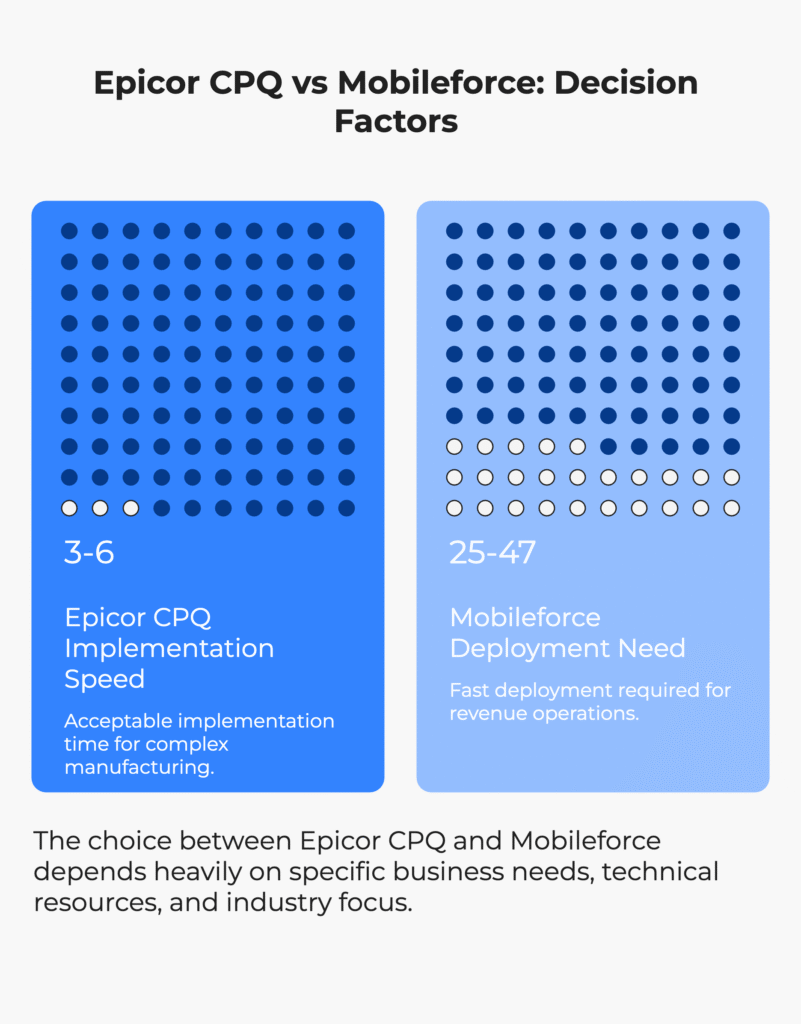
However, this integration depth requires substantial implementation investment with several operational drawbacks. Organizations typically allocate 3-6 months for full deployment, requiring dedicated technical resources and often custom development work. The ongoing maintenance demands specialized expertise for system administration, updates, and workflow modifications.
Cost Structure and Flexibility Limitations: Epicor’s enterprise pricing model creates significant cost barriers for mid-market companies, with per-user fees escalating quickly as organizations scale. The platform’s manufacturing-centric design limits effectiveness for service-based businesses, distributors, and MRO companies requiring flexible revenue operations rather than specialized manufacturing optimization.
User feedback indicates frustration with complex setup processes, extensive training requirements, and dependence on technical specialists for routine modifications. Organizations without dedicated IT resources struggle to maintain and optimize the platform effectively, leading to underutilization of expensive licensing investments.
Industry data from Software Advice shows that 74% of cpq software implementations exceed initial budget projections, with complexity-driven cost overruns averaging 45% above planned investments.
Mobileforce’s Rapid Revenue Operations Deployment: Mobileforce prioritizes broad CRM connectivity and rapid deployment over deep ERP integration. As a HubSpot Platinum Solutions Partner, the platform offers native integrations with leading CRM systems while maintaining unified customer data across sales and service processes.
The key advantage lies in implementation speed and accessibility. Mobileforce guarantees 25-47 day deployments through standardized methodology and no-code configuration capabilities. Business users can modify workflows, pricing rules, and approval processes without technical assistance, reducing long-term operational costs significantly.
This approach particularly benefits MRO companies, distributors, and service organizations where customer relationship optimization and service delivery coordination matter more than deep manufacturing system integration.
|
Implementation Factor |
Epicor CPQ |
Mobileforce |
||||
|
Deployment Timeline |
3-6 months |
25-47 days guaranteed |
||||
|
Technical Resources Required |
Extensive specialist expertise |
Minimal technical support needed |
||||
|
Ongoing Administration |
IT-dependent modifications |
Business user self-service |
||||
|
Total Cost of Ownership |
High upfront, ongoing technical costs |
Lower TCO with faster ROI |
||||
|
Best Fit Industries |
Complex manufacturing, engineer-to-order |
MRO, distribution, service industries |
||||
|
Integration Scenario |
Epicor CPQ Complexity |
Mobileforce Complexity |
Recommended Approach |
|||
|
CRM Integration |
||||||
|
Salesforce |
🟡 Moderate |
✅ Native |
Mobileforce advantage for CRM-centric orgs |
|||
|
HubSpot |
🔴 Complex |
✅ Platinum Partner |
Clear Mobileforce advantage |
|||
|
Microsoft Dynamics |
🟡 Moderate |
✅ Native |
Both viable, Mobileforce faster |
|||
|
ERP Integration |
||||||
|
SAP |
✅ Native Strength |
🟡 API-Based |
Epicor advantage for SAP shops |
|||
|
Oracle |
✅ Native Strength |
🟡 API-Based |
Epicor advantage for Oracle ERP |
|||
|
Epicor Kinetic |
✅ Seamless |
🔴 Complex |
Clear Epicor advantage |
|||
|
NetSuite |
🟡 Moderate |
✅ Streamlined |
Mobileforce easier implementation |
|||
|
Field Service Systems |
||||||
|
ServiceMax |
🔴 Separate Platform |
✅ Native FSM |
Mobileforce unified approach |
|||
|
ServiceNow FSM |
🔴 Complex Integration |
✅ Native FSM |
Mobileforce clear advantage |
|||
|
Custom FSM |
🔴 Development Required |
✅ Built-in Solution |
Mobileforce eliminates need |
|||
|
Customer Portals |
||||||
|
Self-Service Quoting |
❌ Not Available |
✅ Native Portals |
Mobileforce exclusive capability |
|||
|
Order Tracking |
🔴 Custom Development |
✅ Built-in |
Mobileforce advantage |
|||
Legend: ✅ Native/Easy / 🟡 Moderate Effort / 🔴 Complex/Expensive / ❌ Not Available
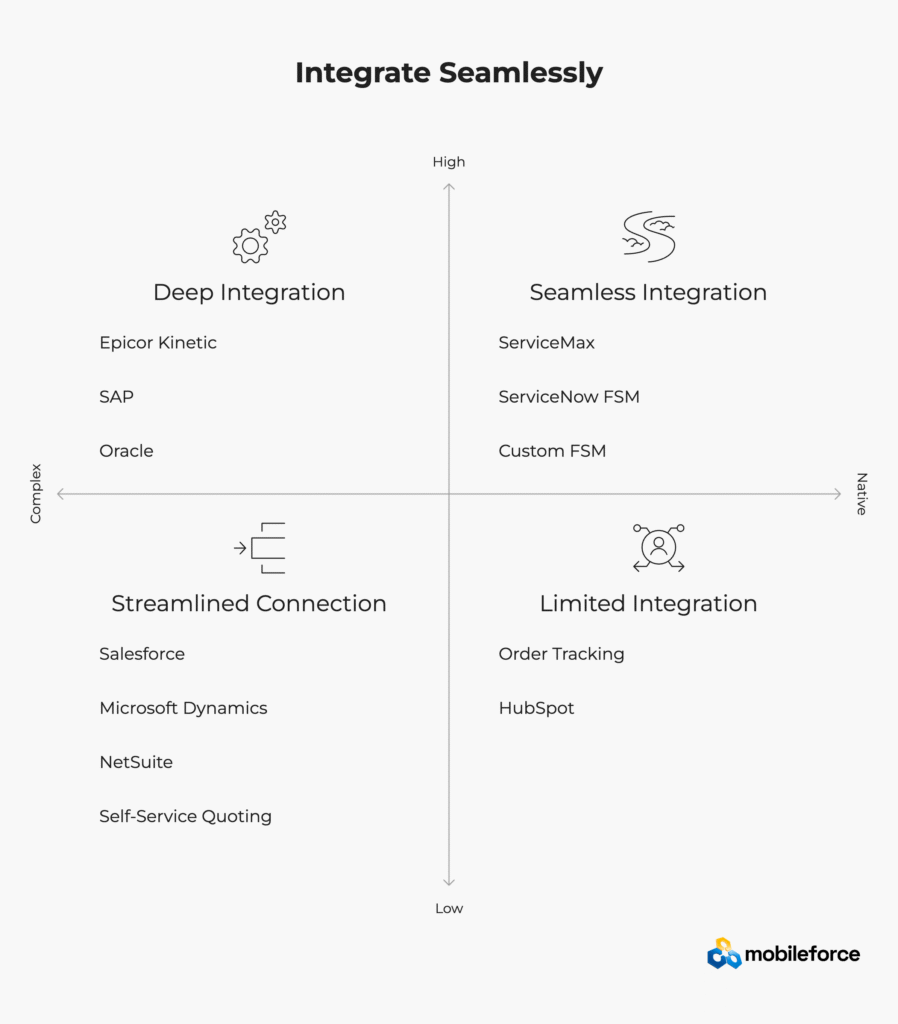
Integration Strategy Guidance: Choose Epicor CPQ when your architecture centers on manufacturing ERP systems and you have technical resources for complex integrations. Choose Mobileforce when CRM relationships, field service, and customer self-service matter more than deep manufacturing system connectivity.
Resource Planning Impact: Epicor integrations typically require dedicated technical specialists and custom development cycles. Mobileforce’s pre-built connectors enable business users to manage most integration scenarios without IT dependency, reducing long-term operational complexity.
Epicor’s Manufacturing Excellence: Epicor CPQ targets companies producing complex, configurable products requiring extensive customization. The platform excels in industrial equipment, machinery, automotive components, and engineered products where visual configuration and manufacturing integration provide clear competitive advantages.
This manufacturing focus influences every platform design decision, from CAD integration capabilities to production workflow automation. Engineer-to-order, configure-to-order, and make-to-order manufacturers find Epicor’s comprehensive manufacturing optimization particularly valuable.
Manufacturing Technology Magazine reports that companies using specialized manufacturing cpq solutions achieve 31% reduction in quote-to-order cycle times and 18% improvement in manufacturing accuracy compared to generic sales automation tools.
Mobileforce’s Cross-Industry Revenue Operations: Mobileforce serves a broader opportunity spanning manufacturing, MRO, distribution, technology services, and field service organizations. The platform’s revenue operations approach appeals to companies prioritizing customer relationship optimization and service delivery integration alongside traditional quote-to-cash processes.
For MRO companies specifically, Mobileforce’s unified platform eliminates the complexity of managing separate CPQ and field service systems. Maintenance contractors, facility service providers, and equipment distributors benefit from seamless workflows connecting initial quotes through ongoing service delivery and customer relationship management.
The cross-industry positioning enables diverse business model support, from equipment manufacturers requiring field service coordination to technology companies offering complex service packages. This versatility supports organizations seeking unified revenue operations rather than specialized manufacturing optimization.
|
Industry/Business Model |
Epicor CPQ Best Fit |
Mobileforce Best Fit |
Why |
|
Complex Manufacturing |
✅ Excellent |
⚠️ Limited |
3D visualization, CAD integration, BOM automation |
|
MRO Companies |
⚠️ Limited |
✅ Excellent |
Field service integration, mobile capabilities, service workflows |
|
Equipment Distributors |
⚠️ Limited |
✅ Excellent |
Multi-vendor catalogs, rapid quoting, customer portals |
|
Engineer-to-Order |
✅ Excellent |
⚠️ Limited |
Custom design workflows, engineering handoffs |
|
Field Service Organizations |
❌ Poor |
✅ Excellent |
Native FSM, mobile-first, offline capabilities |
|
Technology Services |
⚠️ Limited |
✅ Excellent |
Flexible service bundles, subscription billing |
|
Industrial Equipment |
✅ Excellent |
✅ Good |
Both handle well – choice depends on service needs |
|
Facility Management |
❌ Poor |
✅ Excellent |
Service coordination, recurring contracts |
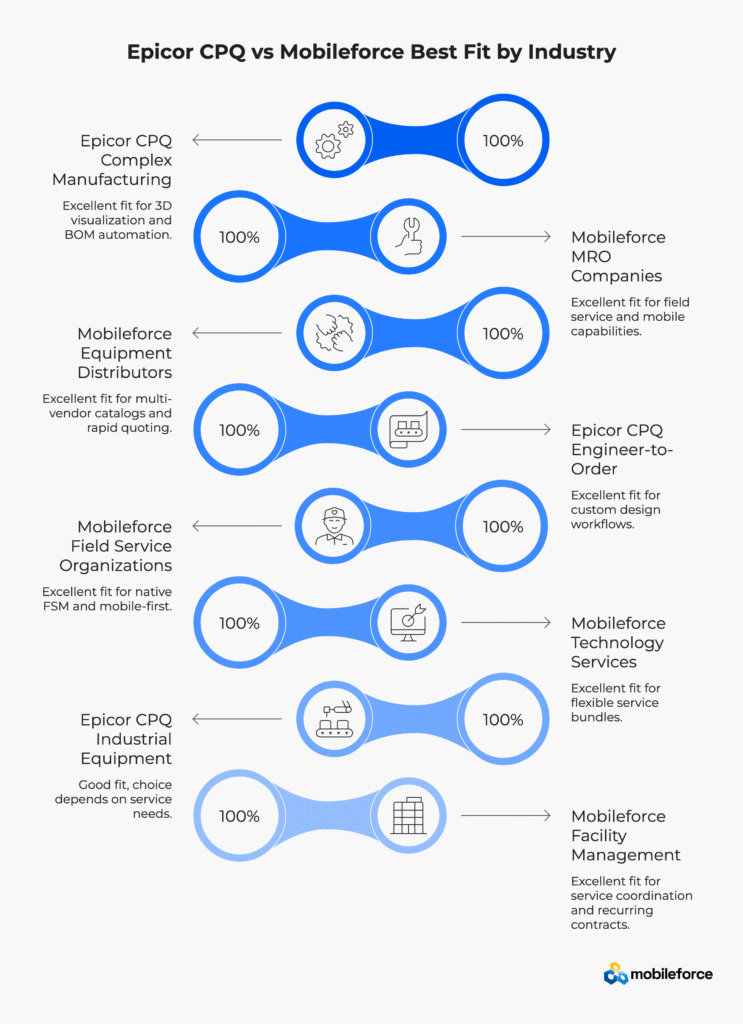
Interpretation Guide: This matrix shows where each platform delivers maximum value. Epicor CPQ dominates in manufacturing scenarios requiring visual configuration and engineering integration. Mobileforce leads in service-oriented industries needing customer lifecycle management and field operations support.
Mobileforce maintains enterprise-grade security with SOC 2 compliance, GDPR adherence, and ISO 22301:2019 business continuity certification. The platform supports multi-currency operations and global deployment scenarios essential for organizations operating across international markets.
The API-first architecture ensures future integration flexibility without requiring platform migration. Organizations can connect additional business systems as needs evolve, maintaining investment protection while scaling operations globally.
According to Gartner research, companies using cloud-native revenue operations platforms experience 43% fewer security incidents and 29% faster compliance audit completion compared to on-premises legacy systems.
Discover how unified revenue operations accelerate growth across diverse industries. Explore Mobileforce’s cross-industry capabilities with a personalized demonstration.
The platform choice fundamentally depends on your primary business challenge and growth strategy. Use this framework to guide your decision:
Choose Epicor CPQ When:
Key Epicor CPQ Limitations to Consider:
|
User Role/Stakeholder |
Epicor CPQ Fit |
Mobileforce Fit |
Key Considerations |
|
Sales Representatives |
🟡 Moderate |
✅ Excellent |
Mobileforce: intuitive interface, mobile access, natural language |
|
Sales Engineers |
✅ Excellent |
🟡 Good |
Epicor: advanced visualization, CAD integration |
|
Field Service Technicians |
❌ Poor |
✅ Excellent |
Mobileforce: mobile-first, offline capabilities, service workflows |
|
IT Administrators |
✅ Excellent |
🟡 Moderate |
Epicor: deep technical control; Mobileforce: reduced IT burden |
|
Business Users/Managers |
🟡 Moderate |
✅ Excellent |
Mobileforce: no-code administration, self-service modifications |
|
Engineering Teams |
✅ Excellent |
⚠️ Limited |
Epicor: CAD automation, BOM generation, design handoffs |
|
Customer Service |
⚠️ Limited |
✅ Excellent |
Mobileforce: unified customer view, service integration |
|
Finance/Pricing Teams |
🟡 Moderate |
✅ Excellent |
Mobileforce: dynamic pricing, margin protection, analytics |
|
Executive Leadership |
🟡 Moderate |
✅ Excellent |
Mobileforce: faster ROI, unified operations, predictable costs |
|
Customers (External) |
❌ No Access |
✅ Excellent |
Mobileforce: self-service portals, order tracking |
Legend: ✅ Excellent Fit / 🟡 Moderate Fit / ⚠️ Limited Capability / ❌ Poor/No Support
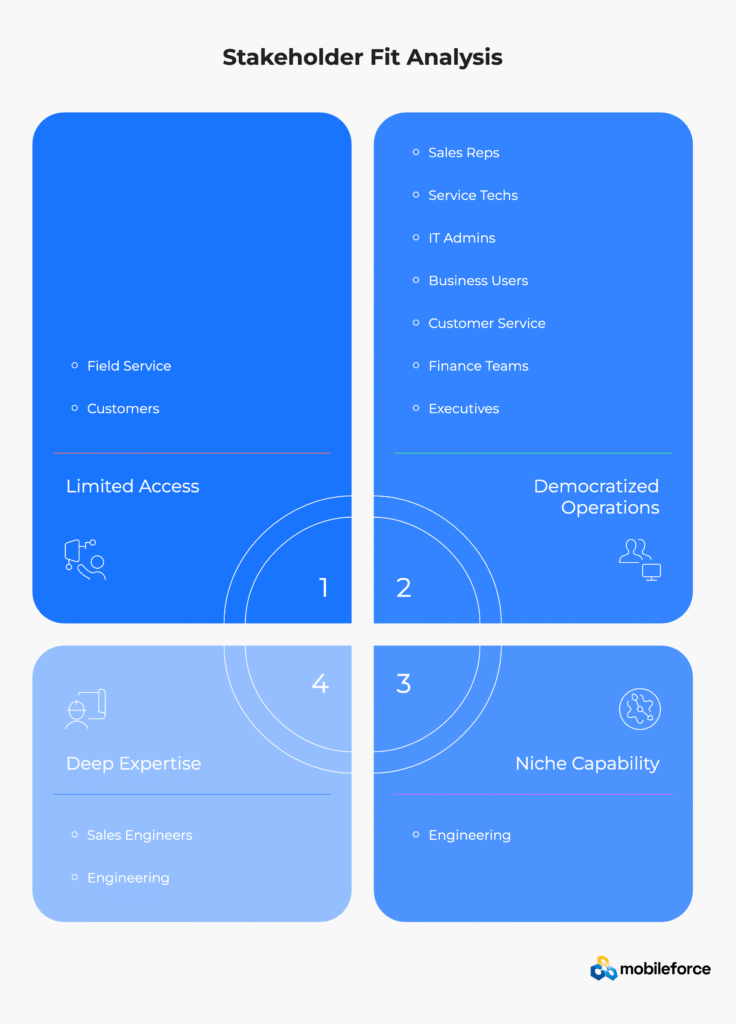
Stakeholder Alignment Strategy: This persona analysis reveals fundamental philosophical differences. Epicor CPQ serves technical teams requiring specialized capabilities, while Mobileforce democratizes revenue operations across broader organizational stakeholders. Consider which user groups drive your revenue success when making platform decisions.
Choose Mobileforce When:
HubSpot Ecosystem Advantages: As a HubSpot Platinum Solutions Partner, Mobileforce provides unique advantages for organizations leveraging HubSpot’s marketing, sales, and service ecosystem. Native integrations enable seamless data flow between marketing campaigns, sales processes, and service delivery without custom development requirements.
This ecosystem integration particularly benefits growing companies using HubSpot for CRM and marketing automation. Organizations can maintain unified customer data across the entire revenue cycle while leveraging HubSpot’s robust analytics and reporting capabilities alongside Mobileforce’s specialized CPQ and field service functionality.
Research from HubSpot indicates that companies using integrated revenue operations platforms achieve 36% better sales and marketing alignment and 29% faster lead-to-customer conversion rates.
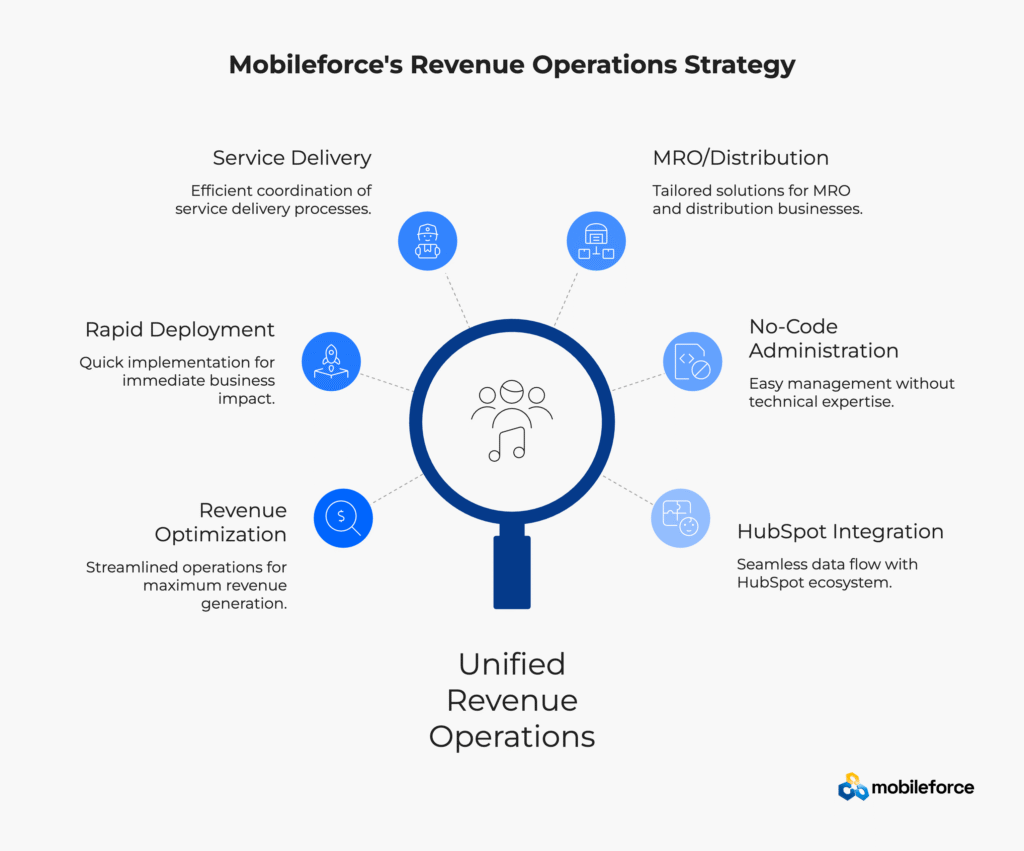
Beyond Traditional CPQ Boundaries: Traditional CPQ platforms focus narrowly on quote generation, leaving organizations to integrate separately with field service, customer management, and ongoing revenue optimization systems. This fragmented approach creates data silos and workflow gaps that slow revenue cycles.
Mobileforce uniquely combines CPQ and field service management within one Revenue Operations Cloud. This integration enables seamless workflows from initial quotes through service delivery and ongoing customer relationships. Sales configurations automatically inform service scheduling, technician dispatch, and inventory management decisions.
Customer Portal and Self-Service Capabilities: Mobileforce includes native customer portals enabling self-service quote requests, order tracking, and service scheduling. Customers can configure products, request modifications, and monitor project progress without requiring sales team intervention. This self-service capability reduces sales administrative burden while improving customer experience.
The platform’s subscription billing integration supports recurring revenue models essential for MRO contracts and ongoing service agreements. Organizations can seamlessly transition from one-time quotes to subscription-based relationships, optimizing lifetime customer value.
Advanced Revenue Intelligence: Unlike traditional CPQ analytics focused on quote metrics, Mobileforce provides comprehensive revenue intelligence spanning the entire customer lifecycle. The platform tracks quote-to-cash conversion rates, service delivery profitability, and customer relationship progression to identify optimization opportunities across revenue operations.
Practical Business Impact: Equipment manufacturers benefit from coordinated quote-to-installation workflows. MRO companies streamline from initial service quotes through ongoing maintenance contracts. Technology service providers connect complex solution quotes with project delivery and support operations.
The unified approach eliminates traditional handoff delays between sales and service teams while maintaining complete visibility into customer relationships and revenue opportunities throughout the entire customer lifecycle.
According to McKinsey research, organizations implementing unified revenue operations report 23% improvement in customer retention rates and 31% increase in cross-selling success compared to companies using disconnected sales automation tools.
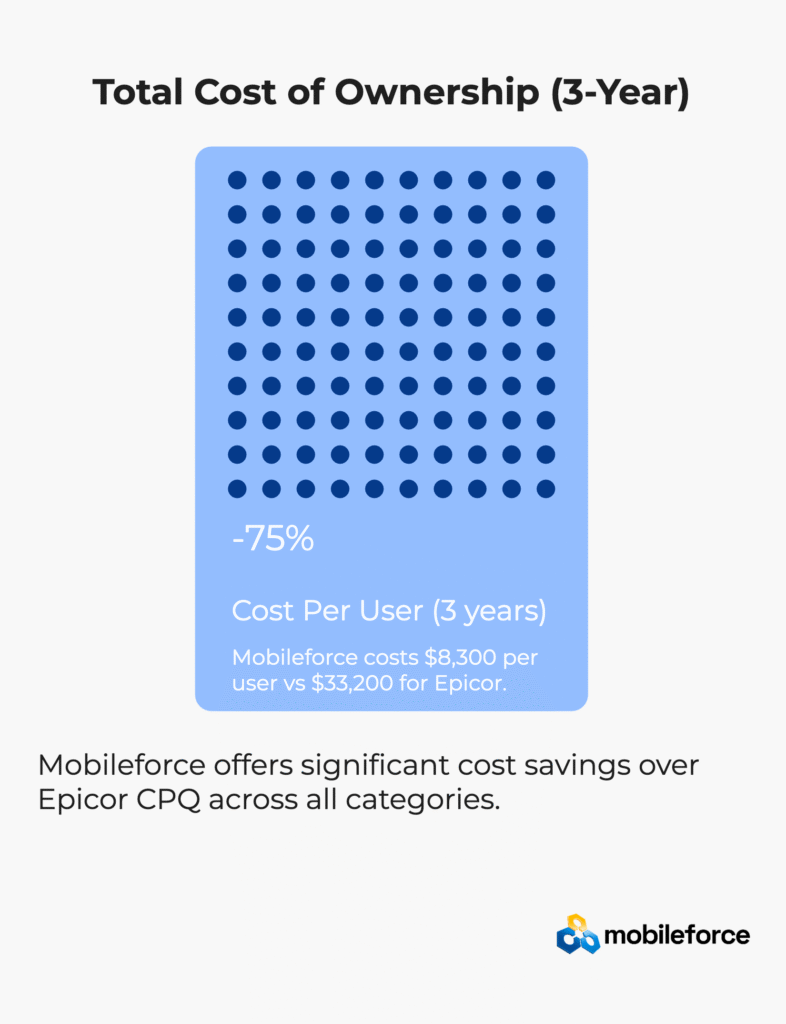
Pricing and ROI Realities: Epicor follows traditional enterprise software pricing with starting costs around $100+ per month per user, escalating based on features and integration complexity. This pricing structure includes substantial implementation services and ongoing technical support necessary for complex platform management.
Mobileforce emphasizes accessible pricing designed for faster ROI realization. The efficient implementation methodology and business user accessibility reduce total cost of ownership while maintaining enterprise-grade capabilities. Organizations typically realize positive ROI within months rather than years due to reduced implementation costs and faster time to value.
Proven Customer Success Metrics: Mobileforce customers report measurable business improvements including 3.2x average ROI within the first year, 75% reduction in quote processing time, and 40% improvement in quote generation speed. These metrics reflect the platform’s focus on practical business outcomes rather than complex feature accumulation.
The no-code configuration approach also reduces change management challenges. Sales teams adopt the intuitive interface quickly without extensive training requirements, eliminating traditional CPQ implementation obstacles that delay user adoption and ROI realization.
|
Total Cost of Ownership (3-Year) |
Epicor CPQ |
Mobileforce |
Difference |
|
Licensing Costs |
|||
|
Software Licensing (10 users) |
$54,000 |
$36,000 |
-$18,000 |
|
Enterprise Features Premium |
$18,000 |
$6,000 |
-$12,000 |
|
Implementation & Setup |
|||
|
Professional Services |
$75,000 |
$15,000 |
-$60,000 |
|
Custom Development |
$45,000 |
$0 |
-$45,000 |
|
Data Migration |
$25,000 |
$3,000 |
-$22,000 |
|
Training & Support |
|||
|
User Training Programs |
$20,000 |
$5,000 |
-$15,000 |
|
Ongoing Technical Support |
$35,000 |
$10,000 |
-$25,000 |
|
System Administration |
$60,000 |
$8,000 |
-$52,000 |
|
Total 3-Year TCO |
$332,000 |
$83,000 |
-$249,000 |
|
Cost Per User (3 years) |
$33,200 |
$8,300 |
75% savings |
Cost Analysis Commentary: This TCO comparison reveals hidden costs in complex CPQ implementations. Epicor’s enterprise licensing appears comparable initially, but implementation complexity, ongoing technical requirements, and system administration costs create a 4x total investment difference.
ROI Timeline Implications: Mobileforce customers typically achieve positive ROI within 6-12 months due to faster implementation and immediate productivity gains. Epicor implementations often require 18-24 months to realize positive ROI due to extended deployment timelines and learning curves.
Risk Factors: Epicor costs can escalate beyond projections when implementations require additional custom development or exceed planned timelines. Mobileforce’s standardized approach provides more predictable cost structures with guaranteed implementation timeframes.
Experience the difference unified revenue operations makes for your business. Start your free Mobileforce trial and see immediate results.
|
Decision Factor |
Choose Epicor CPQ |
Choose Mobileforce |
|
Primary Use Case |
Complex manufacturing visualization |
Revenue operations optimization |
|
Implementation Speed |
3-6 months acceptable |
Need 25-47 day deployment |
|
Technical Resources |
Dedicated IT team available |
Limited technical resources |
|
Industry Focus |
Manufacturing with ERP integration |
MRO, distribution, service companies |
|
Mobile Requirements |
Desktop-centric acceptable |
Mobile-first essential |
|
Customer Interaction |
Internal configuration only |
Customer portals needed |
|
AI Capabilities |
Future roadmap acceptable |
Production-ready AI required |
|
Field Service |
Separate solution acceptable |
Integrated FSM required |
|
Budget Approach |
Enterprise investment ready |
Mid-market ROI focused |
Ready to transform your revenue operations? Schedule a personalized Mobileforce demonstration to see how unified CPQ and field service management can accelerate your business growth and improve customer relationships.
Epicor CPQ focuses on complex manufacturing with advanced 3D visualization and deep ERP integration, while Mobileforce provides unified revenue operations combining CPQ and field service management with no-code configuration and faster implementation.
The core difference lies in architectural approach: Epicor builds from manufacturing ERP systems outward, while Mobileforce starts with revenue operations and customer lifecycle management.
Both serve manufacturing companies but differently. Epicor excels for complex, engineer-to-order manufacturers needing advanced visualization and CAD integration. Mobileforce better serves manufacturers requiring integrated field service and faster deployment timelines.
Manufacturing companies should evaluate based on product complexity, service requirements, and implementation timeline priorities.
Epicor CPQ typically requires 3-6 months for full implementation with technical expertise, while Mobileforce guarantees 25-47 day implementations through no-code configuration and standardized methodology.
Implementation complexity depends on existing system integration requirements, customization needs, and available technical resources.
Epicor CPQ starts around $100/month per user with enterprise-focused pricing, while Mobileforce offers more accessible pricing designed for mid-market growth companies with faster ROI realization.
Total cost of ownership includes licensing, implementation, training, and ongoing maintenance costs that significantly impact long-term investment.
Mobileforce provides broader CRM connectivity as a HubSpot Platinum Partner with native integrations across multiple CRM platforms. Epicor focuses more on ERP integration with selective CRM connectivity.
Organizations using HubSpot, Salesforce, or Microsoft Dynamics should evaluate integration depth and maintenance requirements.
Yes, but differently. Epicor provides gaming-quality 3D visualization and AR/VR capabilities for complex manufacturing. Mobileforce emphasizes rapid configuration with smart recommendations and validation for faster quote generation.
Choose based on visual configuration needs versus speed and ease of use requirements.
Epicor presents ambitious future AI roadmaps including conversational interfaces and generative design. Mobileforce offers practical AI implementations like natural language quote generation through AskCPQ that are available today.
Consider whether you need production-ready AI capabilities now or can wait for future feature development.
Mobileforce provides mobile-first architecture with offline-first capabilities, enabling field sales and service teams to create quotes and access customer data without internet connectivity. Epicor CPQ has limited mobile optimization and typically requires stable internet connections for full functionality.
Field sales teams and remote workers should prioritize mobile capabilities in their evaluation criteria.
Mobileforce includes native customer portals enabling self-service quote requests, order tracking, and service scheduling. Customers can configure products and monitor project progress independently. Epicor focuses primarily on internal user configuration rather than customer-facing self-service portals.
Companies wanting to reduce sales administrative burden should consider self-service portal capabilities.
Mobileforce uniquely integrates CPQ and FSM within one platform, enabling seamless quote-to-service workflows. Epicor requires separate field service solutions or partner integrations for comprehensive service management.
Organizations with field service operations should evaluate unified platforms versus best-of-breed integration approaches.
Epicor CPQ implementations frequently face timeline delays due to integration complexity, custom development requirements, and the need for specialized technical resources. User reviews commonly mention system performance issues including screen freezing and slow response times during heavy usage.
Mobileforce’s standardized implementation methodology and no-code approach reduces these risks, with business users able to configure workflows independently without technical assistance.
Epicor CPQ requires dedicated IT resources for system administration, with business users unable to modify pricing rules or workflows independently. This creates bottlenecks for routine business changes and increases long-term operational costs.
Mobileforce’s no-code administration enables business users to make modifications directly, reducing dependency on technical specialists and improving organizational agility when business requirements change.