
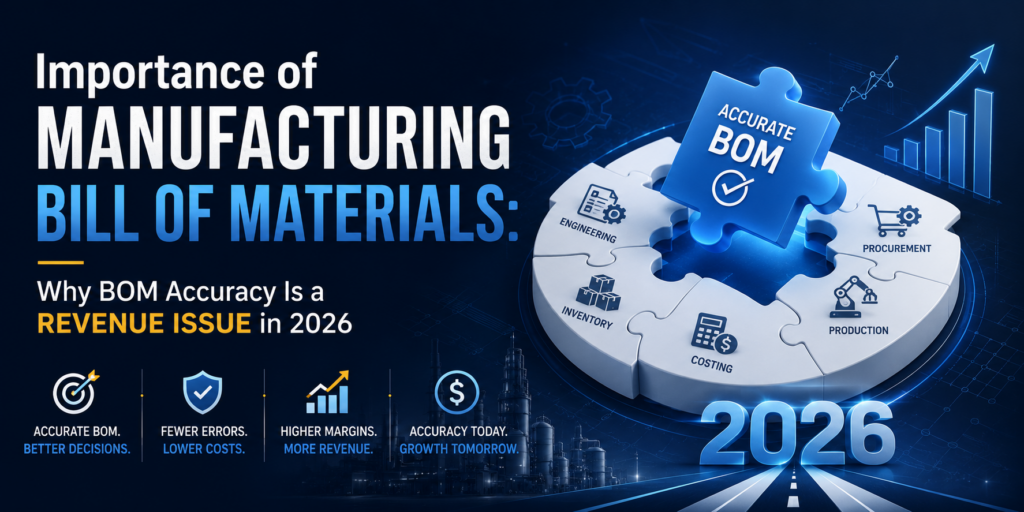
A manufacturing bill of materials is the complete, structured list of every component, subassembly, raw material, and quantity required to build a finished product. It is the document that connects what a customer ordered to what actually gets built. Without it, procurement guesses, production improvises, and field service works from memory.
That last sentence is not an exaggeration. Most BOM failures aren’t dramatic. They’re quiet, a wrong revision level approved for production, a component price that hasn’t been updated in eight months, a technician dispatched without the right part. The damage shows up in rework costs, delayed shipments, and quotes that go out under-priced.
The importance of a manufacturing bill of materials extends well beyond the shop floor. It is the connective tissue between quoting, production, inventory, and post-sale service. Get it right, and every downstream function runs cleaner. Get it wrong, and you’re spending the quarter chasing problems that were built into the process from the start.
“Correct” and “updated” are the operative words here. A BOM that’s one revision behind isn’t a minor inconvenience, it’s a liability that moves through your operation undetected until it surfaces as a defect, a delay, or a missed margin target.
Without a structured BOM, cross-department miscommunication is inevitable. Procurement orders to one specification, production assembles to another, and field service inherits whatever made it out the door. That gap is where rework begins.
A version-controlled, live BOM gives procurement, production, and field teams a single shared source of truth. Every revision is timestamped. Every change is traceable back to who approved it and when.
Manufacturing rework caused by miscommunication costs the industry an estimated $3 billion annually, the majority traceable to documentation gaps at the BOM level.
Quotes built on outdated BOM pricing data go out underpriced. The margin erosion doesn’t show up on the quote, it shows up on the P&L four weeks later when the purchase orders come in.
Real-time BOM data locks cost estimates to actual component prices before a quote is generated. That’s not a workflow improvement. That’s a revenue protection measure.
Inaccurate BOMs inflate material costs by 5–15% per production run. For a manufacturer with $10M in annual material spend, that’s up to $1.5M in avoidable cost leakage every year. This is where CPQ for manufacturing changes the equation, when BOM cost data feeds directly into quoting rules, the number on the quote and the number on the purchase order match.
BOM errors are cited in approximately 40% of production slowdowns (LNS Research). A wrong assembly sequence or a missing component doesn’t just slow one workstation, it cascades across the floor, idling downstream operations that have no visibility into why the upstream feed stopped.
Industry-wide, manufacturing downtime costs $50 billion per year (Siemens, 2024). BOM inaccuracies are among the most direct triggers. A correct, live BOM prevents that cascade before the first part is pulled from inventory.
A BOM doesn’t retire when the product ships. It becomes the service record. Every component, every subassembly, every revision level that went into the build, that data is what a field technician needs to diagnose a fault, order the right part, and close the ticket.
Bill of materials asset management means mapping components to maintenance schedules, warranty periods, and dispatch records.
A BOM’s value extends well beyond the production floor, touching quoting accuracy, compliance, inventory management, and post-sale service.
Benefit | What It Prevents | Benchmark |
Centralized component data | Rework and cross-team errors | Structured BOMs reduce rework by ~30% |
Real-time cost tracking | Budget overruns on production runs | Inaccurate BOMs inflate costs 5–15% |
Assembly sequence clarity | Production line bottlenecks | BOM errors cause ~40% of delays |
Spare parts mapping | Field service SLA breaches | Service BOMs cut repair time by 25% |
Version control & audit trail | Compliance failures and recalls | Required for ISO, FDA, AS9100 audits |
Most manufacturers still rely on static BOMs, fixed documents updated manually on a cycle that rarely keeps pace with component changes or supplier substitutions. The problem surfaces at quoting. When a sales rep configures a custom product against a static BOM, there’s a structural mismatch between what was quoted and what gets built. A dynamic BOM synced to a CPQ system auto-updates based on customer selections, eliminating that gap before it becomes a costly error downstream.
An effective BOM is not just a parts list, it is a living document that connects production, inventory, compliance, and post-sale service.
Most manufacturers manage their BOM in one tool, quoting in another, and field service in a third. That fragmentation is where errors, delays, and margin leakage compound, quietly, until the numbers make the problem visible.
Mobileforce connects those three functions into one workflow. Here’s what that looks like in practice:
Step 1, Configuration: When a customer configures a product, Mobileforce CPQ references the live BOM in real time to validate components, flagging conflicts or substitutions before the quote is finalized.
Step 2, Quoting: Pricing rules pull directly from BOM cost data, so every quote reflects actual material costs. No manual cross-referencing. No spreadsheet lookups.
Step 3, Fulfillment: When an order closes, the BOM automatically triggers field service scheduling and parts dispatch, the right technician, with the right parts, sourced directly from the build record.
Step 4, Post-Sale Asset Management: The BOM becomes the asset record, tracking warranty status, maintenance history, and component replacement schedules across the product’s full lifecycle.
See how manufacturers running on Salesforce and HubSpot use Mobileforce to connect BOM data to quoting and field service, explore the platform →
A BOM is not a static document, it is a living operational asset. In 2026, BOM accuracy is a direct revenue metric. Manufacturers with inaccurate or outdated BOMs lose deals, delay deliveries, and absorb cost leakage that compounds across procurement, production, and post-sale service every quarter.
The four most common BOM failure modes, traceability gaps, cost drift, production sequence errors, and service disconnects, are all fixable at the process level, not the people level. Manufacturers closing faster and quoting more accurately treat their BOM as a connected system asset, not a standalone spreadsheet.
Mobileforce gives manufacturers on Salesforce, HubSpot, Microsoft, Creatio, and SugarCRM a single platform that connects BOM, CPQ, and field service into one unified workflow, so every quote, every build, and every service call runs from the same source of truth. Learn more at mobileforce.ai.
Q1: What is the main purpose of a bill of materials in manufacturing? A BOM defines every component, quantity, and assembly sequence required to build a product. It connects what a customer ordered to what procurement sources, production builds, and field service maintains, across the entire product lifecycle.
Q2: How does BOM accuracy affect quoting? Quotes built on outdated BOM data use stale component prices. That creates margin gaps that don’t surface until purchase orders come in. When BOM cost data feeds directly into a CPQ system, quotes reflect actual material costs at the time of configuration.
Q3: What’s the difference between a static BOM and a dynamic BOM? A static BOM is a fixed document updated manually. A dynamic BOM updates automatically based on product configuration, supplier changes, and pricing rules. For manufacturers using CPQ, a dynamic BOM eliminates the mismatch between what was quoted and what gets built.
Q4: How does BOM data support field service operations? A service-ready BOM maps components to the specific build record of each unit in the field. When a service call comes in, technicians are dispatched with parts that match the actual configuration, not a generic parts list. That’s what reduces repair times by up to 25%.
Q5: What compliance standards require version-controlled BOMs? ISO 9001, FDA 21 CFR Part 820, and AS9100 all require documented, traceable revision histories for product components. A BOM with version control and audit trails satisfies those requirements without requiring separate documentation processes.