
Most CPQ rollouts don’t fail at the software. They fail at the decisions sitting behind it, the rules nobody wrote down, the approvals nobody assigned, the pricing logic one person built and nobody else understands. Two companies can run the exact same platform and get completely different results, because the tool was never the variable. The strategy was.
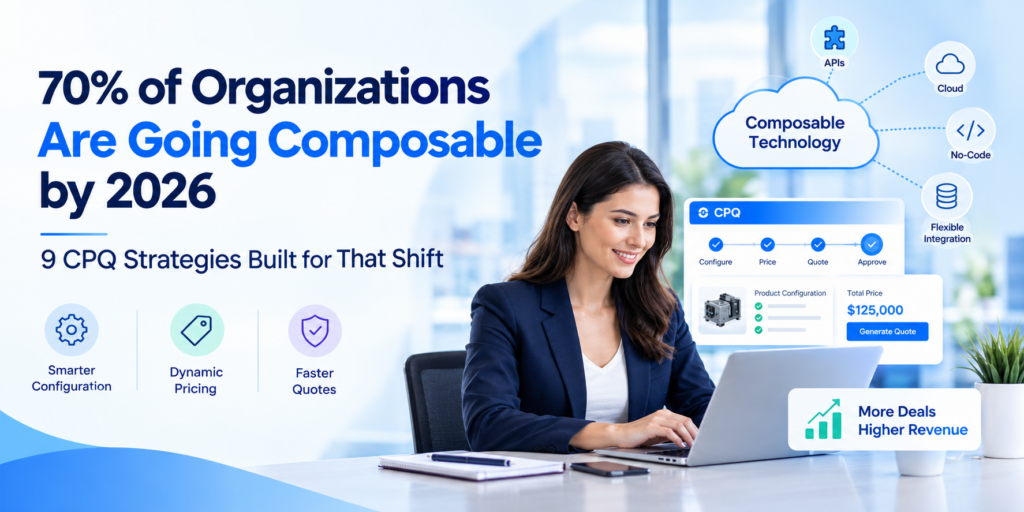
That gap is about to widen. Gartner projects that by 2026, at least 70% of organizations will shift toward composable, API-first technology over rigid, monolithic systems, a move that changes what “good” CPQ architecture even looks like. Systems built to be hard-coded and static are about to look expensive in a way they didn’t five years ago.
A CPQ strategy is the operating framework around the software itself: how configuration, pricing, and quoting rules are actually structured, not just which tool sits on top. These decisions span three areas B2B revenue teams live in daily, configuration and governance, pricing and margin, and quoting and collaboration, and the nine strategies below are built for where that composable shift is taking all three.
A CPQ strategy is different from CPQ software and different from the CPQ process flow itself. It’s the set of decisions about how configuration, pricing, and approval rules are structured to match how the business actually sells, who owns each rule, what gets automated, and what still needs a human sign-off. The same software can run under a strong strategy or a weak one. Two companies on identical platforms can get completely different results, because the strategy behind the tool, not the tool itself, decides whether deals move faster or just get logged faster.
A good strategy compounds. Clean configuration reduces pricing errors. Fewer pricing errors mean fewer approval escalations. Fewer escalations speed up the whole cycle, deal after deal. A weak strategy in any one of those areas undermines the others, which is exactly why the nine strategies below are grouped to interlink rather than treated as a flat checklist. For the full breakdown of what strong CPQ delivers, see eight specific ways CPQ software improves sales efficiency and deal size.
Most CPQ strategy guides list the same six to eight tactics in different words: guided selling, pricing rules, integration, templates. These nine are grouped into three clusters, Configuration & Selling, Pricing & Margin, and Governance & Scale, because that’s how they actually reinforce each other in practice.
Standard configurations should move through untouched. Only non-standard requests, custom terms, deep discounts, should route to a human. Strategies that automate everything equally either bottleneck on approvals or let exceptions slip through ungoverned. See why approval bottlenecks are one of the most common CPQ implementation failure points.
Guided selling only works if the underlying rules reflect how products actually get sold together, not an idealized catalog. Learn how guided selling captures institutional pricing knowledge and turns it into faster, smarter recommendations.
Duplicate SKUs and confusing product variants don’t get fixed by automation, they get automated faster. A catalog audit before configuration rules go live is what makes every other strategy in this group actually work. See how the Configure stage of the CPQ process depends on clean product data.
Sequential discount logic, volume tiers, promo codes, contract adjustments applied in a defined order, means a rep and a manager can both see exactly where margin is being given up, instead of one blended discount hiding several layers. This is core to any real CPQ margin protection strategy. See how misconfigured pricing rules and discount overrides quietly become revenue leakage.
Connecting base prices to real-time supplier costs or contract tiers means margin gets checked before a quote goes out, not discovered in a quarterly review. This is the earliest point to catch pricing errors before they compound into losses. See why undetected pricing errors compound into six-figure annual losses.
Businesses selling across regions, or mixing pricing models like one-time, subscription, and usage-based in the same catalog, face a compounding problem: a discount rule that’s safe in one region or model can be margin-destructive in another. A real CPQ pricing strategy for this needs region-aware and model-aware logic, not one global rule set applied everywhere. This is where generic “set your pricing rules” advice breaks down, and it’s the same complexity that makes a CPQ strategy for manufacturers with multi-tier distributor pricing so different from a straightforward SaaS quote.
Pre-approved, branded templates mean speed doesn’t come at the cost of looking unprofessional or inconsistent deal to deal. See what happens at the Quote stage, including approval routing and document generation.
A CPQ strategy that only optimizes the sales team’s part of the process just moves the friction downstream. Syncing CPQ with CRM and ERP is what keeps a won deal from becoming a manual re-entry project for three other teams. See where CPQ’s ownership of the process ends and the full quote-to-cash lifecycle begins.
Heavily customized, hard-coded CPQ configurations become the exact technical debt that makes future migrations or platform changes expensive, the strategic root cause behind the tactical migration problems companies hit later. A composable CPQ approach, built on codeless CPQ logic, lets the business adjust pricing and configuration without a developer for every change. With roughly 70% of organizations moving toward composable, API-first technology by 2026, this stops being a nice-to-have and starts being the baseline expectation. See the seven migration challenges that determine whether a CPQ system can adapt or has to be rebuilt from scratch.
This isn’t a tactical how-to, it’s a readiness check before you build.
For platform-specific detail, see platform-specific considerations for structuring bundles, price rules, and approval chains.
Mobileforce is a unified quote-to-service platform built for Salesforce, HubSpot, Creatio, SugarCRM, and Microsoft. Two strategies above map most directly onto what a unified platform changes in practice. Composability (Strategy 9) is architectural, not aspirational, on Mobileforce: pricing and configuration logic can be adjusted without a developer rewriting code for every change. Cross-team handoffs (Strategy 8) run on one connected layer instead of point-to-point integrations, so a won deal flows into fulfillment and service without a manual re-entry step in between. For teams weighing a CPQ implementation strategy against the composable shift Gartner is projecting, that’s where a platform-level decision starts to matter more than a feature-level one.
A CPQ strategy isn’t a checklist of independent tactics. Configuration, pricing, and quoting decisions either reinforce each other or quietly undermine each other. Treating them as a flat list is why so many CPQ deployments feel faster but aren’t actually more accurate.
The shift toward composable, codeless CPQ architecture makes that interlinking more important, not less. A strategy that isn’t coordinated across configuration, pricing, and collaboration will get harder, not easier, to adapt as the systems underneath it change.
Mobileforce connects that strategy across Salesforce, HubSpot, Microsoft, Creatio, and SugarCRM in one quote-to-service platform, built for exactly the composable shift this article describes. See how at mobileforce.ai.