A sales rep closes a deal in March with a 15% discount, approved for that one renewal cycle only. Fourteen months later, the customer is still getting that discount because nobody in billing knew it was supposed to expire. Nobody stole anything. The revenue just quietly stopped showing up.
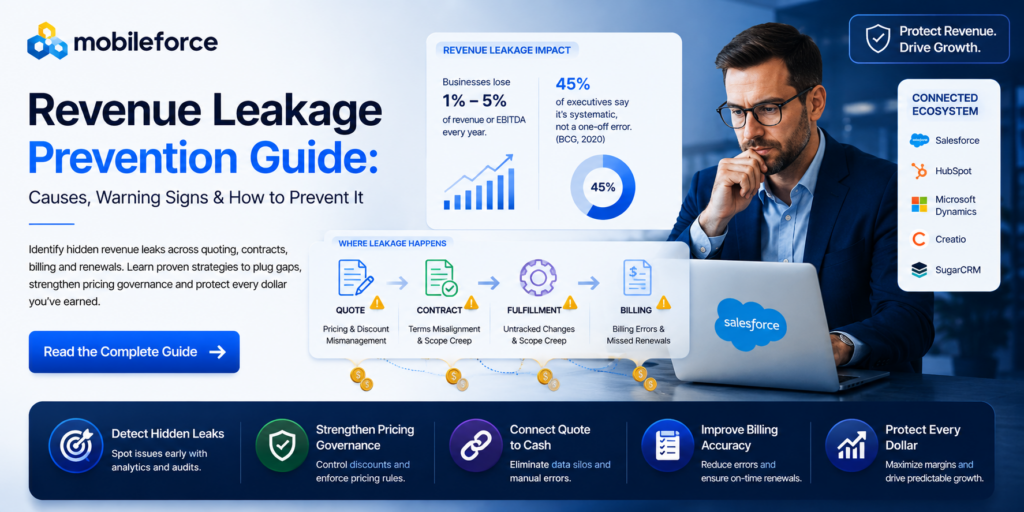
That gap between what a business earns and what it actually collects is called revenue leakage. Industry research converges on a range of 1% to 5% of revenue or EBITDA lost this way each year, and a 2020 BCG survey found that 45% of executives see it as systematic at their company, not an occasional slip-up.
Most guides on this topic start at the invoice, since that’s where leakage becomes visible. This one starts earlier, at the quote, where a large share of leakage for B2B revenue operations teams actually begins.
TL;DR: Revenue leakage is income you’ve already earned but never collected, usually from billing errors, missed renewals, or discount mismanagement rather than a customer leaving. It typically costs businesses 1% to 5% of revenue a year, and much of it starts at the quoting stage, before an invoice is ever sent.
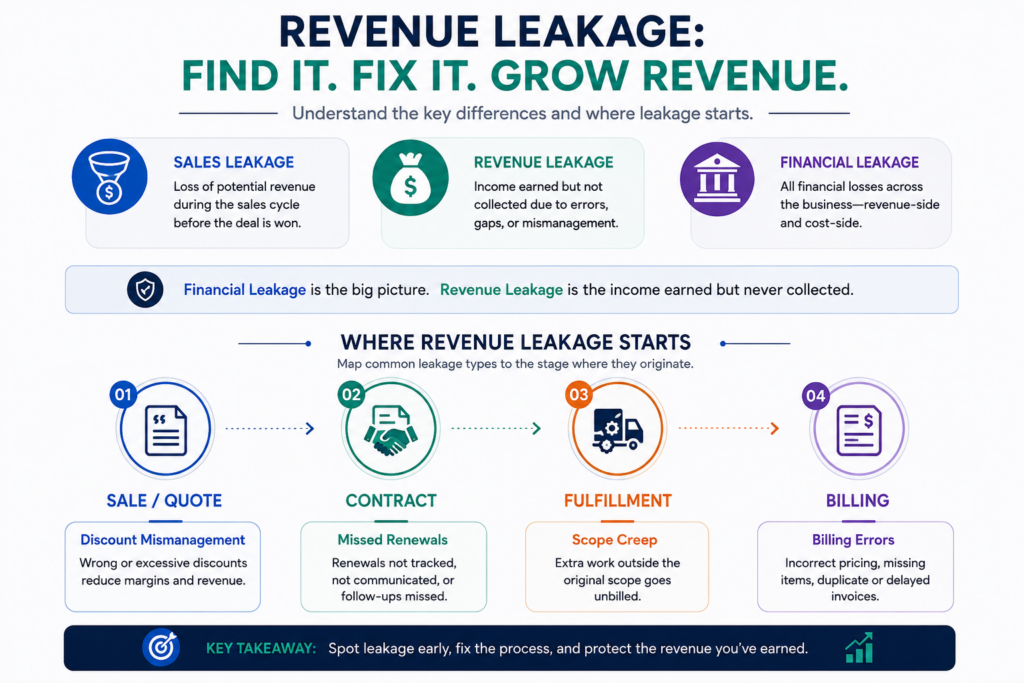
Revenue leakage is the unintentional loss of earned income due to process gaps, billing errors, or poorly managed contracts. It’s different from churn, where a customer leaves, and different from bad debt, where a customer doesn’t pay what was correctly billed. The invoice went out; it just didn’t reflect what the business was owed.
Picture a client who adds a service tier mid-contract. If that change never reaches billing, the company keeps delivering it at the old rate until an audit catches it, if one ever runs.
“Sales leakage” and “revenue leakage” get used interchangeably, though sales leakage sometimes refers to losses during the sales cycle specifically. Financial leakage is the broader umbrella term, covering cost overruns and procurement waste alongside revenue-side losses. Revenue leakage is the specific slice tied to income earned but never collected.
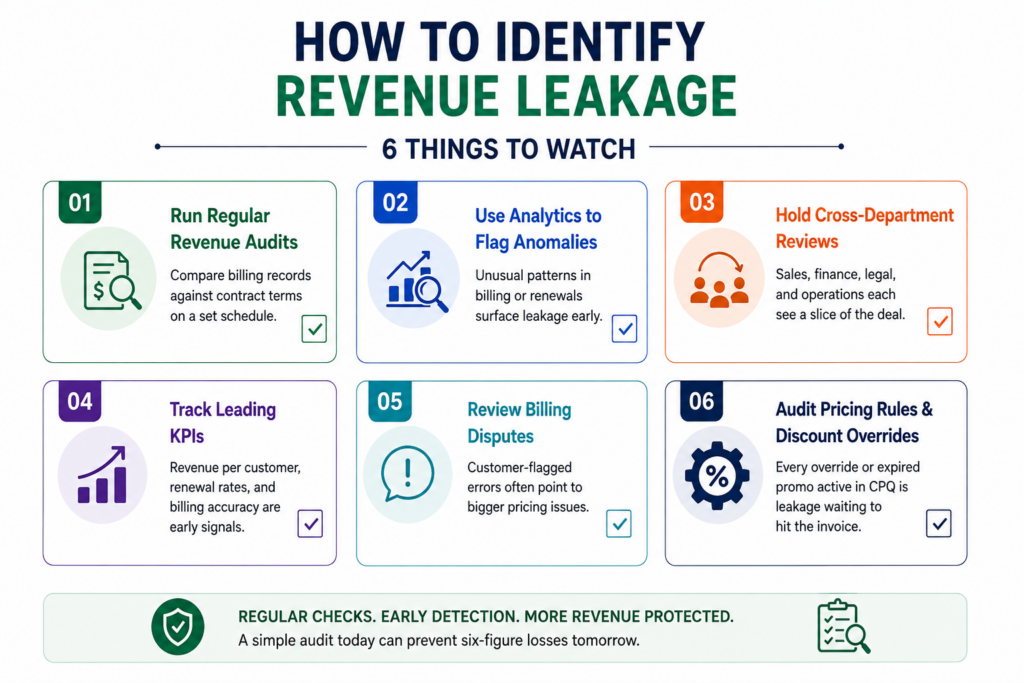
This is essentially what a revenue leakage audit is. Skip it, and a $280,000 pricing error can stay invisible for a year.
Step 1: Replace Manual Billing and Quoting With Automated Systems Every manually entered price, discount, or renewal date is a chance for error. Automated systems apply contract terms the same way every time, removing the human steps where leakage usually gets in: mis-keyed data, forgotten discount expirations, missed renewal dates.
Step 2: Connect the Full Quote-to-Cash Cycle, Not Just Billing Automating billing alone still leaves a gap if the quote, contract, and invoice sit in disconnected systems. When a deal closes, the order should trigger invoicing without anyone re-entering data.
Step 3: Build Ownership and Audit Discipline, Not Just Technology Automation lowers risk, but someone still needs to own the process. Regularly matching contracts against invoices catches expired discounts that software alone won’t flag.
Step 4: Fix Data Silos Between CRM, Quoting, Billing, and Accounting Leakage often lives between systems that don’t sync, a pricing change made in one place that never reaches billing. Keeping catalogs and pricing data synchronized stops outdated rates and wrong invoices.
Step 5: Align Billing and Revenue Recognition Workflows In subscription models, a mismatch between what’s billed and what’s recognized as revenue can hide leakage. This is a finance discipline, tied to ASC 606 alignment, and sits outside what a quoting tool controls.
Billing errors and revenue recognition mismatches happen downstream of the quote, and no quoting platform controls them directly. But a meaningful share of leakage starts earlier: discount overrides never re-approved, configurations that drift from what was quoted, promotional pricing left active past its expiration. That kind of leakage is preventable before it reaches a contract or invoice.
This is where pricing rule errors do the most damage, quietly, because nobody reviews a quote the way they review an invoice. Mobileforce is built as a unified quote-to-service platform, keeping pricing rules, discount governance, and quote accuracy on one connected data layer. It doesn’t replace what finance does for billing or revenue recognition; it closes the gap where leakage starts. Our CPQ platform page covers how that layer works, and our RevOps solution page covers revenue assurance across teams.
Revenue leakage is rarely one dramatic failure. It’s a series of small, systemic gaps across quoting, contracts, and billing that compound quietly over months.
The earliest and cheapest point to catch it is at the quote, before a discount override or configuration drift becomes a contract term or invoice line. Treating pricing governance as revenue protection, not just sales enablement, is what separates companies that catch leakage early.
Mobileforce connects CPQ, discount governance, and quote accuracy into one platform that plugs into Salesforce, HubSpot, Microsoft Dynamics, Creatio, and SugarCRM, keeping pricing consistent through the quote-to-cash cycle. To see where leakage might be starting in your quoting process, get in touch with our team or request a demo.
What is revenue leakage in simple terms?
Money a business already earned but never collected, usually from a billing error, missed renewal, or pricing mistake, not a customer leaving.
What is sales leakage, and is it the same as revenue leakage?
Sales leakage refers to losses during the sales and quoting stage. Revenue leakage is the broader term covering the whole cycle, from quote through billing.
How do I know if my business has revenue leakage?
Run a revenue leakage audit comparing contracts to actual billing, and check for expired discounts still active in your CPQ system.
Can revenue leakage happen even with subscription billing software in place?
Yes. Subscription billing errors are common when billing isn’t connected to quoting and contracts.
Where does most revenue leakage actually start?
Audits consistently point to the quote stage, discount overrides, pricing errors, and configuration drift, well before an invoice exists.