

Enterprise Q2C cycles commonly run 60 to 90 days end to end. Here’s the part that surprises most teams: shortening the quoting stage alone often doesn’t move that number. The delay just resurfaces later, at contract negotiation, fulfillment, or billing.
The quote to cash business process is the full chain from configuring and pricing a deal through cash collection and revenue recognition. It runs across three layers: front office (sales), middle office (legal), and back office (finance). Most companies optimize the front office first, then watch those gains evaporate somewhere downstream.
Key Insights
- The quote to cash business process spans three layers, front office (sales/CPQ), middle office (legal/contracts), back office (finance/billing), not just the quoting stage most CPQ content focuses on.
- Enterprise quote to cash cycle time commonly runs 60 to 90 days end to end. Speeding up quoting alone frequently doesn’t move that number if the rest of the chain stays manual.
- Most Q2C breakdowns happen at the handoffs between layers, not within a single stage. Contract negotiation and billing are two of the most common bottleneck points.
- A fast CPQ stage paired with a slow, disconnected contract and billing process doesn’t remove the delay. It just relocates it.
- Configuration, pricing, and quoting (the CPQ-owned stages) are only 3 of the quote to cash process steps. The other 7 are where most of the cycle time actually lives.
Table of Contents
- What Is the Quote-to-Cash Process?
- What Are the Three Layers of the Quote-to-Cash Process?
- The Quote-to-Cash Business Process: 10 Steps
- What Are the Benefits of a Streamlined Q2C Process?
- How to Find an All-in-One Quote-to-Cash Automation Solution
- Where Mobileforce Fits in the Quote-to-Cash Process
- FAQ
What Is the Quote-to-Cash Process?
The quote to cash process is the end-to-end business process that runs from an initial price quote through contract, fulfillment, billing, and revenue recognition. It’s not just a sales workflow. It’s the full path a deal takes before it turns into collected, recognized revenue.
Most articles on this topic stop at the quote. This one doesn’t, because that’s exactly where most of the real cycle time gets lost.
What Are the Three Layers of the Quote-to-Cash Process?
Break the quote to cash process flow into three layers, and the bottlenecks get a lot easier to spot.
Front Office (owned by sales): configuration, pricing, guided selling. This is the CPQ-owned part of the cycle, and it’s where most optimization dollars go.
Middle Office (cross-functional): contracts, legal review, negotiation. This layer touches procurement, legal, and finance on both sides of the deal, which is exactly why it’s slow.
Back Office (owned by finance/operations): fulfillment, billing, revenue recognition. This is where cash actually gets collected, and where delays stay invisible until a quarterly review flags them.
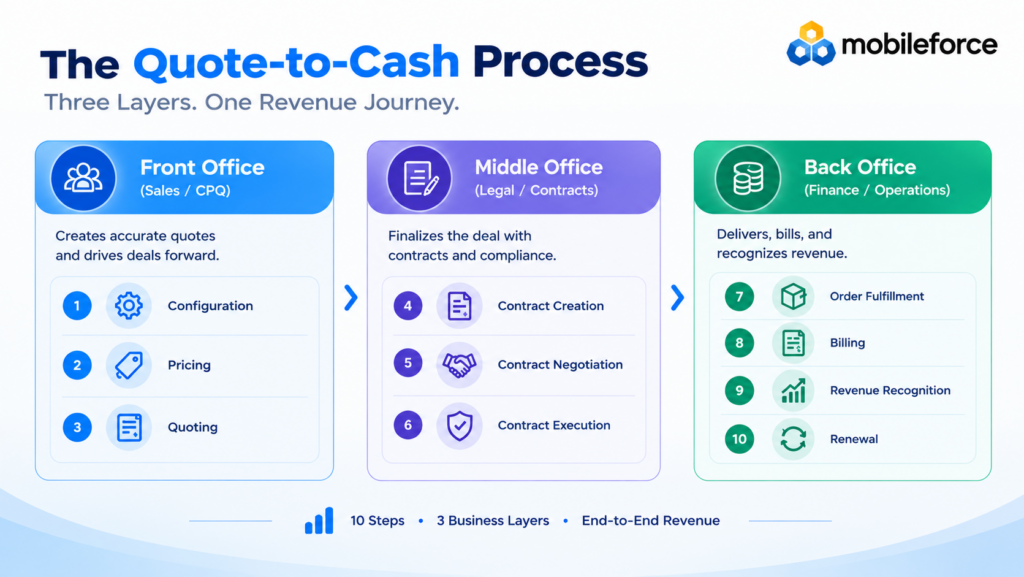
Here’s the pattern worth remembering: most companies pour effort into the front office because it’s the layer they can see from the sales side. The back office is where the money actually lands, and it gets the least attention.
The Quote-to-Cash Business Process: 10 Steps
Steps 1 through 3 are the CPQ-owned front office, already covered in depth elsewhere. They get one sentence each here, with a link out. Steps 4 through 10 are where this breakdown does its real work, since almost no other resource gives the contract, fulfillment, and billing layers the same depth they give quoting.
- Configuration
Product and pricing get configured here, validated against compatibility rules before the deal moves forward. For how the Configure stage works in detail, including the 2026 shift toward agentic configuration, see our full CPQ breakdown. - Pricing
Pricing rules, discount governance, and margin floors get applied at this step. For how the Price stage works in detail, including where most undetected margin loss originates, see our full CPQ breakdown. - Quoting
The finished, branded proposal gets generated and sent for the customer’s review. For how the Quote stage works in detail, including why approval routing is the most common stall point, see our full CPQ breakdown. - Contract Creation
Once a quote is accepted, its terms need to translate into a formal contract, pricing, SLAs, renewal terms, and any negotiated exceptions all need to carry over accurately. A mismatch at this step is where “what was quoted” and “what was signed” start to drift apart, and that drift causes problems for months. - Contract Negotiation
This is one of the most time-sensitive stages in the entire cycle. Legal review, redlines, and multi-stakeholder sign-off, procurement, legal, and finance on both sides, routinely add days or weeks that never show up in CPQ-focused reporting, because CPQ metrics stop tracking the moment a quote gets sent. Contract negotiation is one of the two most frequently cited bottleneck stages in current 2026 Q2C coverage, alongside billing, and it’s a major reason enterprise cycles stretch toward that 60 to 90 day range. - Contract Execution
E-signature and final execution close out the middle office layer. This step is usually fast once negotiation ends. The real delay almost always happens upstream, in Step 5, not here. - Order Fulfillment
The signed deal converts into an order, a physical shipment, software provisioning, or a service activation, depending on the business model. This is where the back office layer begins, and where a deal becomes operational instead of just contractual. If the fulfillment system doesn’t share data with the contract system, someone ends up re-keying the order by hand, which reintroduces the exact errors CPQ was supposed to eliminate upstream. - Billing
Invoices need to reflect exactly what was contracted, including any mid-cycle changes, add-ons, or usage-based charges. This is one of the two most commonly cited quote to cash bottleneck stages alongside contract negotiation, and it’s also where pricing-rule errors from much earlier in the cycle finally show up as real revenue loss. Our guide on how pricing and discount errors made much earlier in the cycle surface as measurable revenue leakage here walks through exactly how that happens. - Revenue Recognition
Finance recognizes revenue according to the contract’s actual terms and delivery schedule, not the invoice date. A mismatch between what’s billed and what’s recognized isn’t just a bookkeeping detail. It’s a compliance and forecasting risk. - Renewal
For subscription or recurring-revenue models, the cycle restarts here. Renewal terms, usage history, and pricing changes all need to flow back into a new configuration, pricing, and quoting pass. A quote to cash process that isn’t connected end to end forces every renewal to start from scratch instead of building on what’s already known about the account.
[Design note: full quote to cash process flow chart here, all 10 steps grouped into the 3 layers above, Front Office: 1 to 3, Middle Office: 4 to 6, Back Office: 7 to 10, with Steps 5 and 8 visually flagged as the most commonly cited bottlenecks. Plain-text list version included above for AI extraction.]
What Are the Benefits of a Streamlined Q2C Process?
A streamlined end to end quote to cash process pays off well beyond faster quoting:
- Shorter overall cycle time, not just quote time. Fixing the handoffs between layers moves the needle more than shaving days off configuration ever will.
- Fewer contract-to-invoice mismatches. When contract terms carry forward accurately into billing, disputes and write-offs drop.
- More accurate revenue forecasting. When billing and revenue recognition stay aligned with actual contract terms, finance stops guessing.
- Faster renewal cycles. When account data carries forward instead of resetting, renewals build on history instead of starting over.
How to Find an All-in-One Quote-to-Cash Automation Solution
Looking for quote to cash automation that actually covers the full chain? Here’s what to check before you commit to anything:
- Native CRM and ERP integration. Data should flow without manual re-entry at any handoff, especially between contract and fulfillment.
- Contract lifecycle management. Redlines, approvals, and version control need to live inside the same system the quote came from, not a separate tool nobody checks.
- Billing accuracy. The invoice needs to match the contract, including every mid-cycle change, automatically.
- Revenue recognition compliance. Whatever handles billing should also handle recognition rules correctly, since a mismatch here becomes a real audit risk.
- Visibility across all three layers. A tool that only reports on the front office will miss exactly the bottlenecks that matter most.
Few platforms genuinely cover all 10 steps under one roof. Most cover a portion of the chain well and integrate with the rest. Knowing which portion a tool actually owns, versus what it just claims to touch, is the real evaluation question.
Where Mobileforce Fits in the Quote-to-Cash Process
Mobileforce is a unified quote-to-service platform built for Salesforce, HubSpot, Creatio, SugarCRM, and Microsoft Dynamics. It’s scoped specifically to Steps 1 through 3 (Configuration, Pricing, Quoting) and Step 7 (Order Fulfillment and field service), not the full 10-step chain.
That scope is deliberate. The handoff between the front office and fulfillment is where re-keying and data loss show up most often, deals get quoted correctly, then something gets lost translating them into an actual order. Mobileforce closes that specific gap rather than claiming to own billing, contract management, or revenue recognition, which stay separate, purpose-built systems in most Q2C stacks.
For teams evaluating a digital quote to cash approach, understanding which layer a platform actually owns matters more than any feature list.
FAQ
What is the quote-to-cash process, in one sentence?
It’s every step a deal goes through between an initial price quote and collected, recognized cash, spanning sales, legal, and finance. Most people think it stops at the signed contract. It doesn’t.
Order to cash vs quote to cash: what’s the actual difference?
Order to cash starts after a deal is already signed and tracks fulfillment through payment. Quote to cash starts earlier, at the first price quote, and covers the entire deal lifecycle, including everything order to cash tracks. Order to cash is really a subset of Q2C.
What quote to cash KPIs should we actually be tracking?
Total cycle time from quote to cash collection matters more than quote time alone. Track time spent at each layer handoff specifically, quote-to-contract, contract-to-order, order-to-invoice, since that’s where most delay hides. Contract negotiation duration and billing accuracy rate are the two most telling numbers for most teams.
Is quote-to-cash the same thing as CPQ?
No, and this mix-up causes real confusion. CPQ (Configure, Price, Quote) is the front-office slice, Steps 1 through 3 of the process described above. Quote to cash includes CPQ plus contracts, fulfillment, billing, and revenue recognition, the other seven steps most CPQ vendors don’t touch.
Can a q2c workflow be automated end to end with one platform?
Rarely, in practice. Most companies connect a few specialized systems, CPQ, CLM, billing, ERP, rather than running everything on a single platform. What matters more than finding one tool that does it all is making sure those systems actually share data at the handoffs, since that’s where cycle time gets lost.
A Fast Quote Doesn’t Guarantee Fast Cash
The quote to cash business process has 10 steps across 3 layers, and most companies only optimize the 3 they can see from the sales side. The other 7 quietly account for most of the cycle.
The highest-leverage fixes usually sit at the layer handoffs, contract negotiation and billing, not inside any single stage. Closing those gaps shortens the real cycle more than making quoting faster ever will on its own.
Mobileforce connects Salesforce, HubSpot, Microsoft Dynamics, Creatio, and SugarCRM to close the specific gap between quoting and fulfillment, where deals most often get lost in translation. See how it fits into your stack at mobileforce.ai.