Gartner predicts that 40% of enterprise applications will embed task-specific AI agents by the end of 2026, up from under 5% in 2025. CPQ sits right in the middle of that shift, with every stage moving from static rules toward AI-guided recommendations.
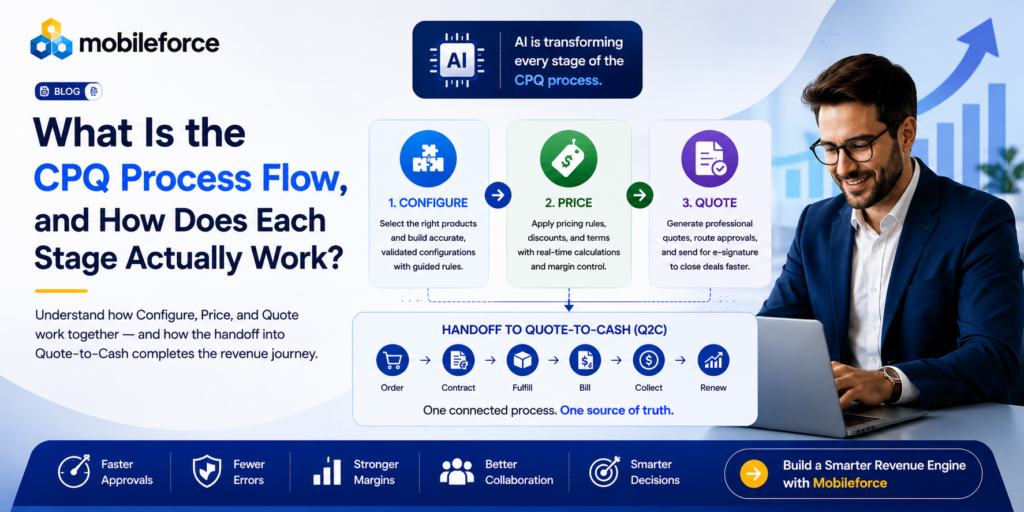
The CPQ process flow is the automated sequence that carries a deal from product configuration through pricing to a finished, approved quote. It runs on three core stages: Configure, Price, and Quote. Knowing where CPQ ends and the wider lifecycle begins is really the cpq vs quote to cash question, and it trips up more B2B sales teams than the stages themselves do.
TL;DR
The process flow only works end to end if each stage feeds clean data into the next one. A rushed Configure step creates pricing errors. A rushed Price step creates approval bottlenecks downstream. Here is what each stage actually involves.
This stage starts with product selection from a centralized catalog. Guided selling rules point reps toward compatible bundles, and validation blocks impossible or out-of-stock combinations before the deal moves any further.
In 2026, agentic configuration tools are starting to recommend the right bundle on their own, based on what the customer says they need. Reps no longer have to build every configuration by hand. See how guided selling captures institutional pricing knowledge and turns it into faster, smarter recommendations.
Pricing pulls list prices from active price books, then runs dynamic calculations for volume tiers and contract-specific terms. Discount and margin enforcement checks every quote against predefined floor limits.
Predictive pricing tools are starting to flag deals likely to need a discount before a rep even asks, instead of only catching problems after the fact. This is also the stage where most undetected margin loss originates, since misconfigured pricing rules and discount overrides quietly become revenue leakage.
Quote covers approval routing for non-standard discounts or terms, document generation for branded proposals, and tracking revisions through to e-signature. AI-drafted proposal language and clause suggestions are starting to speed up negotiation, not just document formatting.
Approval routing, not document generation, is where this stage most often stalls. It is also one of the most common CPQ implementation failure points.
Once a quote is won, it converts into an order, contract, or subscription. CPQ’s direct ownership of the process ends here, and the full quote to cash lifecycle begins, with order fulfillment, billing, and renewals owned by other teams.
A clean process flow pays off across the whole revenue cycle, not just inside CPQ.
Autonomous, AI-driven deal-desk systems are reported to cut quote to cash cycle times by 30 to 50%. That gain only shows up when the underlying process flow is clean before automation gets layered on top. For a broader look at what CPQ software delivers, see eight specific ways CPQ software improves sales efficiency and deal size.
Platform-specific guidance also helps here. See platform-specific best practices for structuring bundles, price rules, and approval chains.
Mobileforce is a unified quote-to-service platform built for Salesforce, HubSpot, Creatio, SugarCRM, and Microsoft. It connects CPQ, selling, and field service into one flow, so the handoff points between Configure, Price, and Quote don’t require manual re-entry.
Those handoff points are the most common failure spots named above. Keeping Configure, Price, Quote, and fulfillment on one connected data layer is how Mobileforce keeps a deal moving without the friction that shows up when each stage sits in a different system.
The CPQ process flow is only as strong as its weakest handoff. Most breakdowns happen between stages, not within them, particularly at the approval-routing step between Price and Quote.
The 2026 shift toward AI-guided configuration and pricing doesn’t remove the need to map the process flow first. It raises the cost of skipping that step, since a poorly mapped flow now gets automated mistakes faster, not just manual ones.
Mobileforce connects CPQ with Salesforce, HubSpot, Microsoft, Creatio, and SugarCRM inside one quote-to-service platform, closing the gaps where deals usually stall. See how it fits your process at mobileforce.ai.
What is the difference between CPQ and quote to cash?
CPQ covers Configure, Price, and Quote, the part of the deal where a rep builds and prices an offer. Quote to cash picks up after the quote is won and covers order conversion, billing, contracts, and renewals. CPQ is one stage inside the larger quote to cash lifecycle.
What are the stages of the CPQ process flow?
Configure, Price, and Quote, followed by a handoff into order management or ERP. Each stage depends on clean data from the one before it.
Why does my CPQ process keep breaking down at approval?
Approval routing for non-standard discounts is the most common failure point in the Quote stage. It usually means the approval chain was never clearly mapped before automation got added on top of it.
Is CPQ the same as revenue lifecycle management?
No. Revenue lifecycle management spans the entire revenue process, from lead to renewal. CPQ is one piece of that, focused specifically on configuration, pricing, and quoting.
How long does it take to see results from optimizing a CPQ process flow?
It depends on how mapped the process was going in. Teams that pilot with one product line before rolling out catalog-wide tend to see faster, cleaner results than teams that automate everything at once.
Ready to see what a connected CPQ process flow looks like for your team? Get a demo from Mobileforce and watch the handoffs disappear.