
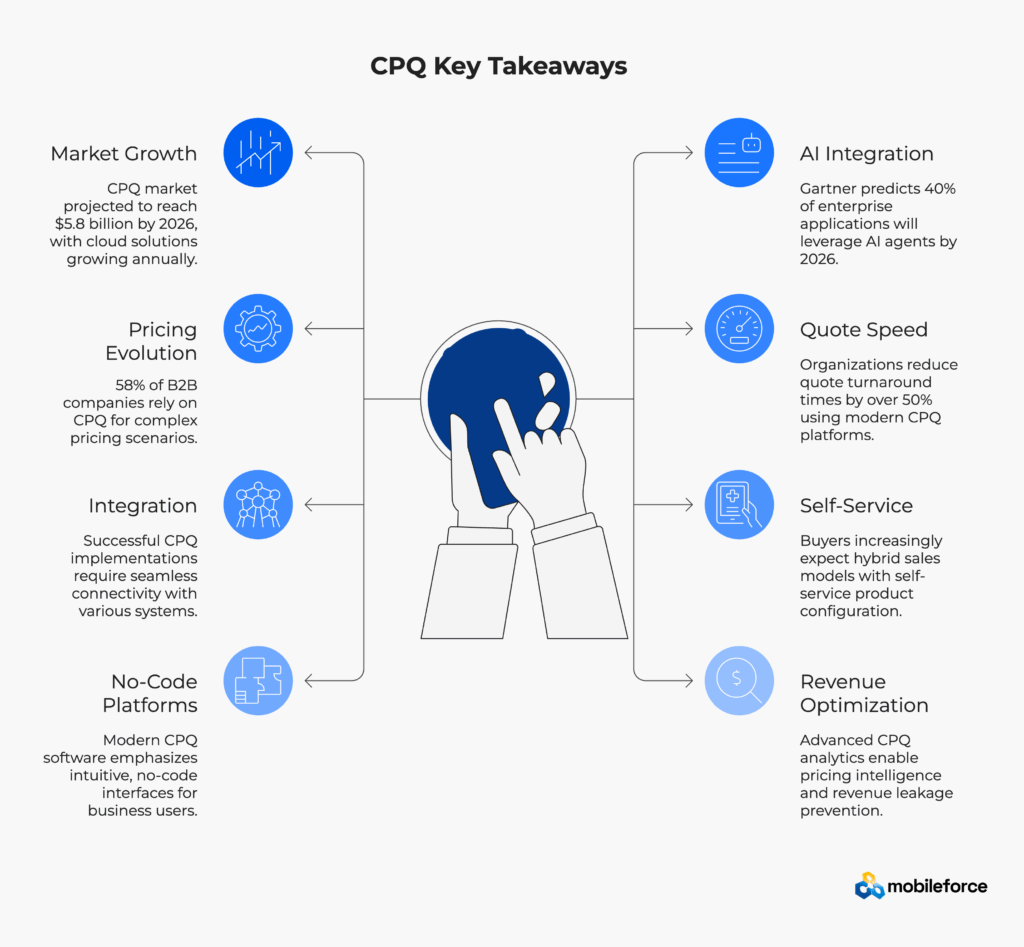
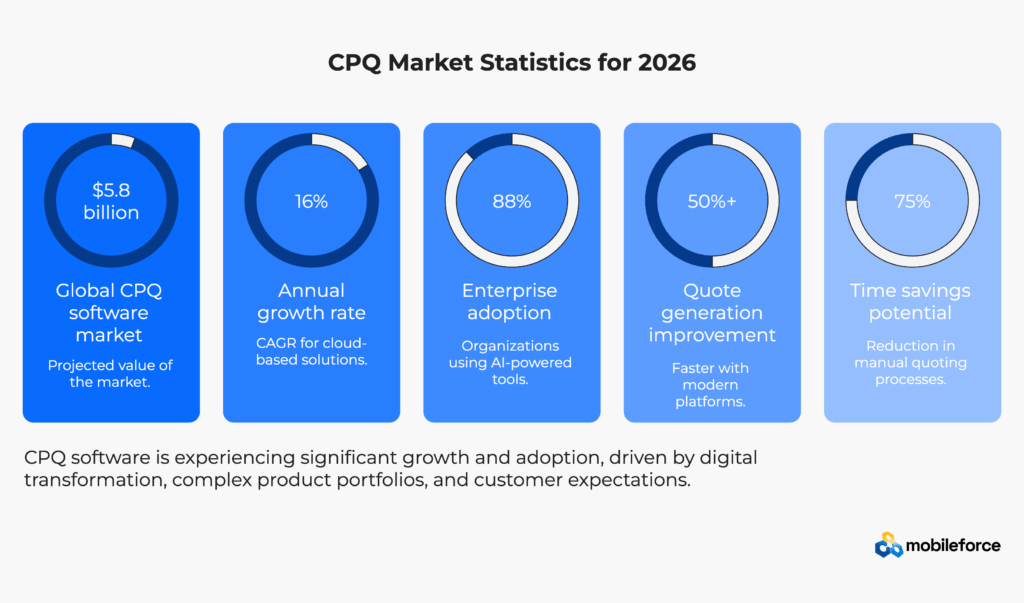
The configure price quote software landscape stands at a transformative inflection point heading into 2026. Market research indicates the global CPQ market will reach nearly $5.8 billion by 2026, driven by cloud-based CPQ solutions growing at 16% annually. Three major forces are reshaping how businesses configure, price, and quote: AI-powered intelligent automation that’s moving beyond pilots to production-ready systems, subscription billing and usage-based pricing models that require dynamic pricing engines, and the rise of self-service buyer experiences. Companies still relying on legacy spreadsheet-based quoting systems or rigid legacy CPQ platforms risk being left behind as customer expectations shift toward instant quote generation, personalized product recommendations, and seamless buying experiences.
The stakes couldn’t be higher. Research shows that organizations reduce quote turnaround times by over 50% using modern CPQ platforms, while 88% of organizations now regularly use AI across business functions to enhance sales productivity and automate complex pricing decisions. For revenue teams looking to stay competitive, 2026 represents the year when next-generation CPQ platforms separate market leaders from those struggling to keep pace.
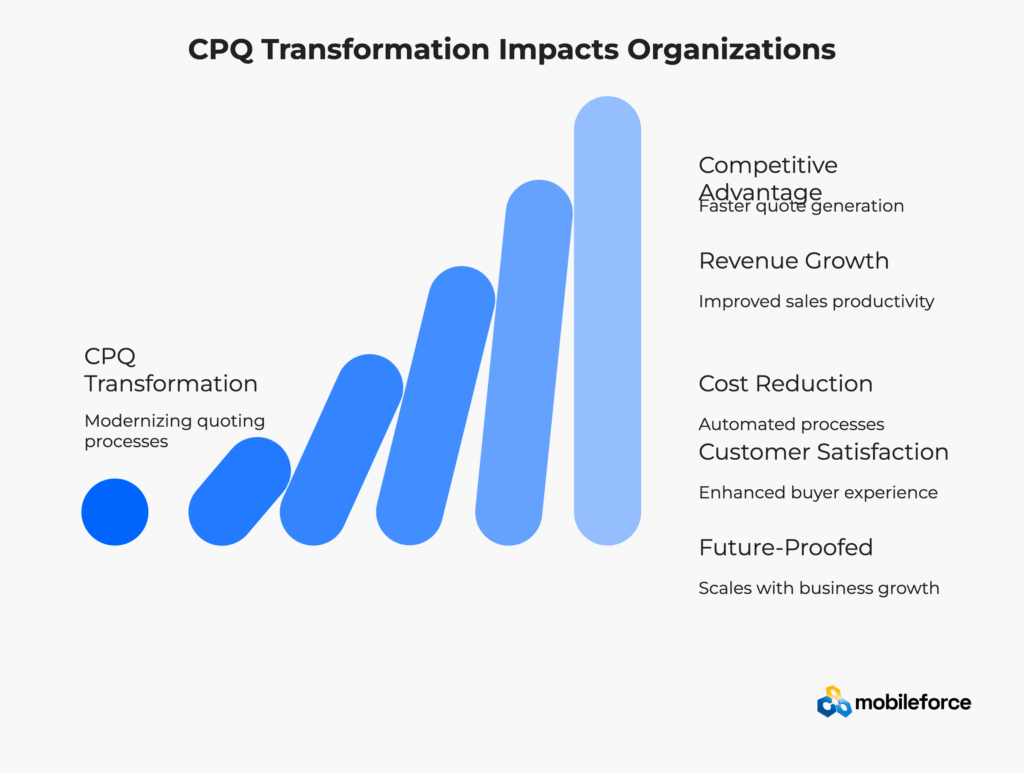
Configure Price Quote (CPQ) software is a sales automation platform that enables businesses to quickly generate accurate quotes for configurable products and services. CPQ systems automate the product configuration process, apply pricing rules and discounts, and produce professional quotes while ensuring accuracy and compliance with business policies.
Modern CPQ platforms handle complex pricing scenarios including subscription billing, usage-based pricing, volume discounts, approval workflows, and multi-currency calculations. They integrate with customer relationship management (CRM) systems, enterprise resource planning (ERP) platforms, and billing systems to create seamless quote-to-cash processes that accelerate sales cycles and improve revenue predictability.
What is driving CPQ market growth in 2026?
Configure price quote software adoption is accelerating due to three primary factors: digital transformation initiatives requiring sales automation, complex product portfolios demanding intelligent configuration tools, and customer expectations for instant quote generation.
“Picture this: a sales rep receives an urgent request for a complex multi-product quote at 4:47 PM on a Friday. The prospect needs pricing by Monday morning for a board meeting that could determine a major software rollout affecting thousands of users.”
This scenario, once a nightmare for sales teams armed only with spreadsheets and static price lists, now represents an opportunity for organizations equipped with modern CPQ platforms.
CPQ Market Size and Growth Projections
The numbers tell a compelling story about enterprise CPQ software adoption. According to MGI Research, the cloud-based CPQ market will reach nearly $5.8 billion by 2026, representing a 16% compound annual growth rate. But behind these figures lies a fundamental shift in how businesses approach the quote-to-cash process automation.
The manufacturing and IT sectors alone contributed over 40% of CPQ market revenue in 2024, driven by the complexity of modern product configuration requirements and the urgent need for sales process optimization. Yet the real growth is happening in sectors historically underserved by traditional CPQ vendors: SaaS companies implementing subscription billing, professional services firms managing complex pricing models, and businesses with usage-based revenue optimization strategies.
Key CPQ Market Statistics for 2026:
Industry Sector | 2024 Market Share | 2026 Projected Growth | Key Drivers |
Manufacturing | 23% | 14% CAGR | Complex product configuration, IoT integration |
IT & Technology | 19% | 18% CAGR | Subscription billing, usage-based pricing |
Healthcare & Life Sciences | 12% | 16% CAGR | Regulatory compliance, equipment financing |
Automotive | 11% | 13% CAGR | Vehicle configuration, aftermarket services |
Telecommunications | 9% | 15% CAGR | Service bundling, network infrastructure |
Financial Services | 8% | 17% CAGR | Insurance products, investment services |
Professional Services | 7% | 20% CAGR | Project-based pricing, consulting packages |
Energy & Utilities | 6% | 12% CAGR | Smart grid solutions, renewable energy |
Retail & E-commerce | 5% | 22% CAGR | Omnichannel selling, personalization |
While North America maintains its dominance with 35% of CPQ market revenue, emerging markets in Asia-Pacific are witnessing explosive growth in CPQ software adoption. The region projects a CAGR over 14% through 2030 due to increasing investments in digital transformation initiatives and sales enablement technologies.
Ready to see how modern CPQ can transform your sales process? Schedule a demo to discover how Mobileforce’s no-code platform delivers quotes in minutes, not days.
How is artificial intelligence transforming CPQ software in 2026?
Artificial intelligence in CPQ has evolved from experimental pilot projects to production-ready sales automation tools that deliver measurable business outcomes. Modern AI-powered CPQ platforms leverage machine learning algorithms, natural language processing, and predictive analytics to automate complex pricing decisions, optimize product configurations, and accelerate quote generation processes.
The conversation around artificial intelligence in configure price quote systems has evolved dramatically. Where 2024 saw widespread experimentation and proof-of-concept initiatives, 2026 will mark the year AI-powered CPQ systems prove their production-ready value through documented ROI improvements and sales performance metrics.
Gartner’s prediction that 40% of enterprise applications will leverage task-specific AI agents by 2026—compared to less than 5% in 2025—signals a massive shift in how CPQ systems will operate for revenue optimization and sales enablement.

What are the key AI capabilities in modern CPQ platforms?
Modern AI-driven CPQ software platforms analyze customer behavior data, purchase history patterns, and market intelligence to recommend optimal product configurations in real-time. This capability extends far beyond simple product bundling to include predictive pricing optimization and intelligent cross-selling recommendations.
Consider how companies using AI-driven CPQ tools experienced a 20% increase in customer satisfaction according to recent market analysis. The technology enables sales teams to present product configurations and pricing strategies that customers didn’t even realize they needed, turning routine quote generation into consultative selling opportunities.
AI algorithms now power:
AI Feature | Traditional CPQ Systems | Modern AI-Powered CPQ | Business Impact |
Product Recommendations | Static rule-based bundles | Dynamic ML-powered suggestions | 20% increase in deal size |
Pricing Optimization | Fixed discount schedules | Real-time market-based pricing | 15% margin improvement |
Quote Generation Speed | Manual configuration required | Natural language processing | 10x faster quote creation |
Compliance Checking | Manual review processes | Automated validation rules | 95% error reduction |
Customer Analytics | Basic reporting | Predictive behavior modeling | 25% win rate improvement |
Competitive Intelligence | Manual research | Automated market monitoring | Real-time pricing adjustments |
Approval Workflows | Static approval chains | Intelligent routing | 75% approval time reduction |
Sales Forecasting | Historical trend analysis | AI-powered predictive models | 30% accuracy improvement |
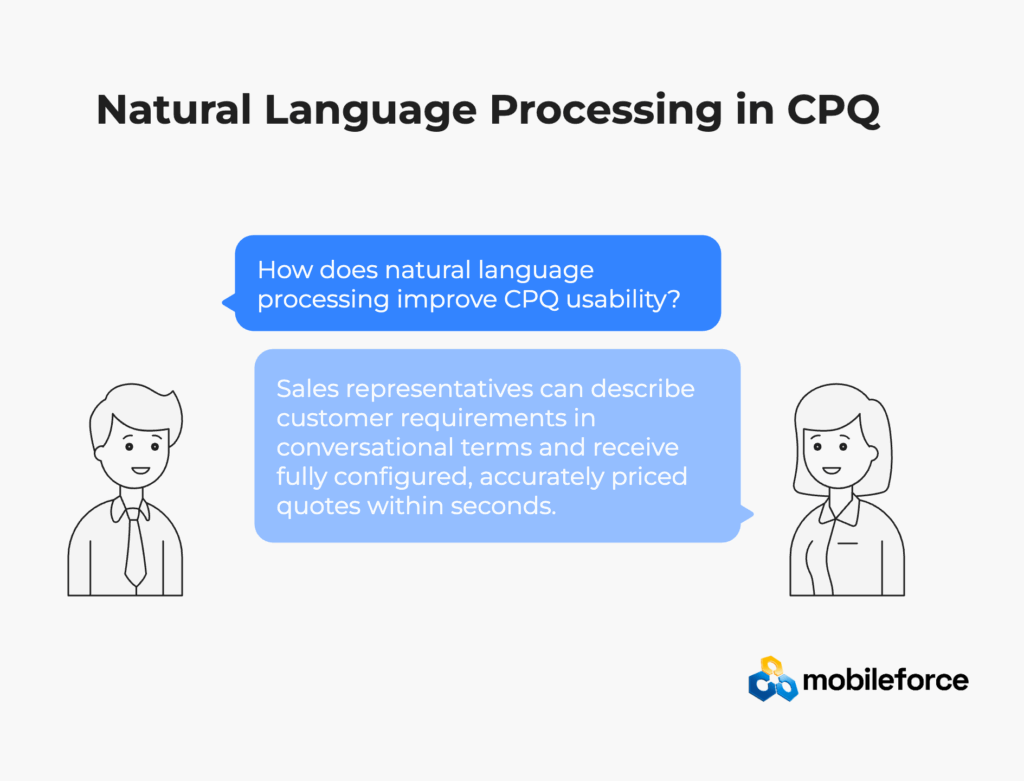
How does natural language processing improve CPQ usability?
Perhaps the most transformative AI application involves natural language processing for quote creation and sales enablement. Sales representatives can now describe customer requirements in conversational terms—”I need a mid-tier SaaS plan for 120 users with overage billing and 24/7 support”—and receive fully configured, accurately priced quotes with appropriate discount schedules within seconds.
This advancement removes the technical barrier that historically prevented non-expert sales personnel from creating complex product configurations, democratizing the quoting process while maintaining pricing accuracy and approval workflow compliance.
What makes subscription billing challenging for traditional CPQ systems?
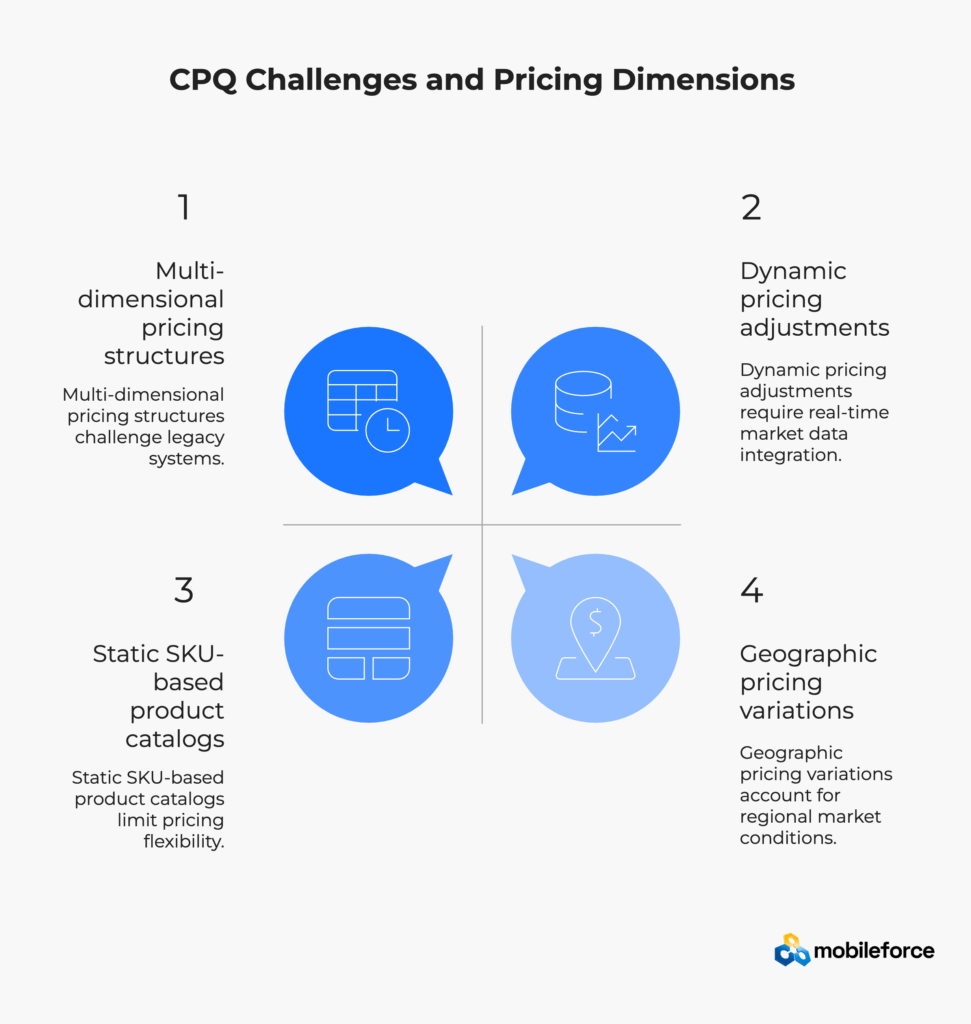
Subscription billing and usage-based pricing models represent one of the most significant challenges for traditional CPQ software platforms. Legacy systems, designed around static SKU-based product catalogs, struggle to handle the dynamic, parameterized pricing logic required by modern subscription business models, recurring revenue optimization, and consumption-based billing scenarios.
Research indicates that 58% of B2B companies now rely on CPQ tools for complex pricing scenarios, including subscription tier management, usage overage calculations, and hybrid recurring-plus-consumption models that blend multiple revenue streams.
Key subscription billing challenges include:
What pricing dimensions must modern CPQ platforms support?
Modern enterprise CPQ software must support pricing dimensions that traditional systems cannot handle effectively:
Time-based pricing variations where rates change based on contract length, seasonal pricing factors, or market condition adjustments Usage-tier structures with complex breakpoints, overage rate calculations, and volume discount schedules Hybrid subscription models combining recurring subscription fees with consumption charges, one-time setup costs, and professional services billing Dynamic pricing adjustments based on real-time market data intelligence, inventory level monitoring, or demand forecasting algorithms Geographic pricing variations that account for regional market conditions, currency fluctuations, and local competitive dynamics
Companies like SAP have responded by introducing usage-based pricing subscription models that support mixed recurring charges and consumption fee calculations, recognizing the growing demand for complex subscription scenarios in enterprise software markets.
Pricing Model | Traditional CPQ Support | Modern CPQ Requirements | Implementation Complexity |
One-time Sales | Full support | Enhanced with bundles | Low |
Subscription Tiers | Limited support | Native subscription engine | Medium |
Usage-Based Pricing | Not supported | Real-time usage tracking | High |
Hybrid Models | Not supported | Combined recurring + usage | High |
Volume Discounting | Basic tier support | Advanced breakpoint logic | Medium |
Geographic Pricing | Manual configuration | Automated regional pricing | Medium |
Time-Based Pricing | Static promotional codes | Dynamic seasonal pricing | High |
Outcome-Based Pricing | Not supported | Performance metrics integration | Very High |
Freemium Models | Not supported | Conversion workflow automation | Medium |
Partner Channel Pricing | Basic markup support | Advanced margin protection | High |
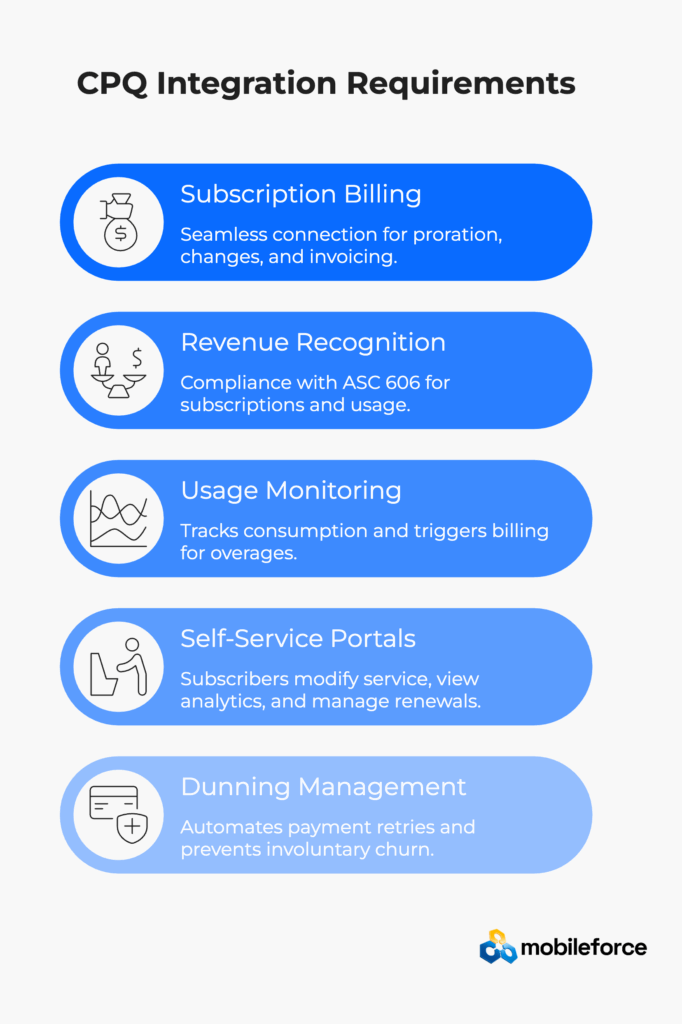
How do subscription models impact CPQ integration requirements?
Subscription and usage-based pricing models create new requirements for end-to-end quote-to-cash integration across revenue technology stacks. CPQ systems must seamlessly connect with:
System Type | Integration Priority | Key Data Flows | Implementation Complexity | Business Impact |
CRM (Salesforce, HubSpot) | Critical | Contacts, opportunities, quotes | Low | High sales efficiency |
ERP (SAP, NetSuite, Oracle) | Critical | Inventory, pricing, orders | Medium | Operational accuracy |
Billing (Zuora, Chargebee) | High | Subscriptions, usage, invoices | Medium | Revenue automation |
Payment Processing (Stripe) | High | Transactions, failed payments | Low | Cash flow optimization |
E-signature (DocuSign) | Medium | Contracts, approvals | Low | Deal closure speed |
Business Intelligence | Medium | Analytics, reporting | Medium | Decision insights |
Marketing Automation | Low | Leads, campaigns | Low | Lead qualification |
Customer Support | Low | Cases, product issues | Low | Service coordination |
Inventory Management | High | Stock levels, availability | Medium | Delivery accuracy |
Tax Calculation (Avalara) | Medium | Tax rates, compliance | Low | Regulatory compliance |
Transform your subscription billing with confidence. Explore Mobileforce’s unified quote-to-cash platform that handles complex pricing models without custom code.
What is driving the demand for self-service CPQ capabilities?
The rise of self-service CPQ platforms represents a fundamental shift in B2B buying behavior driven by digital transformation and changing customer expectations. Modern business buyers, influenced by consumer-grade digital experiences, increasingly expect the ability to configure products, compare pricing options, and generate quotes without direct sales intervention or lengthy approval processes.
Self-service CPQ adoption is accelerating because it delivers measurable benefits: faster quote generation for buyers, reduced sales cycle length, improved customer experience, and lower cost of sales for vendors.
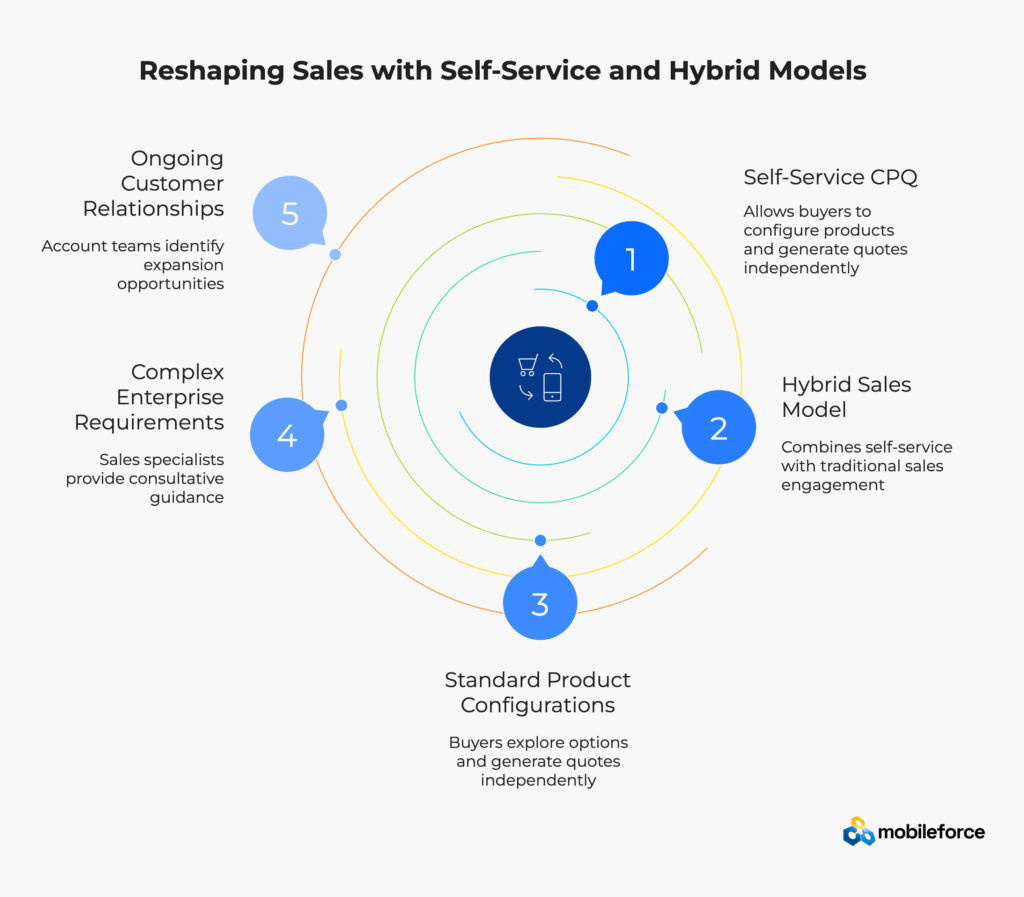
How do hybrid sales models optimize revenue generation?
Smart organizations are implementing hybrid sales approaches that combine self-service CPQ capabilities with traditional sales engagement to maximize conversion rates and deal values:
For standard product configurations: Buyers can explore product options, compare feature sets, and generate quotes independently through intuitive self-service configuration portals For complex enterprise requirements: Seamless handoff to sales specialists who can provide consultative guidance, handle custom pricing scenarios, and manage enterprise-specific customizations For ongoing customer relationships: Account teams maintain visibility into self-service activities to identify expansion opportunities, provide proactive support, and manage renewal processes
Research shows that 73% of organizations deploy hybrid cloud solutions, and this hybrid approach is extending to sales processes as well, creating new opportunities for revenue optimization and customer experience improvement.
What mobile capabilities are essential for modern CPQ platforms?
The mobile revolution has reached enterprise CPQ software, with sales teams and customers increasingly expecting mobile-optimized quoting experiences that work seamlessly across devices and locations. This requirement extends beyond responsive web design to include:
Essential mobile CPQ features:
Mobile Feature | Importance Level | Implementation Difficulty | User Impact | ROI Timeline |
Responsive Web Design | Critical | Low | High | Immediate |
Offline Quote Access | High | Medium | High | 1-3 months |
Touch Configuration | Critical | Medium | Very High | Immediate |
Mobile Approvals | High | Low | High | 1 month |
GPS Integration | Medium | Medium | Medium | 3-6 months |
Camera Integration | Medium | High | Medium | 6-12 months |
Voice Commands | Low | High | Medium | 12+ months |
Barcode Scanning | Medium | Medium | High | 3-6 months |
Push Notifications | High | Low | High | 1 month |
Biometric Security | Medium | Medium | Medium | 6-12 months |
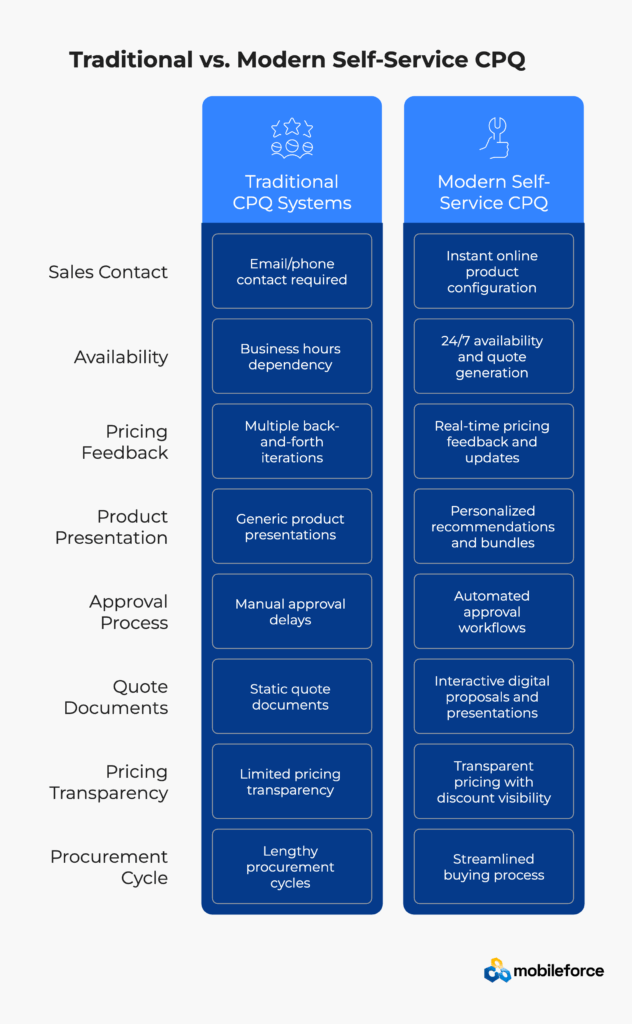
Traditional CPQ Systems | Modern Self-Service CPQ |
Email/phone sales contact required | Instant online product configuration |
Business hours dependency | 24/7 availability and quote generation |
Multiple back-and-forth iterations | Real-time pricing feedback and updates |
Generic product presentations | Personalized recommendations and bundles |
Manual approval delays | Automated approval workflows |
Static quote documents | Interactive digital proposals and presentations |
Limited pricing transparency | Transparent pricing with discount visibility |
Lengthy procurement cycles | Streamlined buying process |
What integration capabilities are essential for enterprise CPQ success?
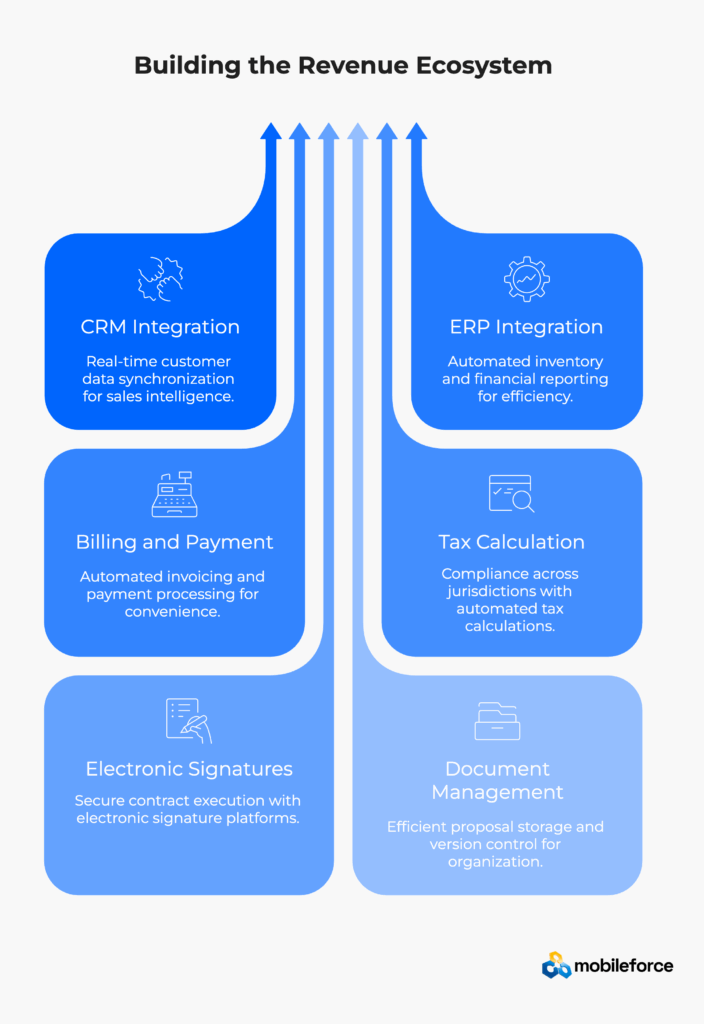
The future of configure price quote software lies not in standalone solutions but in comprehensive revenue platform ecosystems that orchestrate the entire quote-to-cash process. By 2026, winning organizations will have moved beyond point solutions toward integrated revenue technology stacks that connect every touchpoint in the customer revenue journey, from initial lead qualification through subscription renewal management.
Modern CPQ integration requirements encompass sales automation, marketing automation, customer success platforms, financial systems, and business intelligence tools to create a unified view of customer lifecycle value and revenue optimization opportunities.
How does CPQ integration with CRM and ERP systems improve sales performance?
Modern enterprise CPQ platforms must integrate seamlessly with existing business systems to provide unified data flow and eliminate manual processes that create revenue leakage and operational inefficiencies. This integration extends across multiple system categories:
Customer Relationship Management (CRM) Integration Benefits:
Enterprise Resource Planning (ERP) Integration Capabilities:
Advanced Integration Features:
Platforms like Mobileforce have recognized this integration imperative by building their Revenue Engagement Cloud to connect CPQ, selling, and service management into one seamless workflow, eliminating the friction and data silos created by legacy tools that require extensive custom integration work.
How do CPQ platforms support modern distribution strategies?
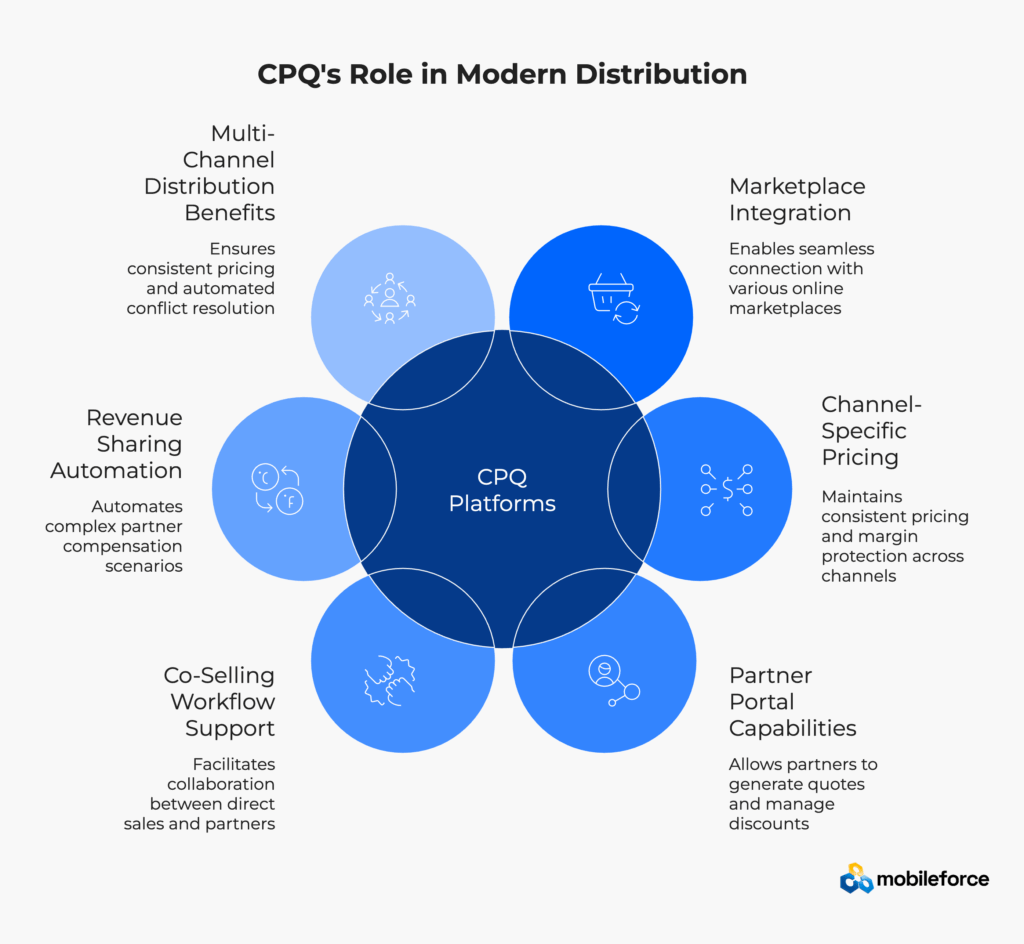
As B2B marketplaces gain traction and businesses adopt multi-channel distribution strategies, CPQ systems must support diverse selling scenarios while maintaining pricing consistency and margin protection. This requirement includes:
Marketplace Integration Capabilities:
Multi-Channel Distribution Benefits:
See how seamless integration drives results. Learn about Mobileforce’s native CRM connections that eliminate data silos and reduce implementation time.
Platform Category | Legacy Enterprise | Traditional Cloud | Modern No-Code | Next-Gen Platforms |
Implementation Timeline | 6-18 months | 3-6 months | 4-8 weeks | 3-6 weeks |
$500K-$2M+ | $200K-$800K | $50K-$300K | $75K-$400K | |
User Training Required | 4-8 weeks | 2-4 weeks | 1-2 weeks | 1-3 days |
Mobile Experience | Poor/Limited | Good | Excellent | Native-first |
AI Capabilities | None/Basic | Limited | Advanced | Leading Edge |
No-Code Configuration | Not Available | Basic | Full Featured | Advanced |
Subscription Billing Support | Add-on Module | Good | Native | Advanced |
API Integration Quality | Limited/Complex | Good | Excellent | API-first |
Quote Generation Speed | Hours/Days | Minutes | Seconds | Instant |
Pricing Model Flexibility | Static | Good | Dynamic | Intelligent |
Scalability | High (expensive) | Medium | High | Unlimited |
Security & Compliance | Enterprise | Standard | Enterprise | Advanced |
Customization Approach | Code-heavy | Configuration | Visual | Intelligent |
Market Position | Declining | Stable | Growing | Emerging Leader |
Representative Solutions | Legacy enterprise systems | Traditional cloud platforms | Modern no-code platforms | Next-generation solutions |
What are the advantages of no-code CPQ platforms for business users?
The no-code revolution has reached enterprise software solutions, and CPQ platforms are at the forefront of this transformation toward business user empowerment. By 2026, successful CPQ implementations will be characterized by their ability to empower business users—not just IT departments—to configure pricing rules, create product bundles, design approval workflows, and manage quote templates without requiring programming expertise or technical training.
No-code CPQ platforms deliver measurable business benefits: faster implementation timelines, reduced total cost of ownership, improved agility for market changes, and enhanced user adoption rates across sales organizations.
How do no-code interfaces improve CPQ adoption and effectiveness?
Traditional CPQ implementations often required extensive technical expertise to modify pricing rules, add new product configurations, or adjust approval processes. Modern no-code platforms enable sales operations teams and business analysts to manage these functions independently:
Visual workflow design capabilities:
Advanced no-code features:
What cost benefits do no-code CPQ platforms provide?
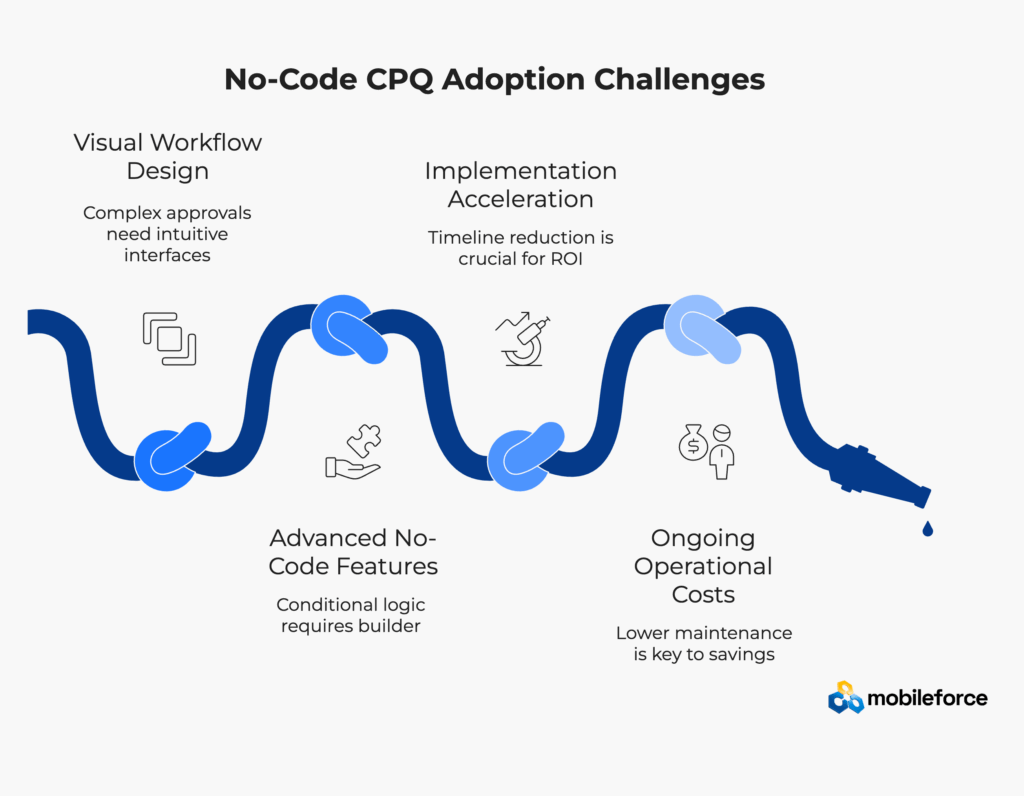
The shift to no-code platforms dramatically reduces both implementation timeframes and total cost of ownership compared to traditional enterprise software deployments. Organizations implementing modern no-code CPQ solutions report significant improvements across multiple cost dimensions:
Implementation acceleration metrics:
Ongoing operational cost savings:
No-Code vs Traditional CPQ: Cost Comparison
Cost Factor | Traditional CPQ | No-Code CPQ |
Implementation timeline | 6-18 months | 25-47 days |
Technical expertise required | High (developers/consultants) | Low (business users) |
Ongoing maintenance | IT-dependent | Business user-managed |
Change implementation speed | Weeks/months | Hours/days |
Training requirements | Extensive (weeks) | Minimal (days) |
System upgrade complexity | High risk/cost | Automated/seamless |
How does quote generation speed impact sales performance and revenue?
In an era where buyer expectations are shaped by consumer-grade digital experiences and instant gratification, quote generation speed has become a critical competitive advantage and revenue driver. The organizations that win in 2026 will be those that can respond to market changes and customer requirements with unprecedented agility while maintaining pricing accuracy and compliance standards.
Research consistently demonstrates the revenue impact of faster quote processes: modern CPQ platforms reduce quote turnaround times by over 50% according to industry research, directly translating to higher conversion rates and improved sales productivity metrics.
What are the expected performance standards for modern CPQ systems?
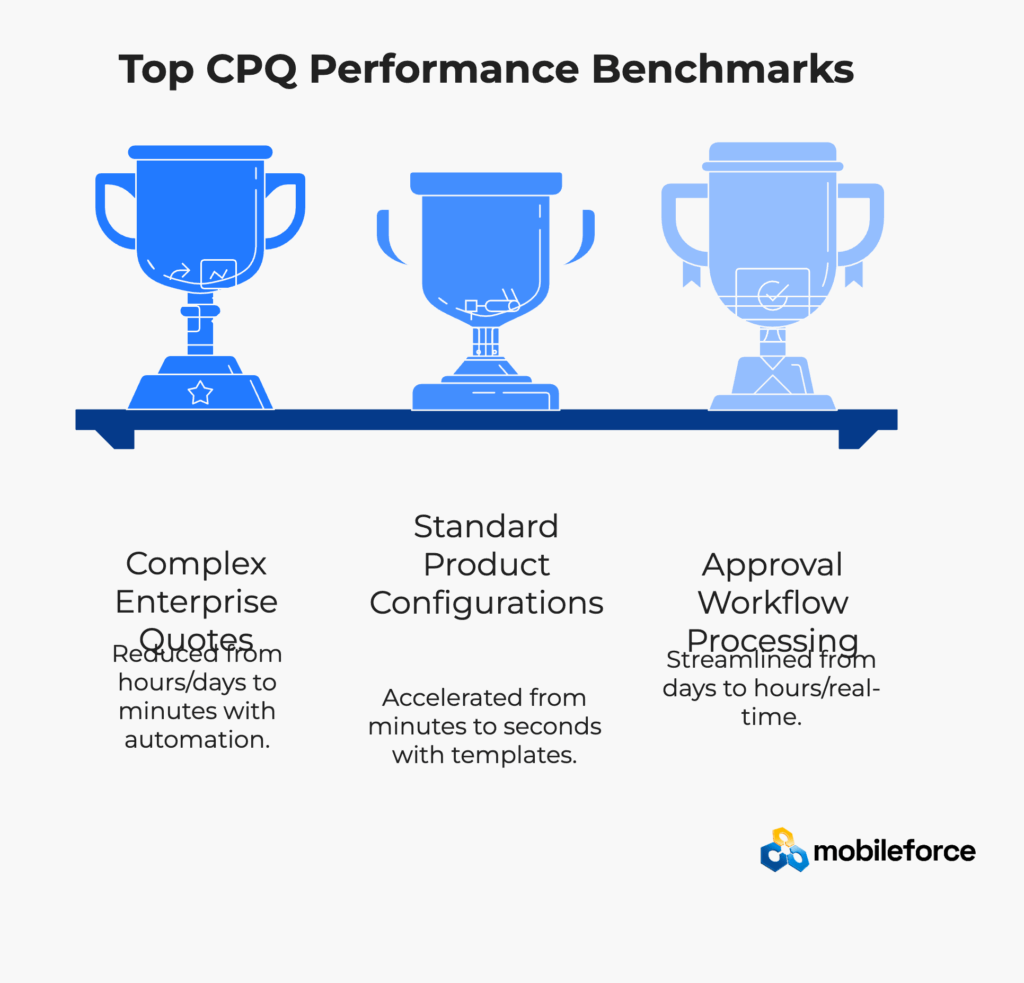
Modern enterprise CPQ platforms are establishing new performance benchmarks that redefine customer expectations and sales process efficiency:
Quote generation speed improvements:
Research consistently shows that organizations using CPQ reduce quote turnaround times by over 50%, with leading implementations achieving even more dramatic improvements in sales cycle acceleration and customer satisfaction scores.
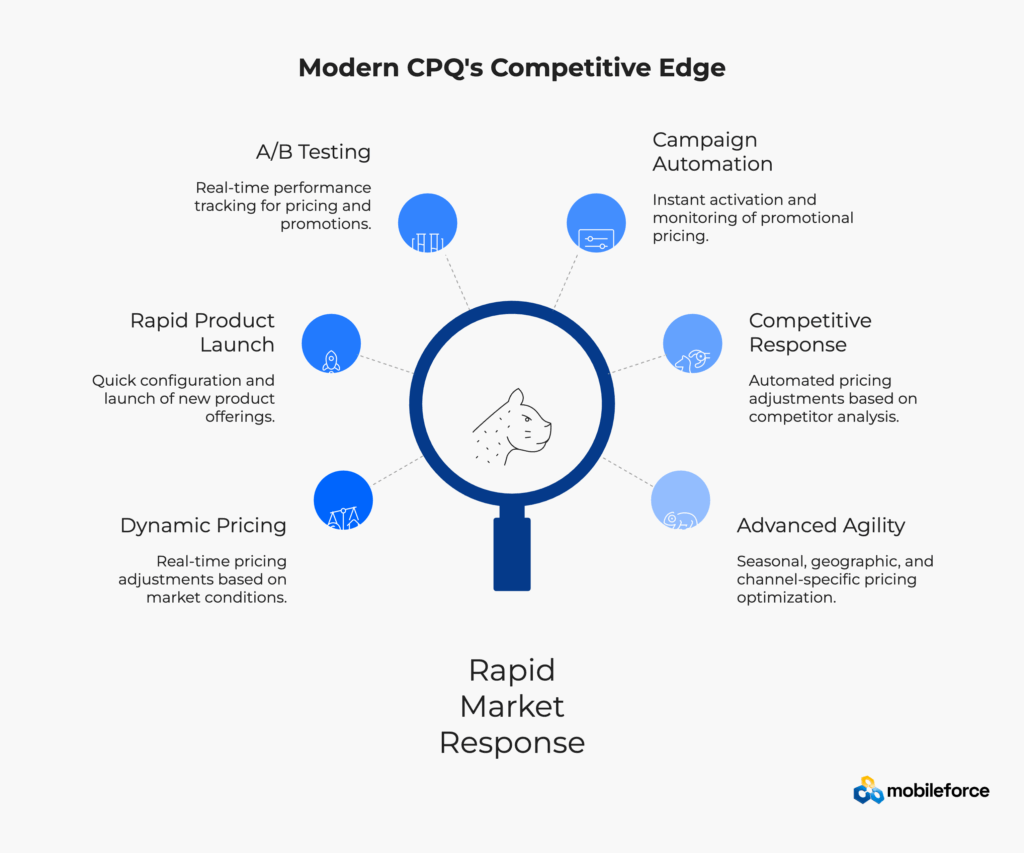
How do modern CPQ platforms enable rapid market response?
The ability to quickly adjust pricing strategies, launch new product offerings, or modify configurations in response to market conditions becomes crucial in volatile business environments and competitive markets. Modern CPQ platforms enable unprecedented market responsiveness:
Dynamic pricing and configuration capabilities:
Advanced agility features:
Performance Metric | Legacy CPQ Systems | Modern No-Code Platforms |
Implementation timeline | 6-18 month deployments | 3-6 week go-live schedules |
Quote generation speed | Hours to days | Seconds to minutes |
Pricing rule changes | Weeks with IT involvement | Minutes with business user control |
New product additions | Complex development cycles | Point-and-click configuration |
System updates | High-risk quarterly releases | Continuous automated updates |
User training requirements | Weeks of intensive training | Hours of intuitive learning |
Market response time | Months for pricing changes | Real-time adjustment capability |
Integration complexity | Custom development required | Pre-built connector libraries |
Key Performance Indicators for CPQ Speed:
Ready to accelerate your sales process? Discover how Mobileforce delivers 75% time savings with their no-code CPQ platform.
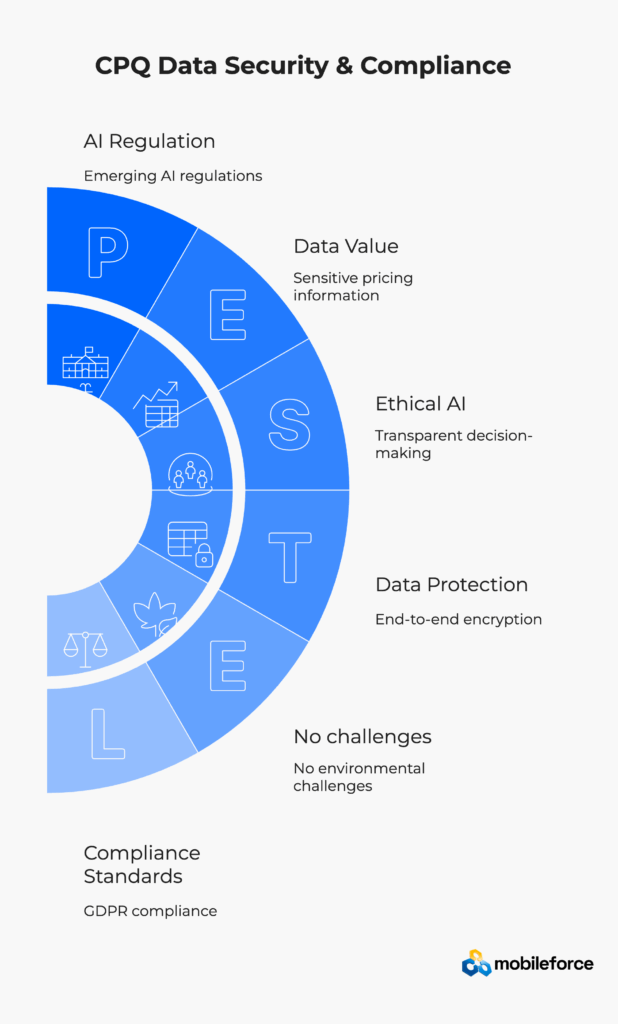
As CPQ systems become more intelligent and autonomous, organizations must address new challenges around data governance, security, and regulatory compliance. The stakes are particularly high given that CPQ systems handle sensitive pricing information, customer data, and competitive intelligence.
With AI-driven pricing decisions and automated quote generation, organizations need robust governance frameworks that ensure:
The EU’s Artificial Intelligence Act and similar emerging regulations will require organizations to demonstrate responsible AI usage, particularly in systems that affect pricing and contract terms.
Modern CPQ platforms must protect sensitive information while enabling collaboration across teams and systems. Key security requirements include:
Platforms like Mobileforce address these concerns with enterprise-grade security including SOC 2 certification, GDPR compliance, and ISO 22301:2019 business continuity standards.
Security Feature | Basic CPQ | Enterprise CPQ | Regulatory Requirement | Mobileforce Support |
Data Encryption (at rest) | Basic | AES-256 | GDPR, HIPAA | ✓ Advanced |
Data Encryption (in transit) | SSL | TLS 1.3 | SOC 2, PCI DSS | ✓ Advanced |
Role-Based Access Control | Limited | Granular | SOX, ISO 27001 | ✓ Advanced |
Multi-Factor Authentication | Optional | Required | NIST, GDPR | ✓ Required |
Audit Trails | Basic | Comprehensive | SOX, GDPR | ✓ Comprehensive |
Data Backup | Manual | Automated | Business Continuity | ✓ Automated |
Disaster Recovery | Basic | Enterprise | ISO 22301 | ✓ Enterprise |
Single Sign-On (SSO) | Limited | Full Support | Enterprise Security | ✓ Full Support |
API Security | Basic | OAuth 2.0/JWT | Industry Standard | ✓ OAuth 2.0 |
Penetration Testing | None | Regular | Security Best Practice | ✓ Regular |
Compliance Certifications | None | Multiple | Industry Requirements | ✓ SOC 2, GDPR, ISO |
Data Residency Options | Single | Multiple | GDPR, Local Laws | ✓ Multiple |
What are the fundamental limitations of legacy CPQ systems?
Understanding where legacy CPQ systems struggle helps illuminate why modern platforms represent such a significant advancement in sales automation and revenue optimization. Traditional CPQ tools, often built around manufacturing and hardware sales models in the 1990s and 2000s, face fundamental architectural limitations when applied to today’s business requirements including subscription billing, usage-based pricing, and digital service offerings.
Legacy CPQ limitations create measurable business impacts: longer sales cycles, higher error rates, increased operational costs, reduced agility, and poor user adoption that directly affects revenue performance and competitive positioning.
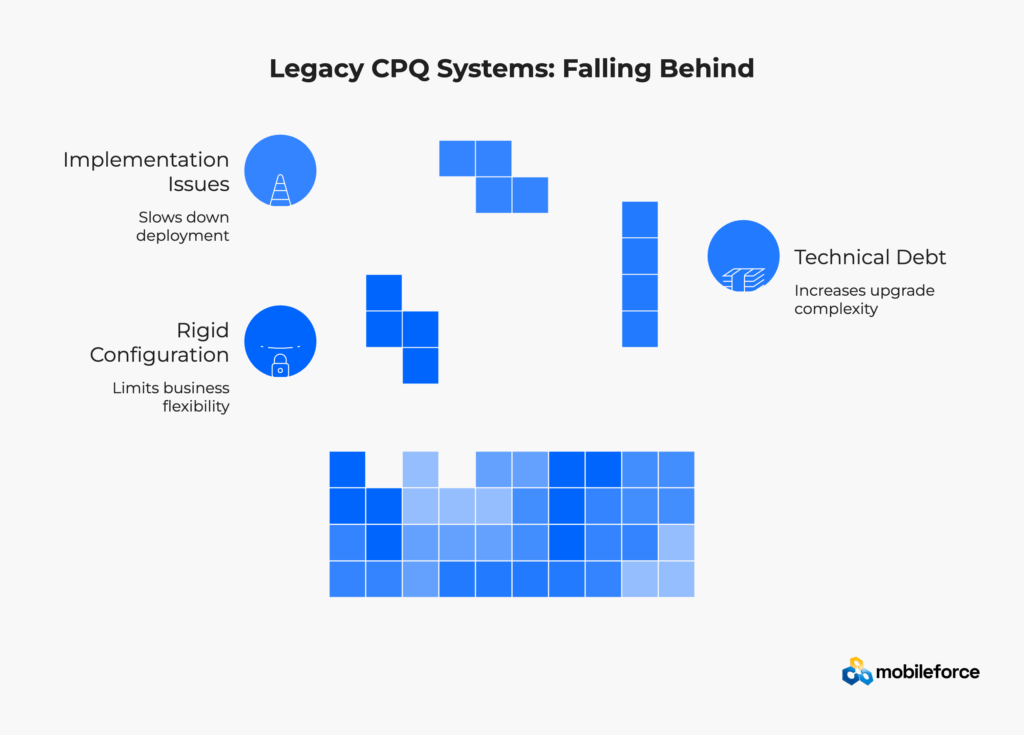
How do legacy architectures limit business flexibility?
Legacy systems typically rely on outdated architectural approaches that cannot accommodate modern business models and pricing strategies:
Structural limitations of legacy CPQ:
Technical debt consequences:
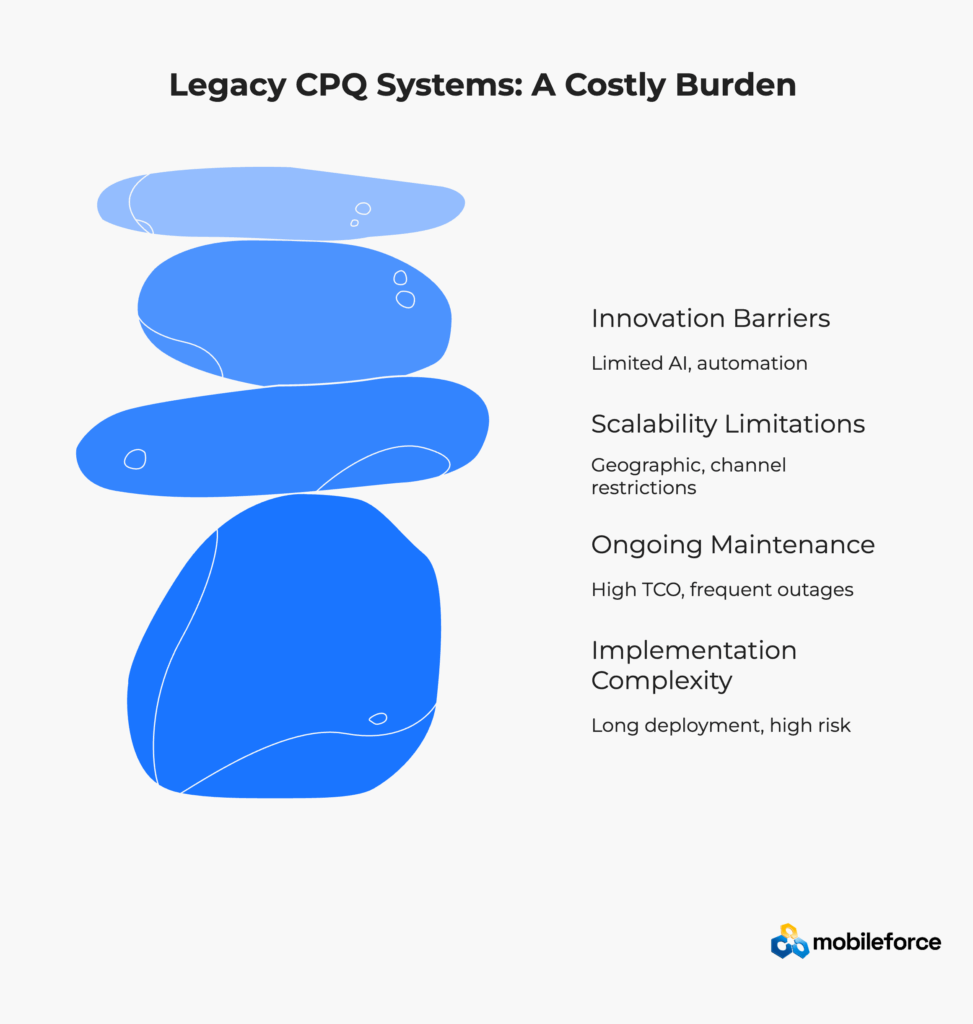
What hidden costs do legacy CPQ systems impose?
Traditional CPQ deployments often suffer from implementation challenges that create long-term operational burdens and hidden costs:
Implementation complexity factors:
Ongoing maintenance burden:
How do legacy systems constrain business growth?
As businesses grow and evolve, legacy systems become constraints rather than enablers of revenue growth and market expansion:
Scalability limitations:
Innovation barriers:
Business impact of legacy CPQ limitations:
Business Function | Legacy System Impact | Modern Platform Benefit |
Sales productivity | Manual processes reduce efficiency | Automated workflows increase output |
Pricing accuracy | Error-prone manual calculations | AI-powered validation and optimization |
Quote generation speed | Hours to days for complex quotes | Minutes for any configuration |
Market responsiveness | Weeks to implement pricing changes | Real-time adjustment capability |
Customer experience | Slow, error-prone quote process | Instant, accurate quote generation |
Revenue optimization | Limited pricing intelligence | Advanced analytics and AI insights |
Competitive positioning | Slow response to market changes | Rapid adaptation to opportunities |
Operational costs | High maintenance and IT dependency | Low-maintenance, self-service management |
Break free from legacy limitations. See how Mobileforce’s modern architecture enables rapid deployment and continuous innovation.
What are the best practices for CPQ vendor selection and implementation?
Organizations evaluating CPQ software platforms or planning legacy system upgrades should consider several critical factors to ensure long-term success, competitive advantage, and measurable return on investment. The most successful CPQ implementations in 2026 will be those that align platform capabilities with specific business requirements while maintaining flexibility for future growth and market evolution.
What features should organizations prioritize when selecting CPQ software?
Essential platform requirements:
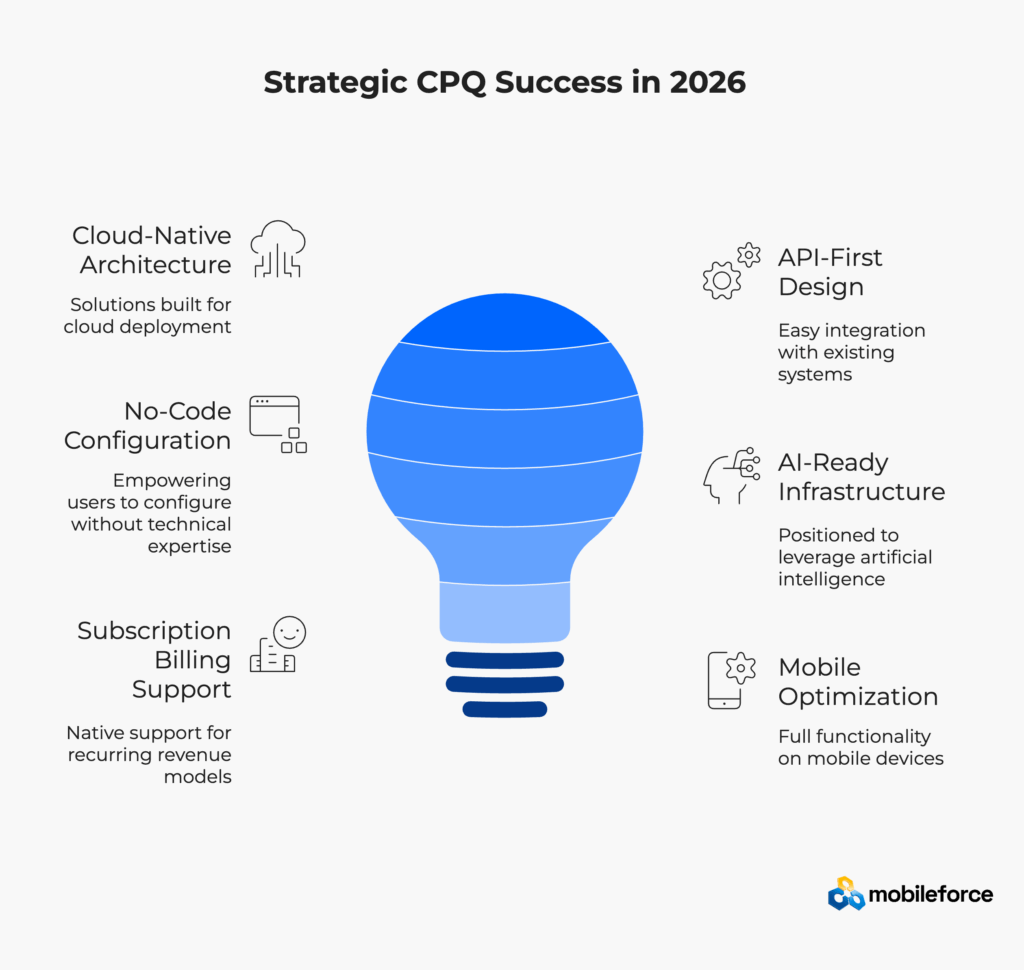
Cloud-Native Architecture: Choose solutions built for cloud deployment from the ground up, not legacy systems adapted for cloud hosting with architectural limitations and performance constraints
API-First Design: Ensure platforms can integrate easily with existing and future business systems through robust APIs, webhook support, and real-time data synchronization capabilities
No-Code Configuration Capabilities: Prioritize solutions that empower business users to configure pricing rules, product bundles, approval workflows, and quote templates without technical expertise
AI-Ready Infrastructure: Select platforms positioned to leverage artificial intelligence for pricing optimization, intelligent product recommendations, and sales process automation
Subscription Billing Support: Verify native support for recurring revenue models, usage-based pricing, proration calculations, and subscription lifecycle management
Mobile Optimization: Ensure platforms deliver full functionality on mobile devices for field sales teams and customer self-service scenarios
How should organizations approach CPQ implementation for maximum success?
Phased implementation strategy:
Start with Core Use Cases: Begin with the most common quoting scenarios and highest-value product lines before expanding to complex edge cases and specialized configurations
Design for End-to-End Integration: Plan comprehensive data flow from initial quote generation through contract execution, order fulfillment, billing, and revenue recognition
Invest in Data Quality Preparation: Clean and organize product catalogs, pricing data, customer information, and business rules before system migration
Plan for Change Management: Prepare sales teams, operations staff, and management for new processes through comprehensive training programs and ongoing support
Establish Success Metrics: Define clear key performance indicators for quote generation speed, pricing accuracy, sales productivity, and customer satisfaction
What metrics should organizations use to measure CPQ implementation success?
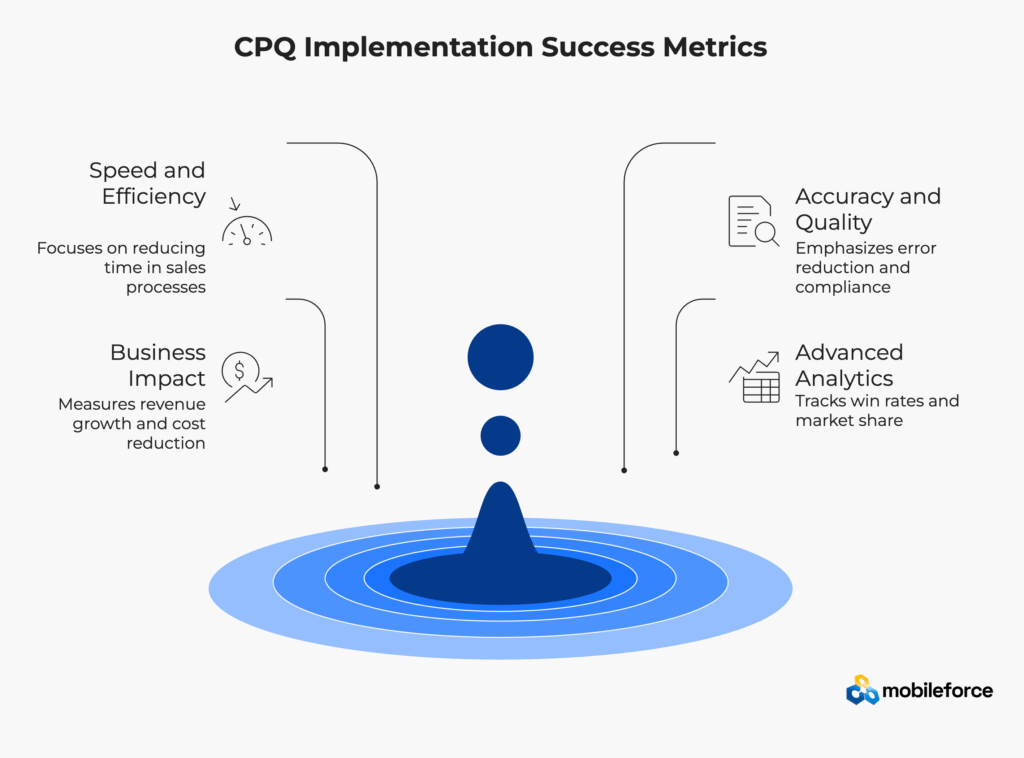
Organizations should establish clear metrics to measure CPQ return on investment across multiple business dimensions:
Speed and Efficiency Metrics:
Accuracy and Quality Metrics:
Business Impact Metrics:
Advanced Analytics and Performance Tracking:
Metric Category | Specific KPI | Measurement Method | Target Improvement | Timeline |
Speed Metrics | Quote Generation Time | Before/after time tracking | 50-75% reduction | 30 days |
Approval Cycle Duration | Workflow analytics | 60-90% reduction | 60 days | |
Sales Cycle Length | CRM integration data | 20-40% reduction | 90 days | |
Accuracy Metrics | Pricing Error Rate | Quote vs. invoice comparison | 90%+ reduction | 30 days |
Quote-to-Order Conversion | Pipeline tracking | 15-25% improvement | 90 days | |
Contract Compliance | Audit trail analysis | 95%+ adherence | 60 days | |
Productivity Metrics | Quotes per Rep per Day | Activity tracking | 100%+ increase | 60 days |
Revenue per Rep | Performance analytics | 25-50% increase | 180 days | |
Administrative Time | Time allocation studies | 60-80% reduction | 90 days | |
Financial Metrics | Deal Size Average | Revenue analysis | 15-30% increase | 180 days |
Win Rate | Opportunity tracking | 20-40% improvement | 180 days | |
Revenue Leakage | Billing reconciliation | 90%+ reduction | 120 days |
What technical considerations are critical for CPQ success?
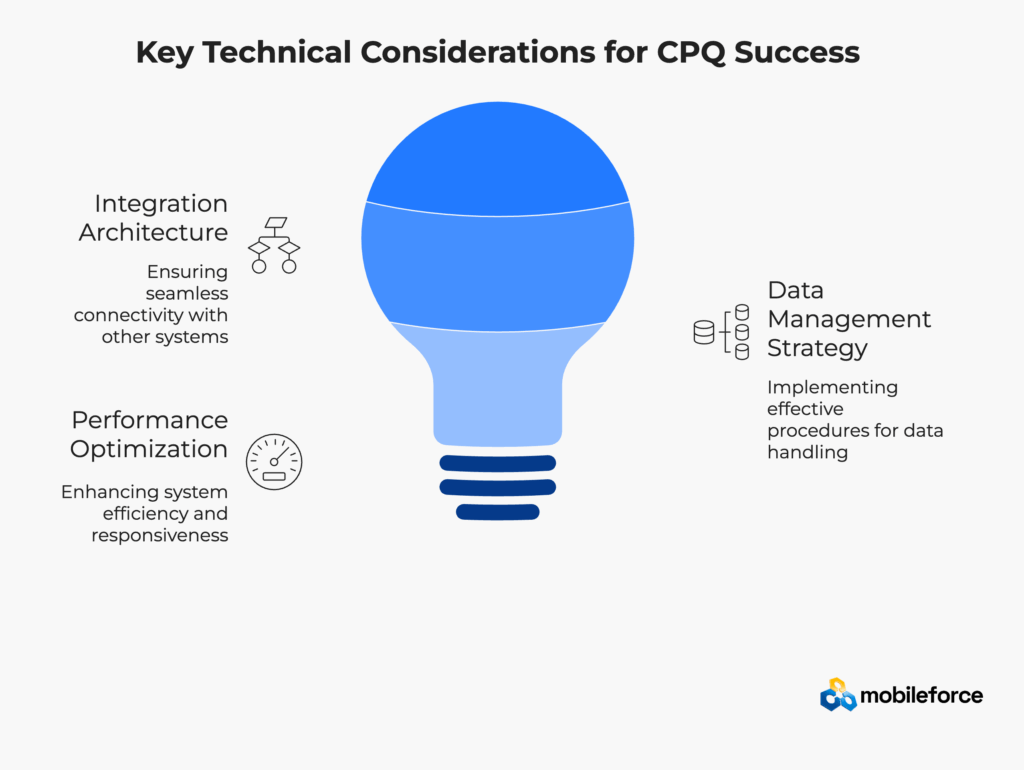
Successful CPQ implementations require careful attention to technical infrastructure, system integration, and data management requirements:
Integration Architecture:
Data Management Strategy:
Performance Optimization:
As organizations evaluate their CPQ options for 2026, platforms like Mobileforce represent the next generation of revenue engagement solutions. Unlike legacy systems retrofitted for modern requirements, Mobileforce was designed from inception to address the challenges outlined in this analysis.
Mobileforce’s no-code platform exemplifies the democratization of CPQ configuration. Sales operations teams can design complex pricing rules, approval workflows, and product bundles using visual interfaces that require no programming expertise.
The platform’s approach to configuration means organizations can:
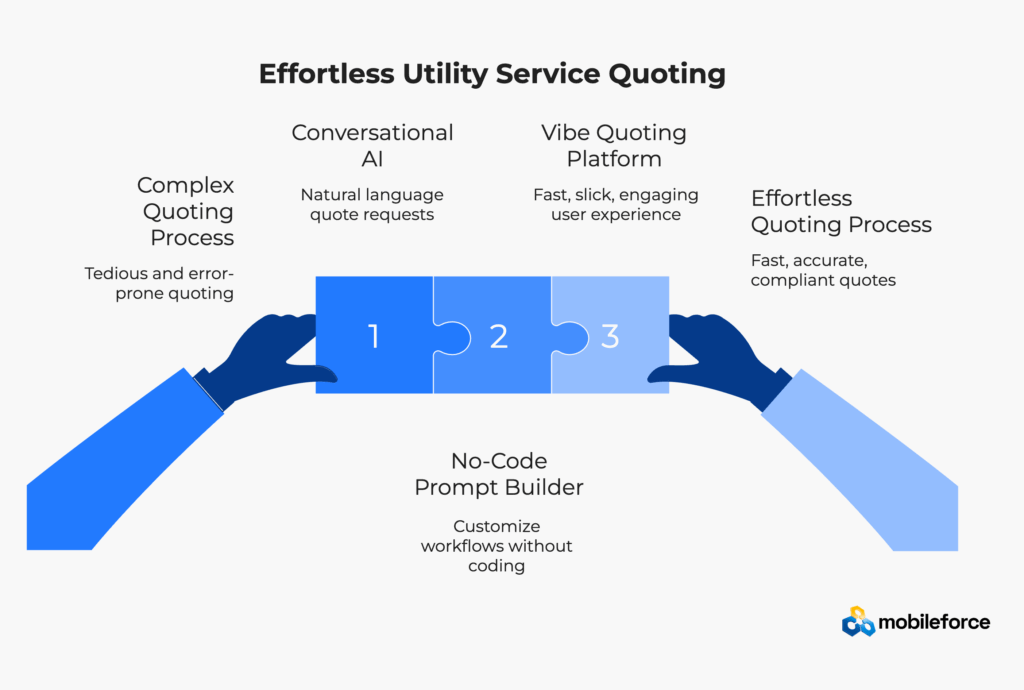
Mobileforce’s AI prompt quoting capability represents the cutting edge of natural language CPQ interaction. Sales representatives can generate complex quotes by describing customer needs in plain English, with the AI system automatically configuring products, applying appropriate pricing rules, and ensuring compliance with approval policies.
Rather than treating CPQ as an isolated function, Mobileforce positions it within a broader Revenue Engagement Cloud that connects quoting, field service management, and customer lifecycle workflows. This integrated approach addresses the end-to-end revenue challenges that will define competitive advantage in 2026.
The platform’s demonstrated results speak to its effectiveness: 3.2x average ROI, 75% time savings, and 40% faster quote generation for customers who have made the transition from legacy systems.
SportSafe’s experience with Mobileforce illustrates the transformative potential of modern CPQ platforms. Alex Wilkins from SportSafe notes: “The efficiency and adaptability that Mobileforce’s no-code platform brought to our processes is dramatic and something no other company could offer us.”
This real-world validation demonstrates how purpose-built platforms can deliver results that incremental improvements to legacy systems cannot match.
Experience the future of CPQ today. Schedule your personalized demonstration to see how Mobileforce can transform your revenue operations.
Business Size | Annual Revenue | User Count | Key Requirements | Budget Range | Recommended Timeline |
Startup/SMB | <$10M | 5-50 | Basic quoting, CRM sync | $10K-$50K | 2-4 weeks |
Mid-Market | $10M-$100M | 50-250 | Approval workflows, integrations | $50K-$150K | 4-8 weeks |
Enterprise | $100M-$1B | 250-1000 | Advanced features, compliance | $150K-$400K | 6-12 weeks |
Large Enterprise | $1B+ | 1000+ | Global deployment, customization | $400K-$1M+ | 8-16 weeks |
Industry Vertical | Unique Requirements | Implementation Complexity | Regulatory Considerations |
Technology/SaaS | Subscription billing, usage tracking | Medium | Data privacy, security |
Manufacturing | BOM management, configurators | High | Safety standards, quality |
Healthcare | Equipment financing, compliance | Very High | FDA, HIPAA, medical device |
Financial Services | Complex products, risk assessment | High | SOX, banking regulations |
Professional Services | Time-based billing, resource allocation | Medium | Industry-specific standards |
Telecommunications | Service bundles, network infrastructure | High | FCC, carrier regulations |
Energy/Utilities | Asset-based pricing, regulatory pricing | Very High | Public utility commissions |
Automotive | Vehicle configuration, dealer networks | High | Safety, environmental standards |
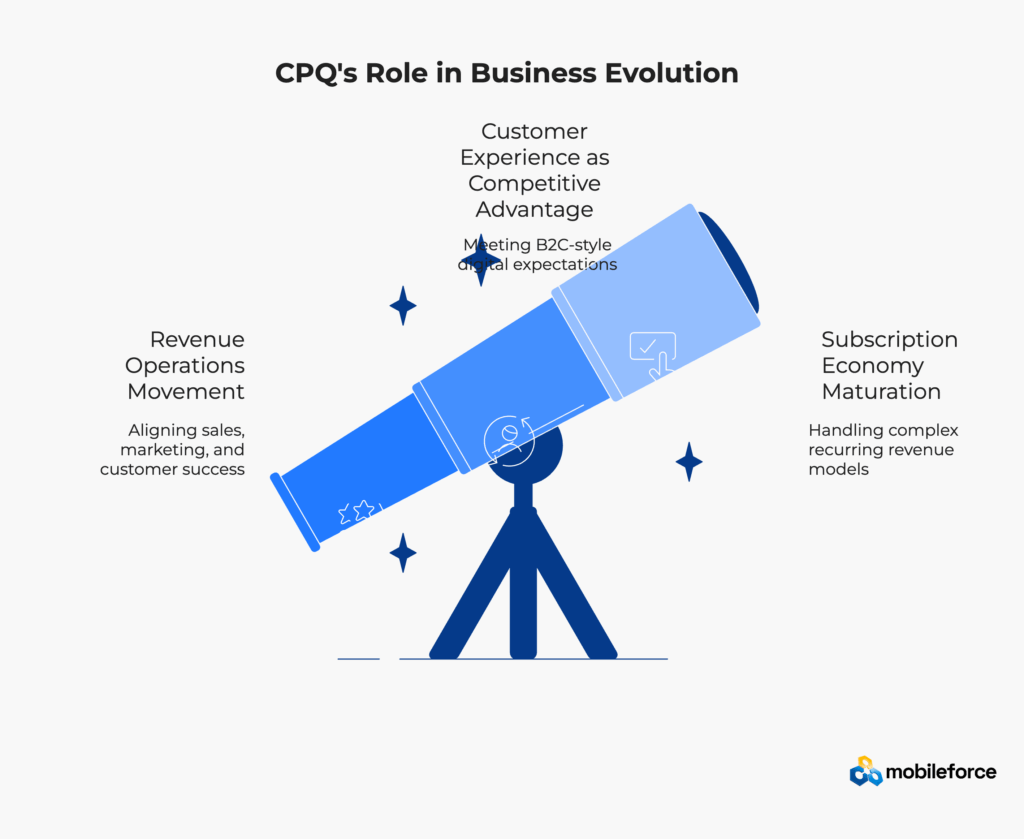
The evolution of CPQ technology reflects broader trends reshaping B2B sales and revenue operations. As we approach 2026, several macro trends will influence how organizations approach their technology investments:
Revenue Operations (RevOps) has emerged as a critical organizational function focused on aligning sales, marketing, and customer success around shared revenue goals. Modern CPQ platforms serve as central components of RevOps technology stacks, providing the data and process automation necessary to optimize the entire revenue journey.
B2B buyers increasingly expect B2C-style digital experiences. This expectation extends to the quoting and purchasing process, where buyers want self-service options, transparent pricing, and frictionless transactions. CPQ platforms that deliver superior buyer experiences will provide significant competitive advantages.
The subscription economy has moved beyond software companies to encompass manufacturing, professional services, and traditional product businesses. This shift requires CPQ platforms capable of handling complex recurring revenue models, usage-based pricing, and subscription lifecycle management.
What actions should organizations take to prepare for CPQ transformation in 2026?
The configure price quote software landscape of 2026 will be defined by intelligent automation, subscription-centric pricing models, and seamless integration across the entire revenue technology stack. Organizations still relying on legacy quoting processes—whether spreadsheet-based manual processes or traditional CPQ systems—face mounting competitive pressure as customer expectations evolve toward instant quote generation and market dynamics accelerate toward real-time responsiveness.
The window for CPQ transformation is narrowing rapidly. Early adopters of modern CPQ platforms are already realizing significant advantages in quote generation speed, pricing accuracy, customer experience quality, and revenue optimization. As artificial intelligence capabilities mature and no-code platforms democratize complex configuration management, the performance gap between market leaders and laggards will only widen through 2026 and beyond.
Immediate action items for CPQ transformation:
Success in 2026 requires more than incremental improvements to existing processes. It demands a fundamental rethinking of how organizations approach the quote-to-cash journey, with CPQ serving as the central orchestration platform for revenue-generating activities across subscription management, usage-based billing, and customer lifecycle optimization.
The question isn’t whether your organization will modernize its CPQ capabilities—market forces and customer expectations make this transformation inevitable. The critical question is whether you’ll lead the transformation as an early adopter or be forced to catch up to competitors who acted decisively when the opportunity was clear.
Organizations that act now will benefit from:
The CPQ revolution is already underway. Market leaders are making their moves now, building sustainable competitive advantages through modern platforms that deliver measurable business results. The window for strategic advantage remains open, but it won’t remain that way indefinitely.
Don’t wait for the competition to gain an insurmountable advantage. Start your CPQ transformation today with a platform built for the future of revenue operations and designed to deliver results from day one.
Traditional CPQ systems were built primarily for manufacturing and hardware sales in the 1990s and 2000s, with rigid product hierarchies and static pricing models designed around bill-of-materials and SKU-based configurations. Modern CPQ platforms are designed for today’s subscription-based, service-oriented businesses with dynamic pricing capabilities, no-code configuration tools, and AI-powered automation features.
Key differences include implementation speed (legacy systems require 6-18 months vs. modern platforms deploying in 25-47 days), user experience (complex interfaces requiring extensive training vs. intuitive business-user friendly designs), and pricing model support (static pricing tables vs. dynamic subscription billing and usage-based pricing).
While legacy systems often require months of implementation and extensive customization, modern platforms like Mobileforce can be deployed in 25-47 days with minimal technical expertise required and no custom coding.
Artificial intelligence enhances CPQ through intelligent product recommendations, dynamic pricing optimization, natural language quote generation, automated compliance checking, and predictive sales analytics. Companies using AI-driven CPQ tools report 20% increases in customer satisfaction, while AI-powered quote generation allows sales reps to create complex configurations by simply describing customer needs in conversational language.
Specific AI capabilities include machine learning algorithms that analyze customer behavior patterns to recommend optimal product bundles, natural language processing for voice-to-quote generation, predictive pricing models that optimize margins and win rates, and automated approval workflows that reduce sales cycle length.
AI also enables real-time competitive intelligence integration, dynamic discount optimization based on deal characteristics, and intelligent cross-sell recommendations that increase average deal size while providing genuine customer value.
Legacy CPQ platforms were designed around static SKU-based configurations that cannot handle dynamic, parameterized pricing logic required by subscription models. Modern businesses need pricing engines that can manage recurring subscription charges, usage tier calculations, proration for mid-term changes, automated renewal workflows, and complex billing scenarios that traditional systems simply weren’t architected to support.
Specific challenges include multi-dimensional pricing structures with time-based variations, complex usage tier management with breakpoint calculations, hybrid pricing models combining subscriptions and consumption charges, revenue recognition compliance for subscription businesses, and automated dunning management for failed payment recovery.
Modern CPQ platforms handle these challenges through purpose-built subscription billing engines, automated proration calculations, usage tracking integrations, and compliance frameworks designed specifically for recurring revenue business models.
Successful CPQ implementations require seamless connectivity with customer relationship management (CRM) systems for account data, enterprise resource planning (ERP) systems for inventory and fulfillment, billing platforms for revenue management, revenue recognition systems for compliance, and business intelligence tools for analytics and reporting.
Essential integrations include real-time data synchronization with leading CRM platforms for customer information; inventory management systems for availability checking; enterprise billing and subscription management platforms for revenue operations; and payment processing systems for transaction completion.
Modern platforms should offer pre-built connectors, API-first architectures, and middleware integration capabilities that eliminate custom development complexity and reduce implementation risk.
Modern no-code CPQ platforms should deploy in 3-6 weeks, not 6-18 months typical of legacy systems. Industry leaders like Mobileforce guarantee 25-47 day implementation timelines, compared to legacy systems that often require extensive customization, complex data migration, and months of user training.
Implementation speed depends on platform architecture (cloud-native vs. on-premise), configuration complexity (no-code vs. custom development), data migration requirements, integration scope, and user training needs. Organizations should expect rapid time-to-value with modern platforms that emphasize intuitive interfaces and pre-built business process templates.
Key factors that accelerate implementation include choosing platforms with visual configuration tools, pre-built industry templates, automated data migration utilities, and comprehensive user training programs.
CPQ platforms must provide enterprise-grade security including data encryption at rest and in transit, role-based access controls with granular permissions, comprehensive audit trails for all system activities, and compliance with standards like SOC 2 Type II, GDPR, CCPA, and industry-specific regulations. Leading platforms maintain certifications including SOC 2, GDPR compliance, and ISO 22301:2019 for business continuity management.
With AI-powered systems, additional considerations include transparent decision-making algorithms, bias prevention in pricing recommendations, human oversight requirements for critical pricing decisions, and explainable AI capabilities for regulatory compliance.
Security requirements also encompass secure API endpoints for integrations, single sign-on (SSO) support for enterprise identity management, regular security assessments and penetration testing, data backup and disaster recovery capabilities, and geographic data residency options for international compliance.
Key metrics for measuring CPQ return on investment include quote generation speed improvements (target 50%+ faster), pricing accuracy increases (reduced error rates), sales productivity gains (more quotes per representative), revenue impact metrics (faster close rates and reduced leakage), and operational cost reductions (lower administrative overhead).
Specific KPIs include quote turnaround time reduction, approval cycle acceleration, deal size increases through intelligent upselling, sales cycle compression, customer satisfaction score improvements, and total cost of ownership reduction compared to legacy systems.
Organizations typically see 3.2x average ROI with properly implemented modern CPQ platforms, along with measurable improvements in sales team efficiency, customer experience scores, and revenue predictability. Leading no-code platforms like Mobileforce deliver 40% faster quote generation and 75% time savings compared to traditional manual processes.
Financial metrics should include implementation cost recovery timeframe, ongoing operational savings, revenue growth acceleration, and competitive advantage quantification through faster market response capabilities.
No-code functionality democratizes CPQ configuration management, allowing business users to modify pricing rules, create product bundles, design approval workflows, and manage quote templates without IT involvement or programming expertise. This capability reduces implementation time, eliminates ongoing maintenance costs, and enables rapid response to market changes.
Business benefits include faster deployment timelines (weeks vs. months), reduced total cost of ownership through eliminated developer dependencies, improved agility for pricing strategy changes, and enhanced user adoption through intuitive interfaces that require minimal training.
No-code platforms enable sales operations teams to experiment with pricing strategies, test new product bundles, optimize approval processes, and respond to competitive pressures without waiting for IT resources or external consultants.
Modern buyers expect the ability to configure products and price solutions independently through intuitive self-service portals, while still having access to sales support for complex requirements. CPQ platforms must support both customer-facing configuration tools and internal sales rep interfaces, with seamless handoff between self-service and assisted selling.
Self-service capabilities require mobile-optimized interfaces, real-time pricing feedback, guided configuration workflows, transparent approval processes, and integration with e-signature platforms for contract execution. Hybrid models enable standard configurations through self-service while routing complex requirements to sales specialists.
This approach improves customer experience through 24/7 availability, reduces sales cycle length for standard products, lowers cost of sales for routine transactions, and allows sales teams to focus on high-value opportunities requiring consultative selling.
Prioritize cloud-native platforms with artificial intelligence capabilities, no-code configuration tools, robust integration options, and proven rapid implementation timelines. Look for vendors with experience in your industry’s pricing models, demonstrated customer success stories, and a track record of successful deployments.
Essential vendor evaluation criteria include platform scalability for business growth, security and compliance certifications, API-first architecture for integration flexibility, mobile optimization for field sales teams, and comprehensive analytics for revenue optimization.
Most importantly, choose platforms positioned for future innovation rather than legacy systems trying to adapt to modern requirements. Evaluate vendor financial stability, product roadmap alignment with business needs, customer support quality, and implementation methodology maturity.
CPQ software pricing typically follows a subscription model based on user count, quote volume, or revenue processed through the system. Small businesses might pay $50-150 per user per month, while enterprise implementations can range from $200-500+ per user monthly depending on features and integration complexity.
Pricing factors include number of sales users, quote volume capacity, advanced features like AI-powered recommendations, integration requirements, implementation services, ongoing support levels, and customization needs.
Many vendors offer tiered pricing with basic quote generation at lower price points and advanced features like subscription billing, usage-based pricing, and AI capabilities in higher tiers. Enterprise deals often include volume discounts, multi-year commitments, and bundled implementation services.
Common implementation challenges include poor data quality during migration, insufficient user training, inadequate change management, scope creep during configuration, and integration complexity with existing systems.
Prevention strategies include conducting thorough data audits before migration, investing in comprehensive user training programs, establishing clear project scope and change control processes, choosing platforms with pre-built integrations, and working with experienced implementation partners.
Success factors include executive sponsorship for change management, dedicated project teams with business and technical expertise, phased rollout approaches for risk mitigation, and clear success metrics with regular progress monitoring.
Organizations should also plan for user adoption challenges by involving sales teams in platform selection, providing ongoing training and support, and demonstrating clear value propositions for new processes.
Challenge Category | Specific Issue | Root Cause | Impact | Recommended Solution |
Data Quality | Incomplete product catalog | Poor data governance | Inaccurate quotes | Pre-implementation data audit |
Pricing inconsistencies | Multiple data sources | Quote errors | Centralized pricing repository | |
Customer data duplication | CRM hygiene issues | Integration failures | Data deduplication process | |
User Adoption | Low system usage | Insufficient training | Reduced ROI | Comprehensive training program |
Resistance to change | Poor change management | Project delays | Executive sponsorship and communication | |
Workflow confusion | Complex interface design | User frustration | Simplified user experience design | |
Technical Issues | System performance | Poor architecture | User abandonment | Infrastructure optimization |
Integration failures | API compatibility | Data silos | Pre-built connector selection | |
Security vulnerabilities | Inadequate controls | Compliance risks | Security-first implementation | |
Project Management | Scope creep | Unclear requirements | Budget overruns | Detailed project planning |
Timeline delays | Resource constraints | Missed deadlines | Realistic timeline setting | |
Budget overruns | Hidden costs | Financial strain | Comprehensive cost analysis |
Modern CPQ platforms manage complex pricing through configurable rules engines that support volume-based discount tiers, customer-specific pricing agreements, time-based promotional pricing, geographic pricing variations, and contract-specific terms and conditions.
Advanced pricing capabilities include automated discount calculations based on quantity breakpoints, approval workflows for pricing exceptions, competitive pricing intelligence integration, margin protection rules, and contract lifecycle management for enterprise agreements.
Platforms also support matrix pricing for complex product configurations, bundle pricing optimization, subscription discount management, usage tier calculations, and renewal pricing automation for ongoing customer relationships.
Future CPQ trends include increased artificial intelligence integration for predictive pricing and automated negotiations, expansion into vertical-specific solutions for healthcare, financial services, and manufacturing, blockchain integration for contract management and payment processing, and augmented reality for complex product configuration.
Emerging capabilities will include voice-activated quote generation, predictive customer behavior modeling, automated competitive response systems, and integration with Internet of Things (IoT) devices for usage-based pricing in physical products.
The market will also see consolidation around comprehensive revenue platform providers, increased focus on customer experience optimization, and development of industry-specific compliance features for regulated sectors.