
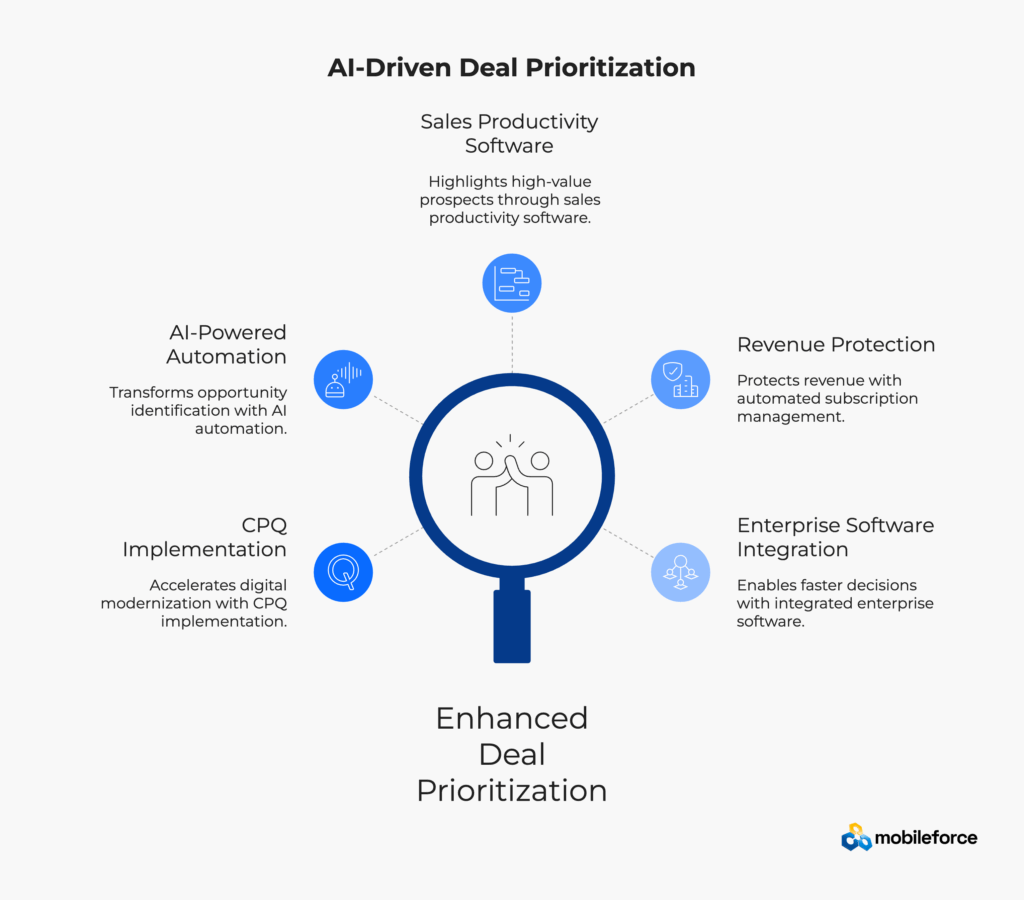
Sales teams lose approximately $1 trillion annually in missed revenue opportunities due to poor deal prioritization and manual quoting processes. Modern configure price quote software powered by conversational AI agents like AskCPQ™ are revolutionizing how businesses identify and pursue their most valuable sales opportunities. Rather than relying on complex predictive scoring algorithms, intelligent CPQ platforms focus on sales process automation that naturally surfaces high-priority opportunities like contract renewals, approval-required quotes, and cross-sell upsell scenarios. With the CPQ software market expanding to $3 billion in 2024 and projected to reach $10.8 billion by 2033, companies can no longer afford to let revenue opportunities slip through the cracks while competitors embrace AI-driven sales automation platforms.
Ready to see how AI-powered quoting can transform your deal prioritization process? Schedule a demo to discover how AskCPQ™ can help your sales team focus on the opportunities that matter most.
Picture this scenario that plays out in sales organizations every day: Sarah, a sales manager at a growing medical device company, starts her Monday morning with 47 open opportunities in her CRM. Three major contracts expire within 60 days, but they’re buried among dozens of smaller prospects. Meanwhile, her team is spending hours manually configuring quotes for deals that may never close, while high-value renewals risk slipping away unnoticed.
This challenge has intensified as product complexity grows. Over 60% of enterprises now report product lines with more than 1,000 distinct SKUs, making it nearly impossible for sales teams to manually track all revenue opportunities effectively.
The cost of these inefficiencies extends far beyond missed individual deals. According to recent industry research, companies using fragmented sales processes typically see:
These metrics highlight why sales enablement technology has become essential for competitive advantage in modern B2B markets.
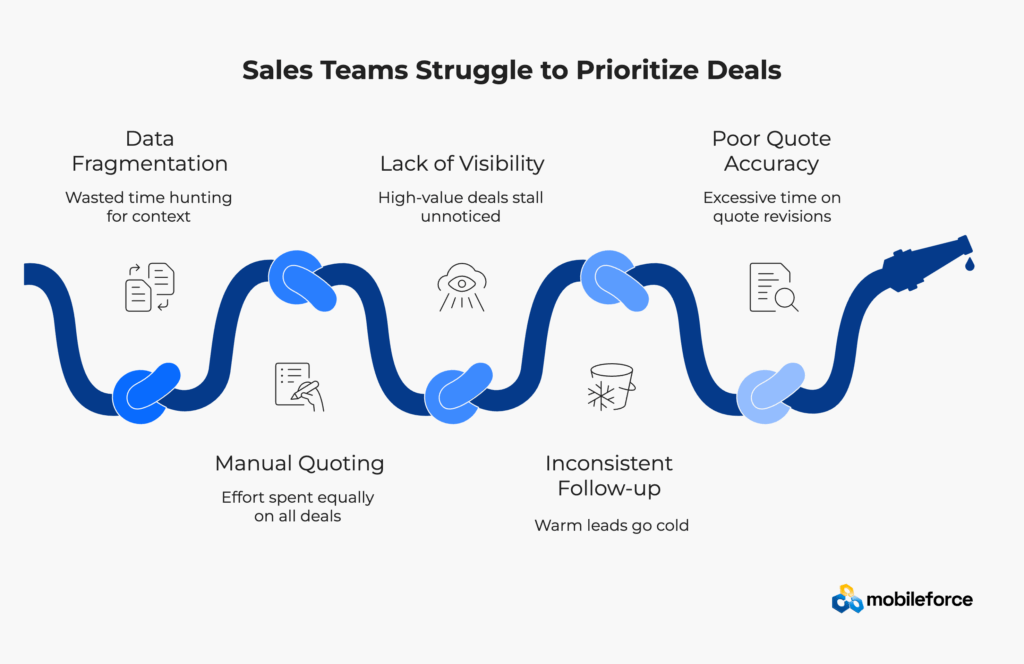
When most people hear “deal scoring,” they imagine complex algorithms analyzing dozens of variables to predict which opportunities will close. But effective deal prioritization in modern configure price quote solutions works differently—and more practically.
Dynamic deal prioritization focuses on intelligent deal routing and automated lead qualification rather than predictive sales analytics. Instead of trying to predict the future, smart CPQ software solutions surface what sales teams need to act on today through systematic opportunity assessment tools.
Modern sales automation platforms identify priority deals through observable business rules:
This approach proves more reliable than complex deal scoring methodology because it’s based on observable business rules rather than predictions. When a customer’s three-year software license expires in 90 days, that’s not a prediction—it’s a fact requiring immediate action.
The shift toward workflow-driven prioritization aligns with broader market trends. Research shows that 78% of companies implementing CPQ systems report improved quote accuracy and faster deal closure, primarily due to better process automation rather than sophisticated predictive analytics.
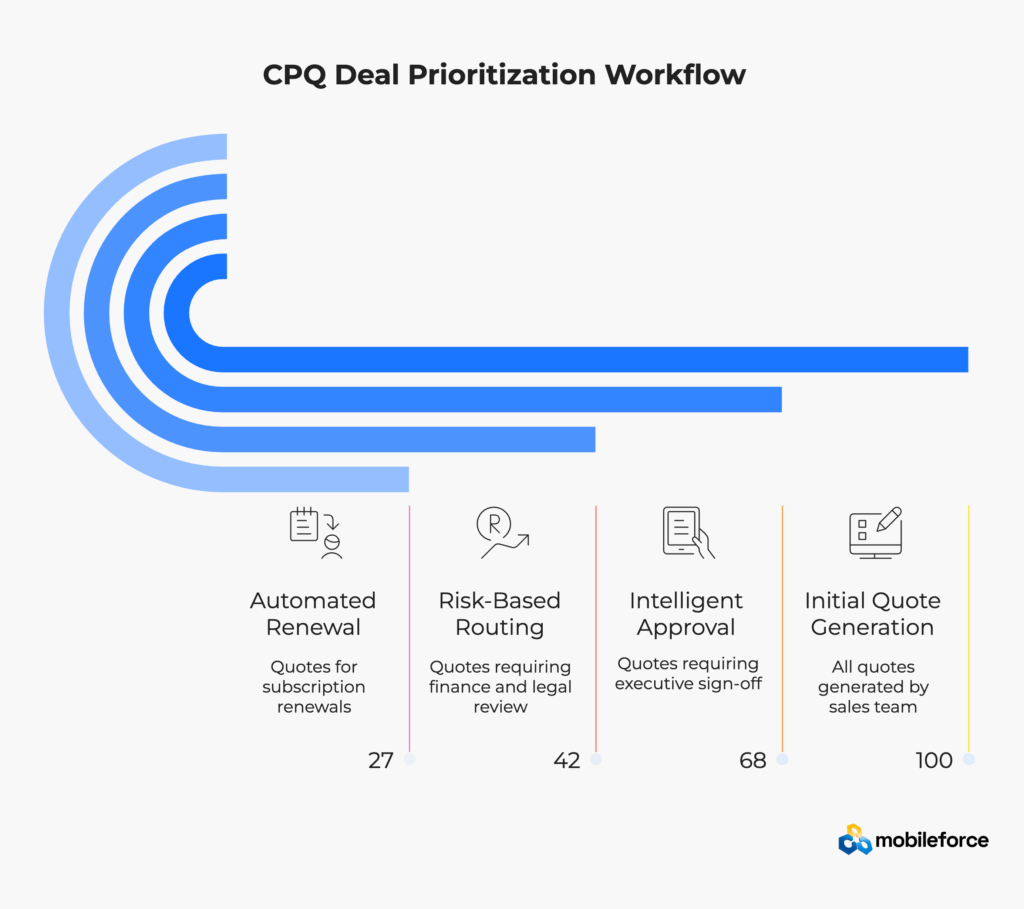
Real-world prioritization looks like this: Instead of scoring every opportunity from 1-100, effective revenue optimization platforms create clear action categories:
Sales teams can then allocate their time based on business impact and urgency rather than algorithmic predictions, leading to improved sales forecasting accuracy and better resource utilization.
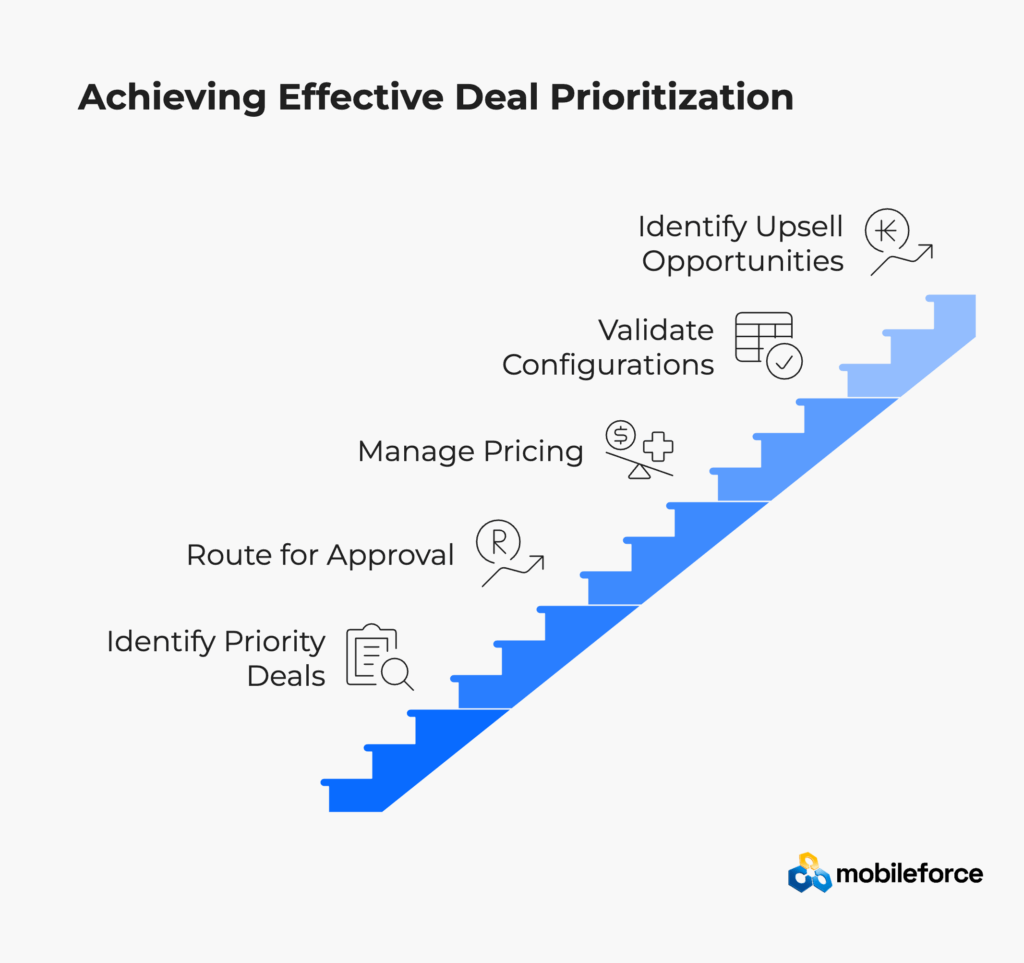
The foundation of effective deal prioritization lies not in complex scoring algorithms, but in well-designed business process automation and workflow optimization. Modern sales automation platforms transform opportunity identification by structuring processes around what actually drives revenue.
Advanced product configuration rules eliminate low-value configuration errors that consume disproportionate sales time. When quote generation software prevents invalid product combinations upfront, sales teams can focus on strategic selling rather than troubleshooting technical issues. This becomes critical as product complexity increases—companies with complex offerings report that rules-based configuration reduces quote preparation time by an average of 40%.
The business impact extends beyond time savings. Configuration accuracy directly affects customer experience, with misconfigured quotes leading to fulfillment delays and customer dissatisfaction. Automated validation ensures every quote can be delivered as specified.
Smart approval workflows surface high-touch deals faster by automatically routing quotes that exceed predetermined thresholds through pricing optimization tools. When a quote requires executive sign-off for pricing, compliance, or scope, the approval workflow management system immediately notifies relevant stakeholders rather than letting the opportunity sit in a queue.
This systematic approach prevents deals from stalling due to simple communication gaps. Industry data shows that automated approval routing reduces deal closure time by an average of 32% compared to manual escalation processes.
Intelligent routing ensures finance and legal teams see high-risk quotes first, enabling faster decision-making on complex opportunities. Rather than treating all deals equally, sophisticated workflow optimization prioritizes review processes based on:
Subscription management automation brings in predictable revenue with minimal guesswork by triggering renewal processes well in advance of contract expiration dates. Sales operations efficiency improves dramatically when systems can:
These workflow improvements compound over time, creating sustainable competitive advantages. Industry data shows that 65% of organizations using CPQ platforms report enhanced quote accuracy, while sales velocity increases by an average of 27% as teams spend more time selling and less time on administrative tasks.
The key insight driving this transformation: effective prioritization emerges from process design, not prediction algorithms. When business process automation routes the right deals to the right people at the right time, natural prioritization occurs without complex scoring models.
Modern sales automation platforms excel through deep integration capabilities that provide comprehensive deal context. When CPQ software connects seamlessly with CRM data, ERP inventory systems, and financial approval workflows, sales teams gain unprecedented visibility into opportunity status and requirements.
Want to see how automated workflows can transform your team’s deal prioritization? Explore Mobileforce’s no-code configuration platform that makes complex rule-based systems accessible to non-technical users.
Traditional configure price quote platforms force users to navigate complex interfaces, learn specialized terminology, and follow rigid workflows. AskCPQ™ takes a fundamentally different approach by bringing conversational AI software and natural language processing to revenue operations.
AskCPQ™ is not a deal scoring engine—it’s an AI-powered quoting platform that helps teams work faster while naturally surfacing high-priority opportunities through conversational commands and intelligent automation.
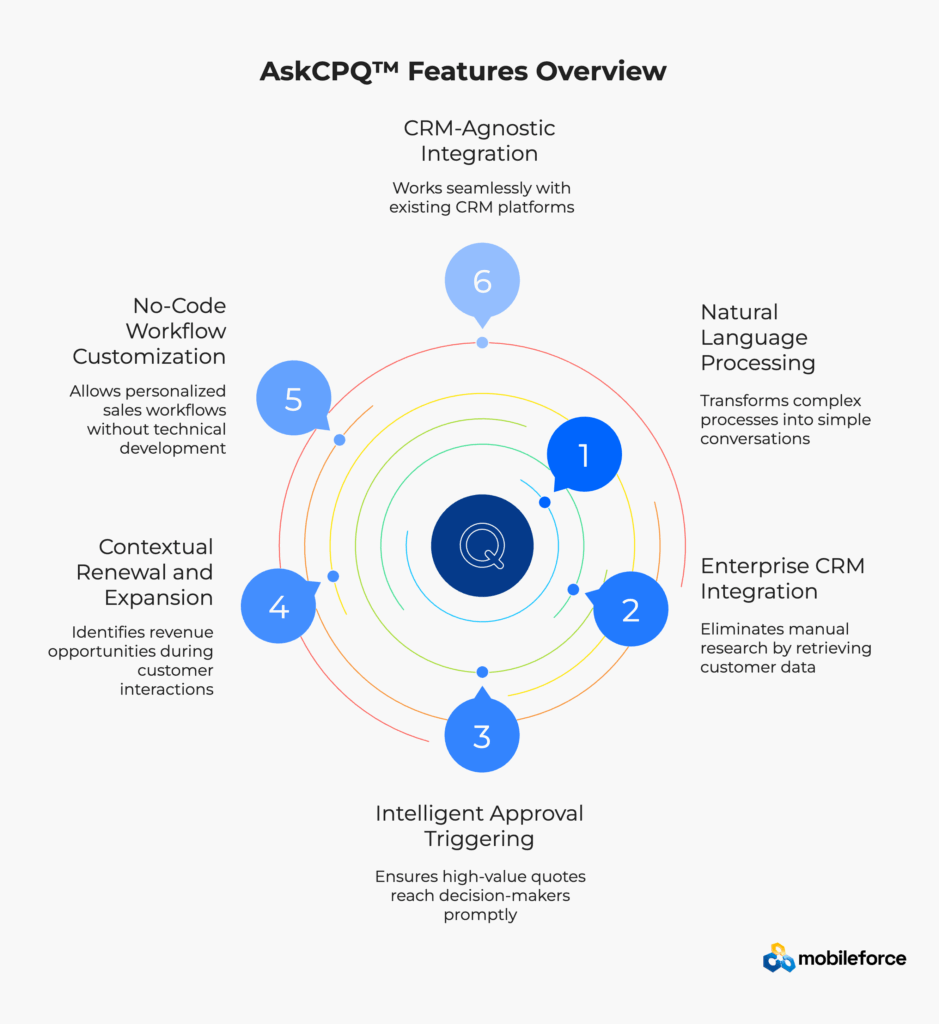
Natural language processing transforms complex business processes into simple conversations. Sales representatives can simply say “Renew Acme Corporation’s contract for 12 months with the same configuration as last year,” and this intelligent sales assistant handles the entire automated quote generation process, from fetching historical data to applying current pricing rules through sophisticated algorithms.
Enterprise CRM integration capabilities eliminate the manual research that typically precedes quote creation. When sales teams mention a customer, AskCPQ™ automatically retrieves relevant account information through deep CRM integration, past purchase history from ERP systems, and active contract terms from subscription management platforms—providing complete customer context without additional clicks or searches.
Intelligent threshold-based approval triggering ensures high-value or margin-sensitive quotes immediately reach the right decision-makers through automated workflow routing. AskCPQ™ recognizes when quotes exceed predefined parameters for pricing exceptions, discount limits, or compliance requirements and automatically initiates multi-stage approval workflows, preventing deals from stalling due to oversight.
Contextual renewal and expansion identification helps sales teams spot revenue opportunities during regular customer interactions through relationship intelligence. When customers request quotes for additional services or products, AskCPQ™ can suggest complementary offerings, identify opportunities for contract expansion, and recommend optimal pricing strategies based on account history and market conditions.
Advanced prompt builder for personalized sales workflows allows organizations to customize AskCPQ™’s responses for specific business processes without technical development. Sales operations teams can create guided experiences for different product lines, customer segments, or approval processes, enabling sophisticated automation while maintaining flexibility for unique business requirements.
CRM-agnostic integration capabilities mean AskCPQ™ works seamlessly with existing sales technology stacks rather than requiring wholesale platform changes. The system connects to Salesforce, HubSpot, Microsoft Dynamics, and other major customer relationship management platforms through native APIs, ensuring seamless data flow across sales operations while maintaining data integrity and security standards.
The real value of AskCPQ™ becomes apparent in day-to-day sales scenarios where speed and quote accuracy enhancement determine revenue outcomes. Rather than theoretical scoring, the system provides practical advantages that directly impact deal prioritization and sales velocity improvement.
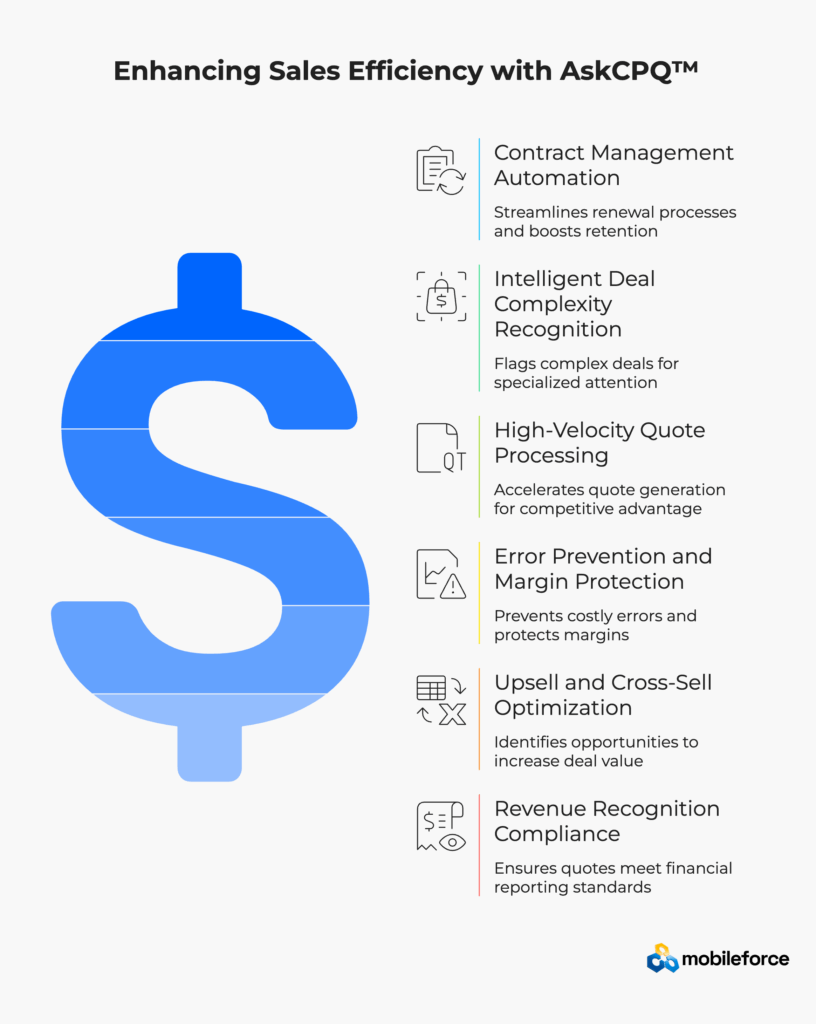
AskCPQ™ surfaces contracts nearing expiration through natural conversation flows and contract management automation. When sales representatives ask about upcoming opportunities or customer status, the intelligent system automatically highlights renewal deadlines, provides relevant contract details, and suggests optimal renewal timing strategies based on customer engagement patterns.
This proactive approach to customer retention strategies ensures recurring revenue receives appropriate attention without requiring separate tracking systems. The business impact proves significant: companies that systematize renewal processes through sales automation typically see 15-20% higher retention rates than those relying on manual tracking, directly improving annual recurring revenue and customer lifetime value metrics.
Research from Harvard Business Review shows that pricing strategies have more impact on profit than volume, cost, or any other business variable, making systematic renewal management a critical competitive advantage.
AskCPQ™ recognizes when product configurations trigger escalation requirements through sophisticated rules analysis and immediately surfaces these opportunities as high-priority items requiring specialized attention. Complex quotes that require legal review, executive approval, or technical validation are automatically flagged through intelligent routing algorithms, ensuring they receive appropriate resources from the start.
This smart escalation prevents common prioritization mistakes where sales teams spend equal time on routine quotes and complex strategic opportunities. Sales managers can quickly identify which deals need additional resources through automated alerts and which can proceed through standard workflows, optimizing resource allocation for maximum revenue impact.
AskCPQ™ removes manual quoting friction through automated quote generation that often slows down time-sensitive opportunities in competitive situations. Simple renewal quotes, standard product configurations, and routine pricing requests can be processed in minutes rather than hours through streamlined workflows, freeing sales teams to focus on strategic selling activities and relationship building.
The sales velocity improvement proves particularly valuable for competitive situations where response speed determines outcomes. Research indicates that companies responding to RFPs within 24 hours win 35% more deals than those taking longer, making rapid quote generation a sustainable competitive advantage in fast-moving markets.
Rules-based prevention of invalid configurations through margin protection software ensures sales teams prioritize deals that are technically sound and financially profitable. AskCPQ™’s underlying rules engine prevents product combinations that would create fulfillment problems, compliance issues, or margin erosion—keeping teams focused on winnable, profitable opportunities that support business growth objectives.
This error prevention becomes critical as deal complexity increases across product lines. Companies selling custom solutions report that configuration errors account for up to 30% of deal delays and 12% of margin leakage, making accuracy a key component of effective prioritization and revenue optimization strategies.
When processing quote requests, AskCPQ™ presents related items, alternative configurations, and strategic bundle options that increase deal value while meeting specific customer needs. The system draws on advanced product rules, customer purchase history, and market intelligence to make relevant suggestions during the natural flow of quote creation, supporting organic revenue expansion.
This guided approach to cross-sell upsell strategies proves more effective than aggressive selling tactics because recommendations emerge organically from customer requirements rather than appearing as obvious sales tactics. Sales teams can explore expansion opportunities naturally while maintaining customer trust and relationship integrity.
Automated compliance tracking ensures all quotes meet revenue recognition standards required for financial reporting and audit purposes. AskCPQ™ maintains comprehensive audit trails for pricing decisions, approval processes, and configuration choices, supporting both internal controls and external compliance requirements while reducing administrative overhead.
See how AskCPQ™ can transform your team’s quoting process and deal prioritization. Request a personalized demonstration to explore how conversational AI enhances sales efficiency.
Different industries face unique deal prioritization challenges that require tailored sales automation approaches. Understanding these sector-specific patterns helps organizations implement more effective CPQ strategies and revenue optimization initiatives.
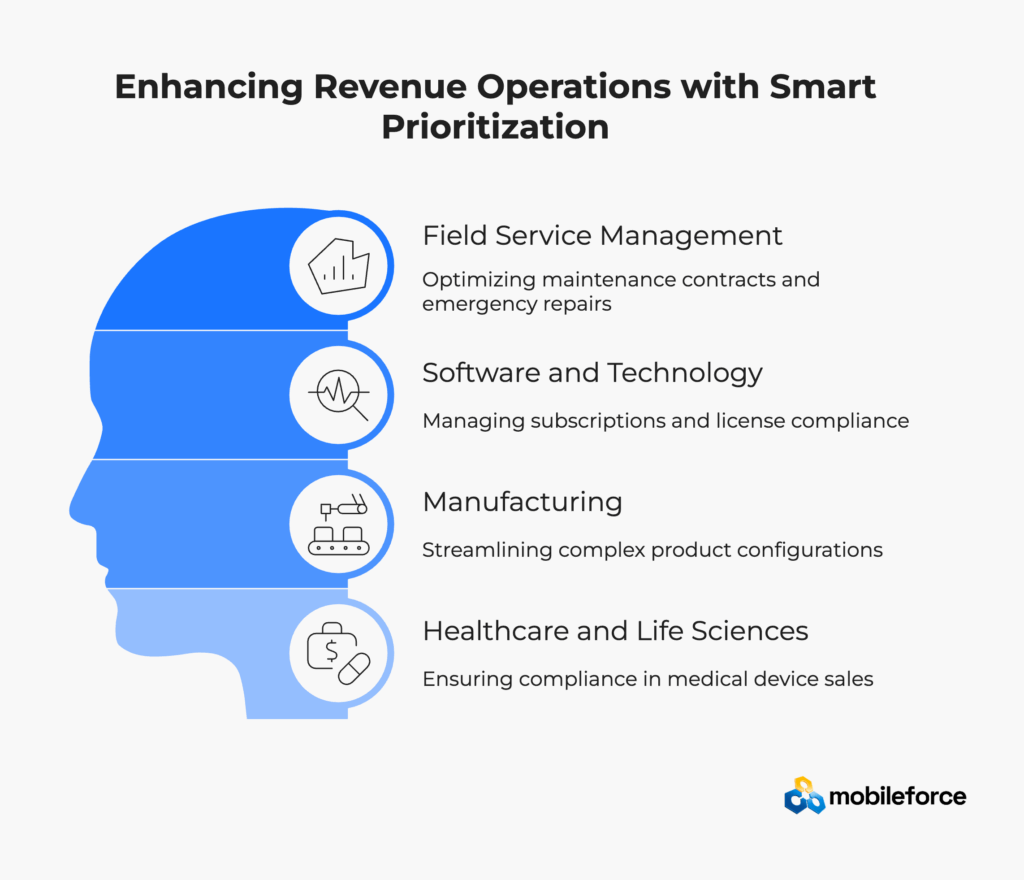
Field service organizations depend heavily on maintenance contracts, service agreements, and parts replacement programs that create predictable recurring revenue streams. Field service management software integration with AskCPQ™ excels in this environment by automatically tracking contract renewal dates, service agreement expiration schedules, and equipment replacement cycles.
Maintenance contract optimization often represents the highest-value, lowest-risk opportunities in field service portfolios. When AskCPQ™ identifies upcoming contract expirations through maintenance contract automation, sales teams can proactively engage customers with renewal proposals before competitors have a chance to bid on the business, protecting valuable recurring revenue streams.
Emergency repair quote generation becomes streamlined when AskCPQ™ can instantly access customer equipment histories, warranty statuses, and approved part numbers through integrated inventory management systems. This speed advantage proves critical when equipment downtime costs customers thousands per hour—making rapid, accurate quoting a sustainable competitive differentiator in service-intensive markets.
Learn more about Mobileforce FSM’s top field service management features that integrate seamlessly with CPQ workflows.
Parts inventory optimization integrates with quote generation to ensure availability commitments are realistic and margin-positive. Smart algorithms prevent quotes for unavailable parts while suggesting alternative solutions that meet customer requirements.
Technology companies face the complex challenge of managing subscription billing automation, usage-based pricing models, and feature upgrade paths across diverse customer segments. AskCPQ™ helps navigate these complexities by maintaining clear visibility into customer subscription statuses, usage patterns, and expansion opportunities through sophisticated analytics.
Seat expansion opportunities often emerge during routine customer interactions when teams mention hiring plans or department growth. AskCPQ™ can immediately calculate expansion pricing through automated pricing algorithms and generate upgrade proposals, turning casual conversations into measurable revenue opportunities while maintaining pricing consistency.
Feature upgrade recommendations become more strategic when AskCPQ™ understands customer usage patterns through integration with product analytics platforms and current subscription levels. Rather than pushing premium features to every customer, the intelligent system can identify accounts that would genuinely benefit from specific capabilities, improving customer satisfaction and reducing churn risk.
License compliance management ensures customers remain compliant with software usage agreements while identifying opportunities for license optimization or expansion based on actual usage data and growth projections.
Manufacturing companies typically deal with highly configurable products requiring technical validation, regulatory compliance management, and sophisticated pricing calculations. Manufacturing-focused CPQ platforms streamline these processes by embedding compliance requirements directly into automated quoting workflows.
Engineering approval workflows for custom configurations get triggered automatically when quotes exceed standard parameters through intelligent routing systems. This ensures complex opportunities receive appropriate technical review without delaying standard product quotes, optimizing engineering resources for maximum impact.
Regulatory compliance management in regulated industries like medical devices, automotive, or aerospace receives immediate attention when AskCPQ™ identifies requirements for FDA approval, quality certifications, or industry standards compliance through automated compliance checking. This proactive approach prevents costly delays and ensures customer requirements are met consistently.
Bill of materials optimization integrates with quote generation to ensure technical feasibility while maintaining competitive pricing. Smart algorithms validate component availability, manufacturing capacity, and delivery commitments before finalizing quotes.
Explore how Mobileforce’s CPQ platform automatically generate technical specifications and compliance documentation for complex manufacturing quotes.
Healthcare organizations require specialized attention to regulatory compliance, patient safety considerations, and complex approval processes that affect revenue timing and deal structure.
Medical device configuration requires integration with FDA databases, clinical validation requirements, and hospital procurement systems. AskCPQ™ ensures all quotes meet regulatory standards while expediting the approval process for time-sensitive medical needs.
Healthcare compliance software integration ensures all pricing, product configurations, and contract terms comply with healthcare regulations, including Stark Law requirements, anti-kickback statutes, and patient privacy considerations that affect deal structure and implementation timelines.
Organizations implementing AI-enhanced CPQ software solutions report measurable improvements across multiple business metrics that directly impact revenue growth, customer satisfaction, and operational efficiency. Industry research provides specific benchmarks for measuring CPQ implementation success.
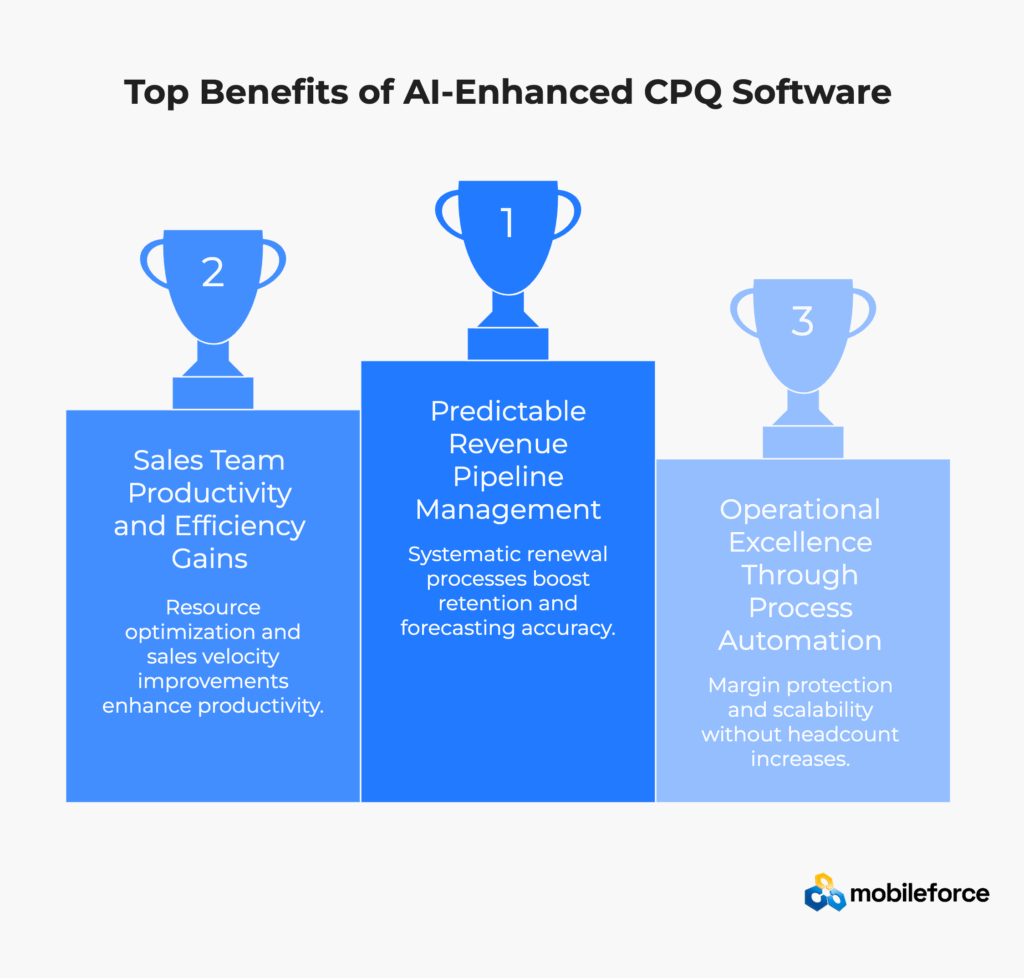
Systematic renewal processes through subscription management automation lead to demonstrably higher retention rates and more accurate sales forecasting. Companies using automated renewal tracking typically see contract renewal rates increase by 12-18% compared to manual processes, primarily because opportunities receive attention before competitors can intervene.
According to McKinsey research on B2B pricing optimization, companies with systematic renewal management achieve:
Quote-to-cash process acceleration improves cash flow velocity and working capital management. Industry benchmarks show that 78% of companies implementing CPQ systems reduce quote turnaround times by more than 50%, enabling faster deal closure and improved quarterly performance predictability.
Additional research from Persana AI on B2B sales automation shows that companies using predictive lead scoring find their top 20% of leads produce 60% of quarterly revenue, while AI adoption in sales teams has reached 43% in 2024.
Resource allocation optimization emerges naturally when high-value opportunities receive appropriate attention through intelligent deal routing. Sales representatives report spending 35-40% more time on strategic selling activities when administrative quoting tasks become automated, directly improving deal quality and customer relationship depth.
Sales velocity improvement metrics from CPQ implementations show consistent patterns across industries:
Training and onboarding efficiency improves when conversational AI interfaces reduce learning curves. New sales representatives become productive 40% faster when using natural language quoting systems compared to traditional CPQ interfaces.
Margin protection and pricing consistency occur when automated pricing rules and approval workflows prevent margin erosion. Companies with systematic pricing governance typically maintain 3-5% higher gross margins than those relying on manual oversight, with particularly strong results in complex product categories.
According to recent Forrester research on revenue enablement, organizations implementing comprehensive CPQ solutions achieve:
Forrester’s research emphasizes that the future of sales enablement is revenue enablement, where organizations enable all customer-facing roles rather than just sales teams, creating seamless customer journeys and better business outcomes.
Scalability without proportional headcount increases becomes possible when AI agents handle routine quoting tasks automatically. Organizations often report processing 40-60% more quotes with the same sales operations team after implementing conversational CPQ systems, directly improving operational leverage.
Quote accuracy and delivery speed improvements directly impact customer satisfaction scores and competitive positioning. Industry data indicates that companies with faster quote response times see 35% higher win rates in competitive situations.
Customer experience improvements include:
Performance Metric | Baseline | Post-CPQ | Improvement | Business Impact |
Quote Turnaround Time | 3-5 days | 1-2 hours | 85% reduction | Faster deal closure |
Renewal Retention Rate | 75-80% | 90-95% | 15-20% increase | Protected recurring revenue |
Sales Team Productivity | 30% selling time | 65% selling time | 35% improvement | Higher deal quality |
Gross Margin Consistency | 82% target achievement | 94% target achievement | 12% improvement | Increased profitability |
Quote Processing Capacity | 100 quotes/month | 160 quotes/month | 60% increase | Scalable growth |
Configuration Error Rate | 8% of quotes | 1% of quotes | 87% reduction | Better customer experience |
Approval Cycle Time | 5-7 days | 1-2 days | 70% reduction | Accelerated decisions |
These improvements compound over time as teams become more efficient at identifying and pursuing their most valuable revenue opportunities, creating sustainable competitive advantages in increasingly competitive markets.
Ready to quantify the potential impact for your organization? Schedule a consultation to explore how Mobileforce can help you achieve similar results.
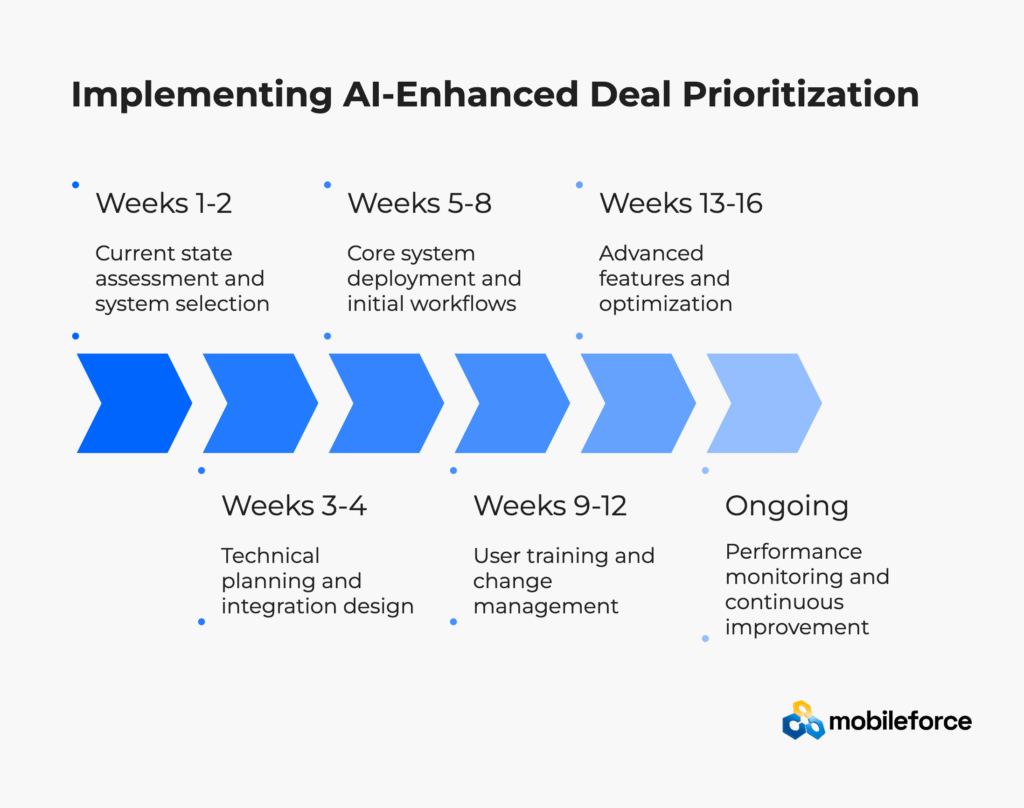
Successfully deploying AI-enhanced deal prioritization requires a systematic approach that balances immediate improvements with long-term strategic goals. This comprehensive implementation methodology ensures maximum ROI while minimizing business disruption.
Conduct comprehensive workflow audit to identify bottlenecks, manual steps, and prioritization gaps. Most organizations discover that their highest-value opportunities receive inconsistent attention due to process limitations rather than intentional decisions. Document current quote turnaround times, approval delays, and revenue leakage points.
Map critical revenue streams that drive the majority of business value—renewals, expansions, new customer acquisitions, or specific product categories. Understanding which opportunities create the most business impact helps prioritize automation efforts and establish ROI measurement baselines.
Document approval requirements and escalation paths for different deal characteristics. High-value quotes, non-standard pricing, custom configurations, and compliance-sensitive products often require different approval workflows that should be systematized through sales automation platforms.
Evaluate integration requirements for existing systems including CRM platforms, ERP systems, financial software, and approval tools. Comprehensive system integration planning ensures seamless data flow and prevents costly customization requirements later in the implementation process.
Start with renewal management automation since these opportunities typically offer the highest return on investment with the lowest implementation complexity. Automated renewal alerts and quote generation provide immediate value while building organizational confidence in AI-assisted processes.
Target routine quote generation workflows for standardized products or services. These high-volume, low-complexity opportunities are ideal for conversational AI since they follow predictable patterns and require minimal human judgment, making them perfect for initial deployment.
Systematize approval routing processes to ensure high-value deals receive appropriate attention. Clear escalation rules and automatic notifications prevent important opportunities from stalling due to communication gaps, improving overall sales velocity.
Implement change management protocols to ensure user adoption and minimize resistance. Training programs, success metrics, and feedback loops help teams adapt to new workflows while maintaining productivity during the transition period.
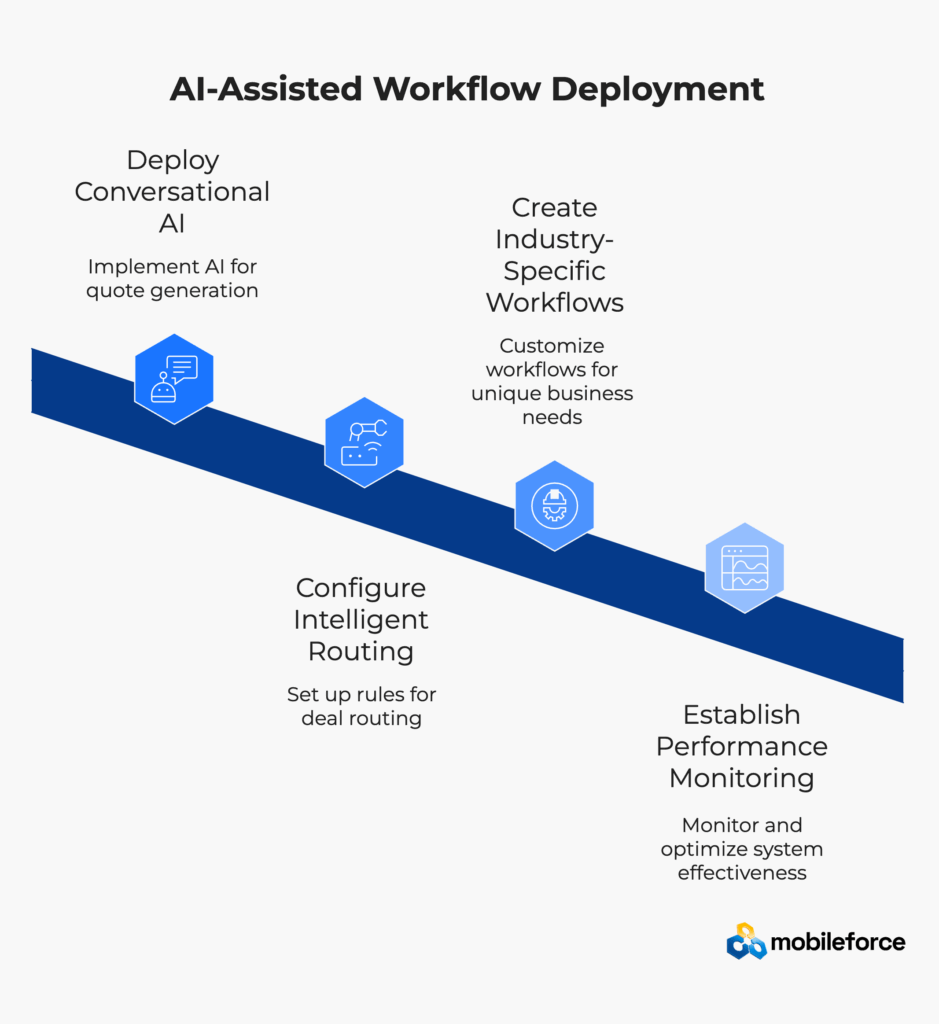
Deploy conversational AI for quote generation starting with simple use cases and expanding capabilities over time. Natural language interfaces reduce training requirements while providing immediate productivity benefits through intuitive user experiences.
Configure intelligent routing rules based on deal characteristics, customer segments, and business requirements. Smart workflow automation ensures the right people see the right opportunities at the right time, optimizing resource allocation and decision-making speed.
Create industry-specific prompts and workflows that reflect unique business requirements. The no-code configuration platform allows non-technical users to customize AI interactions without development resources, ensuring flexibility and scalability.
Establish performance monitoring and optimization processes to continuously improve system effectiveness. Regular analysis of quote accuracy, processing speed, and user satisfaction helps identify optimization opportunities and ensures sustained ROI.
Integrate CRM and ERP data sources to provide comprehensive customer and product information. Seamless data flow eliminates manual lookup tasks while ensuring quote accuracy and reducing errors that can delay deal closure.
Establish real-time pricing and inventory connections for dynamic quote generation. Current product availability and pricing information prevents quotes that can’t be fulfilled, improving customer satisfaction and reducing sales team frustration.
Configure approval system integrations to streamline decision-making processes. Automated workflows should connect directly to approval platforms and notification systems, ensuring fast turnaround on high-value opportunities.
Implement advanced analytics and reporting capabilities to measure business impact and identify additional optimization opportunities. Comprehensive reporting supports continuous improvement and demonstrates ROI to stakeholders.
Typical implementation timeline for comprehensive CPQ deployment:
Resource requirements include:
Organizations transitioning from legacy systems may benefit from Mobileforce’s migration services to ensure seamless data transfer and minimal business disruption during the transition period.
Success metrics and ROI measurement:
Organizations planning CPQ investments should also consider the complete total cost of ownership implications to ensure accurate ROI calculations and budget planning for long-term success.
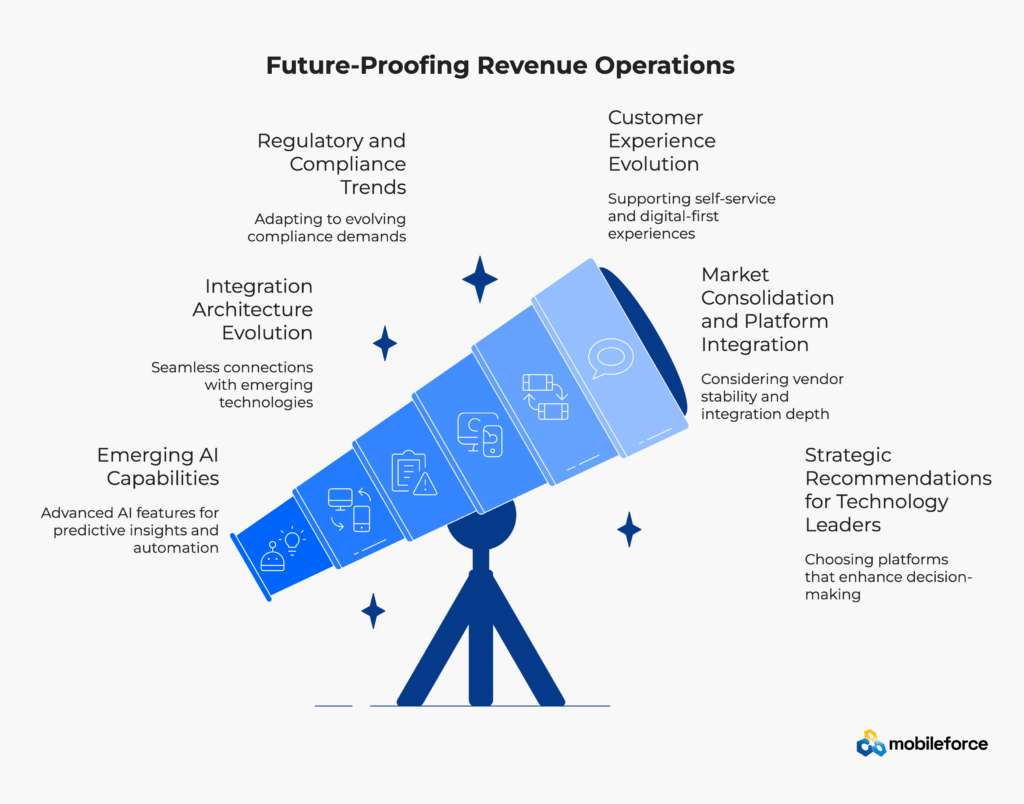
The configure price quote software market continues evolving rapidly, with cloud-based solutions now accounting for over 60% of new implementations and subscription-based pricing models representing nearly 70% of revenue. Organizations planning CPQ investments should consider how current decisions will support future business requirements and emerging technology trends.
Advanced AI capabilities will continue expanding beyond simple automation to include predictive insights, dynamic pricing optimization, and sophisticated customer behavior analysis. Next-generation platforms will incorporate:
Platforms like Mobileforce that build AI-first architectures position organizations to benefit from these advancing capabilities without requiring complete system overhauls.
Integration requirements will become increasingly complex as businesses adopt multi-cloud strategies, specialized software tools, and industry-specific platforms. Future-ready CPQ systems must offer:
CPQ systems with flexible integration options and comprehensive API libraries provide better long-term value than closed platforms with limited connectivity.
Compliance and governance demands will intensify as regulations evolve across industries and audit requirements increase. Future CPQ platforms must accommodate:
Systems with built-in approval workflows, comprehensive audit trails, and compliance reporting capabilities reduce future regulatory risk while supporting business growth.
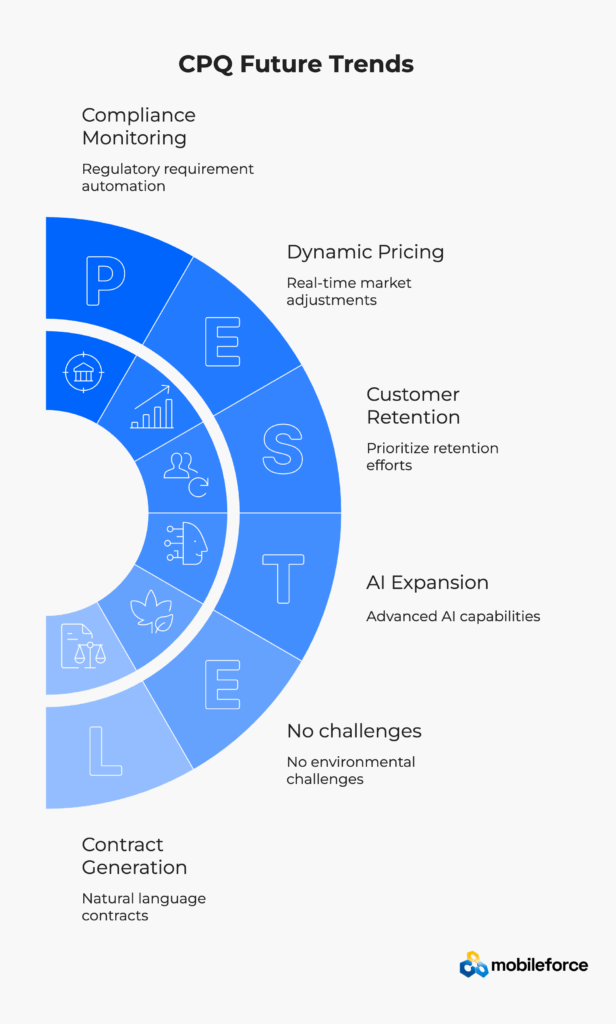
B2B buying behavior continues shifting toward self-service and digital-first experiences. Future revenue operations must support:
The CPQ market is experiencing consolidation as larger technology providers acquire specialized vendors. Organizations should consider:
Choose platforms that view CPQ as part of comprehensive revenue operations rather than standalone quoting tools. Integrated revenue cloud platforms provide better long-term value by connecting quote-to-cash processes, customer success operations, and financial reporting in unified workflows.
Prioritize user experience and adoption over feature complexity. The most sophisticated CPQ system provides no value if sales teams don’t use it consistently. Conversational AI interfaces and intuitive workflows ensure sustained adoption as business requirements evolve.
Plan for scalability beyond current requirements by selecting platforms that can grow with business needs. Consider international expansion, product line growth, and acquisition scenarios when evaluating long-term platform capabilities.
The companies that thrive in this evolving landscape will be those that view CPQ not as a simple quoting tool, but as a strategic revenue operations platform that enhances human decision-making while adapting to changing business requirements.
Discover how Mobileforce can help your organization stay ahead of these trends. Explore our full revenue cloud platform designed for modern sales operations.
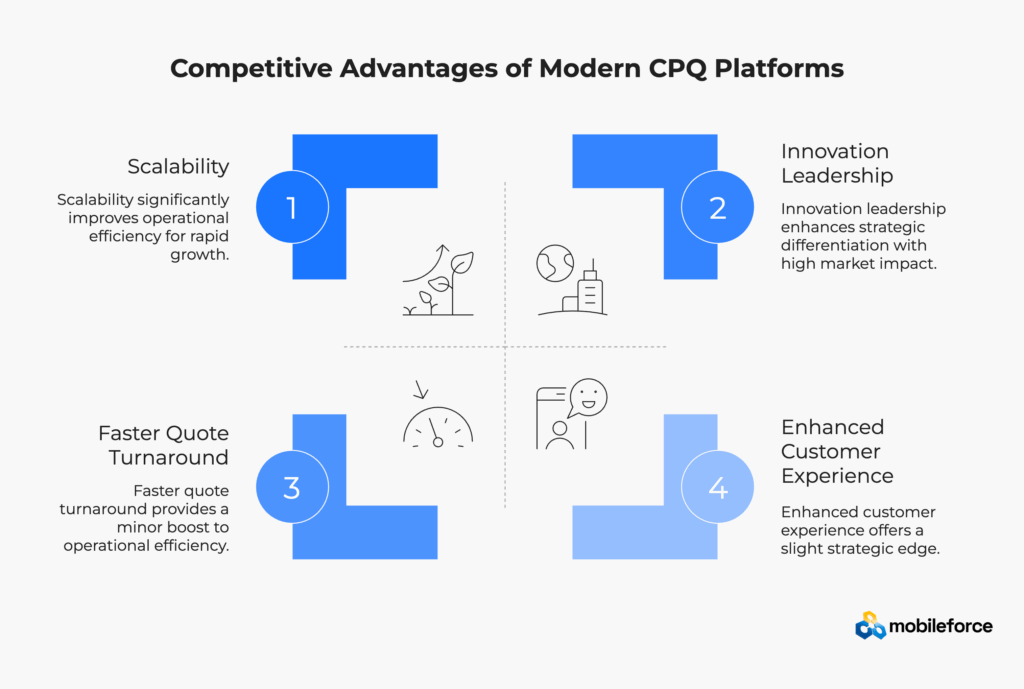
In today’s rapidly evolving B2B landscape, sales automation platforms have become essential differentiators that separate market leaders from competitors struggling with manual processes. Understanding the competitive advantages of modern configure price quote solutions helps organizations make informed technology investments that drive sustainable revenue growth.
Faster quote turnaround capabilities provide immediate competitive advantages in time-sensitive opportunities. While competitors spend days generating complex quotes through manual processes, organizations with conversational AI quoting can respond within hours, often securing deals before alternatives are even presented to customers.
The speed advantage compounds in competitive situations where response time directly correlates with win probability. Sales teams using intelligent quote generation systems consistently outperform traditional approaches by:
Error-free quote generation builds customer confidence while protecting profit margins through automated validation. Manual quoting processes introduce configuration errors, pricing mistakes, and fulfillment conflicts that damage customer relationships and erode profitability.
Modern revenue optimization tools eliminate these risks through:
Enterprise scalability through sales process automation enables rapid business growth without proportional increases in sales operations staff. While competitors must hire additional personnel to handle increased quote volume, AI-enhanced platforms scale automatically.
This scalability advantage becomes particularly valuable during:
Superior customer experiences through self-service capabilities differentiate modern organizations from traditional sales approaches. Partner portal integration and customer-facing configuration tools enable buyers to explore options independently while maintaining professional oversight.
Enhanced customer experiences include:
For deeper insights into enterprise CPQ strategies, explore Mobileforce’s comprehensive guide to enterprise CPQ insights.
Advanced analytics and business intelligence provide insights that manual processes cannot match. Modern sales enablement technology captures detailed information about quote patterns, customer preferences, and market trends that inform strategic decision-making.
Competitive intelligence capabilities include:
Organizations implementing cutting-edge CPQ technology position themselves as innovation leaders in their markets. This perception advantage influences both customer and partner relationships, creating opportunities for premium positioning and strategic partnerships.
Innovation leadership benefits include:
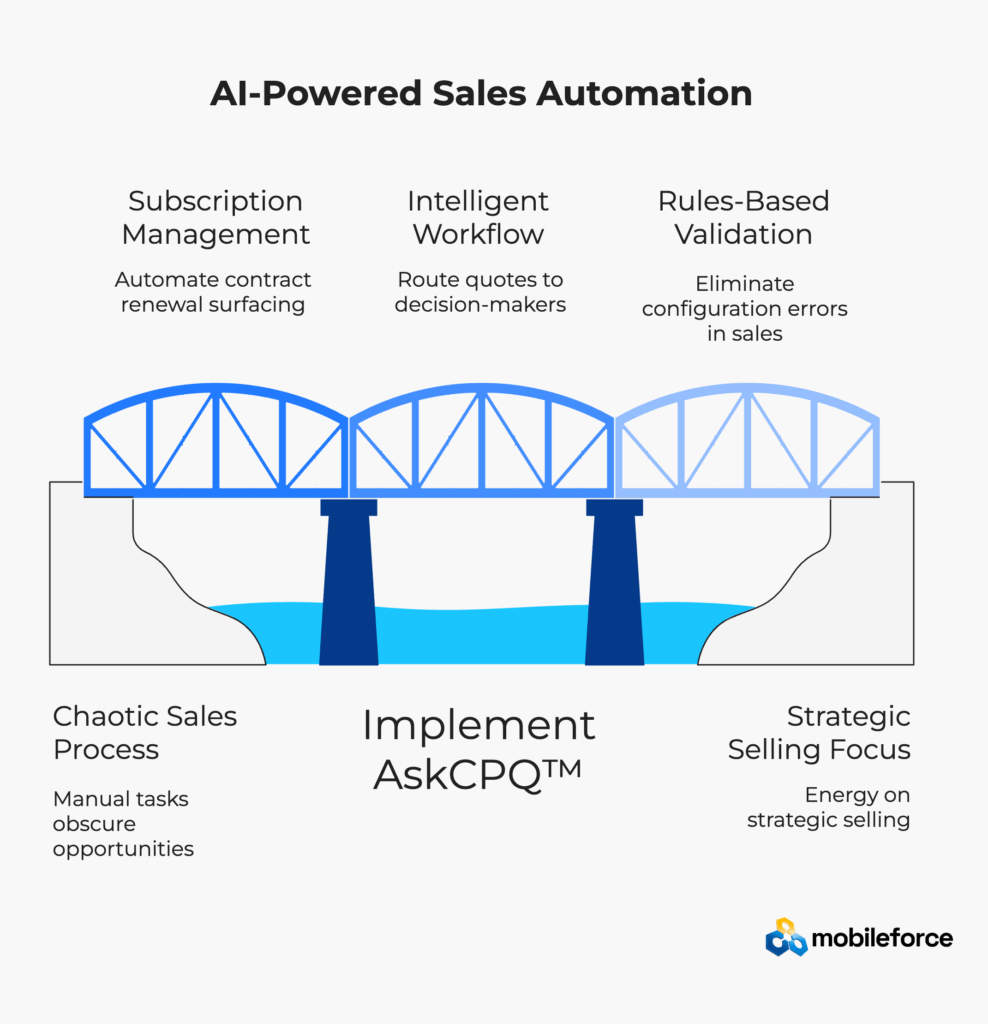
The most effective deal prioritization systems don’t predict the future—they eliminate the chaos that prevents sales teams from focusing on revenue opportunities. AskCPQ™ and modern configure price quote platforms transform prioritization not through complex scoring algorithms, but by removing the manual processes that obscure high-value opportunities and slow down sales velocity.
When contract renewals surface automatically through subscription management automation, approval-required quotes route instantly to decision-makers through intelligent workflow systems, and configuration errors disappear from the sales process through rules-based validation, natural prioritization emerges. Sales teams can focus their energy on strategic selling activities rather than administrative tasks, directly improving customer relationships and revenue outcomes.
The competitive advantage belongs to organizations that recognize this fundamental shift toward sales automation. While competitors debate the merits of various scoring methodologies and struggle with manual processes, forward-thinking companies are implementing conversational AI agents that make smart prioritization effortless and automatic.
As the configure price quote software market approaches $5.8 billion in global spending by 2026, the window for gaining first-mover advantages continues narrowing. The question isn’t whether AI-powered sales automation will transform revenue operations, but whether your organization will lead or follow this transformation.
Market leaders are already implementing these systems to achieve measurable advantages:
The opportunity exists today to implement deal prioritization systems that provide immediate value while building capability for future innovations. The technology is proven, the business case is clear, and the competitive advantages are demonstrable through measurable ROI.
Organizations that delay CPQ implementation risk falling behind competitors who are already benefiting from:
The path forward requires strategic thinking about revenue operations as a competitive differentiator rather than simply a cost center. Modern CPQ platforms like Mobileforce provide the foundation for sustainable growth through intelligent automation that enhances human capabilities rather than replacing them.
Success depends on choosing the right platform and implementation approach that aligns with long-term business objectives while delivering immediate productivity improvements. The most successful organizations will be those that view this transition as a strategic initiative requiring proper planning, change management, and performance measurement.
Ready to transform your deal prioritization process and gain competitive advantage through AI-powered automation? Schedule a comprehensive demonstration to see how AskCPQ™ can help your sales team focus on the opportunities that matter most while eliminating the manual processes that slow down revenue growth.
Traditional lead scoring attempts to predict which opportunities will close by analyzing multiple variables and generating numerical scores ranging from 1-100. AI-powered deal prioritization in modern CPQ software works fundamentally differently—it focuses on workflow automation that naturally surfaces urgent and high-value opportunities based on observable business rules. Instead of scoring every deal, systems like AskCPQ™ identify specific action categories such as “renewal required,” “approval needed,” or “upsell opportunity” based on customer data, contract terms, and business rules rather than predictive algorithms.
AI-enhanced CPQ systems automatically surface several types of high-priority opportunities through intelligent workflow routing: contract renewals approaching expiration dates (typically 90-120 days out), quotes exceeding approval thresholds that require management review, complex configurations needing technical validation, margin-sensitive pricing requiring executive sign-off, expansion opportunities within existing customer accounts, compliance-sensitive deals requiring regulatory review, and emergency or time-sensitive customer requests. The system prioritizes based on business impact, urgency, and risk factors rather than predictive scoring models.
Most organizations report immediate productivity improvements within 2-4 weeks of implementing conversational AI quoting systems. Simple use cases like renewal quote generation and standard product configuration typically show 40-50% time savings within the first week. More complex workflows involving custom approvals and multi-system integrations may require 6-8 weeks to show full impact, but early improvements in quote speed and accuracy appear within 10-15 days. Full ROI, including improved win rates and margin protection, typically becomes measurable within 90 days of implementation.
Effective AI-powered deal prioritization requires integration with several core business systems: CRM platforms (Salesforce, HubSpot, Microsoft Dynamics) for customer data and opportunity tracking, ERP systems for product information, pricing, and inventory data, approval workflow platforms for escalation management and decision routing, contract management systems for renewal tracking and compliance monitoring, financial systems for margin analysis and revenue recognition, and communication platforms for automatic notifications and alerts. Modern platforms like Mobileforce offer pre-built connectors for major business systems, reducing implementation complexity and accelerating time-to-value compared to custom integration approaches.
Organizations typically measure CPQ ROI through several key performance indicators: quote turnaround time reduction (often 50-85% improvement), sales team time allocation toward strategic activities (35-40% increase), contract renewal rate improvements (15-20% typical increase), gross margin protection (3-5% improvement), overall quote processing capacity gains (40-60% higher throughput), configuration error reduction (87% average decrease), approval cycle time reduction (70% typical improvement), and customer satisfaction score improvements (20-30% increase). These metrics should be measured before implementation to establish baselines, then tracked monthly for the first year to demonstrate sustained value creation.
Yes, small and medium-sized businesses often see proportionally greater benefits from AI-powered deal prioritization because they typically have fewer resources to dedicate to manual processes. Cloud-based CPQ solutions with conversational AI interfaces reduce the technical complexity and initial investment traditionally required for sophisticated sales automation. SMBs can implement enterprise-grade systems that were previously accessible only to large corporations. The subscription-based pricing model (representing 70% of new CPQ implementations) makes advanced features affordable for growing businesses, while shorter implementation timelines (8-12 weeks vs. 6-12 months for legacy systems) provide faster time-to-value.
Conversational AI systems like AskCPQ™ handle complex configurations by embedding business rules, product constraints, and validation logic into natural language interactions. Instead of navigating complex configuration screens with hundreds of options, users can describe their requirements conversationally (“I need a manufacturing system for automotive parts with FDA compliance and 24/7 support”), and the system guides them through valid options while preventing invalid combinations. The AI maintains context throughout the configuration process, remembers previous selections, validates technical compatibility, checks inventory availability, and ensures compliance requirements are met—all while providing explanations for recommendations and restrictions.
AI-powered CPQ systems require enterprise-grade security including: data encryption for sensitive pricing and customer information (AES-256 standard), role-based access controls for different approval levels and user permissions, comprehensive audit trails for compliance reporting and change tracking, integration security for connected CRM and ERP systems, API security for third-party connections, regular penetration testing and vulnerability assessments, compliance with industry standards (SOC 2, GDPR, HIPAA where applicable), backup and disaster recovery procedures for business continuity, and AI model security to prevent data poisoning or adversarial attacks. Cloud-based solutions typically provide more advanced security features than on-premise deployments.
AI agents improve through several automated learning mechanisms: analyzing successful quote patterns to refine product recommendations and pricing suggestions, learning from user interactions to optimize conversational flows and reduce friction points, incorporating feedback from approval processes to improve routing decisions and escalation timing, updating product and pricing knowledge automatically from connected systems, identifying common configuration errors to prevent future mistakes, tracking customer preferences to personalize future interactions, and analyzing deal outcomes to optimize prioritization algorithms. The learning happens automatically without requiring manual training, configuration updates, or system downtime.
Industries with complex products, recurring revenue models, or lengthy sales cycles see the greatest benefits from AI-enhanced deal prioritization. Manufacturing companies with configurable products benefit from automated configuration validation and technical approval routing. Technology firms with subscription models see improved renewal management and expansion opportunity identification. Field service organizations with maintenance contracts benefit from automated contract tracking and emergency response prioritization. Healthcare companies with compliance requirements benefit from regulatory workflow automation. Financial services with complex approval processes benefit from intelligent routing and risk assessment. Any B2B business managing renewal cycles, complex pricing, or multi-stage approvals will see measurable improvements in efficiency and revenue protection.
AI-powered CPQ integrates with existing sales processes through several approaches: CRM integration maintains all opportunity data and customer interactions within familiar systems, email integration allows quote generation and approval requests through standard communication channels, mobile apps enable field sales teams to generate quotes during customer visits, partner portals extend quoting capabilities to channel partners and resellers, API connections link to specialized industry software and custom applications, workflow automation connects to existing approval processes and notification systems, and reporting integration provides analytics through current business intelligence platforms. The goal is enhancing rather than replacing proven sales processes that teams already understand and trust.