
TL;DR: HVAC contractors face mounting pressure from equipment price increases (up 40% since 2020), a shortage of 110,000 technicians nationwide, and rising customer expectations for immediate service. Configure-Price-Quote (CPQ) software automates complex HVAC quoting workflows, reduces quote turnaround from days to minutes, and enables field technicians to generate accurate proposals onsite. Companies implementing CPQ report 30-40% faster quote cycles and improved win rates through standardized pricing and real-time equipment configuration.
In late November 2025, Derek, operations manager at a 35-person HVAC contracting firm in suburban Atlanta, reviewed his monthly performance numbers and noticed something troubling. His technicians were generating more service calls than ever—up 18% year-over-year—but quote-to-close conversion had dropped from 42% to 31%. The gap between customer interest and actual sales was widening.
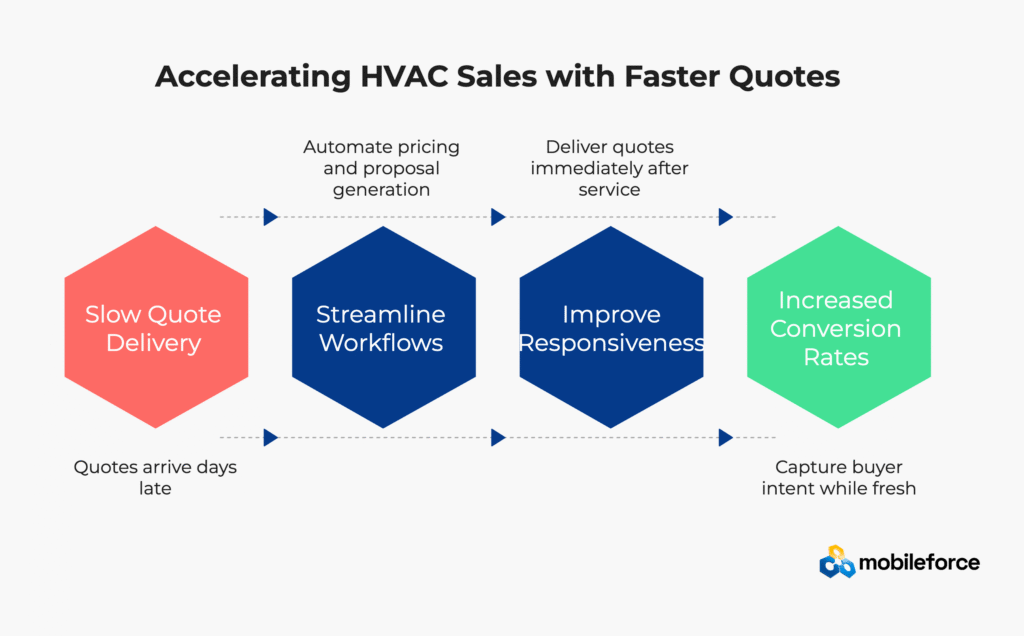
What made Derek’s situation compelling: he wasn’t skeptical about his team’s technical capabilities. His installers averaged 12 years of field experience, customer satisfaction scores ran above 4.6 out of 5, and emergency response times beat local competitors. The equipment knowledge was there. What kept Derek awake was a pattern emerging from lost opportunities—67% of customers who requested replacement system quotes eventually purchased from competitors. Not because the price was too high, but because quotes arrived three to five business days after the initial service call, by which time homeowners had already accepted faster proposals from rivals.
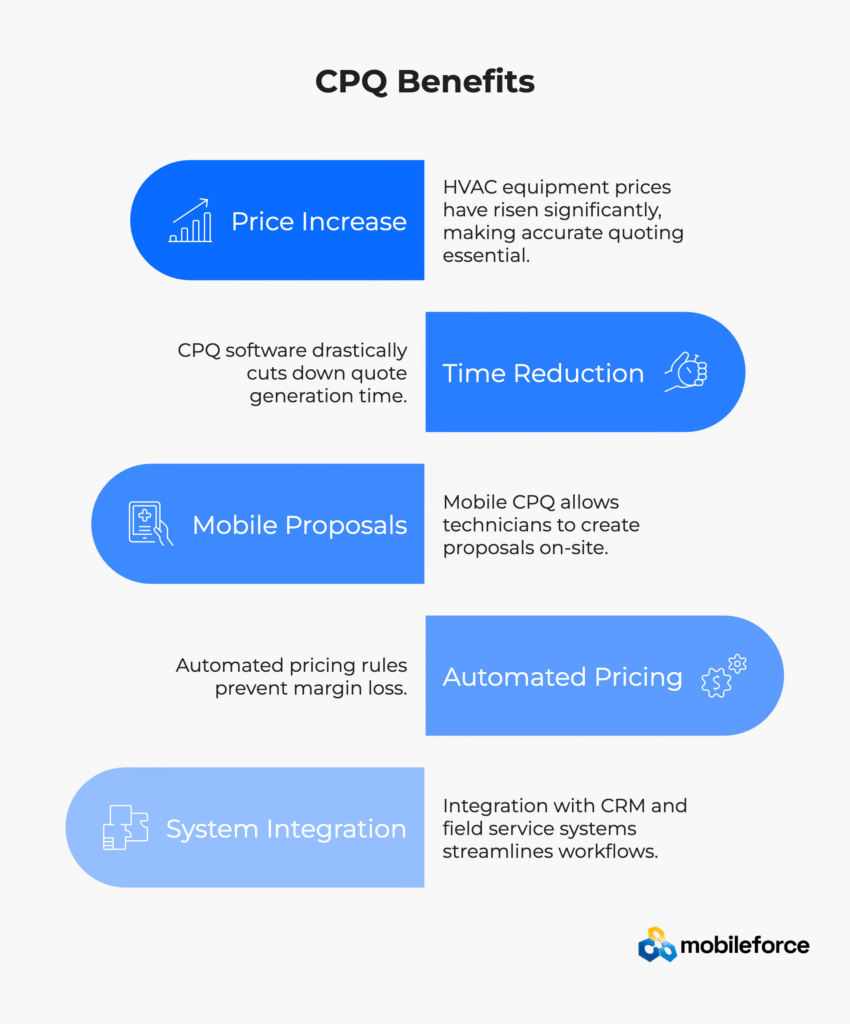
The HVAC industry generated $132.90 billion in revenue by the end of 2026, with the market projected to reach $148 billion by 2030. But that growth masks operational friction points that separate thriving contractors from struggling ones. Equipment costs climbed 40% since 2020 according to ACHR News industry analysis, squeezing margins and forcing contractors to price with precision. Labor shortages created a deficit of 110,000 technicians nationwide per industry reporting, meaning every field visit needs to maximize revenue potential. Meanwhile, homeowners increasingly expect Amazon-style responsiveness—immediate pricing, transparent options, and digital proposals they can review from their phones.
A quoting system is meant to be your revenue acceleration mechanism—a structured process that converts technical assessments into professional proposals quickly enough to capture buyer intent while it’s fresh. Traditional quoting workflows rely on technicians scribbling equipment specs on work orders, office staff manually looking up pricing in manufacturer catalogs, and proposals being emailed days later after multiple approval rounds. Derek understood what many HVAC business owners overlook: the quoting bottleneck isn’t testing whether you can install equipment competently. It’s testing whether your business can respond to customer urgency with the speed modern buyers demand.
Configure-Price-Quote (CPQ) software addresses the specific complexity of HVAC system sales. Unlike simple product catalogs, HVAC quoting requires matching customer requirements (square footage, existing ductwork, insulation levels, local climate zones) with compatible equipment combinations, calculating accurate installation labor, and presenting multiple system tiers that balance performance against budget constraints.
CPQ platforms handle this through three core functions. Configuration engines ensure technical compatibility—preventing quotes for 3-ton condensers paired with 4-ton air handlers or furnaces incompatible with existing gas line capacity. Pricing rules engines apply margin requirements, volume discounts, seasonal promotions, and financing options consistently across all quotes. Quote generation produces professional proposals with equipment specifications, energy efficiency projections, warranty details, and payment terms formatted for immediate customer review.
The technology solves challenges unique to HVAC contracting. Residential service calls require assessing existing systems, recommending appropriate replacements, and pricing installation complexity—all variables that change with every property. Commercial projects demand multi-zone systems, load calculations, and equipment staging that traditional spreadsheet quoting can’t manage efficiently. Field service integration connects initial service diagnostics with replacement quotes, creating seamless handoffs from repair recommendations to system sales.
CPQ implementation transforms three critical workflow stages. Initial assessment captures property details and customer requirements through structured forms rather than handwritten notes. Equipment selection uses rule-based logic to present compatible system options at good-better-best price points. Proposal delivery generates professional documents instantly, enabling same-visit quote presentations that capitalize on customer decision momentum.
HVAC contractors face quoting complexity that exceeds most other service industries. A straightforward residential furnace replacement involves validating existing ductwork capacity, confirming gas line sizing, ensuring electrical service adequacy, calculating proper furnace tonnage for square footage and insulation, selecting compatible thermostats and air filtration, and pricing installation labor that varies based on basement access, permit requirements, and local building codes.
Equipment compatibility rules create additional layers. Heat pumps require specific air handler models. High-efficiency condensers need matching evaporator coils. Ductless mini-splits come in dozens of indoor unit configurations. According to ServiceTitan’s HVAC industry analysis, 70% of HVAC revenue comes from residential work where every property presents unique variables affecting both equipment selection and installation pricing.
Derek’s team encountered this daily. A service technician diagnosing a failing air conditioner would identify replacement needs but lacked tools to generate accurate quotes onsite. The technician took photos, noted equipment model numbers, and estimated square footage. Back at the office, an administrator researched pricing across multiple distributor catalogs, calculated installation hours based on conversations with the install crew, built quotes in Word documents, and emailed proposals two to three days later.
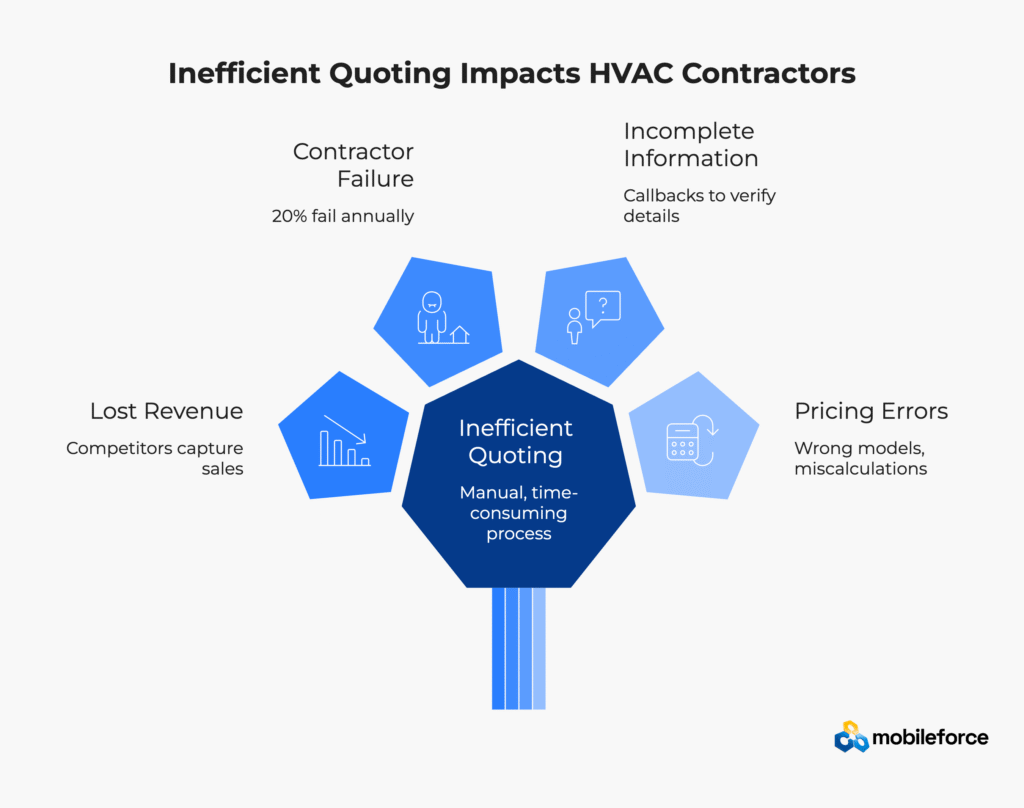
This workflow created multiple failure points. Handwritten notes from field visits contained incomplete information, forcing callbacks to verify details. Pricing research consumed hours as administrators compared distributor costs, applied margin calculations, and double-checked equipment compatibility. Manual quote assembly introduced errors—wrong model numbers, incompatible component pairings, pricing miscalculations. Most critically, the multi-day delay let competitors who could quote faster capture the sale.
The industry recognizes this friction. According to ACHR News market analysis, approximately 20% of HVAC contractors fail annually, with quoting inefficiency contributing to lost revenue that makes survival difficult. Equipment distributors report that contractors who can quote within 24 hours win deals at rates 35-40% higher than those taking 3+ days to respond.
CPQ platforms built for HVAC operations address these challenges through purpose-designed capabilities. Equipment configuration engines contain manufacturer catalogs with technical specifications, compatibility matrices, and pricing. When a technician inputs customer requirements—2,200 square feet, two-story colonial, 15-year-old R-13 insulation, natural gas heating preferred—the system automatically filters equipment options to compatible models and calculates required tonnage based on industry load calculation standards.
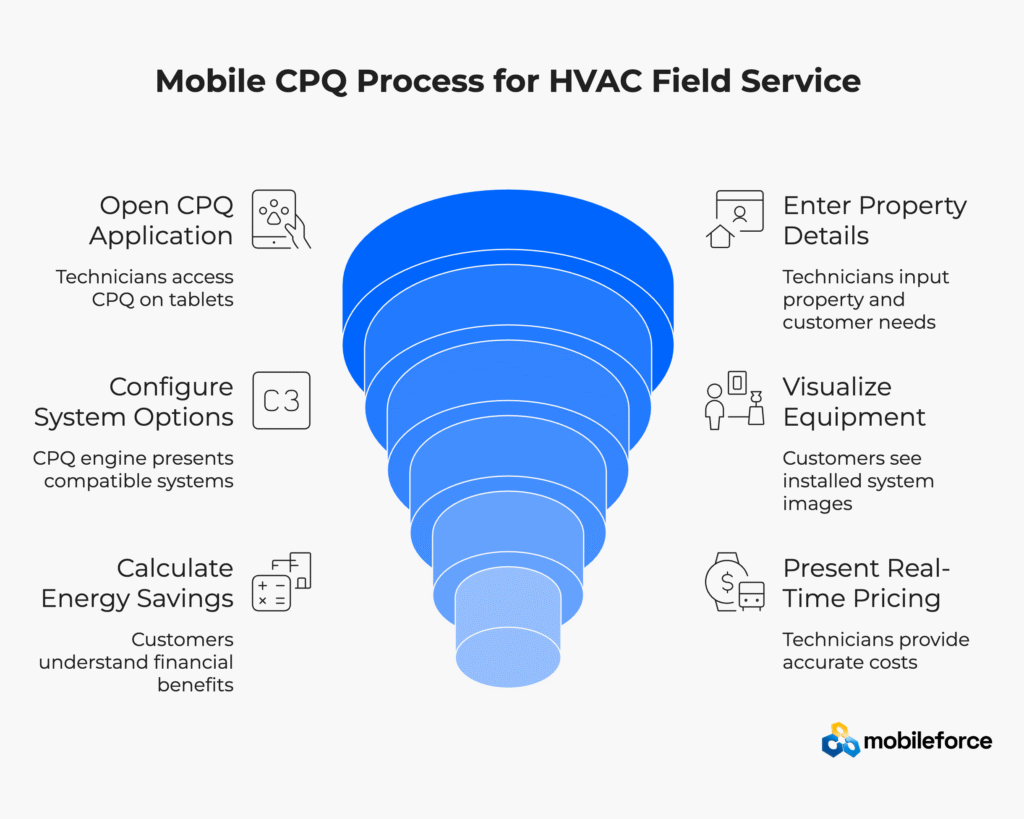
Mobile CPQ capabilities enable field quoting that changes the customer interaction dynamic. Technicians access CPQ software on tablets during service calls, entering property details and customer preferences on-site. The system presents equipment tiers with pricing, energy efficiency ratings, and available rebates. Technicians walk homeowners through options immediately while standing in front of the failing equipment that motivated the service call, capturing decision momentum when customer urgency peaks.
Price optimization prevents margin erosion through automated rules that enforce floor pricing, apply approved discount tiers, and calculate installation complexity premiums. A basement furnace installation automatically adds labor hours for confined space work. A second-floor air handler replacement includes crane or rigging costs. Emergency service quotes apply premium pricing for after-hours installations. These rules execute consistently across all quotes, preventing technicians from underbidding jobs or office staff from accidentally losing money on complex installations.
Integration with CRM systems connects quoting to broader customer relationships. When a technician generates a quote for a system replacement, it automatically creates a sales opportunity in the CRM with appropriate follow-up tasks. Quote acceptance triggers work order generation in field service management software with installation crew scheduling and parts ordering. This connected workflow eliminates data re-entry and the coordination gaps that cause delays between sale and installation.
Real-world implementation demonstrates measurable impact. HVAC contractors report quote turnaround dropping from 2-3 business days to same-day or next-day delivery. Win rates on quoted opportunities improve 25-35% according to field service software vendors serving the trades. Revenue per technician increases as field staff spend less time on administrative tasks and more time on billable service calls and installations.
Explore how automated quoting accelerates revenue cycles for service contractors →
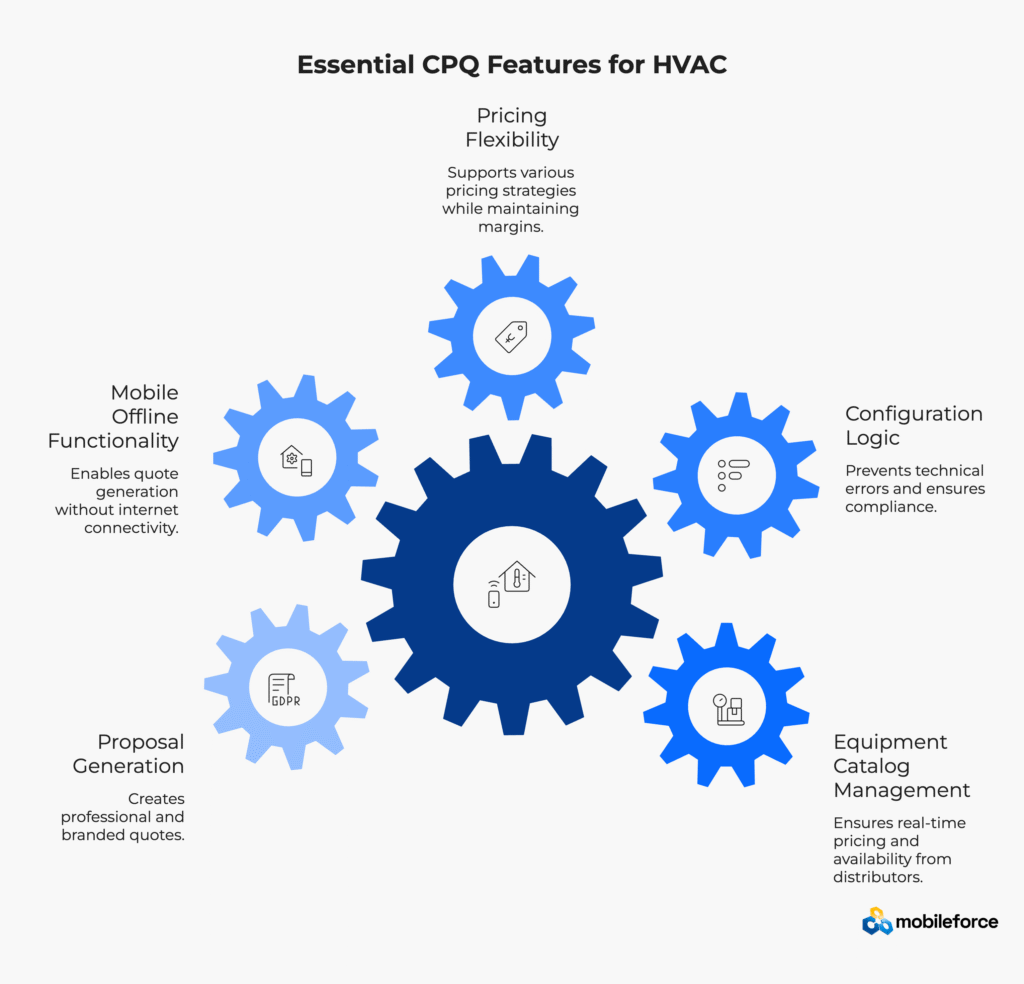
HVAC contractors evaluating CPQ platforms should assess capabilities across several critical dimensions. Equipment catalog management determines whether the system can handle your distributor relationships and equipment mix. Leading platforms integrate directly with major HVAC distributors like Ferguson, Johnstone Supply, and United Refrigeration to pull real-time pricing and availability, ensuring quotes reflect current market conditions rather than outdated price sheets.
Configuration logic prevents costly technical errors. The platform should validate compatibility between condensers and evaporator coils, match furnace capacity to ductwork sizing, and flag installations requiring electrical upgrades or gas line modifications. Advanced systems incorporate manufacturer installation guidelines, local building code requirements, and energy efficiency program specifications, guiding technicians toward compliant system designs that avoid failed inspections or warranty complications.
Pricing flexibility accommodates the variety of pricing strategies HVAC contractors use. Flat-rate pricing presents customers with predetermined prices for standard installations. Time-and-materials pricing suits complex commercial projects where scope varies. Tiered good-better-best presentations let customers choose service levels matching their budget and performance expectations. The CPQ platform should support whichever approach your business model requires while maintaining consistent margin enforcement.
Mobile offline functionality proves critical for field operations. Technicians often work in basements, mechanical rooms, and job sites with poor cellular coverage. CPQ platforms with offline capabilities let technicians complete property assessments, configure equipment, generate quotes, and collect customer signatures without internet connectivity, syncing data automatically when connection resumes. This prevents the productivity loss that occurs when technicians can’t complete quotes onsite due to connectivity limitations.
Proposal generation and presentation tools determine how professional your quotes appear to customers. Modern CPQ systems produce branded PDF proposals with equipment photos, efficiency ratings, rebate information, financing options, and installation timelines. Interactive presentations on tablets let technicians walk through different system tiers, showing cost differences and energy savings projections. Digital signature capture enables immediate quote acceptance, converting interest to commitment before the technician leaves the property.
Successful CPQ deployment follows a structured implementation process tailored to HVAC operations. Initial setup begins with equipment catalog configuration, importing your distributor’s product database and establishing compatibility rules between components. This foundation ensures technical accuracy from the first quote generated.
Pricing strategy definition comes next. Your team documents current pricing approaches—standard labor rates, equipment markup percentages, complexity premiums for difficult installations, and discount approval workflows. These business rules get encoded into the CPQ platform as automated logic that guides quote generation while maintaining margin requirements. According to field service industry research, contractors who standardize pricing through CPQ systems report 15-20% improvement in job profitability by eliminating ad-hoc discounting and pricing inconsistencies.
Quote template development creates the customer-facing documents your technicians will deliver. Templates include company branding, equipment specifications, warranty terms, and payment options. Many contractors develop multiple template variations—one for residential replacements, another for commercial installations, a third for maintenance agreement sales. This variety ensures each quote format matches the specific transaction type while maintaining professional consistency.
Technician training determines adoption success. Field staff need hands-on practice using CPQ software on tablets, walking through realistic scenarios—diagnosing a failed air conditioner, configuring replacement options, presenting quotes to mock customers, capturing digital signatures. According to ServiceTitan research analyzing thousands of HVAC contractors, companies that invest in comprehensive technician training see 40-50% higher quote volume from field teams within 90 days of CPQ deployment.
Integration with existing systems creates unified workflows. CPQ platforms should connect to your CRM for customer history, field service management for installation scheduling, accounting for invoicing, and distributor systems for parts ordering. This connectivity eliminates manual data transfer and the errors that accompany re-entering information across multiple software platforms.
See how integrated quote-to-cash workflows reduce operational complexity →
Mobile CPQ transforms how HVAC technicians interact with customers during service calls. Traditional workflows separated diagnostic work from sales opportunities—technicians identified failing equipment but couldn’t quote replacements onsite, creating a gap where customer urgency cooled and competitors intervened. Mobile CPQ closes this gap by equipping technicians with full quoting capabilities accessible from tablets in the field.
The field quoting process starts when technicians complete diagnostic work on failing equipment. Instead of noting customer needs for office follow-up, they open the CPQ application, enter property characteristics and customer requirements, and let the configuration engine present compatible system options. This immediate response capitalizes on the customer’s decision momentum while they’re focused on the problem requiring resolution.
Mobile-first architecture designed specifically for HVAC field operations differs significantly from desktop CPQ adapted for mobile use. Purpose-built mobile CPQ features large touch-friendly interfaces suitable for use while wearing work gloves, photo capture for equipment nameplate documentation, property measurement tools using phone sensors, and guided workflows that walk technicians through complete quote assembly without requiring extensive training.
Equipment visualization enhances customer understanding. Advanced mobile CPQ platforms include equipment image libraries showing what different HVAC systems look like installed, helping homeowners visualize the products being quoted. Energy savings calculators compare current system operating costs against proposed high-efficiency replacements, quantifying the financial benefits that justify premium equipment investments.
Real-time pricing access prevents the sticker shock that kills deals. Mobile CPQ pulls current pricing from distributor APIs, applies your margin rules, and calculates installation labor based on property-specific complexity factors. Technicians present accurate numbers immediately rather than vague estimates that later balloon when office staff finalizes formal quotes. This transparency builds customer trust and reduces the negotiation friction that delays decision-making.
Digital signature capture enables same-visit commitments. When customers accept quotes, technicians collect electronic signatures on tablets, instantly converting opportunities into booked jobs. This eliminates the delay where emailed quotes sit in customer inboxes while competitors schedule consultations. According to HVAC industry benchmarking data, contractors using mobile CPQ report 30-40% higher same-day close rates on replacement system sales compared to those requiring multi-day quote delivery.
HVAC contractors implement diverse pricing models depending on service mix and market positioning. Flat-rate pricing presents customers with predetermined prices for standard installations, simplifying decision-making by showing clear costs upfront. Time-and-materials pricing suits complex commercial projects where installation scope varies. Good-better-best tiering lets residential customers choose between economy systems, mid-tier efficiency equipment, and premium high-performance installations.
CPQ platforms automate these strategies through configurable pricing rules. Flat-rate pricing loads standard job costs into the system—furnace replacement in accessible basement location gets preset price, air conditioner installation in second-story mechanical closet gets different preset price. When technicians select job types, CPQ automatically applies appropriate pricing without manual calculations that introduce errors or inconsistencies.
Discount management prevents margin erosion while maintaining pricing flexibility for competitive situations. CPQ systems enforce discount approval workflows—technicians can offer 5% discounts autonomously, 10% discounts require manager approval via mobile notification, and 15%+ discounts need owner authorization. This structured approach protects profitability while enabling tactical pricing adjustments when needed to win competitive bids.
Seasonal pricing adjustments accommodate HVAC’s cyclical demand patterns. Many contractors offer spring air conditioning promotions and fall heating system specials. CPQ platforms schedule automatic price changes based on calendar dates, ensuring promotional pricing activates across all quotes during campaign periods and reverses when promotions end. This eliminates the manual process of updating pricing across multiple spreadsheets and hoping technicians apply correct seasonal rates.
Financing integration expands customer affordability. HVAC replacement systems costing $8,000-$15,000 exceed many homeowners’ available cash. CPQ platforms that integrate with lenders like GreenSky, Synchrony, or Wells Fargo calculate monthly payment options automatically, showing customers how $12,000 system purchases translate to $180 monthly payments over 60 months. Presenting financing during initial quote conversations reduces the payment shock that prevents purchase decisions.
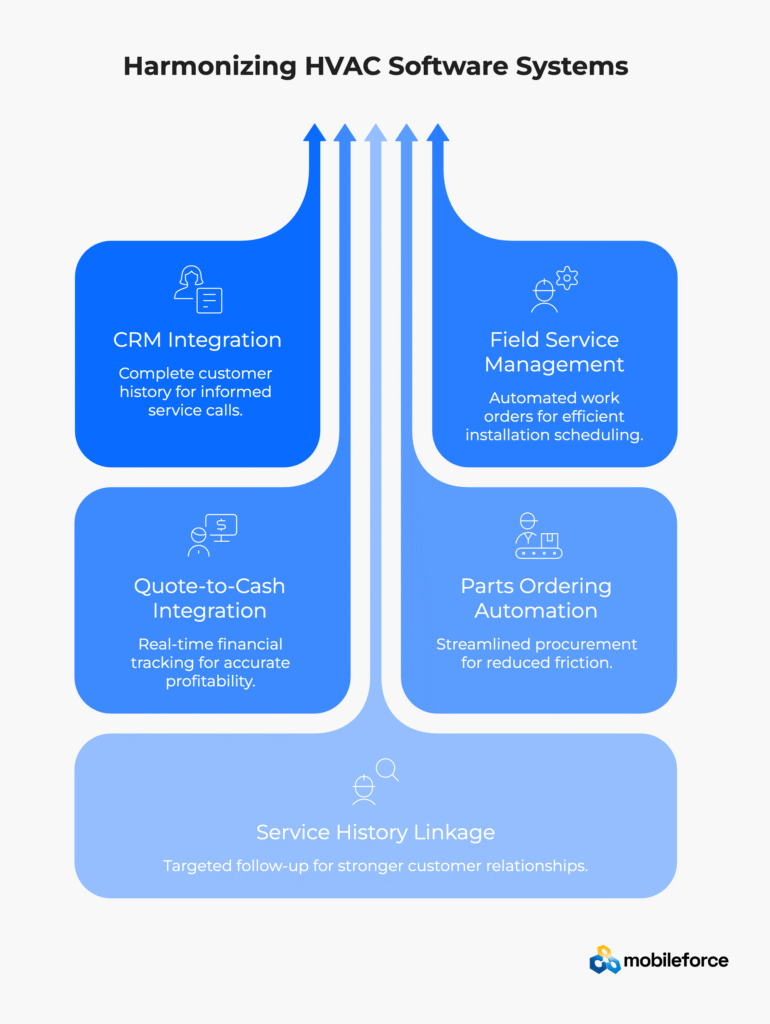
HVAC contractors typically operate multiple software systems—CRM for customer tracking, field service management for scheduling and dispatch, accounting for invoicing and financial reporting, and now CPQ for quoting. Integration between these platforms eliminates manual data transfer and creates unified workflows that improve operational efficiency.
CRM integration begins the customer journey. When existing customers call requesting service, customer service representatives see complete history in the CRM—previous installations, maintenance visits, equipment age, and past quote activity. This context informs the service call. If a 14-year-old air conditioner is being serviced during peak summer heat, the system flags replacement opportunity potential before the technician even arrives onsite.
Field service management connection creates seamless quote-to-installation workflows. When technicians generate quotes using mobile CPQ, the system automatically creates work orders if customers accept. These work orders populate with equipment specifications from the quote, ensuring installation crews order correct parts and schedule appropriate labor hours. Scheduling systems book installation appointments based on equipment availability and crew capacity without requiring separate order entry.
Quote-to-cash integration connects sales through financial reconciliation. Accepted quotes trigger invoice generation with payment terms matching the proposal—deposit due at signing, balance due upon installation completion. Payment collection integrates with accounting systems, updating job profitability reporting automatically. This end-to-end visibility lets contractors track financial performance in real-time rather than waiting for month-end accounting closes.
Parts ordering automation reduces procurement friction. When installation work orders are created from accepted quotes, the system can automatically generate purchase orders to distributors for required equipment and materials. Some advanced integrations check distributor inventory availability, adjust installation schedules if long-lead items require extended delivery times, and suggest alternative equipment options when preferred models are backordered.
Service history linkage improves customer relationships. Every quote generated, whether accepted or declined, becomes part of the customer record. When homeowners call for future service, technicians see previous proposals, understanding which system options customers considered and why deals didn’t close. This intelligence enables more targeted follow-up conversations that address original objections rather than repeating ineffective sales approaches.
Learn how unified quote-to-service workflows reduce revenue cycle friction →
Mobileforce provides CPQ capabilities specifically designed for HVAC contractors and other field service businesses operating complex quoting environments. The platform addresses the unique requirements of service contractors who need to quote equipment, installation labor, service contracts, and ongoing maintenance in a single proposal.
Mobile-first architecture built for field operations enables technicians to generate complete quotes from tablets during customer visits. The system works offline, allowing technicians in basements or mechanical rooms without cellular coverage to configure equipment, calculate pricing, and produce professional proposals. Quotes sync automatically when connectivity resumes, eliminating the productivity loss from waiting for internet access to complete customer transactions.
No-code configuration empowers HVAC contractors to manage quoting rules without IT support. Business owners and operations managers use visual interfaces to establish equipment compatibility rules, define pricing formulas, and create custom quote templates. This business user control eliminates the dependency on developers for routine quoting updates, enabling contractors to respond quickly to manufacturer price changes, seasonal promotions, or competitive market shifts.
Native CRM integration connects quoting directly to customer relationship management across platforms including HubSpot, Salesforce, Microsoft Dynamics, SugarCRM, and Creatio. When technicians generate quotes, customer information flows automatically from CRM into quote documents. Quote acceptance creates sales opportunities with appropriate follow-up tasks and pipeline reporting. This seamless connection prevents the data fragmentation that occurs when quoting operates separately from customer management systems.
AI-powered assistance helps technicians navigate complex quoting scenarios. The AskCPQ AI agent provides real-time guidance on equipment selection, pricing optimization, and proposal customization. Technicians can ask natural language questions—”What furnace works for 2,400 square feet with R-19 insulation in climate zone 5?”—and receive specific equipment recommendations with pricing. This intelligent assistance reduces training requirements and enables less experienced technicians to quote accurately.
Unified revenue operations extend beyond traditional CPQ capabilities to address the full quote-to-cash-to-service lifecycle. The platform handles initial equipment sales quotes, ongoing maintenance agreement proposals, parts and service billing, and renewal contract management. This comprehensive approach eliminates the system fragmentation where contractors use separate tools for different revenue streams, creating operational complexity and data disconnection.
According to Mobileforce’s client implementations, HVAC contractors using the platform report quote generation time dropping from 2+ days to under 30 minutes, same-visit close rates improving 35-45%, and revenue per technician increasing 20-25% as field teams capture more sales opportunities through efficient mobile quoting capabilities.
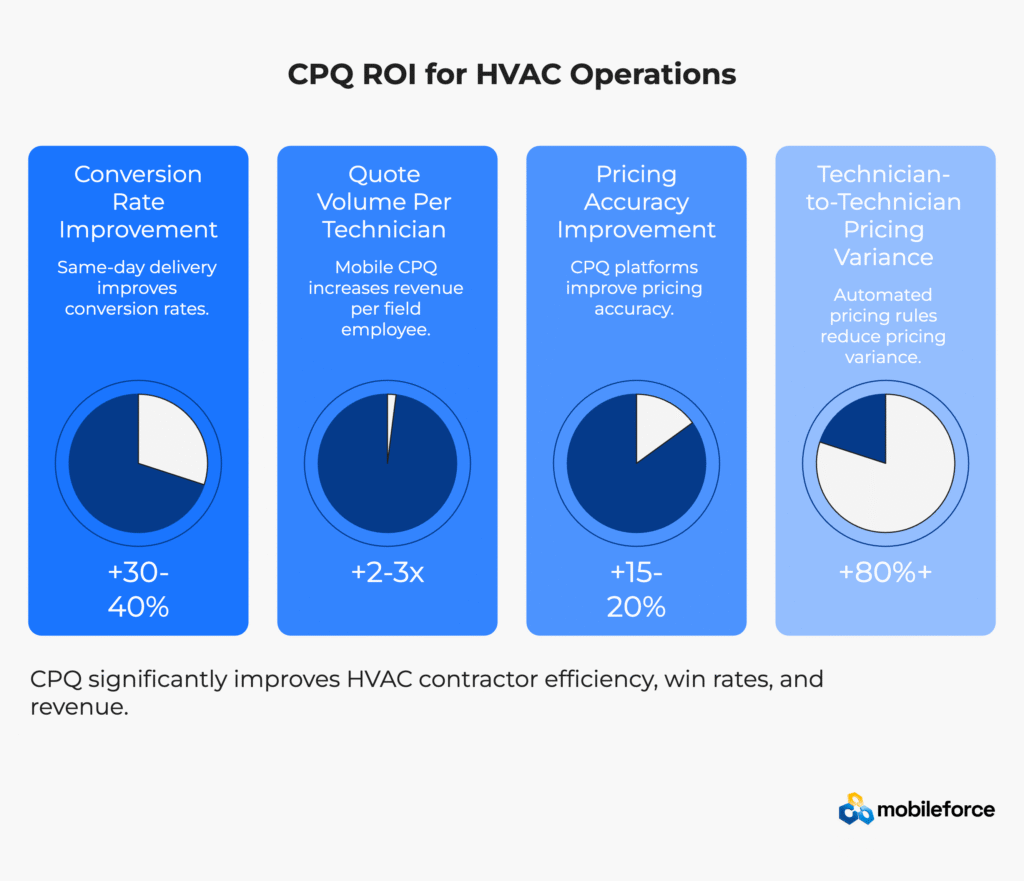
HVAC contractors evaluating CPQ investments should establish clear success metrics aligned with business goals. Quote turnaround speed directly impacts win rates—measuring days from service call to quote delivery quantifies improvement as CPQ implementation compresses this timeline. Industry benchmarks show contractors moving from 3-day turnaround to same-day delivery see conversion rate improvements of 30-40%.
Quote volume per technician indicates whether mobile CPQ increases revenue per field employee. Before CPQ, technicians focus on technical work while office staff handle quoting. After CPQ deployment, technicians generate quotes during service calls without administrative handoffs. Leading contractors report quote volume per technician increasing 2-3x as mobile quoting removes bottlenecks.
Win rate improvement measures quoting effectiveness. Tracking the percentage of quotes that convert to booked jobs shows whether faster, more professional proposals improve sales success. Contractors typically see win rates on equipment replacement quotes improve from 30-35% baseline to 45-55% after CPQ implementation according to field service industry research.
Quote accuracy and pricing consistency protect margins. Comparing quoted prices to actual job costs reveals whether estimates match reality. Comparing quoted prices across different technicians shows whether pricing remains consistent or varies based on who generates the quote. CPQ platforms typically improve pricing accuracy by 15-20% and reduce technician-to-technician pricing variance by 80%+ through automated pricing rules.
Revenue impact provides ultimate ROI validation. Calculate the value of incremental quotes generated, improved win rates, and faster close cycles. A 35-person HVAC contractor generating 800 service calls monthly, quoting 200 replacement opportunities quarterly, and closing 30% of quotes generates roughly $1.2 million quarterly in system replacement revenue. If CPQ increases quote volume 40% (to 280 quotes quarterly) and improves win rate to 42%, quarterly replacement revenue grows to $2.1 million—a $900,000 quarterly increase that quickly justifies CPQ platform costs.
HVAC contractors encounter predictable obstacles during CPQ deployment. Technician adoption represents the most frequent challenge—field staff comfortable with manual processes resist new software requiring behavior changes. Address this through hands-on training focused on how CPQ makes technicians’ jobs easier rather than adding administrative burden. Demonstrate how mobile quoting eliminates callbacks to the office, reduces time spent waiting for quotes, and helps technicians close deals while still onsite with customers.
Equipment catalog accuracy requires ongoing maintenance. HVAC distributors change pricing, discontinue models, and introduce new equipment constantly. Establish processes for weekly or bi-weekly catalog updates, assigning responsibility to specific team members for maintaining equipment data. Some CPQ platforms offer automated distributor integrations that sync pricing changes daily, reducing manual update requirements.
Pricing strategy complexity creates configuration challenges. HVAC contractors often use different pricing approaches for residential versus commercial work, emergency versus planned installations, and customer segments based on relationship history. Map these strategies clearly during implementation, documenting decision trees that govern which pricing rules apply to which scenarios. Convert this logic into CPQ configuration systematically rather than attempting to recreate undocumented tribal knowledge.
Integration gaps between CPQ and existing systems cause workflow friction. Your team generates quotes in CPQ but still manually re-enters data into field service software for scheduling or accounting systems for invoicing. Prioritize integration connections during implementation, working with software vendors to establish automated data flows. According to enterprise software implementation research, integrated systems deliver 3-4x higher ROI than standalone tools requiring manual data transfer.
Change management resistance affects both field technicians and office staff whose roles evolve with CPQ deployment. Service advisors accustomed to building quotes see their responsibilities shift. Technicians comfortable with technical work but uncomfortable with sales conversations face pressure to quote during customer interactions. Address this through clear communication about how CPQ benefits the business and individual team members, providing training and support during the transition period.
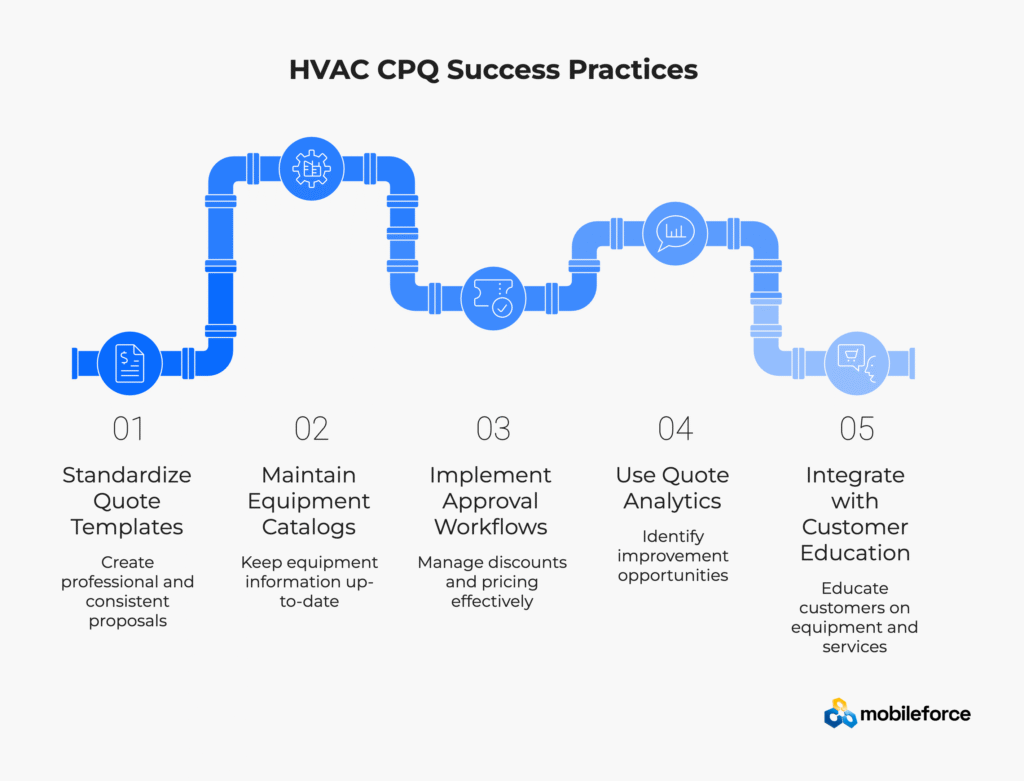
HVAC contractors who successfully deploy CPQ follow several key practices. Start with standardized quote templates that present professional, consistent proposals across all customer interactions. Include company branding, equipment specifications, installation scope descriptions, warranty terms, and payment options. Standardization ensures quality whether the quote is generated by your most experienced technician or newest field team member.
Maintain up-to-date equipment catalogs by establishing regular update schedules. Assign specific team members responsibility for monitoring distributor price changes, new equipment releases, and discontinued models. Weekly catalog reviews prevent quotes from referencing unavailable equipment or outdated pricing that creates margin problems when actual costs exceed quoted prices.
Implement approval workflows for discounts and special pricing to protect profitability while enabling flexibility. Allow technicians autonomy for small discounts (typically 5% or less), require manager approval for moderate discounts (5-10%), and mandate owner authorization for deeper discounts (10%+). This structured approach maintains pricing discipline while preventing rigid processes that cost competitive deals.
Use quote analytics to identify improvement opportunities. Track which equipment packages customers select most frequently, revealing optimal good-better-best pricing tiers. Monitor win rates by quote type, identifying categories where your proposals succeed and areas needing pricing or presentation refinement. Review quote abandonment patterns to understand where customers request quotes but don’t make decisions, suggesting opportunities to improve follow-up processes.
Integrate CPQ with customer education initiatives. Use quote presentations to explain equipment efficiency ratings, warranty coverages, and maintenance requirements. Educated customers make confident purchase decisions, reducing buyer’s remorse and the service calls that result from customers not understanding what they purchased. Professional quote documents serve as reference materials customers review when making final decisions, extending the value beyond initial presentation.
Schedule a demo to see how modern CPQ accelerates HVAC sales cycles →
HVAC quoting technology continues evolving with capabilities that further streamline contractor operations. AI-powered recommendations analyze customer requirements, property characteristics, and historical quote data to suggest optimal equipment configurations. These intelligent systems help technicians navigate the thousands of potential equipment combinations, focusing on options most likely to meet customer needs and budget constraints.
Predictive quoting uses customer data and equipment history to anticipate replacement needs before failures occur. Systems analyze installed equipment age, maintenance history, and typical lifespan data to identify customers approaching replacement decisions. This proactive approach enables targeted marketing campaigns and maintenance conversations that surface replacement opportunities earlier in the customer decision cycle.
Augmented reality integration lets customers visualize proposed equipment in their homes before installation. Technicians use tablets or phones to overlay digital equipment images onto live camera views of mechanical rooms, showing what new systems will look like installed. This visualization removes ambiguity about equipment size, appearance, and placement, addressing concerns that sometimes prevent purchase decisions.
Voice-enabled quoting allows technicians to interact with CPQ systems through spoken commands while hands remain free for technical work. “Configure 3-ton 16-SEER heat pump with gas furnace backup” triggers equipment selection without touching a tablet. Voice input reduces quoting friction during customer interactions, making the process feel conversational rather than administrative.
Energy modeling capabilities calculate expected operating costs for different equipment tiers, quantifying financial benefits of high-efficiency systems. Quotes present side-by-side comparisons showing baseline equipment at lowest upfront cost but highest 10-year operating expense, mid-tier equipment balancing price and efficiency, and premium systems with maximum efficiency but highest initial investment. These total-cost-of-ownership presentations help customers make informed decisions aligned with their financial priorities.
The HVAC industry will continue seeing technology adoption accelerate as contractors compete for talent and customers in challenging market conditions. According to BDR Co. industry analysis, successful HVAC contractors in 2026 invest 8-12% of revenue in technology and marketing to drive operational efficiency and customer acquisition. Those who embrace modern quoting tools position themselves to capture market share while competitors struggle with manual processes that can’t match customer expectations for responsiveness and professionalism.

What is CPQ software for HVAC contractors?
CPQ (Configure-Price-Quote) software helps HVAC contractors automate the process of creating accurate quotes for equipment sales and installations. The platform validates equipment compatibility, applies pricing rules, and generates professional proposals that technicians can deliver to customers during service calls or within hours of assessment.
How much does CPQ software cost for HVAC businesses?
CPQ software pricing for HVAC contractors typically ranges from $100-$400 per user monthly depending on capabilities, integrations, and deployment size. Mid-market platforms serving 10-50 technician operations usually cost $3,000-$12,000 annually. Enterprise solutions with extensive customization and integration capabilities run $15,000-$50,000+ annually. ROI typically comes from improved win rates, faster quote cycles, and better margin protection.
Can HVAC technicians use CPQ software in the field?
Yes, modern CPQ platforms designed for field service include mobile applications that work on tablets and smartphones. Technicians enter customer requirements and property details onsite, configure compatible equipment options, calculate pricing, and generate professional proposals during customer visits. Leading platforms work offline in locations without cellular coverage, syncing data when connectivity resumes.
What’s the difference between CPQ and estimating software?
Estimating software calculates job costs for internal planning—how much equipment, labor, and materials a project requires and what it will cost the contractor. CPQ software focuses on customer-facing quotes—presenting equipment options, pricing, and terms in professional proposals designed to win sales. Many contractors use both—estimating for complex commercial bids and CPQ for routine residential replacement sales.
How does CPQ integrate with field service management software?
CPQ platforms integrate with field service management systems through APIs that share data automatically. When technicians generate quotes and customers accept, the CPQ system creates work orders in field service software with equipment specifications and installation requirements. Scheduling, dispatching, and completion tracking happen in field service management while the original quote data transfers seamlessly without manual re-entry.
What HVAC-specific features should contractors look for in CPQ software?
HVAC contractors need CPQ platforms with equipment compatibility validation to prevent mismatched components, mobile offline capability for field quoting without internet dependency, installation complexity pricing that adjusts labor costs based on property factors, and financing calculator integration to show customers monthly payment options. Platforms should also support both flat-rate and time-and-materials pricing models common in HVAC operations.
How long does CPQ implementation take for HVAC companies?
Typical CPQ implementation timelines for mid-sized HVAC contractors (10-50 employees) run 4-12 weeks. Initial setup including equipment catalog loading, pricing rule configuration, and quote template creation takes 2-4 weeks. Technician training and pilot testing require another 2-4 weeks. Full deployment with all integrations active typically completes within 8-12 weeks. Smaller operations with simpler requirements can launch in 4-6 weeks.
Does CPQ software work for commercial HVAC projects?
Yes, CPQ software supports commercial HVAC quoting but requires more sophisticated configuration than residential systems. Commercial projects need multi-zone capability, complex load calculations, extended warranty options, and maintenance contract proposals. Some CPQ platforms excel at residential replacement sales but lack depth for commercial project quoting. Evaluate platforms specifically for their commercial HVAC capabilities if this represents significant business volume.
What ROI can HVAC contractors expect from CPQ implementation?
HVAC contractors typically see 200-400% ROI within 12 months of CPQ deployment. ROI comes from multiple sources: quote volume increasing 30-50% as technicians quote in the field rather than waiting for office staff, win rates improving 25-35% through faster quote delivery and professional presentations, and margin protection improving 10-15% through automated pricing rule enforcement. A contractor generating $3 million annual revenue typically sees $300,000-$600,000 revenue increase from these improvements.
Can CPQ software handle maintenance agreements and service contracts?
Advanced CPQ platforms designed for field service contractors support maintenance agreement quoting alongside equipment sales. These systems present annual maintenance plans with different service levels, calculate recurring revenue pricing, and generate contract documents customers can sign digitally. Integration with billing systems enables automatic recurring invoicing for maintenance agreements sold through CPQ.
What happens when equipment prices change from distributors?
When distributors change equipment pricing, CPQ platforms need catalog updates to maintain quote accuracy. Some platforms offer automated distributor integration that syncs pricing daily from major suppliers like Ferguson or Johnstone Supply. Others require manual catalog updates where administrators download new price sheets and import them into the system. Automated integration reduces maintenance burden but may cost extra compared to manual update approaches.
How does CPQ prevent pricing errors and margin problems?
CPQ software prevents pricing errors through automated rule enforcement that validates quotes before delivery. The system calculates equipment costs from current distributor pricing, applies required margin percentages, adds installation labor based on complexity factors, and ensures final prices meet minimum profitability thresholds. Quote approval workflows prevent technicians from offering excessive discounts without management authorization.