
CPQ for electrical contractors is specialized Configure-Price-Quote software that transforms complex electrical project pricing from manual spreadsheet processes into automated, mobile-first workflows. Unlike traditional CPQ software, electrical contractor CPQ platforms must handle multi-tier labor rates, material markup hierarchies, and construction site connectivity challenges while maintaining sophisticated pricing accuracy. The best CPQ software for electrical contractors combines enterprise-grade configuration engines with mobile accessibility, enabling field crews to generate accurate quotes through conversational AI during on-site customer meetings.
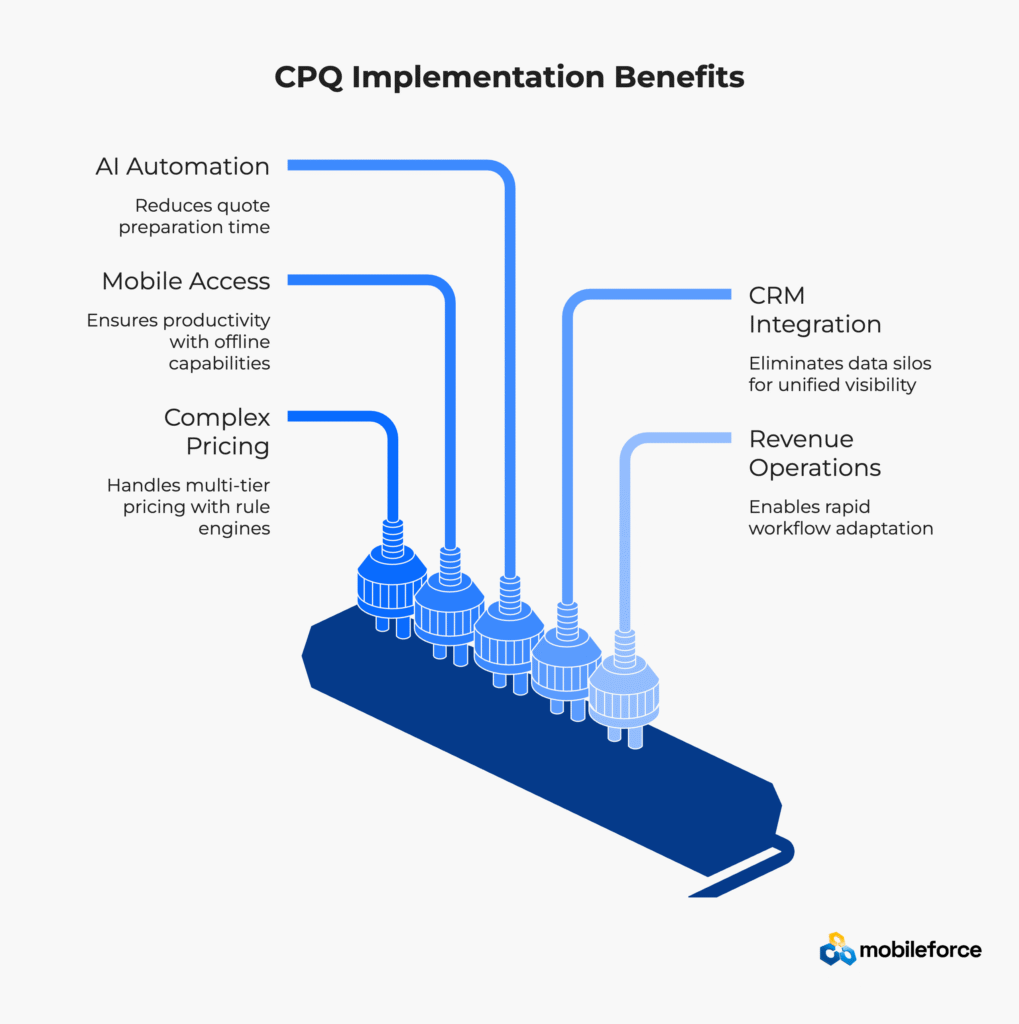
Electrical contractor CPQ solutions address three critical operational requirements: complex pricing configuration that processes multi-dimensional variables automatically, mobile-first architecture that functions during construction site connectivity interruptions, and seamless CRM integration that eliminates data silos between field operations and office management systems. With 49% of contractors still using spreadsheets for quote management according to Construction Industry Institute research, electrical contractor CPQ implementation represents competitive differentiation rather than operational convenience.

The $225 billion electrical contracting industry faces a digital transformation crisis—49% of contractors still rely on spreadsheets while grappling with 81,000 projected annual job openings and massive skilled worker shortages. Mobileforce’s mobile-first electrical contractor CPQ software transforms productivity through AI AskCPQ automation, complex pricing rule configuration, and offline-capable field operations. With enterprise-grade configuration engines handling multi-tier labor rates, material markups, and project complexity variables, electrical contractors achieve 10x faster quote generation and $6.22 ROI per dollar invested while competitors remain trapped in spreadsheet-based operations.
In late October, Marcus, the operations manager at a 300-person electrical contracting firm, received a project inquiry that exposed fundamental limitations in his operational systems. A major commercial developer needed quotes for electrical installations across twelve concurrent construction sites, each requiring real-time pricing adjustments based on material availability and field crew scheduling. The request demanded immediate responsiveness in an industry where quote speed increasingly determines project awards.
What made Marcus’s situation challenging: he wasn’t questioning competitive quoting importance. Industry analysis shows contractors responding within 24 hours capture 60% more opportunities than those requiring 3-4 days for quote preparation. Speed matters. What concerned Marcus was operational reality confronting electrical contractors nationwide—his team managed complex multi-site projects through Excel spreadsheets while competing against contractors implementing mobile-first CPQ platforms that deliver quotes 10x faster.
The catch? Marcus operated in an industry where 49% of contractors still use spreadsheets for core operations, yet construction sites demand real-time access to pricing, customer data, and project specifications during field operations. His current quoting process involved office-based calculations, manual data entry across disconnected systems, and phone coordination between field crews and estimators. Each multi-site quote required 6-8 hours of administrative coordination before pricing reached customers.
Marcus recognized what distinguishes thriving contractors from those struggling with operational bottlenecks: the solution wasn’t just about faster calculations or better pricing accuracy. It was about mobile-first workflow integration that could eliminate field-office communication delays while enabling real-time responsiveness during construction site negotiations. With electrical contractor employment projected to grow 9% annually through 2034 and a $225 billion market demanding operational efficiency, Marcus understood that electrical contractor software transformation represented competitive differentiation rather than convenience.
Traditional electrical contracting suffers from fundamental architectural flaws that compound across project phases. Field crews require immediate access to pricing data and project specifications during on-site negotiations, yet 49% of contractors manage critical information through office-based spreadsheets and disconnected desktop systems. This operational disconnect transforms competitive quoting from hours into days while competitors using mobile-first CPQ platforms deliver real-time pricing responses.
When field supervisors encounter scope changes during installations, traditional contractors require office coordination to recalculate pricing and approve change orders. Projects experience average delays of 4-6 hours while contractors coordinate through phone calls between field crews and estimating teams. Marcus’s firm managed 25-30 concurrent projects across multiple construction sites, meaning communication delays affected operational efficiency systematically rather than sporadically.
Electrical contractor pricing involves sophisticated variables that spreadsheets handle poorly: multi-tier labor classifications, regional rate adjustments, material markup hierarchies, project complexity factors, and overtime calculations. Manual pricing processes create systematic inefficiencies that electrical contractors normalize but competitors exploit strategically. Complex multi-site projects requiring customized specifications, varying labor rates, and material substitutions become administrative challenges that stretch manual processes beyond practical limits.
AI-powered CPQ systems with advanced configuration engines eliminate these calculation errors while processing electrical contractor complexity through automated workflows. Marcus recognized that sophisticated pricing configuration represented competitive differentiation rather than operational convenience—the difference between reactive quote processing and proactive customer engagement through accurate, immediate pricing responses.
Construction sites present connectivity challenges that office-based systems cannot accommodate. Field crews need immediate access to customer data, pricing information, and project specifications during on-site meetings, yet traditional contractors manage this information through desktop systems requiring office coordination. Mobile-first competitors maintain operational continuity through integrated platforms that enable productivity during construction site connectivity interruptions while providing real-time customer interaction capabilities.

Configure-Price-Quote software represents a fundamental shift from spreadsheet operations to mobile-first workflow integration, yet most CPQ platforms were designed for office environments rather than construction site reality. Mobile-first CPQ architecture recognizes that electrical contractors operate across multiple locations simultaneously, requiring platforms that maintain sophisticated pricing accuracy regardless of location or connectivity status.
Mobileforce’s platform addresses Marcus’s operational challenges through integrated capabilities: AI AskCPQ for natural language quote automation, complex pricing rule engines that handle multi-tier labor classifications and material markup hierarchies, and offline-capable mobile architecture that functions during connectivity interruptions. This combination transforms electrical contracting from reactive quote processing to proactive customer engagement through field accessibility.
Mobileforce’s enterprise-grade configuration capabilities handle electrical contractor pricing complexity that spreadsheets cannot manage systematically. The platform processes multi-dimensional pricing variables through sophisticated rule engines: labor classifications by skill level and overtime rates, material markup hierarchies by category and volume, regional rate adjustments, project complexity factors, and customer-specific pricing agreements. These variables interact through automated calculation logic that ensures pricing consistency while enabling customization for specific project requirements.
The configuration approach extends beyond pricing to encompass workflow rules, approval processes, and customer communication patterns. Electrical contractors can establish automated triggers for project milestones, material ordering, and billing cycles while maintaining pricing accuracy across varying project complexity levels. Marcus recognized that sophisticated configuration represented strategic differentiation—the capability to handle complex projects that overwhelm manual processes while maintaining competitive responsiveness.
AI AskCPQ transforms complex pricing calculations from manual spreadsheet processes into natural language interactions that apply sophisticated pricing rules automatically. Field crews generate comprehensive quotes by describing project requirements conversationally: “Three-phase 480V service upgrade for 50,000 square foot warehouse with emergency backup systems.” The AI agent processes specifications, applies contractor-specific pricing rules, and generates formatted quotes in minutes rather than hours.
The conversational approach eliminates technical barriers while maintaining pricing sophistication. Traditional systems require specialized training on complex interfaces and detailed catalogs. AI AskCPQ enables immediate quote generation through natural communication, allowing field supervisors to respond to customer inquiries and scope changes without office coordination delays while ensuring pricing accuracy through automated rule application.
Mobileforce’s offline-capable architecture ensures operational continuity during construction site connectivity challenges while maintaining access to complex pricing configurations and customer data. Field crews can generate quotes, modify specifications, and coordinate with office operations without requiring internet connectivity. When connectivity returns, the platform automatically synchronizes updates while maintaining data consistency throughout project lifecycles.
With the electrical industry facing 81,000 projected annual job openings and contractors competing for qualified crews, mobile-first platforms enable individual technicians to handle complex customer interactions that traditionally required office-based coordination. This technological capability becomes critical when skilled labor constraints demand maximum productivity from existing crews.

Mobileforce’s AI AskCPQ transforms electrical contractor quoting from manual calculations into conversational automation that applies sophisticated pricing rules through natural language understanding. Field supervisors generate comprehensive quotes by describing projects conversationally: “Industrial lighting retrofit for 75,000 square foot distribution center with LED conversion and emergency systems.” The AI agent interprets specifications, applies complex pricing configurations including multi-tier labor rates and material markup hierarchies, and delivers formatted quotes that include accurate cost calculations and project timelines.
The conversational approach eliminates technical barriers while maintaining pricing sophistication. Traditional systems restrict quote generation to trained estimators familiar with complex interfaces and detailed product catalogs. AI AskCPQ democratizes quote generation across field crews while ensuring consistency through automated rule application that reflects contractor expertise and competitive positioning.
The platform’s enterprise-grade configuration capabilities handle electrical contractor pricing complexity through sophisticated rule engines that process multiple variables simultaneously. Labor classifications by skill level and certification, overtime calculations based on project schedules, material markup hierarchies by category and volume, regional rate adjustments, and customer-specific pricing agreements interact through automated logic that ensures accuracy while enabling customization.
Marcus recognized that complex configuration capabilities represented strategic differentiation. The platform could handle multi-site projects with varying specifications, regional labor rates, and material substitution requirements—complexity that overwhelms manual processes while maintaining competitive response times through automation. Configuration extends beyond pricing to encompass approval workflows, project milestone tracking, and customer communication patterns tailored to electrical contractor operations.
Mobileforce’s mobile architecture enables field crews to access comprehensive customer histories, complex pricing configurations, and project specifications through mobile devices while maintaining functionality during connectivity interruptions. Field supervisors process change orders, material substitutions, and scope modifications during construction site visits, generating updated pricing immediately rather than scheduling follow-up meetings after office coordination.
CRM integration capabilities eliminate data fragmentation through comprehensive connectivity with HubSpot (Platinum Solutions Partner), Salesforce, and Microsoft Dynamics. Customer communication workflows integrate across platforms, providing unified project visibility that informs scheduling, resource allocation, and customer engagement strategies while maintaining automated workflow triggers for project milestones and completion notifications.
With electrical contractor markets experiencing significant growth—employment projected to grow 9% annually through 2034 according to academic workforce research—contractors require technology platforms that multiply individual technician productivity through systematic operational efficiency. Mobile-first CPQ platforms transform construction site negotiations from coordination delays into immediate customer responsiveness that influences contract awards in competitive bidding situations.
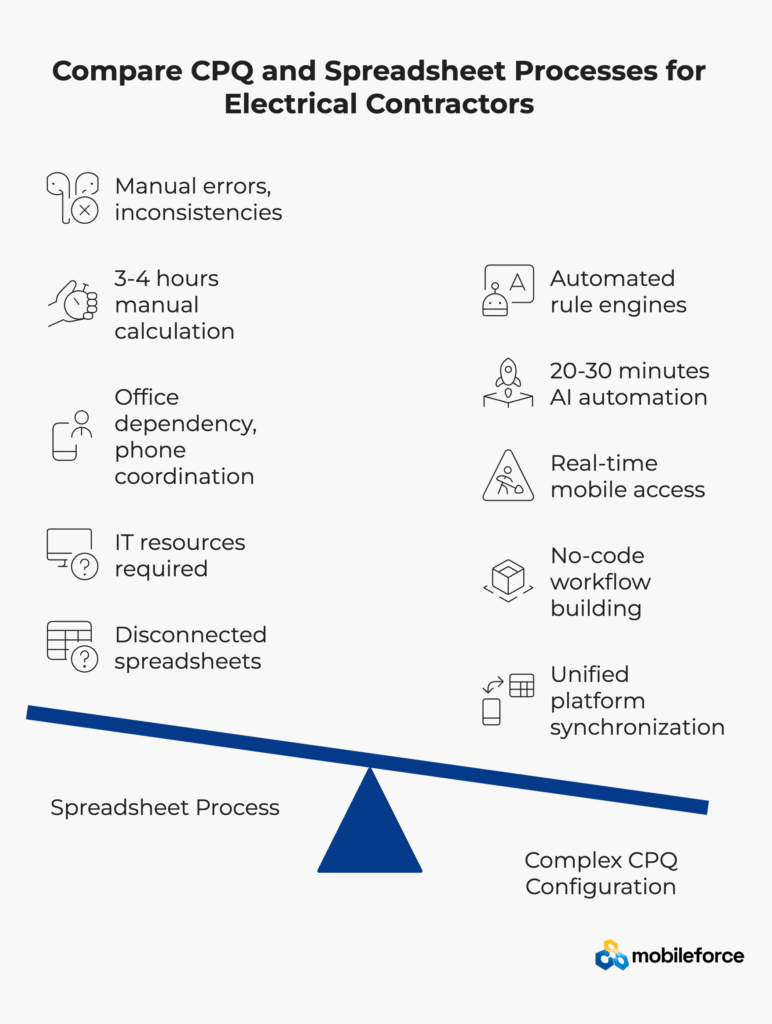
|
Operational Metric |
Spreadsheet Process |
Complex CPQ Configuration |
Enterprise Advantage |
|
Multi-Tier Pricing Accuracy |
Manual errors, inconsistencies |
Complex labor/material hierarchies |
|
|
Quote Generation Speed |
3-4 hours manual calculation |
Conversational intelligence |
|
|
Field Data Access |
Office dependency, phone coordination |
||
|
Configuration Complexity |
IT resources required |
Self-service adaptation |
|
|
CRM Integration |
Disconnected spreadsheets |
HubSpot Platinum Partnership |
Successful Mobileforce implementation begins with systematic configuration of complex pricing engines that transform enterprise CPQ capabilities into electrical contractor-specific workflows. The platform’s no-code tools enable contractors to establish multi-dimensional pricing rules: labor classifications by skill level and certification, material markup hierarchies by category and volume, regional rate adjustments, project complexity factors, and customer-specific pricing agreements. Configuration activities focus on building the pricing intelligence that AI AskCPQ uses to generate accurate quotes through conversational interactions.
AI AskCPQ training requires systematic input of contractor-specific terminology, pricing preferences, and project specification patterns. Electrical contractors upload existing quote databases, material catalogs, and labor rate structures, enabling the AI agent to understand industry language and pricing relationships. The training process typically requires 2-3 weeks before achieving contractor-specific accuracy that matches manual calculations while delivering 10x speed improvements.
Field crew integration transitions from office-based coordination to mobile-first customer engagement through systematic training and adoption management. Field supervisors receive comprehensive training on mobile quote generation, customer data access, and offline functionality that enables productivity during construction site connectivity challenges. Mobile deployment testing validates offline functionality while ensuring data synchronization accuracy when connectivity returns.
CRM integration becomes critical as mobile operations synchronize with existing customer relationship workflows. Mobileforce’s HubSpot Platinum Partnership and Salesforce connectivity ensure seamless data flow between field operations and office management systems. Integration testing validates customer data accuracy, communication history synchronization, and project status visibility across platforms.
Operational optimization measures productivity improvements while identifying configuration adjustments that enhance platform effectiveness. Performance measurement includes quote generation speed comparisons, customer response time improvements, and field crew productivity metrics. Contractors typically achieve 5-8x quote speed improvements while gaining real-time customer engagement capabilities that influence contract awards.
Workflow refinement addresses operational challenges while leveraging no-code configuration tools to optimize platform performance. Advanced feature implementation includes integration with existing inventory management, accounting platforms, and project scheduling tools that create comprehensive workflow integration.
Industry research indicates electrical contractors face unprecedented workforce challenges, with skilled technician employment requiring maximum productivity through technology multiplication. Implementation success depends on systematic change management that demonstrates operational benefits while maintaining project productivity throughout the transition period.

Marcus’s twelve-week evaluation timeline was approaching decision deadlines that would determine his firm’s competitive positioning throughout the construction industry’s digital transformation. The twelve concurrent projects couldn’t wait for organizational readiness assessments, field crews couldn’t continue coordinating customer interactions through phone calls while competitors delivered immediate pricing responses, and operational efficiency gaps were compounding daily through spreadsheet-based processes that consumed administrative resources without delivering customer responsiveness.
What distinguished Marcus’s strategic thinking: he understood that electrical contracting success increasingly depends on sophisticated pricing capabilities rather than traditional office-based coordination systems. With 49% of contractors still managing operations through spreadsheets while construction projects demand complex pricing for multi-tier labor rates and material hierarchies, competitive advantage belongs to contractors who can process this complexity through automated configuration engines. Mobileforce’s enterprise-grade pricing rules, AI AskCPQ automation, and mobile-first architecture provide technological sophistication that transforms construction site negotiations from reactive coordination into proactive sales opportunities.
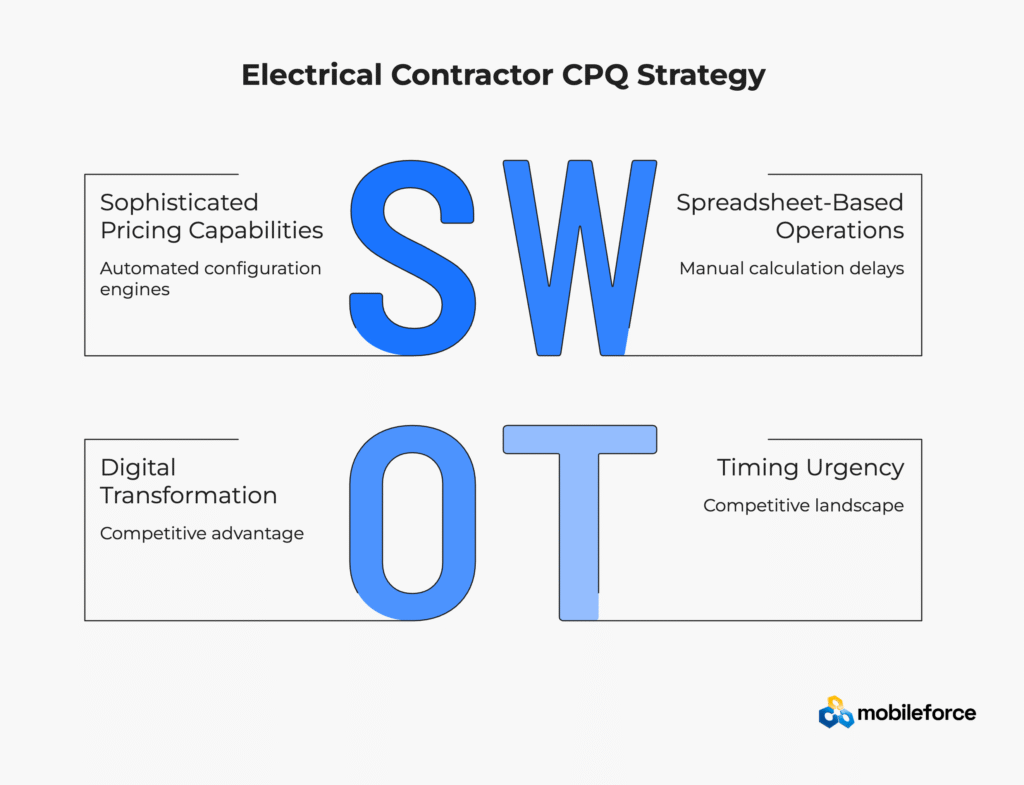
The competitive landscape reveals timing urgency that transcends operational convenience. Electrical contractors using complex configuration platforms capture customer opportunities through sophisticated pricing accuracy while traditional contractors lose projects during manual calculation delays. Construction customers increasingly expect immediate pricing adjustments for scope modifications and material substitutions that spreadsheet-based operations cannot provide systematically. Early CPQ adopters establish competitive advantages through pricing sophistication that compounds through customer satisfaction and referral generation.
Marcus faced a strategic choice between implementing proven enterprise CPQ capabilities that handle complex electrical contractor pricing, or continuing spreadsheet-based operations while waiting for purpose-built solutions. Mobileforce offers enterprise-grade configuration functionality with demonstrated manufacturing success, comprehensive CRM integration through HubSpot Platinum Partnership, and no-code tools that enable electrical contractor workflow customization without requiring dedicated IT resources.
Success requires understanding Mobileforce as a strategic platform investment that transforms electrical contracting from reactive spreadsheet processing to proactive customer engagement through sophisticated pricing capabilities and mobile accessibility. With the electrical industry experiencing significant workforce demand according to federal energy employment research, contractors require technology platforms that multiply individual technician productivity through systematic operational efficiency. Marcus’s timeline was advancing toward implementation decisions. The question wasn’t whether complex configuration platforms could improve electrical contractor operations—the question was whether his organization would implement enterprise CPQ capabilities while competitors remain constrained by manual pricing limitations.
The best electrical contractor CPQ software combines complex pricing configuration engines with mobile-first architecture and AI-powered automation. Mobileforce leads this category through enterprise-grade configuration capabilities that handle multi-tier labor rates, material markup hierarchies, and project complexity variables while maintaining offline functionality during construction site connectivity interruptions. Unlike traditional CPQ platforms designed for office environments, electrical contractor software requires mobile accessibility, conversational AI capabilities, and comprehensive CRM integration to address construction industry operational requirements.
Mobileforce’s enterprise-grade configuration engines process multi-dimensional pricing variables through sophisticated rule automation. Contractors configure pricing structures for labor classifications by skill level and certification, material markup hierarchies by category and volume, regional rate adjustments, project complexity factors, and customer-specific agreements. AI AskCPQ applies these complex pricing rules through conversational interactions—field crews describe projects in natural language while the system automatically calculates accurate pricing using configured rule engines. The platform processes electrical contractor complexity that overwhelms spreadsheet-based operations while maintaining competitive response times through automation.
Mobileforce’s offline-capable architecture maintains full CPQ functionality including complex pricing calculations during construction site connectivity interruptions. Field crews generate quotes through AI AskCPQ, access comprehensive customer histories, and process multi-tier pricing configurations without requiring internet connectivity. All pricing rules, customer data, and configuration logic remain accessible through mobile devices during offline conditions. When connectivity returns, the platform automatically synchronizes updates while maintaining data consistency throughout project lifecycles.
CPQ software pricing for electrical contractors varies based on user count, feature requirements, and integration complexity. Mobileforce offers transparent pricing models that reflect electrical contractor operational requirements rather than generic enterprise software pricing structures. Implementation costs are typically recovered within 6 months through operational efficiency gains, with contractors achieving 5-8x quote generation speed improvements and $6.22 ROI per dollar invested. Free trial options enable contractors to evaluate platform capabilities before committing to enterprise implementation.
As a HubSpot Platinum Solutions Partner with proven Salesforce and Microsoft Dynamics connectivity, Mobileforce provides comprehensive CRM integration that eliminates information silos. Customer data, project histories, and pricing configurations synchronize seamlessly between mobile CPQ operations and existing CRM platforms. Integration extends beyond data synchronization to include automated workflow triggers—project milestones generate customer notifications and completion confirmations without requiring manual coordination. Electrical contractors leverage existing CRM investments while gaining sophisticated pricing capabilities and mobile accessibility.
The platform’s no-code configuration tools enable contractors to build sophisticated pricing structures, workflow rules, and operational processes without technical expertise. Contractors establish multi-tier pricing hierarchies, approval processes reflecting operational hierarchy, custom project forms, and automated scheduling notifications through intuitive interfaces. Configuration changes are implemented by business users independently, enabling workflow adaptation without IT dependency or development costs. This configurability addresses electrical contractor operational diversity while maintaining systematic consistency.
CPQ implementation for electrical contractors typically requires 8-12 weeks from platform configuration through full field crew adoption. The process includes 3-4 weeks of complex pricing configuration, AI AskCPQ training with contractor-specific terminology, and CRM integration with existing customer management systems. Success depends on systematic change management that demonstrates operational benefits while maintaining project productivity throughout the transition period.
Electrical contractors typically achieve 5-8x quote generation speed improvements through AI AskCPQ automation, reducing preparation time from 3-4 hours to 20-30 minutes. Complex pricing configuration eliminates manual calculation errors while enabling sophisticated pricing strategies that improve profitability. Field crew productivity improves through real-time customer engagement capabilities during construction site visits. Industry analysis demonstrates consistent ROI of $6.22 return per dollar invested, with additional benefits through mobile accessibility and CRM integration that traditional spreadsheet-based systems cannot provide. Implementation costs are typically recovered within 6 months through operational efficiency gains.
Marcus’s evaluation timeline was approaching decision deadlines that would determine competitive positioning throughout the construction industry’s digital transformation. The twelve concurrent projects couldn’t wait for readiness assessments, field crews couldn’t continue coordinating through phone calls while competitors delivered immediate pricing responses, and operational efficiency gaps compounded daily through spreadsheet-based processes that consumed administrative resources without delivering customer responsiveness.
The electrical contracting industry presents implementation urgency that transcends operational convenience. With 49% of contractors managing quotes through spreadsheets while construction customers expect sophisticated pricing for complex multi-tier requirements, competitive advantage belongs to contractors who implement enterprise-grade configuration engines that process this complexity automatically. Mobileforce’s complex pricing rules, AI AskCPQ automation, and mobile-first architecture provide the technological foundation for systematic operational efficiency while competitors remain constrained by manual processes.
Marcus understood that the strategic question wasn’t whether complex CPQ configuration could improve electrical contractor operations—the question was execution timing and organizational commitment to platform adoption that transforms electrical contracting from reactive spreadsheet coordination to proactive customer engagement through sophisticated pricing capabilities and conversational AI automation.
Schedule Your Mobileforce CPQ Demonstration
Discover how electrical contractors achieve 5-8x quote speed improvements through complex pricing configuration, AI AskCPQ automation, and enterprise-grade CRM integration designed for construction site reality.