
Remote sales teams face a harsh reality: connectivity fails at the worst possible moments. When a $500K manufacturing deal hinges on an instant quote in a facility with spotty Wi-Fi, or a field service technician needs to price complex equipment configurations while standing in a rural wind farm, traditional cloud-only CPQ systems fall short. Hybrid online-offline quoting bridges this gap by enabling full quote creation, pricing rule enforcement, and customer interactions regardless of network status. Modern configure price quote platforms like Mobileforce’s offline-first CPQ solution ensure sales velocity never depends on signal strength, delivering enterprise-grade quoting capabilities that work anywhere business happens.
The future belongs to sales teams that can operate seamlessly across connected and disconnected environments, maintaining quote accuracy and customer responsiveness whether they’re in a Manhattan boardroom or a remote construction site. This sales enablement approach doesn’t just solve connectivity problems—it creates competitive advantages through faster response times, reduced quote errors, and enhanced customer experiences that modern B2B buyers expect from digital transformation initiatives.
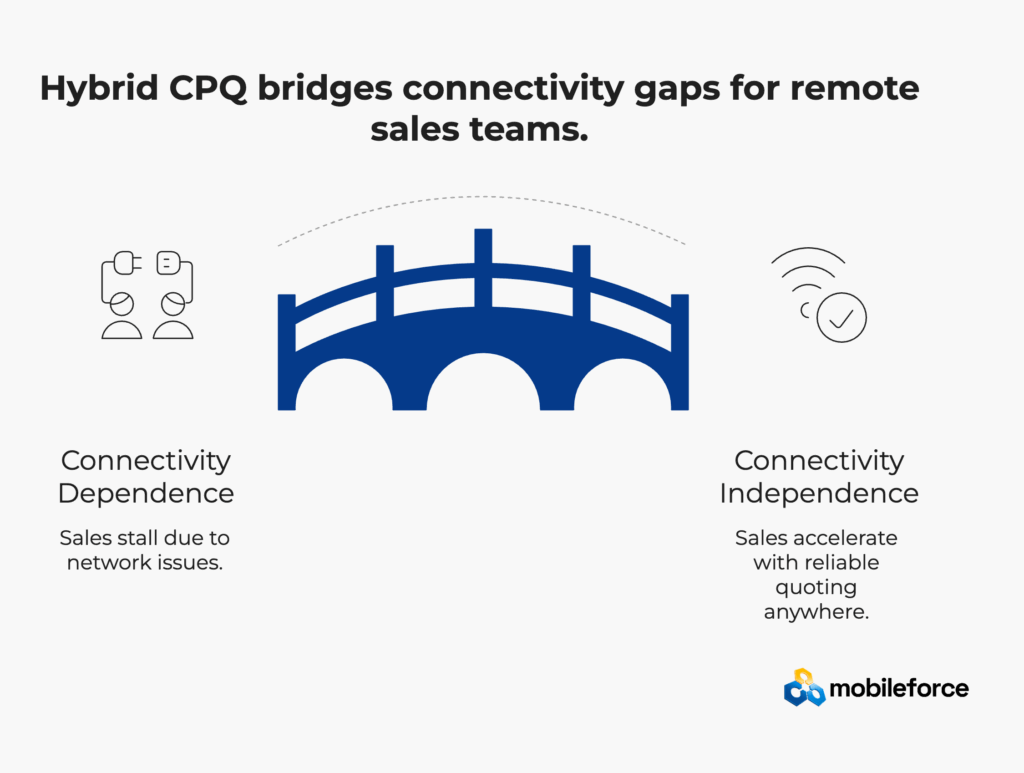
Picture this: A sales engineer is presenting to a potential customer at their manufacturing facility. The conversation is going well, and the prospect asks for an immediate quote on a complex equipment configuration. But the facility’s guest Wi-Fi is spotty, and the cellular signal barely reaches inside the industrial building. Traditional cloud-dependent CPQ systems would fail at this crucial moment.
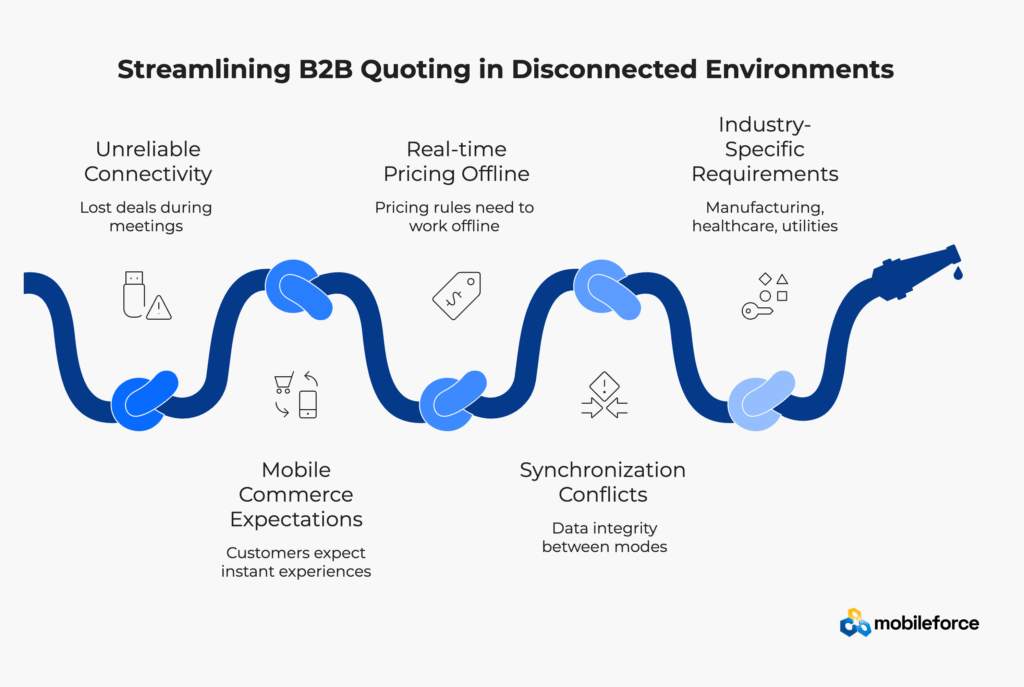
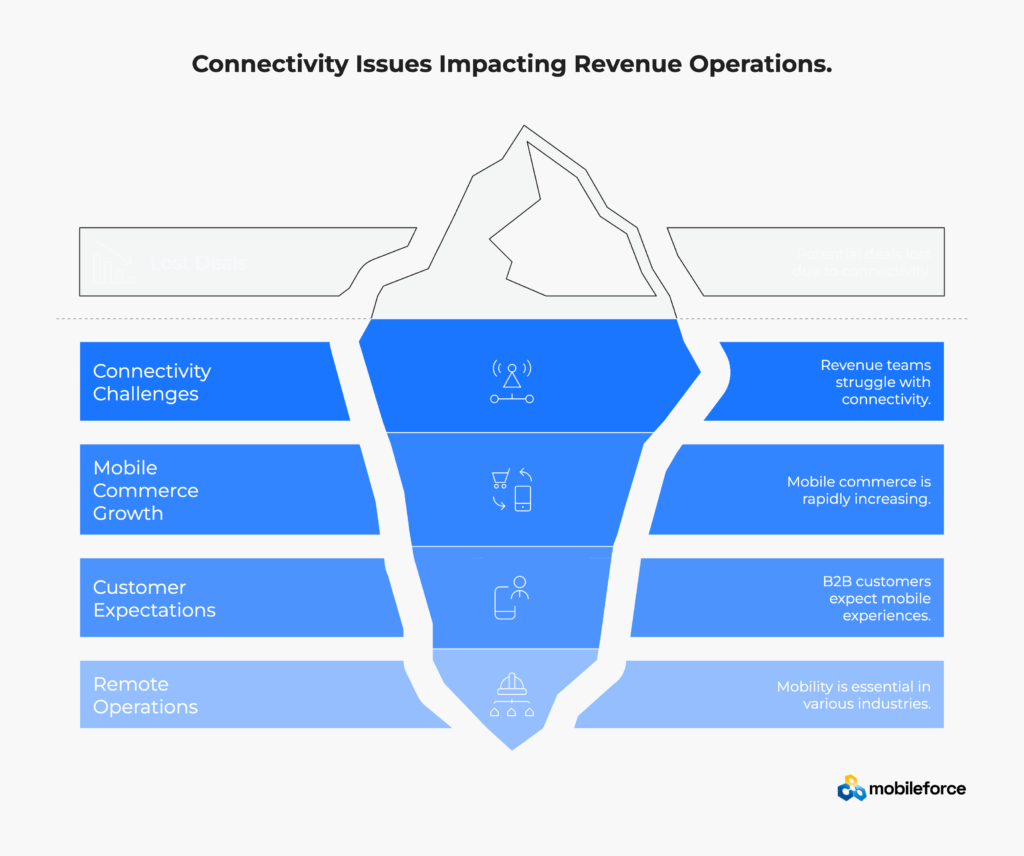
This scenario plays out thousands of times daily across industries where revenue operations teams struggle with connectivity challenges. According to recent field sales research, 74% of field sales professionals report losing potential deals due to connectivity issues during customer meetings. The problem extends beyond individual sales calls—entire business models depend on quote responsiveness in remote locations where sales force automation tools must function reliably.
Consider the scope: Mobile commerce reached $2.07 trillion in 2024, representing 57% of total e-commerce sales. B2B customers increasingly expect the same instant, mobile-optimized experiences they receive as consumers. When a potential customer can order a $10 product on Amazon while sitting in a remote location, they rightfully expect business suppliers to provide equally responsive quote experiences for $50,000 purchases through modern sales productivity tools.
The trajectory toward mobile-first business interactions continues accelerating. Mobile commerce reached $2.07 trillion in 2024, representing 57% of total e-commerce sales. B2B customers increasingly expect consumer-grade experiences including instant responses and mobile-optimized interactions from configure price quote systems. Mobileforce’s mobile-first design ensures organizations can meet these expectations even in challenging connectivity environments through advanced sales force automation.
The stakes are particularly high in industries where mobility and remote operations are essential. Manufacturing facilities, construction sites, healthcare institutions, and energy utilities often exist in locations where connectivity cannot be assumed. Yet these environments frequently involve the highest-value transactions that require immediate quote responses from sales automation tools designed for challenging connectivity conditions.
Location Type | Average Connectivity Reliability | Peak Revenue Impact |
Manufacturing facilities | 67% reliable during business hours | $2.3M average deal size |
Construction sites | 45% consistent mobile coverage | $850K average project value |
Healthcare institutions | 78% network availability | $1.2M average equipment purchase |
Energy/utility locations | 52% dependable connectivity | $5.1M average infrastructure deal |
Ready to see how offline-first quoting can transform your sales process? Schedule a demo with Mobileforce to experience enterprise CPQ that works anywhere your business operates.
Most established configure price quote platforms were architected during the early cloud computing era, when “always connected” seemed like a reasonable assumption for sales force automation. These quote software systems typically require continuous internet connectivity for several critical functions that can’t be delayed or approximated during customer relationship management interactions:
When connectivity fails, these sales productivity tools essentially become non-functional. Sales representatives are left explaining to customers why they cannot provide immediate quotes, scheduling follow-up meetings, or attempting to manually calculate complex pricing on paper—approaches that destroy sales momentum and professional credibility in B2B sales processes.
System Function | Traditional CPQ Dependency | Business Impact When Offline |
Pricing calculation | Cloud-based rules engine | Manual calculations, potential errors |
Product configuration | Server-side validation | Incomplete or invalid product bundles |
Approval workflows | Real-time API connections | Delayed quote delivery, lost momentum |
Document generation | Cloud rendering services | Unprofessional manual proposals |
CRM integration | Continuous sync requirements | Lost activity tracking, data gaps |
According to Adobe Analytics data, mobile devices drove 54.5% of online transactions in 2024, demonstrating the critical importance of optimized mobile experiences in sales automation tools. However, traditional CPQ systems often provide poor mobile experiences that assume large screens and full keyboards, making them particularly unsuitable for field sales scenarios where deal management requires immediate responsiveness.
According to McKinsey research on digital transformation, organizations implementing comprehensive mobile-first architectures see significant improvements in customer satisfaction and response times. These performance metrics become critical when sales teams operate in challenging connectivity environments where traditional quote software fails completely.
Hybrid online-offline quoting represents a fundamental architectural approach that enables complete quote creation, pricing rule enforcement, and customer interaction regardless of network connectivity status. Unlike traditional “offline mode” features that provide limited functionality, true hybrid sales enablement systems maintain full CPQ capabilities across connected and disconnected states for comprehensive revenue operations.
Local data caching stores essential product catalogs, pricing rules, and customer information directly on devices, enabling immediate access during customer relationship management interactions without server dependencies.
Intelligent synchronization manages data consistency when transitioning between online and offline states, ensuring sales force automation maintains accuracy across all connectivity scenarios.
Conflict resolution mechanisms handle simultaneous edits or price changes occurring during disconnected periods, preserving data integrity for deal management processes.
Capability Category | Offline Requirements | Online Enhancement |
Quote Creation | Complete product selection, pricing, configuration | Real-time inventory validation, updated catalogs |
Pricing Calculation | Local rules engine with discount validation | Dynamic pricing updates, competitor analysis |
Approval Workflows | Offline queue with local business rules | Instant manager notifications, escalation tracking |
Document Generation | Professional templates, brand compliance | Cloud storage integration, automated delivery |
Customer Interaction | Immediate quote presentation, modifications | CRM updates, activity logging, follow-up automation |
Functional requirements encompass complete quote creation including product selection, configuration, pricing calculation, and document generation while offline; approval workflow routing that queues approval requests for automatic processing when connectivity returns; and real-time customer interaction including quote presentation, modification, and acceptance during face-to-face meetings.
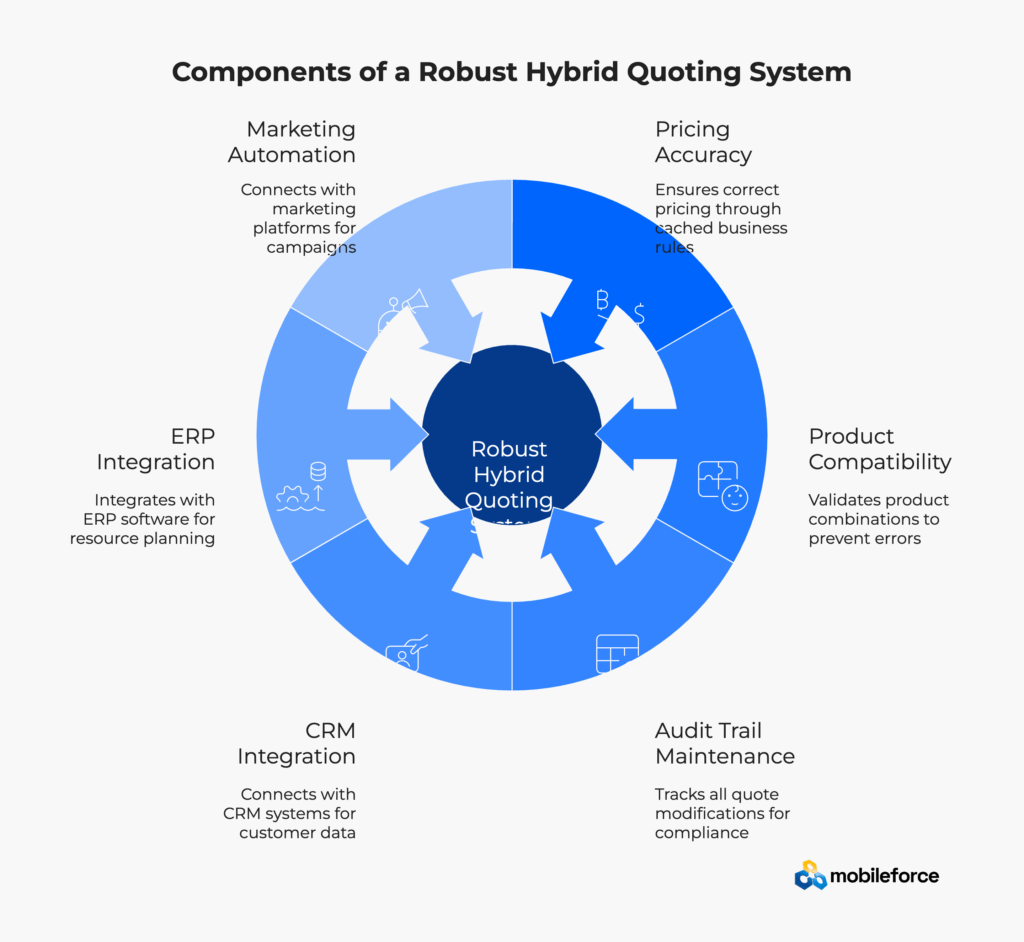
Pricing accuracy safeguards ensure local enforcement of discount limits, approval requirements, and special pricing terms through cached business rules that mirror server-side logic.
Product compatibility validation uses locally stored configuration rules and constraint matrices to prevent invalid product combinations during offline quote creation.
Audit trail maintenance tracks all quote modifications regardless of connectivity status, ensuring complete compliance documentation for sales operations and revenue recognition requirements.
Research from Forrester indicates that organizations implementing offline-capable sales technologies report 47% faster quote generation times and 35% reduction in quote-related errors compared to purely cloud-dependent systems. This performance improvement directly impacts sales productivity tools effectiveness and overall revenue operations efficiency.
Gartner research on B2B selling trends shows that 82% of B2B buyers complete more than half of their purchasing research before engaging with sales representatives, making immediate quote responsiveness crucial for deal management success in competitive environments.
Successful hybrid quoting platforms require seamless integration with existing sales technology stack components including customer relationship management systems, enterprise resource planning software, and marketing automation platforms. The best CPQ software maintains bidirectional data flow that supports both connected and disconnected operation modes.
The most successful remote region quoting implementations follow proven methodologies that prioritize offline-first operation, intelligent synchronization, and mobile-optimized user experiences. Organizations achieving the best results—like those implementing Mobileforce’s approach—focus on these critical practices for effective sales enablement and revenue operations optimization:
Avoid retrofitted solutions that add offline features to cloud-dependent platforms. Leading organizations prioritize configure price quote platforms designed specifically for disconnected operation, ensuring all critical quoting functions work identically regardless of connectivity status. This architectural decision determines long-term success more than any other factor in sales force automation implementations.
Local processing capabilities must handle complex pricing calculations, product configuration validation, and document generation without server dependencies. Mobileforce’s local pricing rules engine exemplifies this approach by enforcing discount limits, approval workflows, and compatibility checks entirely on local devices.
Remote region sales teams depend heavily on mobile devices during customer relationship management interactions. Mobile-optimized workflows should enable productive quote creation on smartphones and tablets without sacrificing functionality. Given that mobile drives 78% of e-commerce traffic, B2B customers expect equally responsive mobile experiences from sales automation tools.
Touch-optimized interfaces ensure sales representatives can efficiently navigate product catalogs, configure complex offerings, and modify pricing during face-to-face customer meetings. Poor mobile experiences destroy sales momentum during critical moments in the B2B sales process.
AI-powered guidance that works offline provides competitive advantages when sales representatives need expert support during remote customer interactions. Mobileforce’s AskCPQ AI agent offers product recommendations, pricing guidance, and competitive positioning assistance without requiring cloud connectivity.
Local knowledge bases enable AI systems to provide relevant support based on industry requirements, customer history, and product specifications stored directly on devices. This ensures sales representatives have expert-level guidance regardless of network conditions during deal management activities.
Native CRM connectivity eliminates data silos that reduce sales team effectiveness and compromise revenue operations visibility. Mobileforce’s native integrations with HubSpot, Salesforce, SugarCRM, Microsoft Dynamics, and Creatio ensure quote activity automatically updates customer records and sales pipelines without manual intervention.
Quote-to-cash process integration prevents operational gaps that frustrate customers and slow revenue recognition. Leading implementations connect quote acceptance directly to order processing, fulfillment, and billing systems for seamless customer experiences that support digital transformation initiatives.
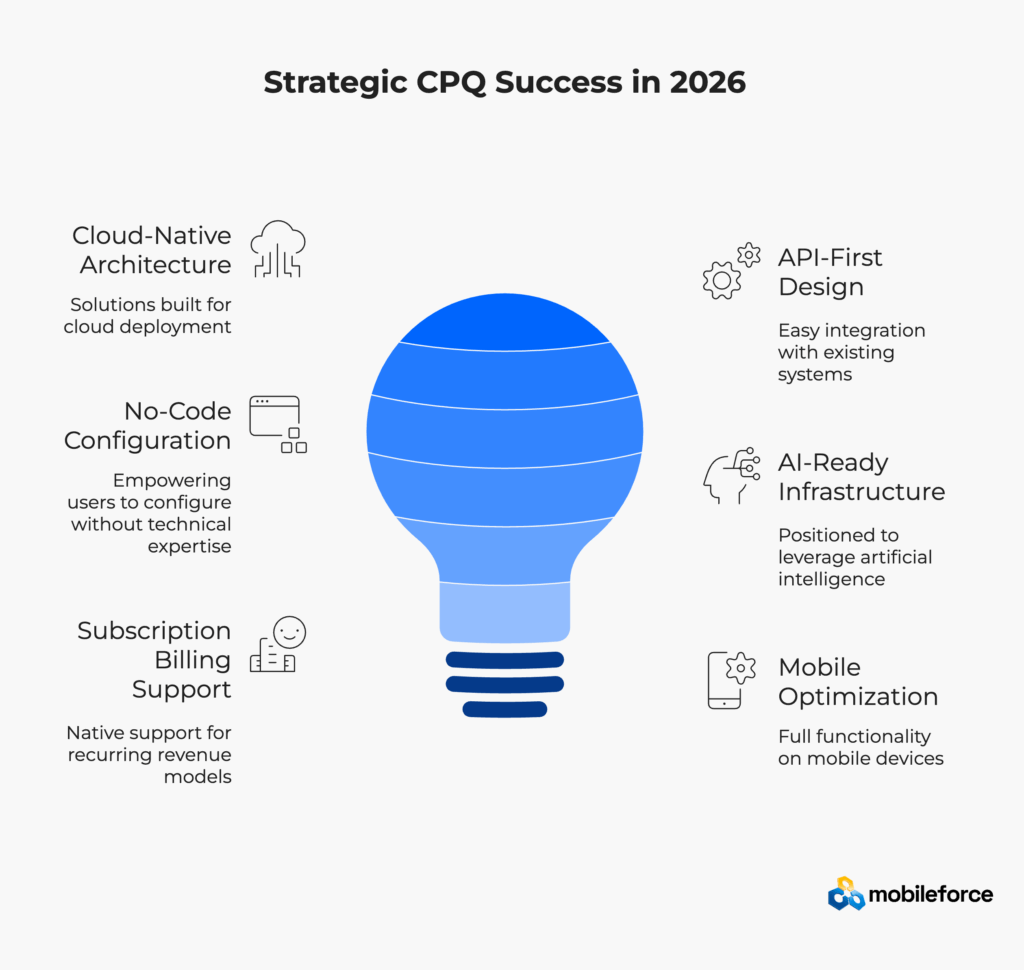
No-code configuration capabilities allow business users to modify product rules, pricing logic, and approval workflows as market conditions change. Mobileforce’s no-code platform enables immediate adaptation without IT development cycles or system downtime that impacts sales productivity.
Industry-specific customization ensures platforms address unique requirements for manufacturing complexity, healthcare compliance, or energy field service rather than forcing business processes to fit generic system limitations. Organizations can access specialized manufacturing solutions that handle complex product configurations and engineering specifications.
Implementation Practice | Success Indicator | Industry Benchmark |
Offline-first architecture adoption | Quote creation speed in disconnected mode | <30 seconds average |
Mobile-optimized interface deployment | Field representative adoption rate | >85% daily usage |
AI assistance integration | Recommendation acceptance rate | >60% AI suggestions used |
CRM integration quality | Data synchronization accuracy | 99.5% error-free sync |
No-code customization usage | Time to implement rule changes | <24 hours average |
Architecture Component | Traditional Cloud-Only CPQ | Hybrid Online-Offline CPQ |
Data Storage | Central cloud database only | Local device cache + cloud sync |
Pricing Engine | Server-side calculations | Local rules engine + cloud validation |
Product Catalog | Real-time API queries | Cached catalog + incremental updates |
Document Generation | Cloud-based rendering | Local generation capabilities |
Connectivity Dependency | Always required | Gracefully handles disconnection |
Mobile Performance | Network-dependent response times | Instant local responses |
Modern hybrid quoting platforms leverage device processing power to handle complex calculations locally rather than depending on cloud resources. This includes pricing rule engines that evaluate discount eligibility, volume pricing tiers, and promotional offers using locally cached business logic.
Product configuration engines validate component compatibility, enforce option dependencies, and calculate extended pricing for complex products without requiring server communication. This ensures customers receive immediate feedback during product selection processes.
Quote document rendering occurs locally using cached templates and brand assets, enabling immediate quote presentation and delivery. Professional PDF generation, email integration, and e-signature capabilities function independently of network status.
Bidirectional synchronization ensures data flows efficiently between local devices and central systems when connectivity permits. Priority queues handle urgent updates like price changes or product discontinuations, while lower-priority data syncs during optimal network conditions.
Version control mechanisms track quote modifications across multiple devices and users. When conflicts arise, business rule engines can automatically resolve many scenarios based on predetermined policies, escalating only complex situations that require human intervention.
Incremental update processing minimizes bandwidth usage and sync times by transmitting only changed data rather than complete records. This approach enables efficient synchronization even over limited connectivity like mobile networks or satellite internet.
While many CPQ vendors struggle to retrofit offline capabilities onto cloud-first architectures, Mobileforce built their entire Revenue Cloud platform around the reality that business happens everywhere—not just where Wi-Fi reaches. Their approach solves hybrid quoting challenges through purpose-built technology that treats offline operation as a primary use case, not an afterthought, delivering comprehensive sales enablement and revenue operations capabilities.
Mobileforce’s offline CPQ capabilities go far beyond basic data caching or read-only quote access found in traditional configure price quote solutions. The platform enables complete quote creation, complex product configuration, pricing rule enforcement, and document generation without any network dependency. This means sales representatives can handle the most demanding customer requests immediately, whether they’re in a remote manufacturing facility, underground utility vault, or international customer site.
The architecture includes a local pricing rules engine that enforces discount limits, approval workflows, and special pricing terms using cached business logic. When a field representative configures a complex equipment bundle for a customer in a remote location, they receive immediate feedback about pricing, compatibility, and approval requirements—exactly as they would in a connected environment through sales force automation.
Intelligent synchronization technology handles the complex challenge of merging offline work with ongoing business operations. When connectivity returns, the platform automatically reconciles locally created quotes with any pricing changes, product updates, or policy modifications that occurred during disconnection. Advanced conflict resolution algorithms handle most scenarios automatically, escalating only situations that require human judgment for deal management purposes.
Traditional AI assistants fail when connectivity disappears, leaving sales representatives without intelligent support during critical customer relationship management interactions. Mobileforce’s AskCPQ AI agent operates locally on devices, providing expert-level guidance regardless of network status for enhanced sales productivity.
Research shows that organizations implementing AI-powered sales assistance see significant improvements in quote accuracy and sales velocity compared to traditional manual processes. Harvard Business Review research indicates that effective sales technology implementations help teams overcome the challenge that only 57% of salespeople make their annual quotas.
The AI agent offers real-time product recommendations based on customer requirements, historical purchase patterns, and industry best practices. During complex configuration sessions, it suggests compatible components, identifies potential issues, and recommends optimization opportunities that increase deal value while ensuring customer satisfaction in B2B sales processes.
Pricing guidance capabilities help representatives navigate complex discount scenarios, volume pricing tiers, and promotional offers. The AI agent can instantly evaluate the profitability impact of different pricing strategies and suggest alternatives that meet customer budget requirements while maintaining healthy margins.
Competitive positioning assistance provides talking points and differentiation strategies when customers compare offerings against competitors. The AI agent draws from successful deal patterns and industry insights to help representatives address objections and highlight unique value propositions effectively during sales automation interactions.
Business requirements change faster than traditional IT deployment cycles can accommodate in today’s digital transformation landscape. Mobileforce’s no-code configuration platform enables business users to modify product rules, pricing logic, approval workflows, and user interfaces without technical development or code deployment.
Product configuration rules can be updated immediately when new products launch, compatibility requirements change, or regulatory updates affect offering availability. Business users define complex option dependencies, constraint matrices, and validation rules through intuitive visual interfaces rather than coding requirements that slow sales productivity tools implementation.
Pricing rule management allows rapid response to competitive pressures, promotional campaigns, or margin optimization initiatives. Users can create sophisticated discount matrices, volume pricing tiers, and customer-specific terms that automatically enforce appropriate approval processes through the sales enablement platform.
Workflow customization ensures quote processes align with organizational requirements and industry standards. Approval routing, document templates, and notification systems can be modified quickly as business requirements evolve, supporting agile revenue operations.
Most CPQ systems focus narrowly on quote creation while leaving organizations to struggle with disconnected downstream processes. Mobileforce’s integrated quote-to-cash approach eliminates process gaps that create customer friction and operational inefficiency in modern sales automation environments.
Seamless order processing automatically converts accepted quotes into orders, purchase orders, and fulfillment instructions without manual data entry or system transitions. This integration prevents errors and reduces processing delays that frustrate customers and slow cash flow.
Service lifecycle connection links initial equipment quotes to ongoing service contracts, maintenance agreements, and parts availability. Field service representatives can create service quotes that reference original equipment specifications and maintain complete customer relationship management history.
Financial system integration ensures quote acceptance immediately triggers appropriate revenue recognition, billing processes, and inventory allocation. Real-time financial reporting provides accurate pipeline visibility and cash flow forecasting based on actual quote activity for enhanced revenue operations oversight.
Rather than requiring complex third-party integrations, Mobileforce provides native connectivity with major CRM platforms including HubSpot, Salesforce, SugarCRM, Microsoft Dynamics, and Creatio. This ensures sales representatives have complete customer context during quote creation while maintaining accurate pipeline reporting through sales force automation.
Bidirectional data synchronization keeps customer information, opportunity details, and quote status current across systems without manual updates or delayed batch processing. Sales managers maintain real-time visibility into quote activity, conversion rates, and pipeline health through integrated sales productivity tools.
Activity tracking integration automatically logs quote creation, customer interactions, and follow-up requirements in CRM systems. This eliminates administrative overhead while ensuring complete customer relationship documentation for future reference and deal management optimization.
Mobileforce recognizes that different industries have unique quoting requirements that generic CPQ platforms struggle to accommodate effectively in their digital transformation initiatives:
Industry | Unique Requirements | Mobileforce Solution |
Manufacturing | Complex BOMs, engineering specifications, custom manufacturing | Advanced configuration engine with unlimited product complexity |
Healthcare | Regulatory compliance, medical device specifications, patient safety | Specialized documentation and approval workflows |
Energy/Utilities | Field service integration, infrastructure specifications | Remote-optimized platform with service lifecycle management |
Construction | Project-based pricing, multi-phase implementations | Timeline-based quoting with milestone tracking |
Manufacturing organizations benefit from complex product configuration capabilities that handle thousands of components, engineering specifications, and custom manufacturing requirements. The platform manages bill-of-materials complexity while ensuring accurate pricing for engineered-to-order products through advanced configure price quote functionality. Specialized manufacturing and distribution solutions address unique industry challenges including complex pricing matrices and multi-level product hierarchies.
Healthcare companies leverage specialized pricing models, regulatory compliance documentation, and integration with medical device specification requirements. Quote accuracy becomes critical when dealing with patient safety and regulatory approval requirements that demand the best CPQ software capabilities.
Energy and utilities companies utilize field service integration that connects equipment quotes to maintenance contracts, service agreements, and long-term operational support requirements. Remote location capabilities ensure quotes can be created during site visits in locations with challenging connectivity through robust sales automation tools.
Organizations implementing Mobileforce Revenue Cloud typically achieve significant ROI improvements through enhanced sales efficiency, reduced quote errors, and faster customer response times. Industry studies show that comprehensive CPQ implementations deliver substantial time savings in quote creation processes while significantly reducing quote-related errors compared to traditional sales productivity tools.
Implementation timelines typically range from 4-12 weeks depending on complexity and integration requirements, compared to extended deployment periods required for custom development or complex system integration projects. Pre-built industry templates, proven integration patterns, and comprehensive training programs enable rapid deployment with minimal business disruption to existing revenue operations. Organizations can start with a free trial to evaluate platform capabilities before full implementation.
Customer success metrics demonstrate the platform’s effectiveness in real-world scenarios. According to HubSpot’s 2025 State of Sales Report, 37% of sales representatives use AI tools more than any other sales tool category, with AI rated as having the highest ROI impact. Organizations implementing mobile-first sales technologies report significant improvements in field sales productivity compared to desktop-only solutions.

When selecting hybrid quoting solutions for remote regions, organizations must prioritize platforms designed specifically for disconnected operation rather than cloud-first systems with retrofitted offline features.
Offline-first architecture testing should include creating complex quotes, configuring multi-component products, and generating professional documents completely disconnected from the internet. Many vendors claim offline capabilities but provide only basic data entry or read-only access during actual testing.
Mobile-optimized user experience becomes critical given that mobile drives 78% of e-commerce traffic and field representatives often work with smartphones and tablets. The interface should enable productive quote creation on mobile devices without sacrificing functionality.
AI-powered local assistance separates leading platforms from basic offline tools. Sales representatives in remote locations need intelligent guidance for product recommendations, pricing optimization, and competitive positioning that works without cloud connectivity.
Rapid deployment capabilities matter significantly when implementing hybrid quoting solutions. Organizations should prioritize platforms with proven quick deployment timelines rather than custom development projects that extend implementation periods indefinitely.
Industry-specific functionality ensures the platform addresses unique requirements for manufacturing complexity, healthcare compliance, energy field service, or other specialized business needs that generic CPQ systems cannot accommodate effectively.
The difference between successful and failed hybrid quoting implementations often comes down to architectural decisions made during initial platform design. Organizations need sales automation tools built specifically for the realities of remote sales rather than generic CPQ systems with added offline features that compromise revenue operations effectiveness.
When selecting the best CPQ software for remote operations, decision-makers should prioritize these critical capabilities that distinguish true offline-first platforms from retrofitted solutions:
Critical Capability | Why It Matters | Mobileforce Advantage | Generic CPQ Platform |
True offline-first architecture | Enables complete functionality without connectivity | Native design from ground up | Retrofitted features with limitations |
Local AI-powered assistance | Provides expert guidance during remote customer meetings | AskCPQ agent works locally on devices | Cloud-dependent AI with connectivity requirements |
No-code business configuration | Adapts quickly to changing business requirements | Business users modify rules without IT | Developer-dependent customization |
Integrated quote-to-cash-to-service | Eliminates process gaps and data silos | Complete lifecycle management | Narrow CPQ focus requires third-party integration |
Rapid deployment capability | Minimizes disruption and accelerates ROI | Proven rapid implementation timeline | Extended timeline with custom development |
Industry-specific functionality | Addresses unique manufacturing, healthcare, energy requirements | Purpose-built solutions for complex industries | Generic approach requires extensive customization |
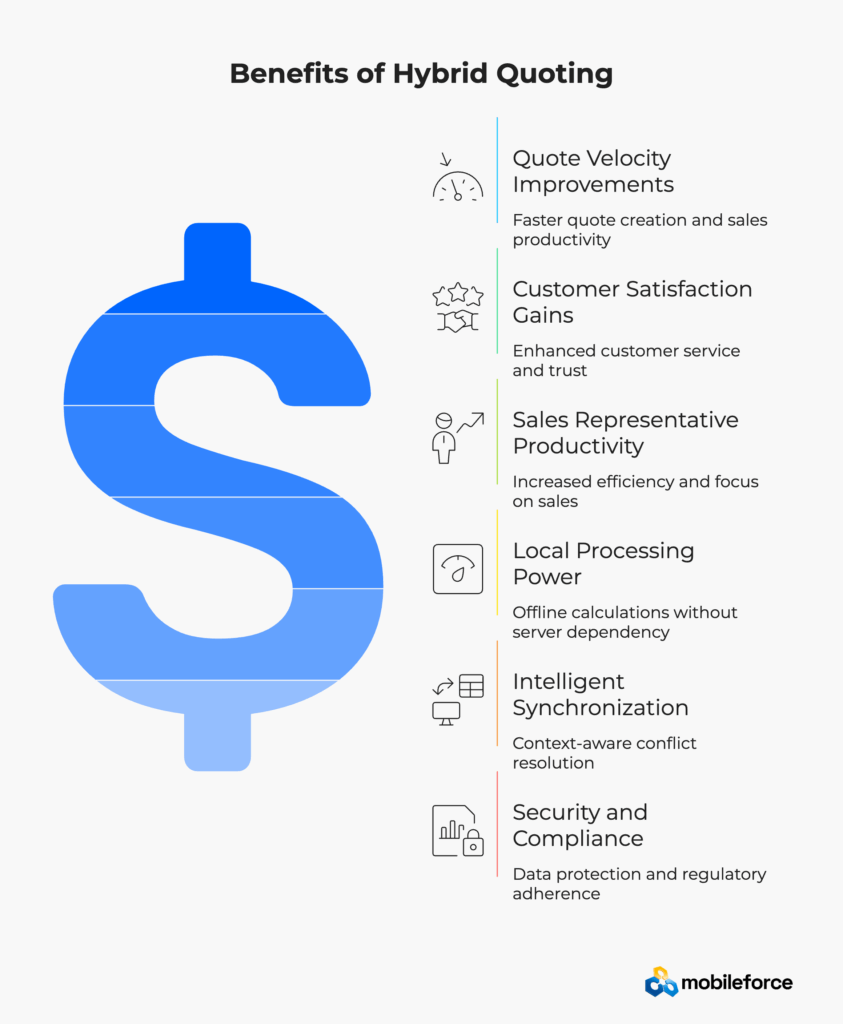
Quote velocity improvements provide immediate evidence of hybrid quoting value for sales productivity enhancement. Organizations implementing purpose-built solutions like Mobileforce typically achieve significant time savings in quote creation compared to manual processes during connectivity failures, directly impacting sales force automation effectiveness.
Customer satisfaction gains reflect the professional impact of always-available quoting capabilities in customer relationship management interactions. When sales representatives can provide immediate responses during facility visits or site meetings, customers perceive higher service levels that influence purchase decisions in B2B sales processes.
Sales representative productivity increases significantly when administrative overhead decreases and customer-facing time increases through effective sales enablement tools. Industry studies demonstrate that comprehensive CPQ implementations deliver measurable business impact through eliminating connectivity-related sales delays in deal management activities.
Local processing power must handle complex pricing calculations, product configuration validation, and approval workflow routing without server dependencies. Leading platforms cache complete business rules locally rather than relying on simplified offline modes that compromise functionality.
Intelligent synchronization requires sophisticated conflict resolution algorithms that understand business context, not just data timestamps. When pricing changes occur while representatives work offline, the system should apply new rules while preserving customer-specific negotiations already in progress.
Security and compliance become critical when sensitive customer data, pricing information, and product specifications reside on local devices. Enterprise-grade encryption, access controls, and remote wipe capabilities ensure data protection in field environments. Mobileforce’s security documentation provides detailed information about compliance standards and data protection measures.
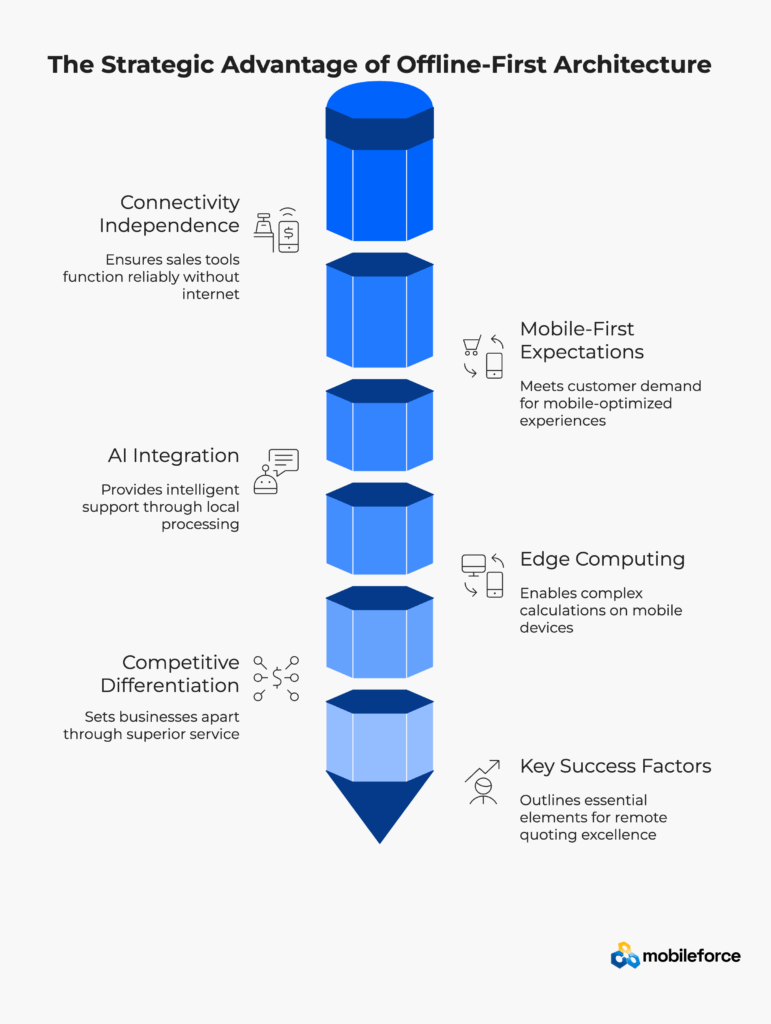
The fundamental challenge in remote region quoting isn’t connectivity speed—it’s connectivity reliability in environments where sales automation tools must function consistently. Even with 5G expansion and improved infrastructure, remote manufacturing facilities, construction sites, healthcare institutions, and energy operations will continue experiencing connectivity challenges that can derail critical sales moments and compromise revenue operations.
Organizations that recognize this reality and invest in offline-first platforms like Mobileforce position themselves for consistent success regardless of infrastructure limitations. While competitors struggle with failed connections during customer meetings, companies with robust offline capabilities deliver professional, responsive experiences through reliable sales enablement tools that drive business growth in any environment.
Mobile-first customer expectations continue accelerating, with mobile commerce reaching $2.07 trillion in 2024 and representing 57% of total e-commerce. B2B customers increasingly expect consumer-grade experiences including instant responses and mobile-optimized interactions from configure price quote systems. Mobileforce’s mobile-first design ensures organizations can meet these expectations even in challenging connectivity environments through advanced sales force automation.
AI integration advantages become more significant as local processing capabilities improve in modern sales productivity tools. Mobileforce’s AskCPQ agent operates entirely on devices, providing expert-level guidance during remote customer relationship management interactions without depending on cloud connectivity. This approach ensures sales representatives always have intelligent support regardless of network conditions during critical deal management activities.
Edge computing evolution enables more sophisticated local processing for complex pricing calculations, advanced product configuration, and real-time analytics directly on mobile devices. This trend reinforces the importance of offline-first architectures in best CPQ software solutions.
The most successful organizations will be those that view reliable quoting capabilities as a competitive advantage rather than a technical requirement in their digital transformation initiatives. When every customer interaction matters and connectivity cannot be guaranteed, offline-first hybrid quoting becomes essential for sustained sales success through dependable sales automation tools.
Competitive differentiation emerges when sales teams can operate effectively regardless of infrastructure limitations. While competitors apologize for connectivity issues or reschedule meetings, organizations with robust offline capabilities close deals on-site and demonstrate superior customer service through responsive B2B sales processes.
What is hybrid online-offline quoting and how does it work?
Hybrid online-offline quoting is a sales enablement approach that enables complete quote creation, pricing calculation, and customer interaction regardless of internet connectivity status. Unlike traditional configure price quote systems that require constant connectivity, hybrid platforms store product catalogs, pricing rules, and business logic locally on devices. When online, the system synchronizes with cloud databases for real-time updates. When offline, all critical quoting functions continue working through local processing engines, ensuring sales representatives can handle customer requests immediately in any environment.
How does hybrid quoting differ from traditional offline modes in CPQ software?
Traditional offline modes in quote software typically provide read-only access to previously created quotes or limited data entry capabilities that sync later. Hybrid quoting enables complete functionality including complex product configuration, pricing rule enforcement, approval workflow routing, and professional document generation without any network dependency. Sales automation tools with true hybrid capability maintain identical functionality whether connected or disconnected, while traditional offline modes offer reduced feature sets that compromise sales productivity.
What happens to quotes created offline when connectivity returns?
Modern hybrid sales force automation systems use intelligent synchronization that automatically uploads offline quotes while checking for potential conflicts with pricing changes, product updates, or approval rule modifications that occurred during disconnection. Advanced conflict resolution engines can automatically handle most scenarios based on business rules, escalating only complex situations that require human review. The system preserves all customer-specific negotiations while applying any new pricing policies or product configurations that became available during the offline period.
Can approval workflows function effectively in offline environments?
Yes, sophisticated hybrid platforms queue approval requests locally and automatically submit them when connectivity returns through intelligent sales enablement workflows. Local business rules engines can evaluate many approval criteria immediately, providing instant feedback about discount limits, deal sizes, or special terms that require management approval. Users receive clear indicators about pending approvals that will process automatically upon reconnection, ensuring deal management continues smoothly without connectivity dependencies.
How is data security maintained during offline operation in remote regions?
Enterprise hybrid quoting platforms implement device-level encryption for all locally stored data including customer information, product catalogs, and pricing rules. Access controls, session timeouts, and remote wipe capabilities ensure sensitive business data remains protected even if devices are lost or stolen in remote locations. Local authentication mechanisms prevent unauthorized access during offline periods, while audit trails track all activities for compliance with revenue operations requirements and security standards.
What level of product configuration complexity can be handled offline?
Advanced hybrid configure price quote systems cache complete product configuration matrices, option dependencies, and compatibility rules locally on devices. This enables handling thousands of product variations, complex bundles, and engineered-to-order specifications without network connectivity. The sophistication level matches or exceeds cloud-based configuration engines while providing instant response times for B2B sales processes. Complex manufacturing BOMs, healthcare device specifications, and energy equipment configurations all function fully offline.
How does hybrid quoting integrate with existing CRM and ERP systems?
Leading hybrid platforms like Mobileforce provide native integrations with major customer relationship management systems including HubSpot, Salesforce, SugarCRM, Microsoft Dynamics, and Creatio through robust sales automation tools. Bidirectional synchronization ensures customer data, opportunity information, and quote status updates flow seamlessly between systems. ERP integration enables real-time inventory checking, order processing, and fulfillment coordination when connectivity permits, while offline capabilities ensure quote creation continues regardless of system availability.
What implementation timeline should organizations expect for hybrid CPQ deployment?
Implementation timelines vary based on complexity, but organizations working with proven hybrid platforms often achieve deployment within 4-12 weeks compared to extended timelines for custom development or complex system integrations. Key factors include data migration scope, integration requirements with existing sales productivity tools, user training needs, and industry-specific customization requirements. Pre-built templates and proven deployment methodologies accelerate implementation while minimizing business disruption. Organizations can access comprehensive documentation and support throughout the implementation process.
How does AI assistance work in offline environments for sales teams?
Modern hybrid platforms integrate AI engines that operate locally on devices rather than depending solely on cloud-based services. Features like product recommendation, pricing guidance, and configuration assistance function immediately without network connectivity through advanced sales enablement technology. Mobileforce’s AskCPQ AI agents can provide expert-level support during customer meetings regardless of connectivity status, offering intelligent suggestions based on locally cached knowledge bases and historical deal patterns.
What industries benefit most from hybrid quoting capabilities in remote regions?
Industries with significant field sales activities, remote operations, or challenging connectivity environments see the greatest benefits from hybrid sales automation tools. This includes manufacturing with complex equipment configuration needs, construction with site-based operations, healthcare with regulatory compliance requirements, energy and utilities with remote infrastructure, telecommunications with field installations, and distribution companies with warehouse operations. Organizations with high-value transactions requiring immediate quote responses particularly benefit from reliable offline-first capabilities. Specialized manufacturing solutions address unique industry challenges including complex BOMs and engineering specifications.
How can organizations measure ROI from hybrid quoting implementations?
Key ROI metrics include quote velocity improvements, deal conversion rate increases, quote accuracy enhancements, customer satisfaction score improvements, and sales representative productivity gains through effective revenue operations. Organizations typically track time from customer request to quote delivery, conversion rates for quotes created during face-to-face meetings, reduction in quote-related errors compared to manual processes, and decreased administrative overhead. Industry studies show that comprehensive CPQ implementations deliver measurable ROI through significant time savings and substantial error reduction in quoting processes. According to McKinsey research on digital transformation, organizations implementing comprehensive hybrid solutions report substantial improvements in sales cycle velocity and customer retention rates compared to traditional quoting approaches.
What are the key technical requirements for successful hybrid quoting implementation?
Successful hybrid implementations require local processing power for complex calculations, intelligent synchronization with conflict resolution capabilities, mobile-optimized user interfaces, enterprise-grade security with device encryption, seamless integration with existing business systems, and industry-specific configuration flexibility. The best CPQ software combines offline-first architecture with no-code customization capabilities, enabling business users to modify rules and workflows without technical development. Proven platforms also provide comprehensive training and support to ensure user adoption and system optimization.