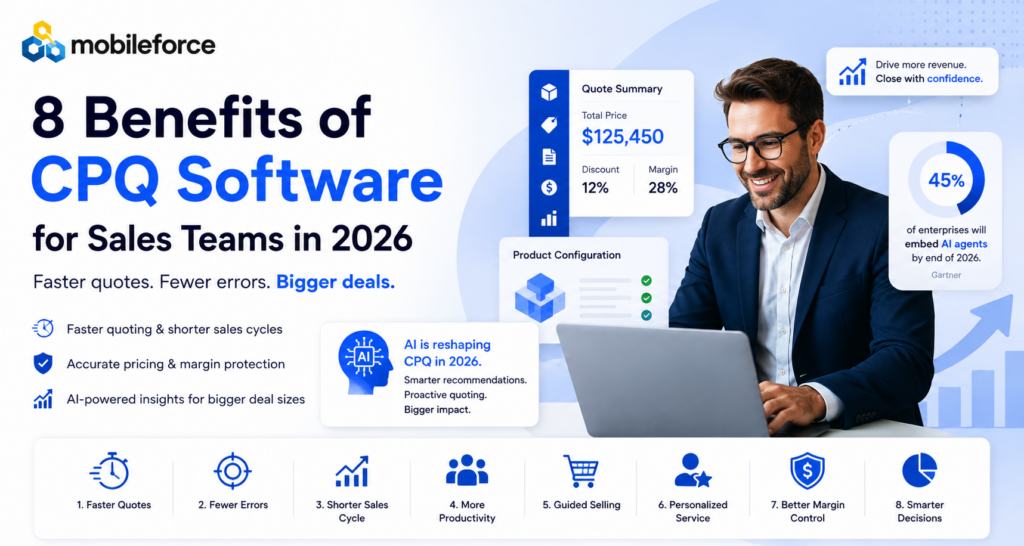
The benefits of CPQ software usually get summarized in three words: faster quotes, fewer errors, bigger deals. That’s accurate, but 2026 adds a layer. Gartner predicts 40% of enterprise applications will embed task-specific AI agents by the end of this year, up from under 5% in 2025, and CPQ software is one of the categories most directly affected, moving from rule-based automation toward AI-guided and increasingly autonomous quoting. This article covers both the established benefits and where the category is heading next.
TL;DR: CPQ software automates quoting, pricing, and proposal generation, cutting errors and closing deals faster while increasing deal size through guided selling. In 2026, AI is pushing CPQ toward agentic, proactive quoting, with Gartner projecting 40% of enteinforprise apps will embed task-specific AI agents by year end.
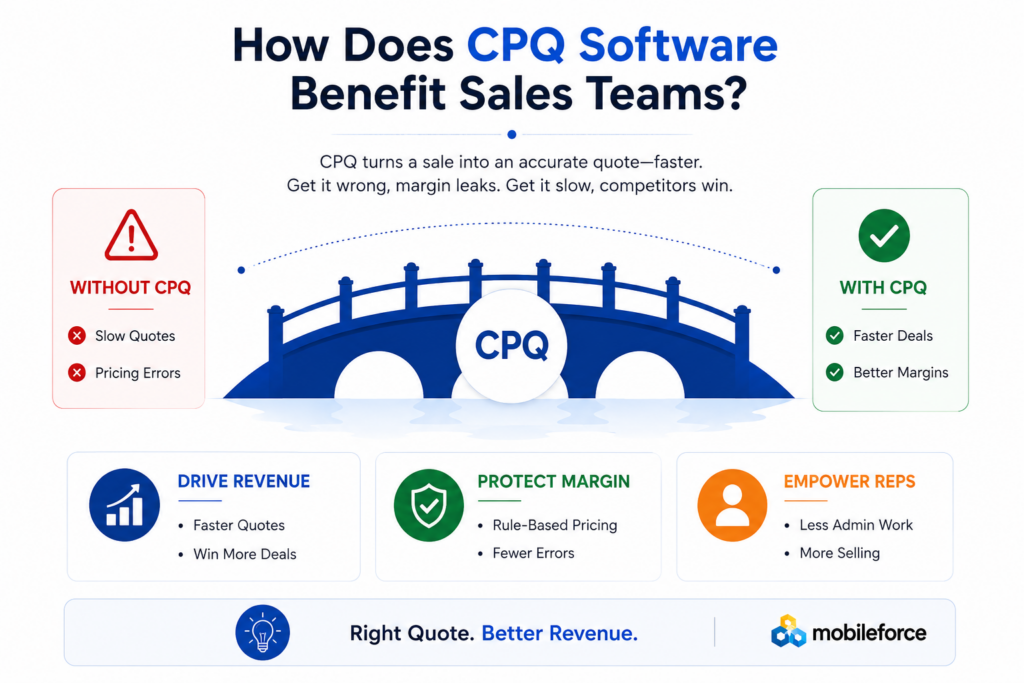
CPQ sits at the point where a sale turns into a quote, and that’s where speed, accuracy, and deal structure get decided. Get the quote wrong and margin leaks out before a contract exists. Get it slow and a competitor closes first.
The business case breaks into three lines: revenue grows because quotes go out faster, margin holds because pricing rules stay consistent, and reps get selling time back instead of rebuilding proposals by hand.
Most CPQ benefits pages restate the same three buckets, speed, accuracy, customer experience, without saying where they show up in a real sales process or how AI is changing them in 2026. These eight are organized by where in the deal cycle each one lands, with the AI shift woven into the two it actually affects.
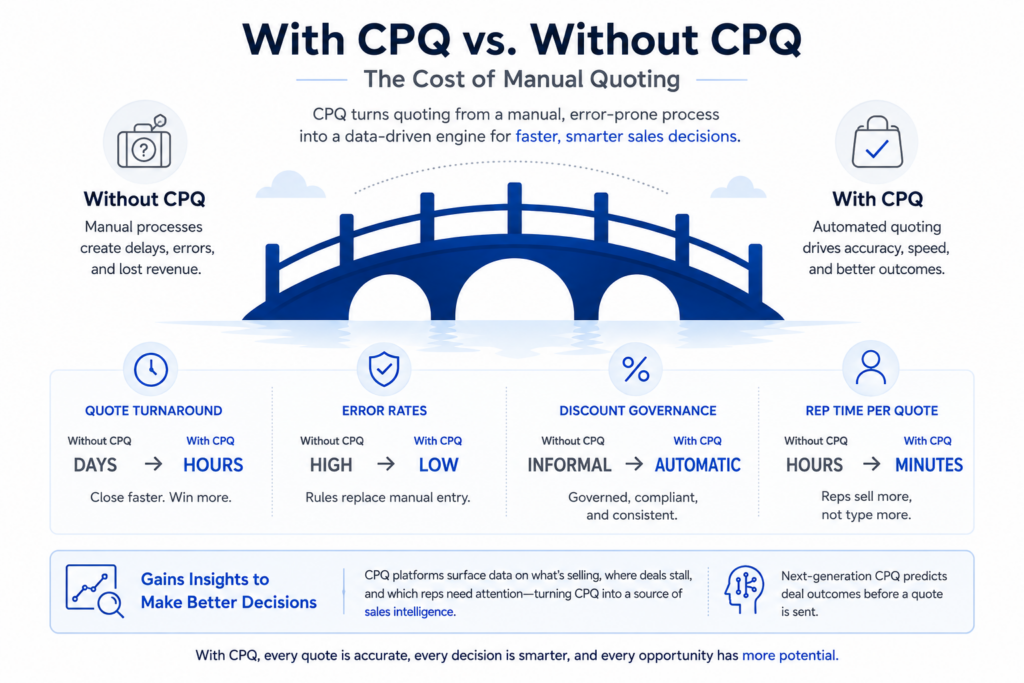
With CPQ vs. without, at a glance: quote turnaround drops from days to hours, error rates fall as rules replace manual entry, discount governance becomes automatic instead of informal, and rep time per quote drops from hours to minutes.
CPQ software isn’t free or instant, and the payoff depends on deal complexity and how mature your process already is. For high-volume, configurable product lines, CPQ software ROI shows up fast: fewer errors, faster cycles, more selling time. For simple, low-volume sales, the case is weaker.
The cost side matters just as much as adoption cost. Uncontrolled pricing and discount errors quietly compound into six-figure annual losses, the same territory covered in How to Identify and Prevent Revenue Leakage in 2026. The real question isn’t whether CPQ costs money. It’s whether the current manual process already does, just less visibly.
Mobileforce is a unified quote-to-service platform, CPQ plus selling plus field service, built for Salesforce, HubSpot, Creatio, SugarCRM, and Microsoft. Guided selling (Benefit 5) extends into field service scheduling here, so the same pricing logic that shapes a deal shapes how it gets delivered. Discount governance (Benefit 7) runs on the same connected data layer that feeds fulfillment, so an approved price stays approved. That’s what CPQ software features and benefits look like connected end to end.
CPQ’s core benefits, speed, accuracy, margin protection, are well established. What’s new in 2026 is how they compound with AI, moving from rule-based automation toward guided and increasingly autonomous quoting.
The businesses getting the most from CPQ aren’t just automating existing steps. They’re using the data it generates to make better pricing and sales decisions going forward, not just faster ones today.
Mobileforce brings CPQ, guided selling, and quote-to-service delivery together on one platform connected to Salesforce, HubSpot, Microsoft, Creatio, and SugarCRM. To see what these benefits look like inside your own sales process, get in touch with our team or request a demo.
What are the main benefits of CPQ software?
Faster quoting, fewer pricing errors, and higher deal sizes through guided selling, plus better sales data over time.
Why use CPQ software instead of spreadsheets?
Spreadsheets depend on someone remembering every pricing rule and discount limit correctly, every time. CPQ applies those rules automatically and consistently.
Does CPQ software actually increase deal size?
Yes, mainly through guided selling, which surfaces upsell and cross-sell combinations a rep might not think to offer manually.
How is AI changing CPQ software in 2026?
CPQ is moving from rule-based automation toward AI-guided and increasingly agentic quoting, with Gartner projecting 40% of enterprise apps will embed task-specific AI agents by year end.
Is CPQ software worth it for a small sales team?
It depends on product complexity. Teams selling configurable products at volume see the fastest payoff.