
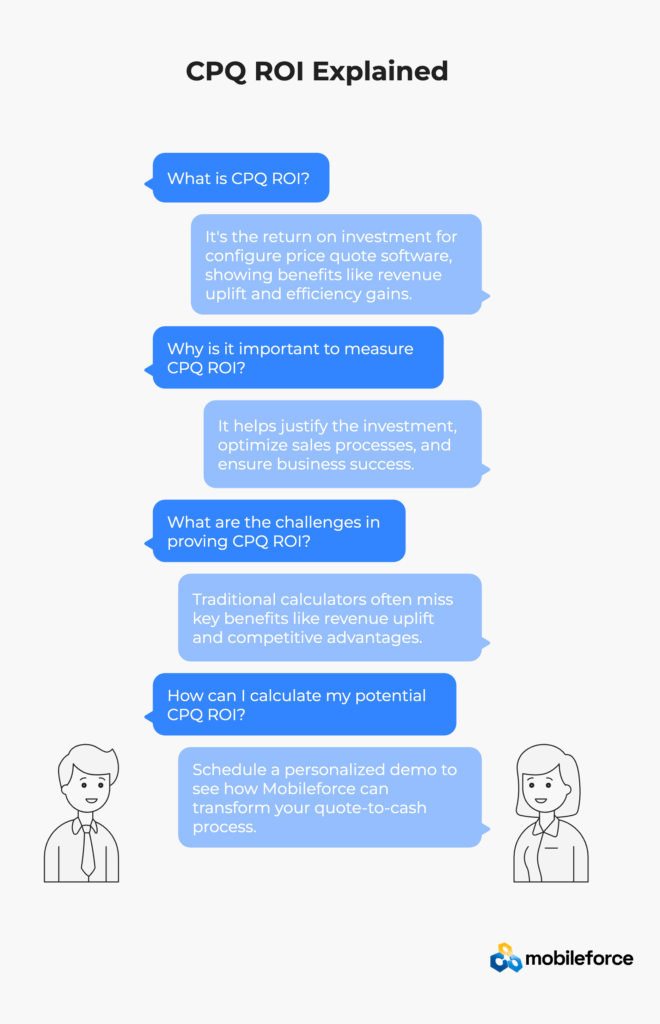
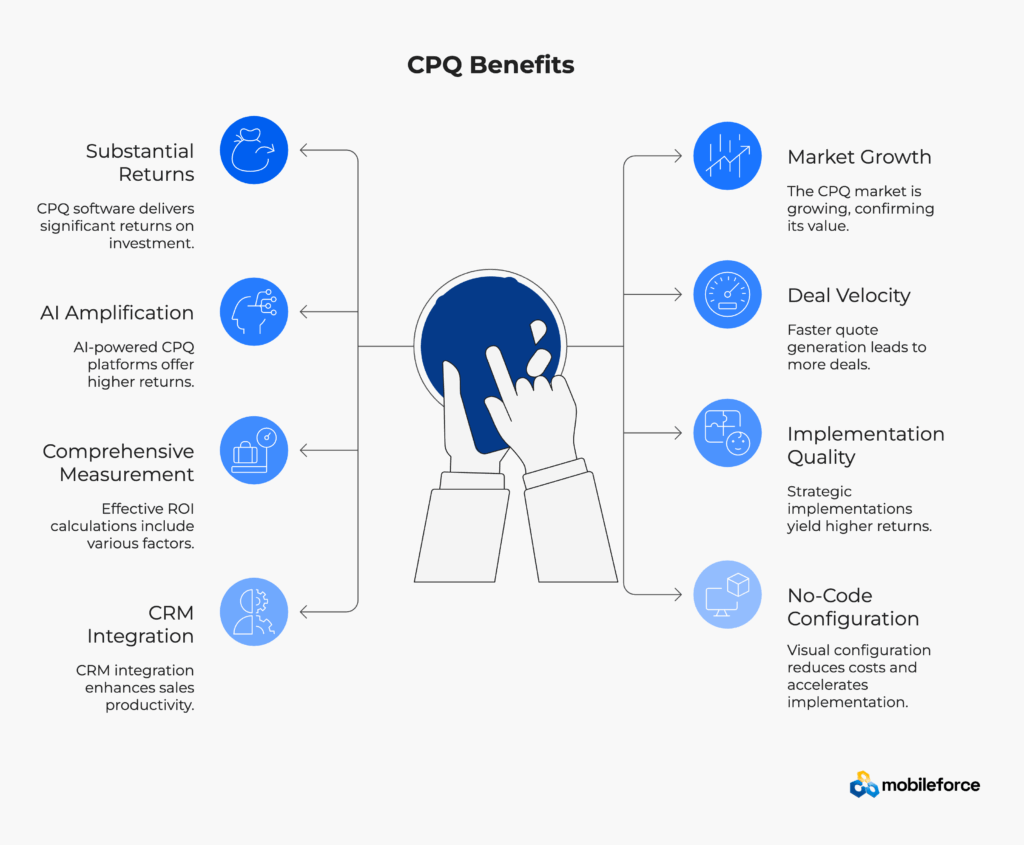
Organizations implementing configure price quote software are seeing substantial returns, with Nucleus Research studies showing returns like $6.22 for every dollar spent on CPQ technology. Modern CPQ ROI calculators help businesses quantify benefits beyond basic time savings, measuring revenue uplift, pricing accuracy improvement, error reduction, and operational efficiency gains. The CPQ software market in 2025 is driven by the growing cost of inaction, making accurate return on investment measurement critical for sales process optimization and business success.
Ready to calculate your potential CPQ ROI? Schedule a personalized demo to see how Mobileforce can transform your quote-to-cash process.
According to recent sales productivity research, every minute spent on manual quoting is a minute lost to competitors who have invested in quote automation software. This reality hits hardest when sales teams are drowning in spreadsheets while prospects move to faster alternatives with superior sales quoting tools. Modern Configure, Price, Quote (CPQ) platforms have evolved far beyond simple automation tools—they’re strategic revenue operations platforms that organizations use to capture market share through deal velocity acceleration.
The challenge lies in proving return on investment for CPQ implementation before deployment. Traditional CPQ ROI calculators often miss the full picture, focusing only on time savings while ignoring revenue uplift, margin protection software benefits, pricing optimization capabilities, and competitive advantages that modern AI-powered CPQ solutions deliver through sales process automation.
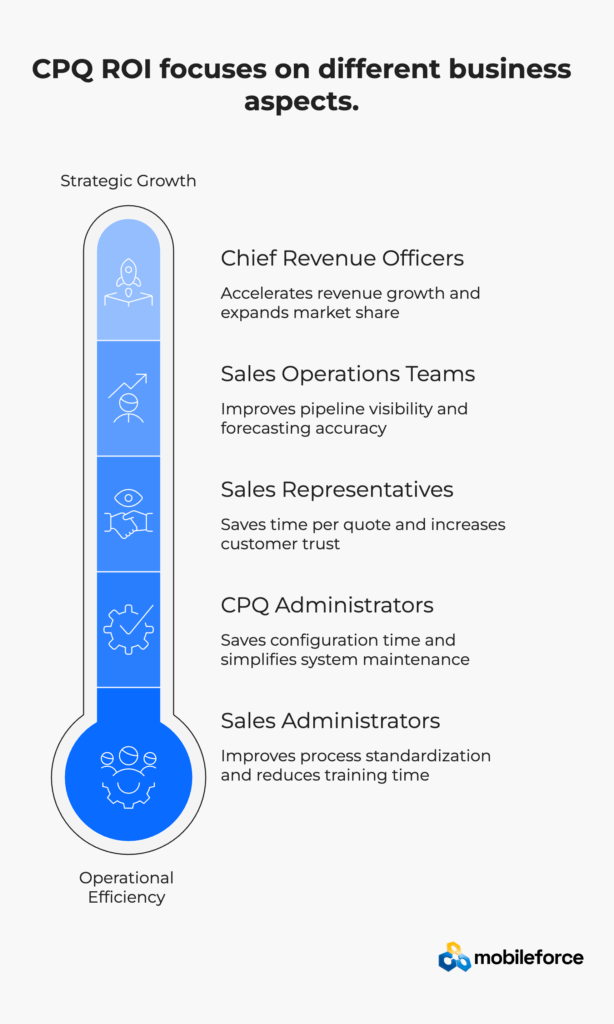
Understanding how configure price quote software impacts different roles helps organizations build comprehensive business cases that resonate across the entire buying committee. Each stakeholder brings unique priorities and pain points that influence their ROI evaluation criteria.
Sales representatives primarily struggle with slow quote generation and complex product configurations that limit their selling time. For them, ROI centers on time savings per quote, with successful implementations delivering 60-80% reduction in quote generation time. They value mobile accessibility for field selling, quote accuracy that builds customer trust, and reduced administrative tasks that free them for relationship building. Their success gets measured through quotes per day, deal velocity improvements, higher win rates, and enhanced customer satisfaction scores.
Sales administrators face different challenges around user adoption, training overhead, and process inconsistency across teams. Their ROI focus includes reduced training time for new users, improved process standardization, lower administrative overhead, and faster user onboarding cycles. They track success through user adoption rates, training hour reductions, and process compliance improvements that create operational efficiency.
CPQ administrators deal with complex system maintenance, integration challenges, and configuration difficulties that consume technical resources. They measure ROI through setup and configuration time savings, with modern platforms delivering 85% reductions compared to traditional systems. They value integration simplicity, system reliability, and the ability to modify business rules without IT involvement. Their metrics include implementation timelines, system maintenance hours, and monthly configuration changes that demonstrate platform flexibility.
Sales operations teams struggle with limited pipeline visibility, forecasting inaccuracy, and siloed data that prevents strategic decision-making. They focus ROI measurement on pipeline visibility improvements, forecasting accuracy gains, data quality enhancements, and cross-functional workflow efficiency. Success metrics include forecast accuracy percentages, pipeline conversion rate improvements, reduced process cycle times, and enhanced data quality scores.
Chief Revenue Officers face revenue growth pressure, competitive threats, and operational scalability challenges that impact strategic positioning. Their ROI evaluation encompasses revenue acceleration, market share growth, competitive differentiation through response speed, and operational scalability without proportional cost increases. They measure success through revenue growth percentages, market share expansion, customer lifetime value improvements, and competitive win rate increases that drive sustainable business growth.
Ready to understand your role-specific ROI potential? Get personalized analysis based on your stakeholder priorities and business objectives.
The evolution of configure price quote software has fundamentally transformed how businesses calculate return on investment for sales process automation. According to Cameron Marsh, Senior Analyst at Nucleus Research, organizations that modernize their quote automation software are not just quoting faster—they’re protecting margins, improving deal quality, and accelerating time to cash through comprehensive quote to cash optimization.
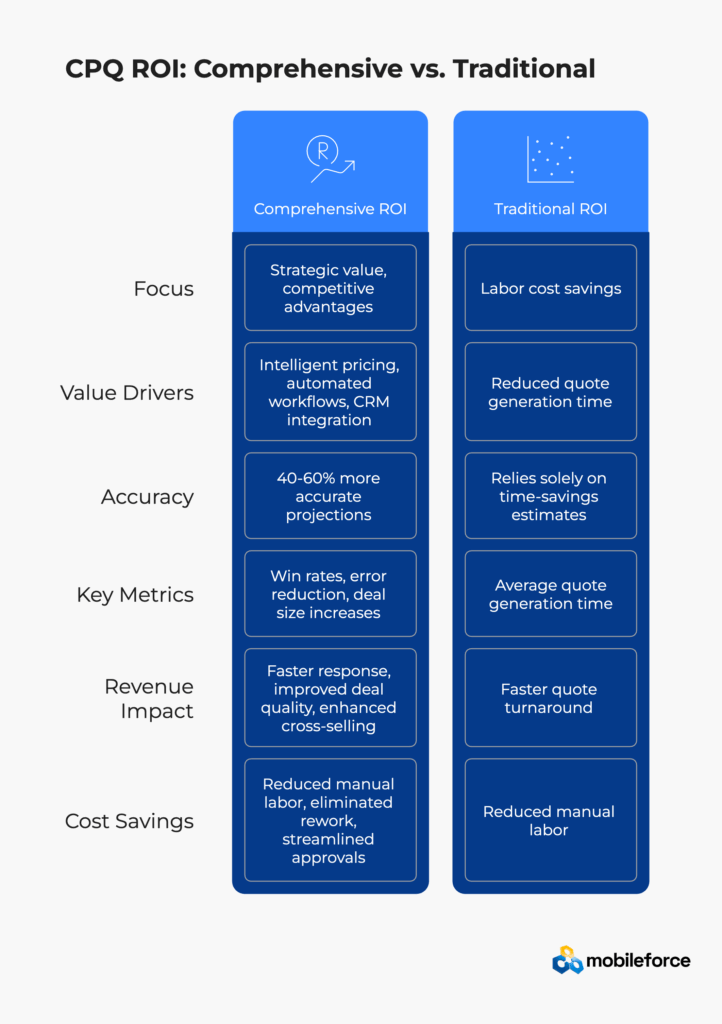
Traditional quote to cash ROI models focus heavily on labor cost savings from reduced quote generation time. However, this narrow approach misses critical value drivers that modern sales quoting tools deliver through intelligent pricing engines, automated approval workflows, and CRM integration capabilities. Organizations recognize that CPQ platforms create competitive advantages that extend far beyond simple time savings.
The real value emerges when sales teams can respond to prospects faster than competitors while maintaining pricing accuracy. Research shows that the first vendor to respond wins 35-50% more deals, making quote speed a direct revenue driver. Additionally, automated validation reduces configuration errors by up to 90%, preventing costly rework and protecting customer relationships.
Creating an accurate configure price quote ROI calculator requires understanding the full spectrum of sales process automation benefits. Organizations using comprehensive measurement frameworks achieve 40-60% more accurate projections than those relying solely on time-savings estimates. The key lies in capturing both quantitative improvements and strategic value creation that modern platforms enable.
Successful ROI calculations start with honest baseline assessment of current quoting processes. Many organizations discover hidden inefficiencies during this analysis—sales reps spending hours on configuration errors, deals stalled in approval workflows, or competitive losses due to slow response times. These insights often reveal greater improvement potential than initially expected.
Current state assessment should document average quote generation time by product complexity, monthly quote volume and win rates, configuration error rates and revision frequency, sales cycle length and deal sizes, plus current approval workflow timing. Target projections should reflect realistic improvement expectations, with typical time savings of 50-80% for complex configurations, win rate improvements of 5-15%, error reduction of 60-90% through automation, and deal size increases of 10-25% from intelligent upselling capabilities.
Understanding the complete value equation helps organizations justify investment and set appropriate success metrics. Revenue impact often provides the strongest business case, particularly when sales teams can demonstrate faster competitive response and improved deal quality. This includes faster quote turnaround increasing win rates, enhanced cross-selling through guided selling, and improved pricing optimization with margin protection.
Cost savings encompass reduced manual labor across teams, eliminated rework from errors, and streamlined approval processes. Implementation costs include software licensing and professional services, integration and training expenses, plus change management programs.
Total CPQ ROI = (Revenue Gains + Cost Savings – Total Investment) / Total Investment × 100
Where Revenue Gains include deal velocity acceleration, average deal size increases, win rate improvements, and market share expansion. Cost Savings cover reduced labor costs, error elimination, process efficiency gains, and training reduction. Total Investment encompasses software licensing, CPQ implementation costs, training, integration, and change management expenses.
Leading revenue operations teams use this comprehensive approach to capture both quantitative and qualitative benefits from their configure price quote software investment. According to enterprise software implementation studies, organizations using this methodology achieve significantly more accurate ROI projections compared to simplified time-savings-only models.
Ready to build your comprehensive ROI model? Schedule a consultation with Mobileforce experts who specialize in quote automation software ROI optimization.
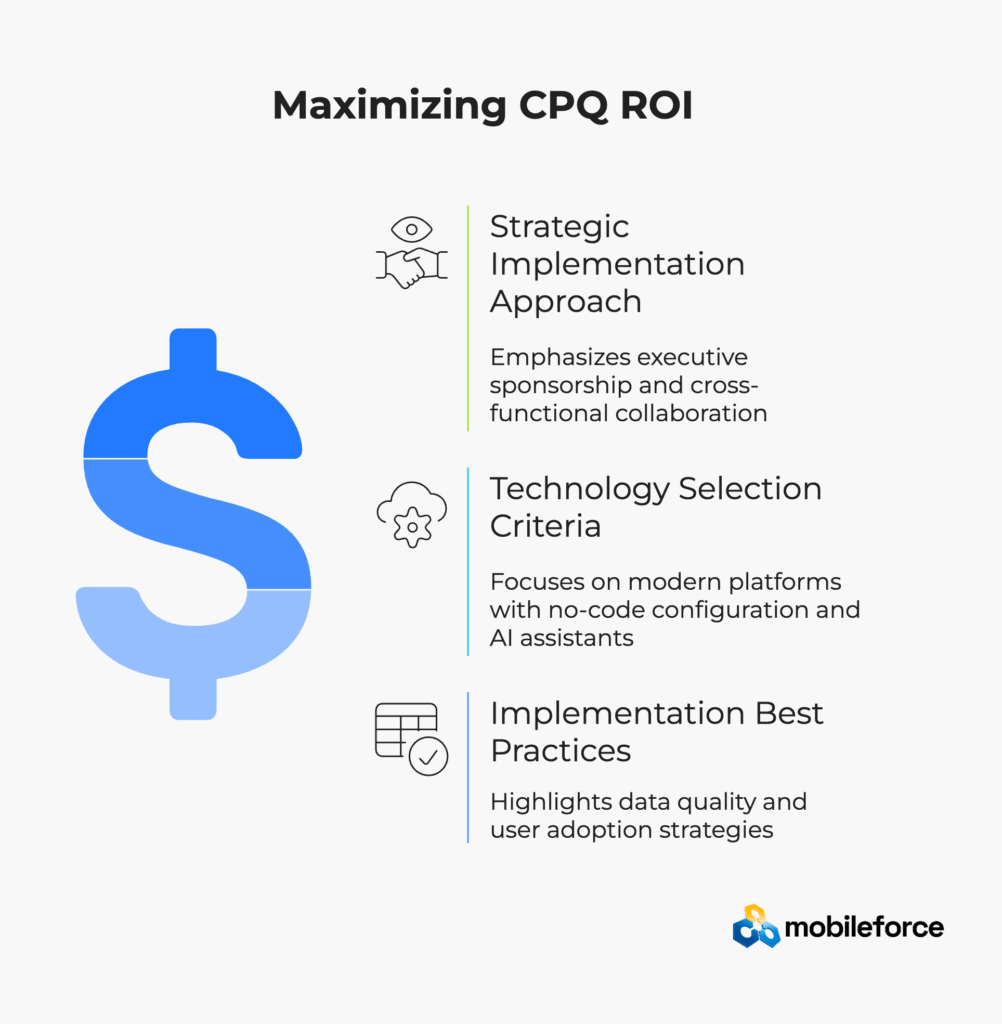
The difference between successful and unsuccessful CPQ implementations often comes down to strategic approach rather than technology choice. Organizations treating quote automation software as strategic revenue infrastructure achieve 3-5x higher returns than those viewing it as a tactical tool. This fundamental shift in perspective drives different implementation approaches, resource allocation, and success measurement criteria.
Success requires executive sponsorship, cross-functional collaboration between sales, finance, and IT teams, and clear ROI measurement frameworks. Companies that establish dedicated steering committees and maintain regular progress reporting see significantly better adoption rates and faster time-to-value.
Modern platforms with advanced capabilities deliver superior results through intuitive user experiences and powerful automation. The most successful implementations leverage no-code configuration tools that empower business users to modify processes without technical expertise, reducing dependence on IT resources and accelerating customization cycles.
Modern platforms with no-code configuration and AI assistants deliver superior results through cloud-native architecture supporting scalability and integration, natural language processing for intuitive quote generation, native CRM connectivity with real-time data synchronization, and comprehensive analytics for strategic decision-making.
Implementation success also depends heavily on data quality and user adoption strategies. Organizations that invest in comprehensive data auditing and role-specific training programs consistently achieve higher user engagement and faster ROI realization.
Critical practices include comprehensive audit and phased migration approach for data quality, role-specific training and change management support for user adoption, starting with core systems and expanding gradually for integration strategy, plus monitoring quote generation time, win rates, and customer satisfaction for performance tracking.
Transform your implementation approach with expert guidance. Schedule a consultation with Mobileforce specialists who have successfully guided organizations through quote automation software deployments.
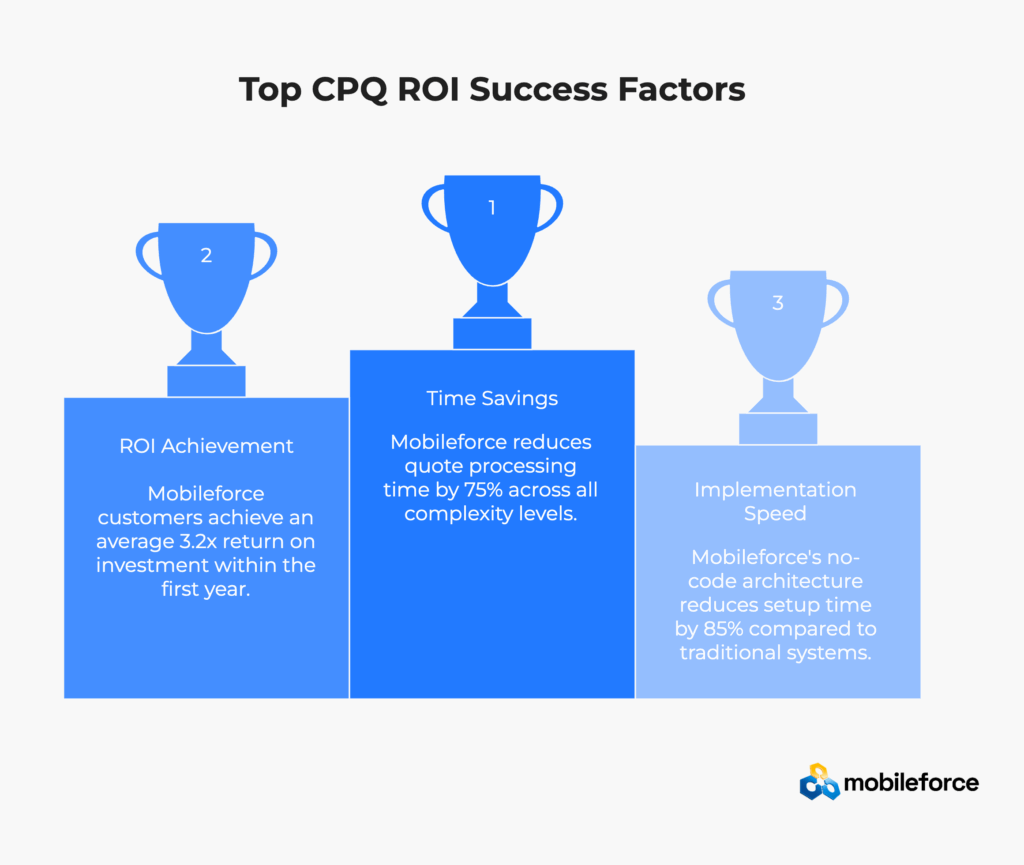
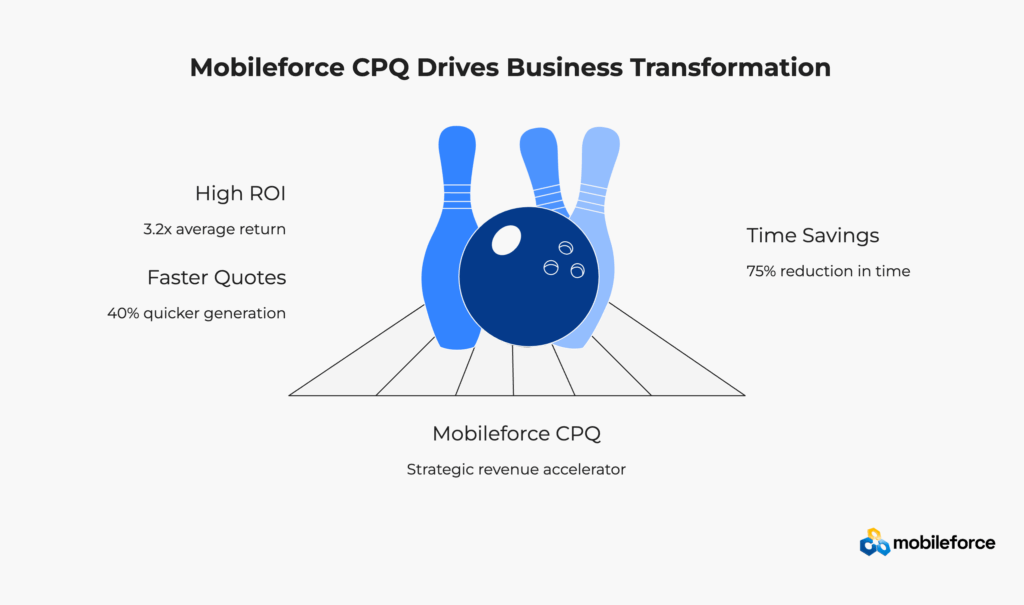
Mobileforce consistently delivers transformative business results with customers achieving an average 3.2x return on investment within the first year. Organizations typically realize 75% time savings in quote processing while improving quote generation speed by 40% across all complexity levels. The platform’s modern no-code architecture reduces setup time by 85% compared to traditional systems, with guaranteed 25-47 day implementation timelines that provide predictable deployment schedules.
SportSafe, a leading safety equipment provider, represents the transformative potential of modern CPQ implementation. Before Mobileforce, the company struggled with manual quoting processes that required days for complex safety equipment configurations. Sales representatives spent excessive time coordinating between technical specialists and operations teams, creating competitive disadvantages in time-sensitive safety situations.
The implementation of Mobileforce’s no-code platform automated safety equipment bundling with built-in compliance validation while streamlining workflows between departments. Real-time integration with inventory and CRM systems eliminated manual data entry, and customer self-service capabilities reduced routine quote requests. The transformation was immediate and dramatic.
Alex Wilkins from SportSafe confirms the impact: “The efficiency and adaptability that Mobileforce’s no-code platform brought to our processes is dramatic and something no other company could offer us.” Complex quotes that previously took days now receive same-day responses, enabling SportSafe to compete more effectively for urgent safety requirements. Automated validation eliminated configuration errors while the sales team handles significantly higher quote volumes without additional staffing.
The SportSafe success reflects patterns across Mobileforce’s customer base of over 1,000 field service teams and 500+ RevOps teams. Manufacturing facilities worldwide leverage the platform for complex product configurations, while service organizations achieve operational scalability through intelligent automation. These diverse implementations demonstrate the platform’s versatility in delivering measurable ROI across different industries and use cases.
Join proven customer success stories. Explore Mobileforce’s platform and discover why organizations achieve consistent 3.2x ROI results.
Mobileforce delivers consistent ROI achievement across organizations of all sizes, with scalable benefits that adapt to different operational complexities and resource constraints.
Business Size | Mobileforce Results | Key Benefits | Implementation Timeline |
Enterprise (1000+ employees) | 3.2x average ROI | Global standardization, compliance automation | 25-47 days |
Mid-market (100-1000 employees) | 3.2x+ ROI potential | Competitive differentiation, sales productivity | 25-35 days |
Small Business (<100 employees) | Higher ROI potential | Complete automation, professional presentation | 15-25 days |
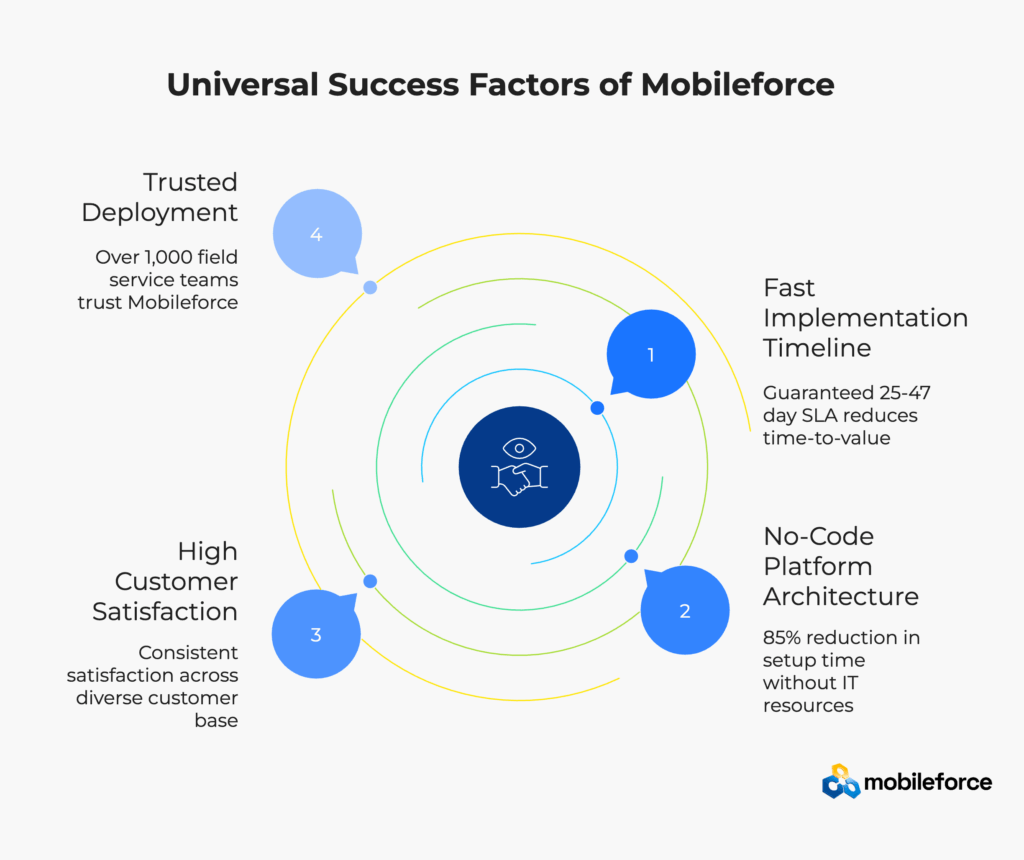
Organizations of all sizes benefit from Mobileforce’s fast implementation timeline, with guaranteed 25-47 day SLA that reduces time-to-value regardless of company complexity. The no-code platform architecture delivers 85% reduction in setup time compared to traditional systems, making advanced CPQ capabilities accessible to businesses without extensive IT resources. Customer satisfaction remains consistently high across the entire customer base, with trusted deployment by over 1,000 field service teams representing diverse industries and organizational structures.
Ready to see results for your business size? Schedule your consultation to discover how Mobileforce delivers ROI across all organization types.
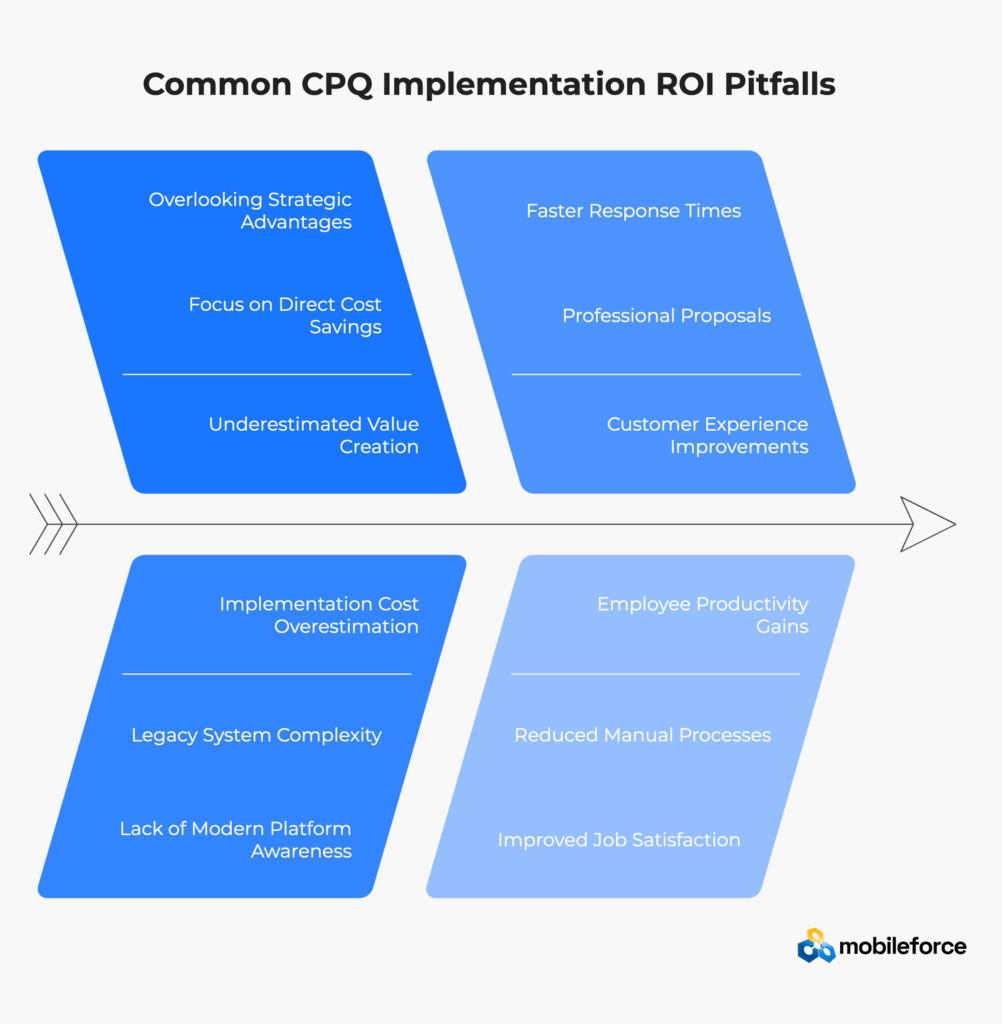
Many organizations significantly undervalue their CPQ investment by focusing exclusively on direct cost savings while overlooking transformative business benefits. This narrow financial lens misses strategic advantages that often deliver the highest returns over time. Research consistently shows that companies taking comprehensive value approaches achieve 40-60% higher ROI than those using simplified cost-reduction models.
The customer experience transformation alone can justify CPQ investment. Professional, branded proposals generated in minutes rather than days enhance brand perception and competitive positioning. When sales teams respond faster with more accurate quotes, they don’t just win more deals—they establish themselves as preferred vendors for future opportunities.
Customer experience improvements include professional proposals and faster response times that enhance brand perception. Employee productivity gains from reduced frustration with manual processes improve job satisfaction. Competitive advantages emerge through speed and accuracy that create market differentiation beyond cost savings. Scalability benefits provide platform capabilities that support growth without proportional resource increases.
Traditional CPQ implementation cost estimates often reflect legacy system complexity rather than modern platform capabilities. Cloud-native solutions with intuitive interfaces dramatically reduce deployment time, training requirements, and ongoing maintenance overhead compared to previous generation tools.
Cloud-based architecture eliminates infrastructure investments and reduces IT overhead. No-code configuration reduces professional services requirements and accelerates deployment. Mobileforce’s 25-47 day SLA provides predictable implementation costs. Phased rollouts enable organizations to validate ROI with pilot programs before full deployment.
Minimize implementation risks and maximize ROI potential. Partner with Mobileforce’s proven implementation team for successful quote automation deployments.
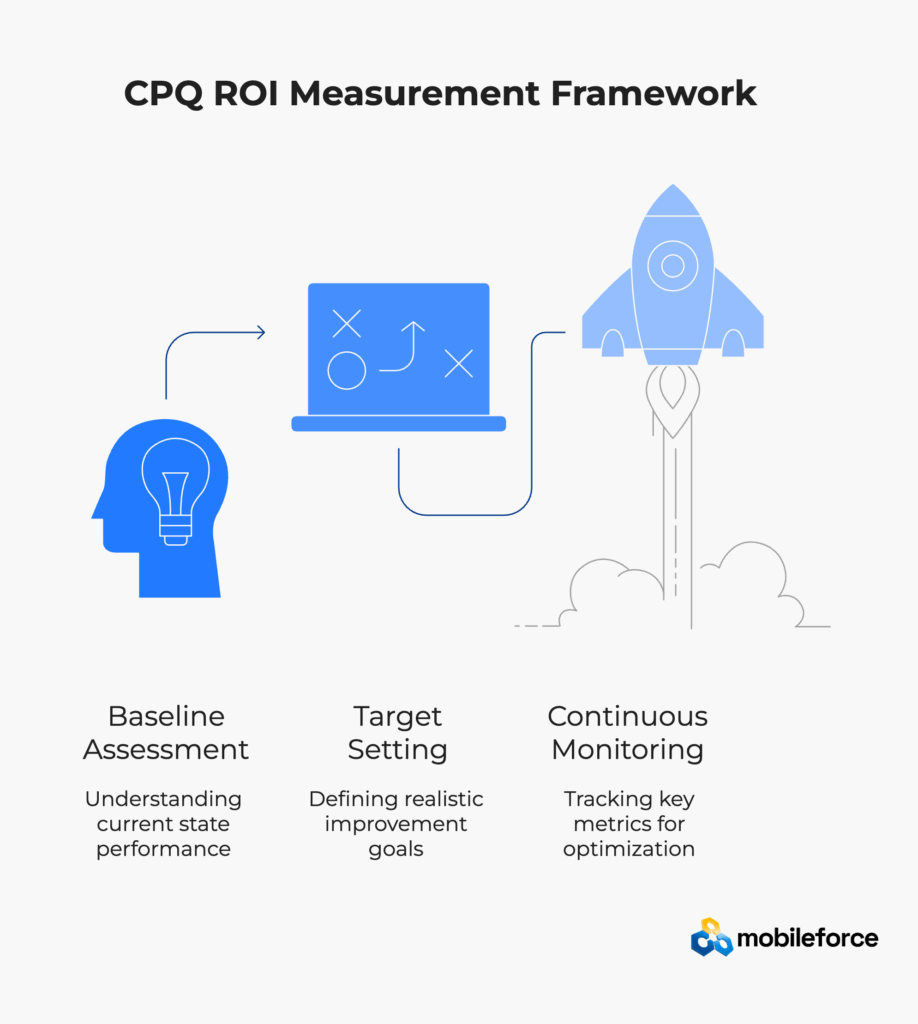
Successful CPQ ROI measurement requires systematic approach that begins before implementation and continues throughout the deployment lifecycle. Organizations that establish comprehensive measurement frameworks from the outset achieve more accurate projections and faster optimization cycles. The key lies in creating baseline benchmarks that enable meaningful progress tracking and continuous improvement opportunities.
Understanding current state performance provides the foundation for realistic improvement targets and accurate ROI projections. Many organizations discover significant inefficiencies during this assessment phase, often uncovering hidden costs in manual processes, error correction, and competitive response delays.
Document current state by tracking quote generation time by product complexity, error rates and revision frequency, sales productivity metrics and win rates, plus current technology capabilities and integration points.
Realistic goal setting balances aggressive improvement targets with achievable timelines and organizational capacity. The most successful implementations establish stretch goals while maintaining conservative projections for financial planning and stakeholder expectations.
Define improvement goals including 60-80% reduction in quote speed generation time, 10-20% win rate increase through faster response, 85-95% error reduction through fewer configuration mistakes, and 40-60% productivity increase in sales capacity.
Ongoing measurement enables proactive optimization and rapid issue resolution. Successful organizations establish monthly performance reviews and quarterly strategic assessments to ensure sustained value creation and identify emerging improvement opportunities.
Track key metrics including quote generation time and accuracy improvements, win rate changes by representative and territory, revenue attribution from faster cycles, plus customer satisfaction and retention rates.
Monthly dashboard elements should cover operational performance including volume, cycle time, and quality measures. Financial impact tracking includes revenue attribution and cost savings analysis. Strategic outcomes monitoring encompasses market position and scalability assessments.
Establish a comprehensive ROI measurement framework. Partner with Mobileforce implementation experts who bring proven methodologies to your quote automation deployment.
Configure price quote software has evolved from simple automation tools to strategic revenue accelerators that deliver measurable business transformation. Mobileforce’s proven track record demonstrates this evolution through customer results: 3.2x average ROI, 75% time savings, and 40% faster quote generation. Organizations like SportSafe validate this success, with Alex Wilkins confirming the “dramatic efficiency and adaptability” that modern no-code platforms provide.
The key to successful CPQ ROI lies in comprehensive measurement that captures revenue acceleration, operational excellence, and customer experience enhancement. With Mobileforce’s 25-47 day implementation guarantee and track record of serving 1,000+ field service teams, organizations can achieve rapid value realization while building sustainable competitive advantage through intelligent automation and seamless integration capabilities.
Transform your revenue operations with proven results. Join successful organizations and begin your strategic quote automation journey.
Q: How accurate are CPQ ROI calculators and what factors affect their reliability?
A: Modern configure price quote ROI calculators can achieve 85-95% accuracy when based on comprehensive current-state data and realistic improvement assumptions. The key to accuracy lies in using multiple measurement points including quote generation time, win rates, deal sizes, and error reduction rather than relying solely on time savings estimates. According to enterprise software implementation research, organizations using comprehensive baseline data and industry benchmarks achieve significantly more accurate ROI projections than those using simplified models.
Q: What is the typical payback period for CPQ implementation and how does it vary by business size?
A: Well-executed configure price quote software deployments typically achieve payback within 3-6 months across all business sizes. Small businesses often see faster payback (1-3 months) due to significant manual process automation, while enterprises may require 4-6 months due to implementation complexity. Based on customer success data, organizations can break even on quote automation software purchases in as little as 1.6 months with optimized deployment strategies and comprehensive user adoption programs.
Q: How does artificial intelligence impact CPQ ROI calculations and what specific benefits should organizations expect?
A: AI-powered configure price quote platforms typically deliver 20-40% higher ROI than traditional systems through intelligent pricing optimization, predictive configuration capabilities, and automated decision-making. Natural language interfaces like Mobileforce’s askCPQ reduce training costs by 30-50% and accelerate user adoption, while machine learning algorithms improve pricing accuracy by 15-25% through dynamic market analysis and customer behavior prediction.
Q: Should small and medium-sized businesses invest in CPQ software given the implementation costs?
A: Small and medium-sized businesses often achieve the highest percentage ROI from configure price quote software implementation due to significant automation of manual processes and professional image enhancement. While high implementation costs historically deterred SMEs from adopting quote automation solutions, modern cloud-based platforms with no-code configuration significantly reduce barriers to entry. SMEs typically achieve 500-1000% first-year ROI through comprehensive process transformation and competitive differentiation.
Q: What factors most influence configure price quote software ROI and which should organizations prioritize?
A: The three biggest ROI drivers for quote automation software are: 1) Deal velocity improvements that increase win rates by 10-25%, 2) Configuration error reduction that eliminates rework and improves margins by 15-30%, and 3) Sales process optimization that scales operations efficiently without proportional resource increases. Organizations focusing on these areas through comprehensive platform selection and strategic implementation achieve the highest returns and sustained competitive advantage.
Q: How do organizations measure long-term CPQ value beyond initial implementation ROI?
A: Long-term configure price quote software value measurement includes customer lifetime value improvements through enhanced buying experience, competitive advantage sustainability through operational excellence, operational scalability supporting business growth, and strategic decision-making enhancement through advanced analytics and business intelligence. The most successful organizations track ROI continuously using comprehensive dashboards and optimize processes based on performance data, resulting in sustained value creation extending 3-5 years beyond initial deployment.
Q: Can CPQ ROI be negative and what factors contribute to unsuccessful implementations?
A: While rare with modern quote automation platforms, negative configure price quote ROI can occur due to poor vendor selection, inadequate change management, insufficient user training, or misaligned business objectives. Critical success factors include executive sponsorship ensuring organizational commitment, cross-functional collaboration between sales, IT, and finance teams, strategic rather than tactical implementation approaches, and comprehensive measurement frameworks enabling ongoing optimization and value creation.
Q: How does configure price quote software ROI compare across different industries and what drives these variations?
A: Manufacturing organizations typically see 20-40% higher ROI due to complex configuration requirements and significant error reduction potential, while technology services benefit from subscription revenue optimization and recurring revenue automation. Professional services organizations achieve rapid payback through improved proposal accuracy and resource allocation optimization. Distribution companies often realize substantial margin improvements through automated tier-based pricing and partner portal capabilities. Industry-specific ROI variations reflect unique business process requirements and value creation opportunities.
Q: What is the difference between traditional CPQ systems and modern AI-powered platforms in terms of ROI potential?
A: Modern AI-powered configure price quote platforms deliver 2-3x higher ROI compared to traditional systems through advanced capabilities including natural language processing (70-90% faster quote generation), intelligent pricing optimization (15-25% margin improvement), predictive analytics (10-20% win rate increases), and no-code configuration (50-70% faster implementation). Traditional systems focus primarily on automation while AI-powered platforms enable strategic transformation through enhanced decision-making and customer experience optimization.
Q: How should organizations calculate the total cost of ownership for CPQ software including hidden costs?
A: Comprehensive configure price quote software total cost of ownership includes direct costs (licensing fees, implementation services, training expenses) and indirect costs (internal resource allocation, data migration, system integration, ongoing maintenance). Modern cloud-based platforms typically reduce TCO by 30-50% compared to on-premises solutions through eliminated infrastructure requirements, managed updates, and reduced IT overhead. Organizations should also factor in opportunity costs of delayed implementation and competitive disadvantages from manual processes when calculating true investment requirements.
Q: What specific metrics should organizations track to validate CPQ ROI after implementation?
A: Essential configure price quote software ROI validation metrics include quote generation cycle time reduction by product complexity, win rate improvements tracked by sales representative and territory, average deal size growth trends, configuration error reduction percentages, customer satisfaction score improvements, sales representative productivity increases, pricing accuracy improvement rates, and revenue attribution from faster sales cycles.
Mobileforce customers consistently track these metrics, achieving results including 3.2x average ROI, 75% time savings, 40% faster quote generation, and 90% increase in quote accuracy. Advanced organizations also monitor customer lifetime value improvements, competitive win/loss ratios, and market share growth in target segments for comprehensive value assessment.
Q: How do real customer results compare to ROI projections for configure price quote software?
A: Based on Mobileforce customer data, actual ROI results consistently meet or exceed initial projections. For example, Mobileforce customers achieve 3.2x average ROI within the first year, with 75% time savings and 40% faster quote generation. Alex Wilkins from SportSafe states: “The efficiency and adaptability that Mobileforce’s no-code platform brought to our processes is dramatic and something no other company could offer us.” The platform’s 25-47 day implementation SLA demonstrates predictable value delivery across diverse industries, including trusted deployment by 1,000+ field service teams.
Q: How do integration capabilities affect configure price quote software ROI and what should organizations prioritize?
A: Seamless integration capabilities significantly amplify quote automation software ROI through eliminated data silos, reduced manual data entry, improved process efficiency, and enhanced decision-making capabilities. Organizations should prioritize native CRM integration for real-time customer data synchronization, ERP connectivity for accurate inventory and pricing information, document management integration for streamlined proposal generation, and business intelligence connections for comprehensive analytics. Poor integration architecture can reduce ROI by 25-40% through increased administrative overhead and data accuracy issues.