
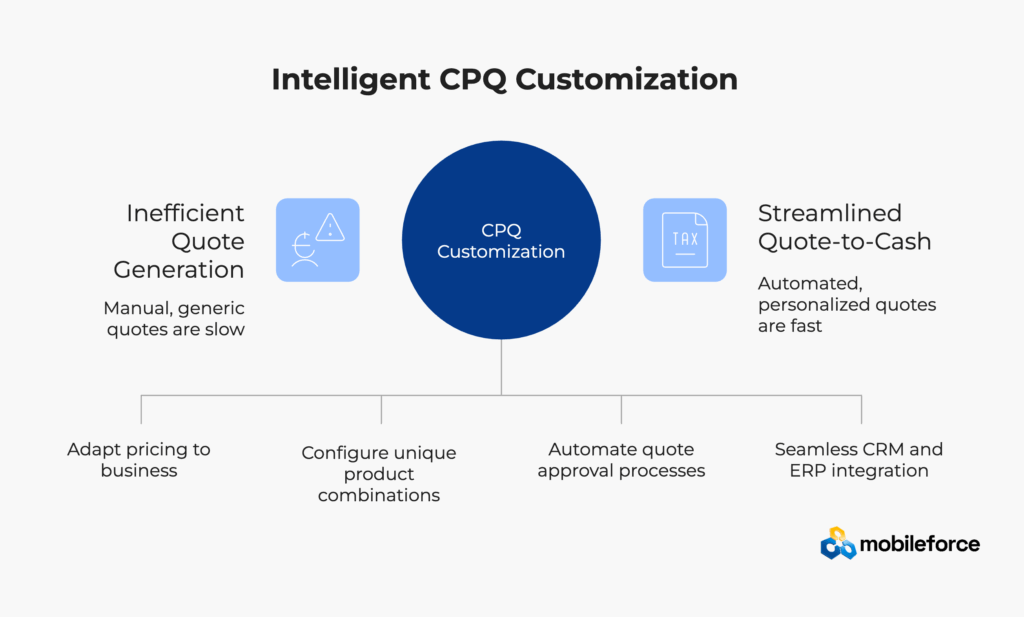
Imagine trying to fit every customer into the same quote template, regardless of their industry, size, or buying pattern. That’s exactly what happened to a manufacturing client before they discovered the power of configure price quote customization. Their sales reps were spending hours manually adjusting generic quotes for complex industrial equipment bundles, often missing critical configuration requirements or pricing exceptions that could make or break multi-million dollar deals.
The breakthrough came when they realized their CPQ system needed to work like their business actually operates—not force their business to work around system limitations. According to recent research from McKinsey on digital B2B transformation, companies pursuing configure-price-quote applications alongside end-to-end price optimization see dramatic improvements in margin performance and deal velocity through sales process automation.
The configure price quote software market continues evolving toward solutions that support selling complex goods and services across multiple channels. Gartner’s latest research on CPQ applications shows the market becoming increasingly focused on omnichannel capabilities and advanced customization features that enable businesses to maintain competitive advantage through pricing precision and quote accuracy.
Enterprise CPQ platforms like Mobileforce.ai represent this evolution, offering no-code CPQ capabilities that allow organizations to adapt quote-to-cash flows to their specific business rules, pricing structures, and product configurations without requiring extensive technical resources or months-long implementations.
Today’s B2B landscape demands pricing sophistication that goes far beyond simple list prices. McKinsey research on digital B2B transformation reveals that companies deploying advanced analytics to optimize commercial functions achieve sustainable sales growth through data-driven pricing strategies that traditional quote management systems cannot support.
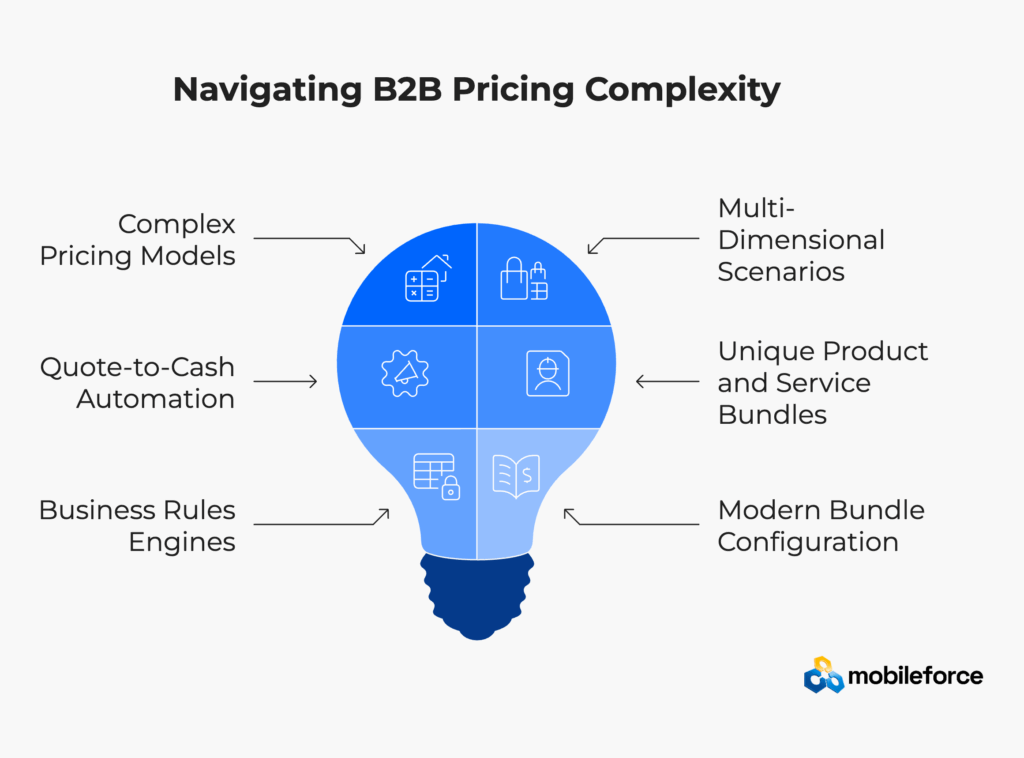
Organizations are implementing subscription pricing models, usage-based billing, volume-based discounts, and hybrid pricing structures that generic CPQ systems simply cannot handle effectively. The complexity extends beyond individual pricing strategies to encompass multi-dimensional scenarios where product configuration choices directly impact pricing calculations, discount eligibility thresholds, and margin protection requirements across different customer segments.
Consider a manufacturing company selling industrial equipment with maintenance contracts, software licenses, and field service packages. Each component has different pricing methodologies, discount authorization levels, and approval requirements. Without proper CPQ customization for complex pricing, sales reps waste time calculating prices manually or, worse, provide inaccurate quotes that hurt profitability and customer relationships through pricing errors.
Quote-to-cash automation becomes essential when dealing with complex product bundles, tiered pricing structures, and dynamic discount management across multiple sales channels. Sales teams need intelligent pricing engines that can handle real-time price optimization while maintaining margin controls and approval workflows.
Discover how Mobileforce.ai’s intelligent pricing engine handles complex multi-dimensional pricing scenarios. Schedule a personalized demo to see how AI-powered pricing optimization can transform your quote accuracy.
The trend toward solution selling means most B2B organizations offer complex product bundles combining hardware, software, services, and ongoing support. According to McKinsey’s analysis of B2B sales transformation, successful companies like GEA have implemented dedicated configure price quote systems that enable automated quote creation while freeing up frontline sales teams to focus on customer interaction rather than back-office coordination.
The market for cloud CPQ tools among publicly traded companies is projected to reach nearly $5.8 billion in 2026, driven largely by this increasing complexity of product and service bundling requirements across manufacturing, technology, and professional services industries.
These product configuration bundles require sophisticated business rules engines to ensure compatibility, proper sequencing, and accurate delivery timelines. Customized CPQ systems can enforce product compatibility rules that prevent impossible configurations while guiding sales teams toward optimal solution packages that maximize customer value and organizational profitability through intelligent cross-selling and upselling recommendations.
Modern bundle configuration capabilities include guided selling workflows, dynamic product catalogs, compatibility validation, and automated pricing calculations that consider volume discounts, service level agreements, and contract terms across multi-year agreements.
Every organization has unique approval hierarchies, delegation rules, and risk management requirements. Research shows that some of the biggest companies have gone from zero self-service capabilities to processing most of their quotes with no intervention, which has proven to be game-changing for operational efficiency and customer experience.
Modern approval workflow customization goes beyond simple hierarchical routing. Advanced systems consider deal characteristics, customer risk profiles, historical performance data, and market conditions to determine appropriate approval paths. This intelligence enables organizations to balance speed with control, ensuring quotes move efficiently through proper channels while maintaining necessary oversight.
Platforms like Mobileforce.ai support configurable approval workflows that align with your specific organizational structure, ensuring quotes move efficiently through the right channels while maintaining proper controls and audit trails for compliance and performance tracking.
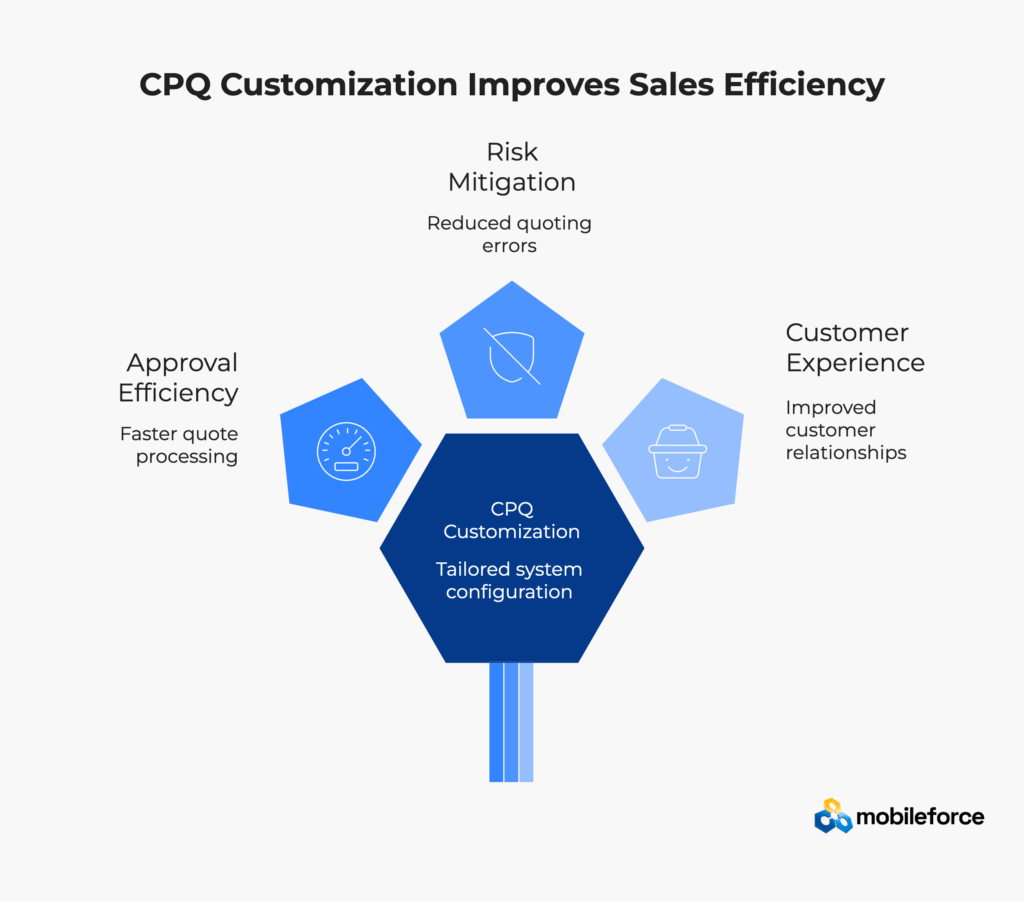
Quoting errors don’t just slow down sales cycles—they can damage customer relationships, impact profitability, and create operational headaches that ripple through manufacturing, service delivery, and customer support organizations. Gartner’s analysis of CPQ applications emphasizes that leading solutions focus on accuracy and error prevention as primary value drivers.
Customized CPQ systems provide the guardrails and validation rules needed to prevent these costly mistakes while maintaining the flexibility teams need to close complex deals. Advanced configuration engines can validate product compatibility, check inventory availability, verify pricing authorization levels, and ensure service delivery capabilities align with quoted commitments.
What is CPQ pricing customization? Modern CPQ customization starts with sophisticated pricing engines that handle multiple pricing models simultaneously. Organizations need systems that can manage tiered volume pricing, subscription billing, usage-based charges, and custom discount structures all within a single quote configuration workflow.
According to McKinsey’s research on digital pricing transformations, B2B companies can feed external and internal data into models to dynamically update prices for specific customers, enabling more sophisticated pricing strategies than traditional static approaches through real-time market analysis and competitive intelligence.
How to customize CPQ pricing rules involves several key areas:
Advanced pricing automation capabilities include real-time price optimization, competitor price matching, dynamic discount approval workflows, and margin protection rules that prevent unprofitable deals while maintaining sales velocity.
Enterprise pricing management through CPQ enables sales teams to handle complex pricing scenarios including contract pricing, volume-based discounts, promotional pricing, and customer-specific pricing agreements without manual intervention or pricing errors.
Mobileforce.ai’s rules-based pricing engine enables organizations to configure these complex scenarios without custom coding, ensuring sales teams always have access to accurate, up-to-date pricing information that reflects current market conditions and business rules through automated price book management.
What is product configuration in CPQ? Product configuration represents one of the most challenging aspects of CPQ customization, particularly for organizations selling engineered-to-order or complex configurable products. Organizations selling complex products need systems that understand mandatory components, optional add-ons, compatibility rules, and configuration constraints while maintaining manufacturing feasibility.
How does CPQ product configuration work? Advanced configuration engines use business rules to guide users through valid product selections while preventing invalid combinations that cannot be manufactured, delivered, or supported.
Essential configuration capabilities for CPQ systems include:
CPQ configuration management enables complex product catalog management with hierarchical product structures, option dependencies, feature constraints, and pricing relationships. Sales teams can configure products using visual configurators, constraint-based engines, and rule-based validation systems.
Product bundle configuration benefits include reduced quoting errors, faster quote generation, improved quote accuracy, and enhanced sales productivity through automated product selection guidance. Manufacturing companies particularly benefit from CPQ configuration capabilities when selling customizable equipment, machinery, or engineered systems.
For companies with extensive product catalogs or complex engineering requirements, Mobileforce.ai provides no-code configuration tools that enable business users to maintain complex product rules without technical expertise or dependence on IT resources for ongoing configuration management.
See how intelligent product configuration can eliminate quoting errors and accelerate deal velocity. Request a demo of Mobileforce.ai to explore advanced configuration capabilities tailored to your industry.
How do CPQ approval workflows work? Research indicates that CPQ reduces the amount of time needed to wait for approvals by 95% when properly configured with intelligent automation. Effective CPQ customization creates approval workflows that balance speed with control, ensuring appropriate oversight without creating unnecessary bottlenecks in the sales process.
What are the benefits of automated approval workflows? Approvals can be automatically greenlighted based on the specific guidelines of a business, such as those under certain price thresholds, standard product configurations, or established customer relationships. Advanced systems consider multiple variables simultaneously to determine routing requirements through machine learning algorithms.
CPQ approval automation features include:
Sales approval workflow optimization eliminates unnecessary delays while maintaining appropriate oversight for high-risk or high-value transactions that require senior management review. Intelligent approval routing considers factors like customer credit rating, deal profitability, discount percentages, and contract terms.
Quote approval process automation enables faster deal closure through streamlined decision-making, reduced manual intervention, and improved audit trails for compliance reporting. Sales teams benefit from predictable approval timelines and clear visibility into approval status throughout the quote-to-cash process.
The goal is eliminating approval bottlenecks while maintaining appropriate risk management controls through intelligent workflow automation that adapts to business rules and organizational policies.
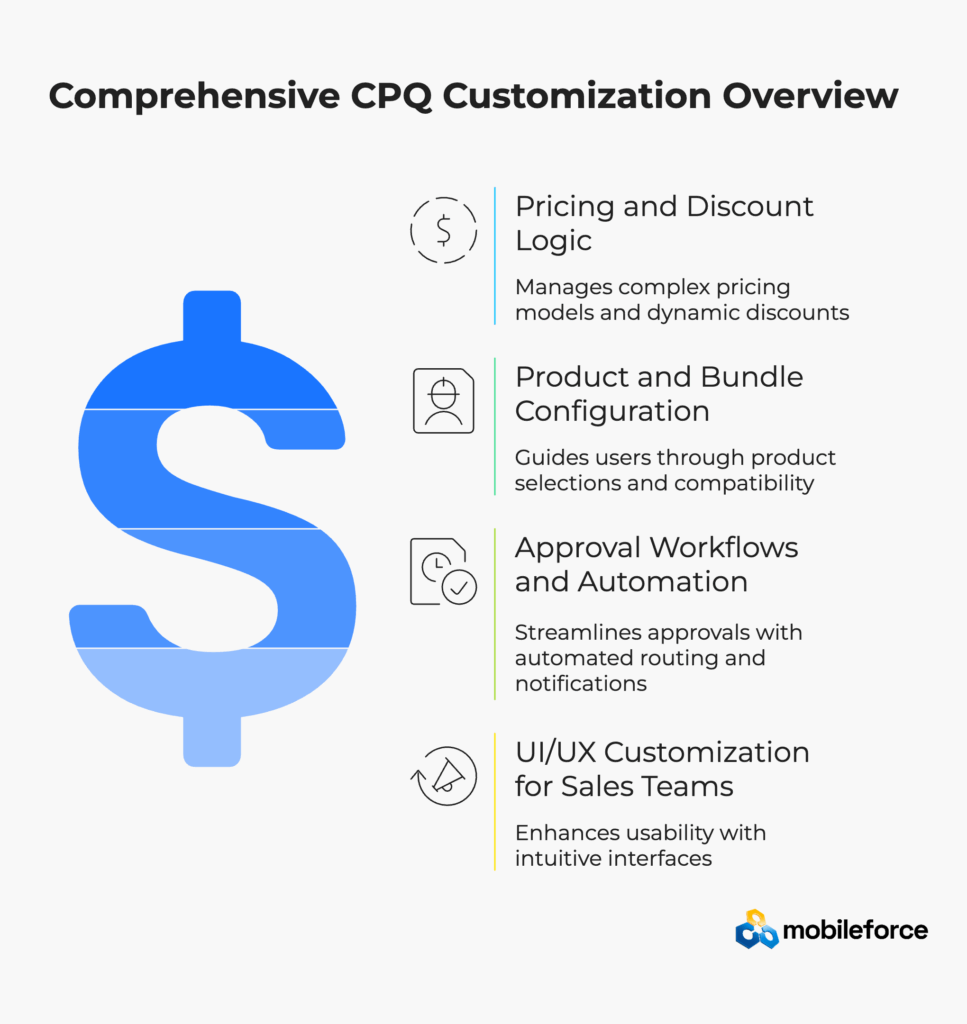
Sales productivity depends heavily on system usability and workflow optimization. According to Salesforce research on CPQ implementation, customized CPQ platforms provide intuitive interfaces tailored to how teams actually work, rather than forcing adoption of generic workflows that may not align with established sales processes.
User experience enhancements:
Mobileforce.ai’s platform includes mobile quoting capabilities designed specifically for field teams who need to generate accurate quotes anywhere, anytime, with full integration back to central systems when connectivity is restored.
Discover how mobile-first CPQ design can boost field sales productivity by 40%. Schedule a personalized demo with Mobileforce.ai to see mobile quoting capabilities in action.
Perhaps the most critical aspect of CPQ customization involves seamless integration with existing business systems. McKinsey’s analysis of commercial operations emphasizes that one of the most important trends today is to integrate it all—CRMs, ERPs, customer-facing portals, and eCommerce platforms—to provide smarter decision-making capabilities and a unified experience.
Essential integration capabilities:
Mobileforce.ai offers plug-and-play cloud integrations that connect bidirectionally with CRM systems like Salesforce and Microsoft Dynamics, plus any ERP, inventory, payment, or back-end system your organization uses, ensuring seamless data flow throughout your quote-to-cash process.
CPQ Feature | Standard Systems | Customized Systems |
Pricing Rules | Basic tiered pricing | Multi-dimensional pricing with AI optimization |
Product Config | Simple catalogs | Complex bundles with compatibility rules |
Approvals | Fixed hierarchies | Dynamic routing based on business rules |
Integration | Limited APIs | Bi-directional sync with CRM, ERP, and billing |
Mobile Access | Basic responsive design | Native mobile apps with offline capabilities |
How to implement CPQ customization successfully? Successful CPQ customization starts with thorough discovery of your current processes, pain points, and business objectives. NetSuite’s research on CPQ requirements emphasizes that implementation teams should define clear, measurable objectives for CPQ implementation, such as reducing quote generation time or improving pricing accuracy, and choose key performance indicators (KPIs) that analysts will use to monitor progress.
What should you consider before implementing CPQ? The discovery process must extend beyond surface-level requirements to understand the underlying business logic that drives pricing decisions, approval hierarchies, and configuration rules. This comprehensive approach prevents the common implementation pitfall of building solutions that work in theory but fail under real-world business pressures.
CPQ implementation requirements checklist includes:
CPQ business requirements analysis helps prioritize customization efforts and ensures the final system addresses your most pressing business needs while building a foundation for future enhancement and growth through modular implementation approaches.
Ensure your CPQ implementation addresses all critical business requirements. Schedule a discovery session with Mobileforce.ai to map your unique processes and identify optimization opportunities.
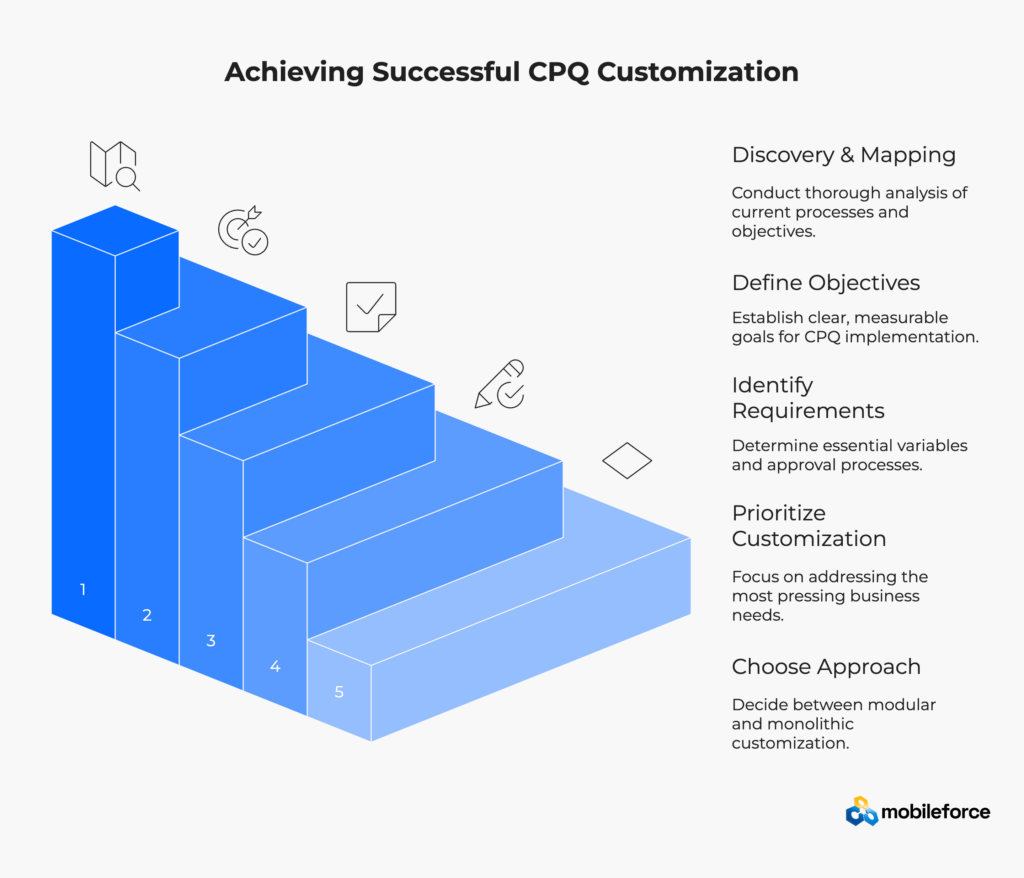
Organizations face a fundamental choice between building extensive customizations within their CPQ platform versus using external middleware and integration tools. Research on CPQ implementation challenges shows that each approach offers distinct advantages and trade-offs that significantly impact both implementation timeline and long-term maintainability.
Modular approach benefits:
Mobileforce.ai supports modular customization through no-code configuration tools that enable rapid setup without extensive technical resources. Their platform can be configured and deployed in 4-8 weeks compared to 6-18 months for traditional enterprise platforms, making it ideal for organizations that need to move quickly while maintaining implementation quality.
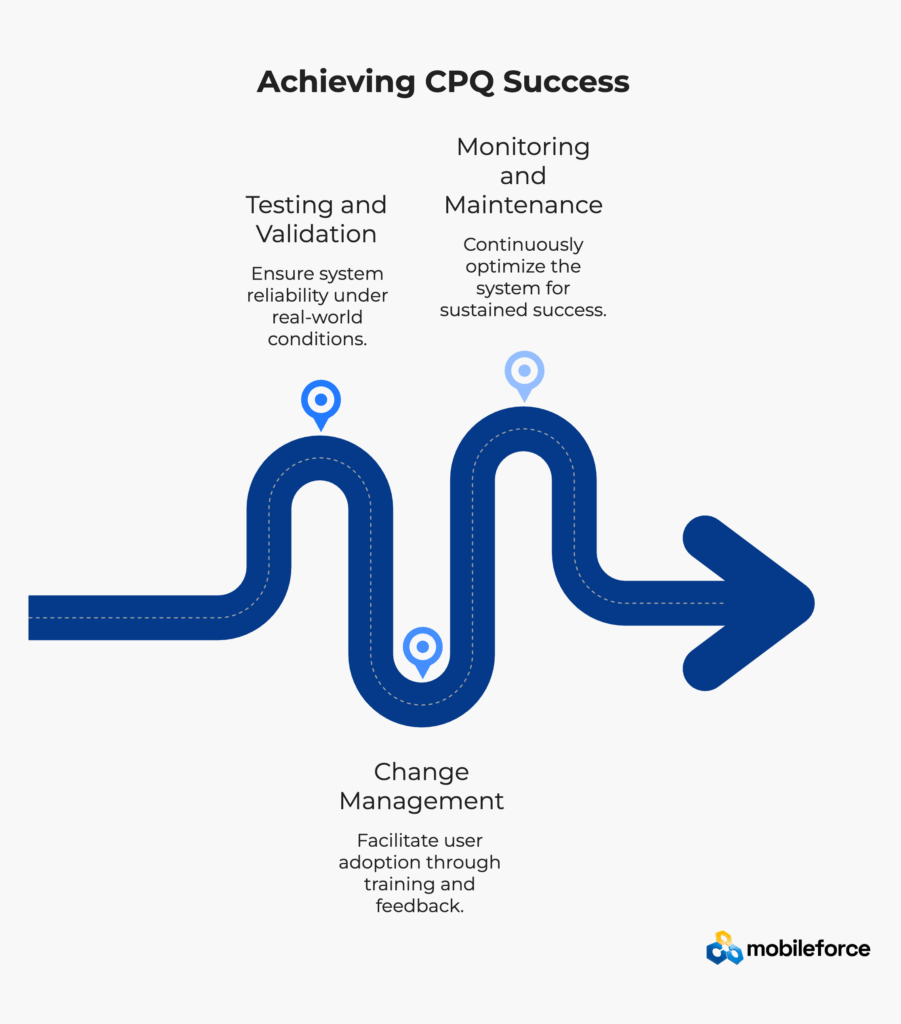
According to NetSuite’s CPQ best practices research, companies can create a strong foundation that enables their CPQ system to maintain data accuracy and drive growth by following accepted best practices. Comprehensive testing ensures your customized CPQ system performs reliably under real-world conditions and edge cases that may not emerge during initial configuration.
Essential testing scenarios:
The testing phase should also include user acceptance testing with actual sales representatives and operations personnel who will use the system daily. Their feedback often reveals usability issues and workflow gaps that technical testing alone cannot identify.
Technology adoption challenges can derail even the best-designed CPQ customizations. Research on CPQ implementation challenges shows that if the system is not user-friendly, sales reps may resist using it, resulting in low user adoption rates that undermine the entire investment.
Change management strategies:
Success depends on balancing user needs with system simplicity, ensuring the final solution empowers rather than burdens your sales teams while delivering measurable business value.
Ongoing optimization is essential for sustained CPQ success. NetSuite’s analysis shows that an ongoing commitment to these practices can create a more efficient, accurate, and profitable sales operation that better serves the business and its customers through continuous refinement and improvement.
Key performance indicators to track:
Regular monitoring helps identify optimization opportunities and ensures your CPQ system continues delivering value as your business evolves and market conditions change.
Background: SportSafe, a UK-based supplier specializing in complex field service and installation workflows, represents a compelling example of successful CPQ customization in action. As a company that provides safety equipment and services across multiple industries, SportSafe faced significant challenges coordinating sales and service operations across distributed teams and varying customer requirements.
Challenge: SportSafe needed to streamline their quote-to-service workflow while maintaining the flexibility to handle complex, customized installations that varied significantly by industry, location, and regulatory requirements. Their existing processes involved multiple handoffs between sales representatives, service technicians, project managers, and compliance specialists, creating numerous opportunities for errors, delays, and miscommunication that could impact both customer satisfaction and project profitability.
The company’s traditional approach required sales teams to manually coordinate with service departments to verify installation feasibility, gather accurate pricing for customized configurations, and ensure compliance with industry-specific safety regulations. This process often took several days or weeks, putting SportSafe at a competitive disadvantage against companies with more streamlined operations.
Solution: SportSafe implemented Mobileforce.ai’s unified quote-to-cash-to-service platform, leveraging the no-code CPQ capabilities alongside integrated field service management functionality. The solution enabled sales and service teams to work from the same system, standardizing product and service bundles while maintaining customization capabilities for unique requirements.
The implementation included several key components:
Learn how unified CPQ and field service management can eliminate operational silos. Schedule a demo with Mobileforce.ai to explore integrated quote-to-service workflows.
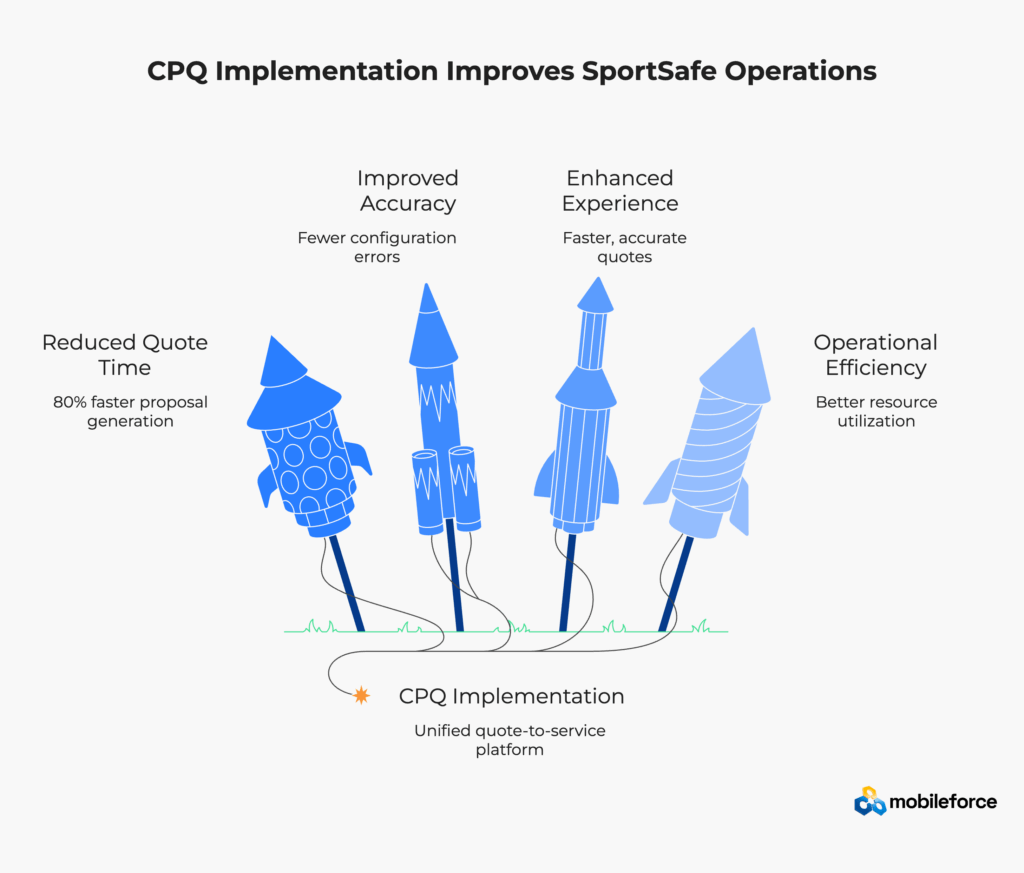
Results: SportSafe achieved dramatic improvements in operational efficiency and customer satisfaction through their CPQ implementation:
Key Success Factors:
Lessons Learned: The SportSafe implementation demonstrates several critical principles for successful CPQ customization:
This case study illustrates how thoughtful CPQ customization can transform not just quoting processes, but entire operational workflows that span from initial customer contact through service delivery and ongoing support.
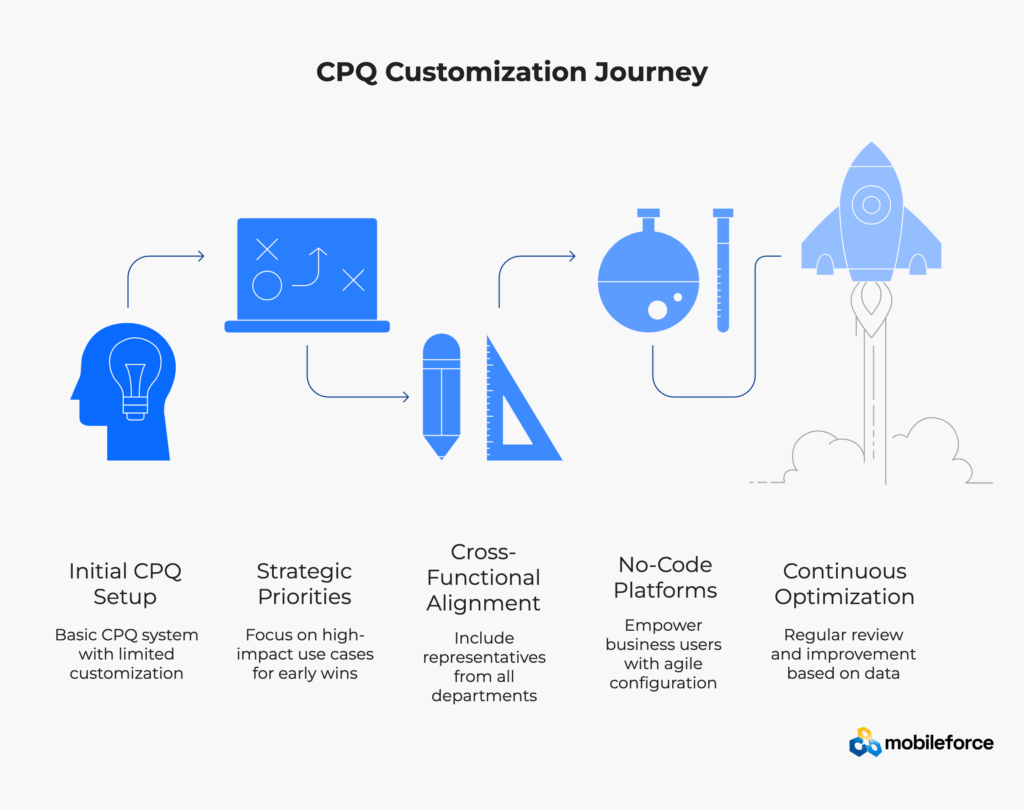
Successful CPQ customization requires focused execution rather than trying to optimize everything simultaneously. Begin with your highest-impact use cases—typically your most common quote types and largest revenue opportunities.
Recommended first phase scope:
This focused approach generates early wins while building internal expertise for more complex customizations.
CPQ customization affects multiple departments, making cross-functional alignment essential. Include representatives from sales operations, finance, IT, and customer service in your planning process to ensure the final system supports everyone’s needs.
Regular stakeholder meetings help prevent scope creep while ensuring important requirements aren’t overlooked.
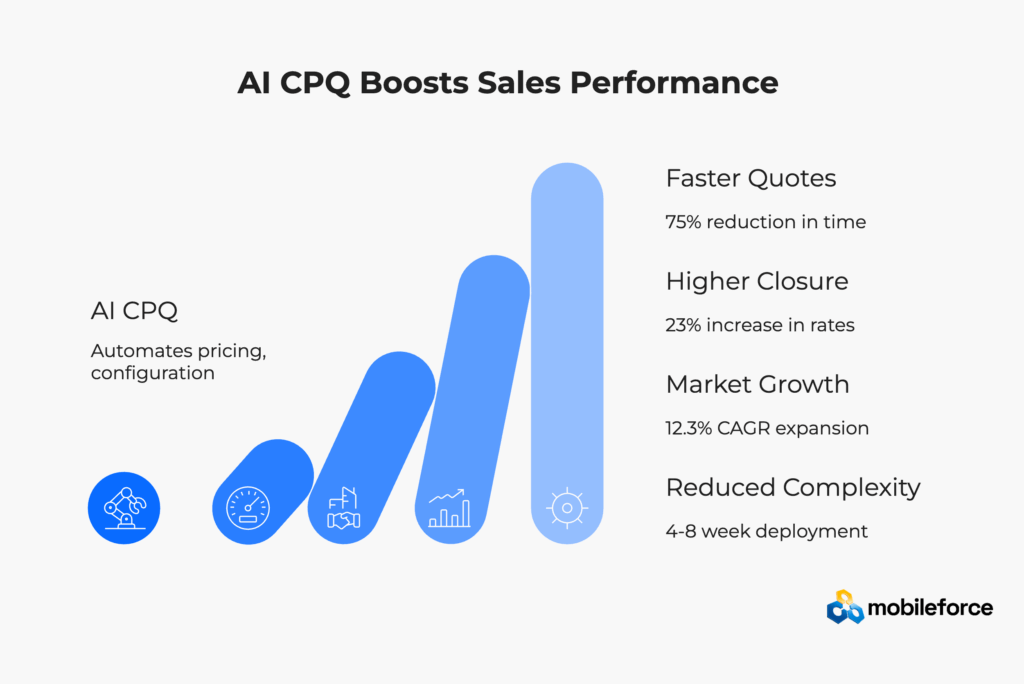
Where enterprise platforms like Salesforce and Oracle require 6-18 month implementations, Mobileforce typically deploys in 4-8 weeks. No-code CPQ platforms like Mobileforce.ai enable business users to make configuration changes without relying on technical teams, reducing both implementation time and ongoing maintenance costs.
This approach also provides greater agility, allowing organizations to adapt their CPQ systems as business needs evolve.
CPQ customization isn’t a one-time project—it’s an ongoing process of refinement and improvement. Integration with artificial intelligence (AI) and analytics technologies is revolutionizing the global Configure Price and Quote (CPQ) software market.
Establish processes for regular review and optimization, incorporating user feedback and performance data to guide future enhancements.
Q: What is CPQ customization and why do businesses need it? A: CPQ customization involves adapting configure, price, quote software to match your specific business processes, pricing models, and product configurations. According to Gartner’s research on CPQ applications, generic CPQ systems often force organizations to work around system limitations, while customized solutions work exactly how your business operates, improving efficiency and accuracy while reducing time to quote and implementation complexity through tailored workflows.
Q: Which CPQ features provide the highest ROI for customization efforts? A: Pricing rule automation and approval workflow optimization typically deliver the fastest return on investment for CPQ customization projects. Research shows that companies implementing AI CPQ software report average quote generation time reductions of 75%, while deal closure rates jump by an average of 23%. Focus first on automating your most time-consuming manual processes, such as complex pricing calculations, multi-level approvals, and product configuration validation to maximize CPQ ROI.
Q: How do you maintain compliance and audit trails when customizing CPQ rules? A: Modern CPQ platforms include comprehensive audit capabilities that track all configuration changes, approval decisions, and pricing adjustments with timestamped logs and user attribution. Mobileforce.ai maintains detailed logs of all system activities, ensuring compliance requirements are met while providing visibility into quote-to-cash processes for performance analysis and regulatory reporting across SOX, GDPR, and industry-specific compliance frameworks.
Q: How long does CPQ customization implementation typically take? A: CPQ implementation timelines vary significantly based on complexity and platform choice. NetSuite’s research on CPQ implementation shows that simple implementations using standard, out-of-the-box configurations typically take 8-12 weeks, while complex implementations involving multiple integrations, customization, and extensive product catalogs may require 6-18 months. No-code platforms can reduce implementation time from 6-18 months to 4-8 weeks for most organizations.
Q: What are the biggest CPQ customization challenges to avoid during implementation? A: According to Tacton’s State of Manufacturing Report, while 53% of manufacturers now respond to requests for quotes within 24 hours, 79% continue to struggle with quoting quality despite implementing CPQ systems. Common CPQ implementation pitfalls include inadequate data quality, overly complex configurations, insufficient user training, poor integration planning, and scope creep. Starting with a focused scope and building gradually helps avoid these implementation challenges.
Q: How do you ensure user adoption of customized CPQ systems across sales teams? A: User adoption depends on system usability, proper training, and comprehensive change management. Research on CPQ implementation challenges shows that sales development reps and account executives need to be trained to maintain clean data and use CPQ features correctly. Involve users in the customization process, provide role-specific training that demonstrates clear value for their daily work, implement feedback loops for continuous improvement, and establish clear governance to prevent customization sprawl.
Q: Can CPQ customization integrate with existing CRM and ERP systems? A: Yes, modern CPQ platforms are designed for seamless integration with existing business systems. Mobileforce.ai offers plug-and-play integrations with CRM systems like Salesforce and Microsoft Dynamics, plus bidirectional connectivity with ERP, inventory, payment, and other business systems. The key is choosing a platform with robust integration capabilities and pre-built connectors for your specific technology stack to ensure data consistency across systems.
Q: What’s the difference between no-code and traditional CPQ customization approaches? A: No-code CPQ platforms enable business users to configure rules, workflows, and integrations using visual tools without programming expertise. Traditional customization often requires developers and extensive coding, leading to longer implementation times and higher costs. Mobileforce.ai’s no-code approach reduces implementation time, lowers total cost of ownership, and enables faster adaptation to changing business needs while maintaining enterprise-grade functionality and security.
Q: How do you handle complex pricing models with CPQ customization? A: Advanced CPQ platforms support multi-dimensional pricing models including subscription billing, usage-based pricing, volume discounts, and dynamic pricing based on market conditions. McKinsey’s research on digital pricing shows that sophisticated pricing engines can analyze external and internal data to dynamically update prices for specific customers, enabling competitive advantage through pricing precision and real-time optimization.
Q: What is the typical cost of CPQ customization for mid-market companies? A: CPQ solution costs vary depending on number of users, included features, implementation complexity, and ongoing support requirements. Many vendors offer subscription-based pricing but often charge additional fees for implementation, training, and customization services. When evaluating CPQ costs, consider total cost of ownership including training, integration, and ongoing maintenance versus potential return on investment from faster sales cycles, improved accuracy, and increased deal sizes through sales productivity improvements.
Q: How do you measure success after CPQ customization implementation? A: Key performance indicators for CPQ success include quote accuracy rates, time to generate quotes, deal velocity from quote to close, approval cycle time, user adoption rates, and overall sales productivity metrics. Successful implementations typically show 20-80% reduction in quote generation time, significant improvement in quote accuracy, increased sales team satisfaction with the quoting process, and measurable impact on revenue growth through faster deal closure and reduced quoting errors.
Q: Can small and medium businesses benefit from enterprise CPQ customization? A: Absolutely. While enterprise CPQ solutions traditionally required significant resources, modern no-code platforms make sophisticated CPQ customization accessible to organizations of all sizes. Small and medium businesses often see faster implementation and higher relative ROI due to their ability to adapt processes more quickly and deploy solutions across their entire organization simultaneously without complex change management processes.
Ready to transform your quote-to-cash process with intelligent CPQ customization that adapts to your unique business requirements? Schedule a personalized demo with Mobileforce.ai today to discover how no-code configuration, AI-powered pricing, and seamless integrations can deliver measurable results for your organization. Join the 2,000+ companies already experiencing faster quote generation, higher close rates, and improved sales productivity.