Why CPQ Security Now Matters More Than Ever
A deal worth $8.5 million nearly collapsed, not because of a bad negotiation, but because of a misconfigured CPQ rule. An unauthorized user applied a steep discount without approval, and by the time finance caught it, the quote was already in the customer’s inbox.
This is not an edge case. It happens more often than most revenue leaders want to admit.
The stakes have never been higher. Consider the consequences of CPQ security failures:
- Financial Impact: Unauthorized discounting or pricing manipulation can cost companies millions in lost margins.
- Competitive Exposure: Leaked pricing strategies or special terms can undermine your market position.
- Regulatory Penalties: In regulated industries, mistakes or security breaches can trigger severe compliance penalties.
- Reputational Damage: Customer trust erodes quickly when sensitive quote information is compromised.
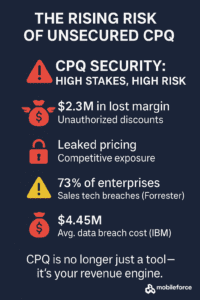
A recent Forrester study found that 73% of enterprises experienced at least one security incident related to their sales technology stack in the past 24 months. With the average cost of a data breach now exceeding \$4.45 million (according to IBM’s Cost of a Data Breach Report), the business case for securing CPQ platforms has become overwhelming.
Enterprise CPQ deployments are typically integrated with CRMs (like Salesforce or HubSpot), ERPs (like NetSuite or SAP), contract management systems, and even billing and invoicing engines. This interconnected architecture creates a broader attack surface that, if not properly secured, can lead to unauthorized access, compliance failures, or worse—financial data breaches.
The traditional approach to CPQ security—implementing basic authentication and limited access controls—is no longer sufficient. Modern enterprise environments demand a comprehensive security model that addresses:
- Identity assurance: Verifying that users are who they claim to be
- Contextual access: Ensuring appropriate permissions based on role, location, and device
- Cross-system security: Maintaining protection across integration points
- Continuous monitoring: Detecting and responding to suspicious activities
- Compliance documentation: Providing evidence for regulatory requirements
Mobileforce CPQ stands apart as a cloud-native solution purpose-built with enterprise-grade security in mind. While legacy CPQ tools often treat security as an afterthought or a bolt-on feature, Mobileforce embeds identity, access, and compliance controls at the arOASISchitectural level—ensuring security and scalability go hand in hand.
Implementing SSO in CPQ Platforms
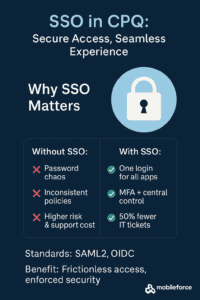
Single Sign-On is the foundation of enterprise authentication in CPQ. The idea is straightforward: users log in once with their corporate credentials and can move freely between their CRM, CPQ, ERP, and other systems without having to log in again. But what SSO actually delivers in a CPQ context goes far beyond convenience.
Why SSO Matters in CPQ:
Sales teams, operations staff, pricing analysts, finance reviewers, and external channel partners all use CPQ, often simultaneously, often from different locations and devices. Without SSO, you manage a separate set of credentials for each user group within the CPQ platform. That means password reuse. It means credentials written on sticky notes. It means shared logins are passed back and forth among team members. And it means your CPQ access policies are entirely disconnected from the rest of your enterprise identity governance.
SSO eliminates that problem. Every user accesses CPQ through their existing corporate identity, the same one governed by your identity provider (IdP). Every authentication policy you have in place already, MFA requirements, password rules, conditional access based on location or device, applies automatically to CPQ. You are not running two parallel security regimes. You are running one.
Organizations that implement SSO in CPQ typically see authentication-related support tickets drop by around 50%. That is a real operational benefit. But the security benefit is larger: when an employee leaves, their CPQ access is revoked at the IdP level immediately, along with access to every other system. No manual offboarding steps. No forgotten accounts.
The two standards that matter here are SAML 2.0 and OpenID Connect (OIDC). SAML 2.0 is the XML-based federated identity protocol that large enterprises have standardized on for a long time. OIDC is the more modern alternative, built on top of OAuth2, REST-friendly, and increasingly preferred for cloud-native deployments. Enterprise CPQ platforms need to support both.
Key Industry Standards:
- SAML 2.0: XML-based federated identity protocol widely adopted by large enterprises.
- OpenID Connect (OIDC): An identity layer on top of OAuth2, more modern and REST-friendly.
Where Mobileforce CPQ stands apart:
Most CPQ vendors support SSO in theory. In practice, getting it working requires significant custom development, professional services time, and back-and-forth with your IdP vendor. Mobileforce ships with prebuilt, production-tested integrations for Okta, Azure AD, Google Workspace, Ping Identity, ForgeRock, and OneLogin. You do not start from scratch. You configure, not build. Beyond the basics, Mobileforce supports attribute-based role provisioning at login. When a user authenticates, their role in CPQ, what they can see, what they can do, and which products and pricing tiers they can access, is automatically derived from their identity attributes: department, group membership, geography, and product line. The moment they log in for the first time, they have exactly the right access. No administrator needs to set them up manually. For sensitive operations, such as applying large discounts, modifying contract terms, or overriding approval rules, Mobileforce enforces step-up authentication automatically. The system recognizes when a user is attempting something higher-risk and requires them to re-verify before proceeding. Certificate rotation occurs automatically, eliminating one of the most common failure points in federated identity implementations.
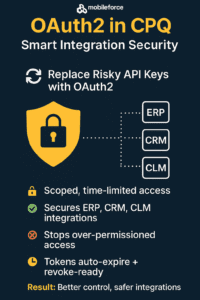
OAuth2 in CPQ: Secure, Tokenized Access for APIs and Services
If SSO handles how people get into your CPQ platform, OAuth2 handles how your CPQ platform talks to everything else. A typical enterprise CPQ implementation integrates with five to ten external systems: an ERP for product and pricing master data, a CRM for customer and opportunity information, a contract management system, an e-signature tool, business intelligence platforms, and possibly a customer self-service portal. Each of those integrations requires your CPQ to send and receive data. Without a proper authorization framework, each of those integrations is a shared credential waiting to be compromised.
Here is the practical difference OAuth2 makes. Without it, when your CPQ needs to pull customer-specific pricing from SAP, it might use a service account with permanent, broad access to SAP data, an account that, if compromised, gives an attacker wide access to your ERP. With OAuth2, the CPQ requests a short-lived token scoped to the pricing data needed for that customer and that session.
When the token expires, access is gone. If the token is somehow intercepted, the blast radius is tiny. It is the difference between a security incident that is contained and one that cascades across your entire revenue stack.
What is OAuth2 in a CPQ Context?
OAuth2 is a secure authorization protocol that allows applications to access data on behalf of users without exposing their passwords. It uses access tokens to grant and restrict access to specific resources for a defined period.
Let’s illustrate with a common scenario: A sales rep creating a quote that needs to pull customer-specific pricing from SAP. Without OAuth2, the CPQ might use a service account with permanent, broad access to SAP data. With OAuth2, the CPQ requests a short-lived token with permissions limited to just the pricing data needed for that specific customer—dramatically reducing the potential attack surface.
What OAuth2 protects in a CPQ context:
Real-time product configuration APIs, price retrieval from external sources, order submission into ERP, CRM data syncing, partner portal access for channel quoting, analytics connections, and approval workflows that cross departmental boundaries, all of these require secure, scoped, auditable access. OAuth2 provides that at each integration point.
The core security benefits are worth stating plainly. First, scoped access control: each integration partner or application can only access exactly what it needs, nothing more. A partner portal can see specific product catalogs; it cannot touch pricing strategies or approval workflows. Second, short-lived tokens: the vulnerability window of any given token is measured in minutes or hours, not months. If suspicious activity is detected, tokens can be revoked in seconds without disrupting other active integrations. Third, safe third-party extensibility: analytics platforms, contract tools, and custom sales applications can be connected securely without becoming security liabilities.
Key Security Benefits of OAuth2:
Enterprise-Grade Scoped Access Control: Define precisely what data and functionality each integration partner or application can access within your CPQ ecosystem, creating security boundaries that prevent lateral movement in case of a breach—for example, allowing a partner portal to access only specific product catalogs while keeping pricing strategies and approval workflows completely isolated.
Dynamic Token Management with Rapid Response Capability: Implement short-lived access tokens with automatic expiry and rotation mechanisms that dramatically reduce the vulnerability window compared to traditional API keys, enabling security teams to revoke access within minutes if suspicious activity is detected without disrupting other system integrations.
Secure Third-Party Ecosystem Enablement: Safely extend your CPQ capabilities through external tools and applications (such as analytics platforms, contract management systems, or custom sales tools) while maintaining granular control over their access patterns, ensuring these integrations enhance rather than compromise your security posture.
Where Mobileforce CPQ stands apart:
Most CPQ platforms implement API security at the platform level, a single, broad set of permissions for the entire system. Mobileforce takes a microservice approach. The Quoting API, Pricing API, Approval API, and Catalog API each have their own dedicated, scope-limited access tokens. A credential compromise in one area cannot propagate to others. This is architecturally different from what legacy CPQ platforms offer, and it matters significantly for organizations in high-security environments. Token lifecycle management is handled comprehensively: automated refresh, configurable expiration policies, and emergency revocation with near-instant effect. The administrative interface allows operations teams to connect and manage integrations without needing a developer in the room. Client registration, token diagnostics, and permission assignment are all self-service.
For enterprise IT teams managing complex, interconnected revenue technology stacks, this is what zero-trust API access actually looks like in a CPQ context.
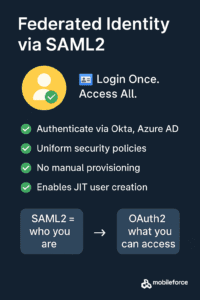
Federated Authentication via SAML2: Enterprise Identity, Applied to CPQ
As organizations expand globally and embrace hybrid work, managing user access consistently across dozens of systems becomes genuinely difficult. Federated authentication via SAML2 is how enterprises solve this at scale, users log in to third-party platforms like CPQ using their existing corporate credentials, all under the enterprise IdP’s governance.
The practical advantages in a CPQ context are significant. Authentication policies, session management, and identity governance all live in one place, Okta, Azure AD, or whichever platform your organization has standardized on. There are no inconsistencies between how CPQ enforces security policies and how your other business systems do. Adaptive MFA, device compliance checks, network location restrictions, and suspicious login detection are applied uniformly across CRM, CPQ, ERP, and contract systems simultaneously.
For sales teams and channel partners, this means no additional login barriers when moving between systems. For compliance officers, it means security controls are not fragmented across applications. For IT, it means a single control plane for identity governance rather than a patchwork of application-level policies.
It is worth being precise about how SAML2 and OAuth2 relate to each other. SAML2 handles authentication, verifying and asserting a user’s identity. OAuth2 handles authorization, what a user or an integrated system is permitted to access. Enterprise CPQ requires both. SAML2 for user logins and identity federation. OAuth2 for system-to-system integrations. They are complementary, not interchangeable.
Where Mobileforce CPQ stands apart:
Mobileforce provides production-ready, fully tested federated authentication integrations with all major identity providers, Okta, Azure AD, Ping Identity, ForgeRock, and OneLogin. These are not generic SAML implementations that require extensive configuration. They are purpose-built integrations with enterprise-specific features, such as step-up authentication for sensitive CPQ operations and built-in automatic certificate rotation.
The administrative interface requires no developer involvement. Security and IT administrators configure federated authentication end-to-end without writing configuration files or editing code. Implementation time drops from weeks to hours. Just-in-Time provisioning is handled intelligently. When a new user logs in for the first time, Mobileforce automatically creates their account based on multiple SAML assertion attributes, department, geography, role, and product line can all inform the initial access configuration. The result is that new users, channel partners, and regional staff have exactly the right access from their first login, without any manual provisioning by administrators.
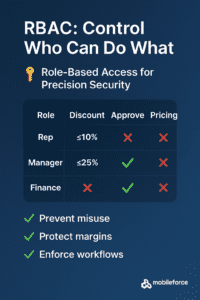
Role-Based Access Control in CPQ: Precision Access That Protects Margin
The most underestimated security risk in CPQ is not an external attacker. It is an internal user with too much access. Sales representatives who experiment with pricing. Customer success managers who adjust renewal quotes beyond their authority. Regional managers who create custom bundles without engineering approval. These are not malicious actors. They are employees working around processes they find inconvenient, because the system allows them to.
The financial consequences are real. One global manufacturer found that sales reps had been offering unauthorized discounts of up to 30% on high-margin products, resulting in $2.3 million in lost profit over a single quarter. A SaaS company discovered that customer success managers had been modifying pricing tiers in CPQ, resulting in inconsistent renewal quotes and triggering revenue recognition issues. A distribution company identified that regional managers were creating unapproved product bundles, leading to fulfillment failures. None of these were security breaches in the traditional sense. They were permission failures. And they are exactly what proper Role-Based Access Control in CPQ is designed to prevent.
What RBAC actually means in a CPQ context:
RBAC defines what each user can do in the system based on their role. In a well-configured enterprise CPQ platform, roles map to real organizational functions with precision: a sales rep can create quotes and apply standard discounts; a sales manager can approve quotes with flexible pricing within defined thresholds; a pricing analyst manages price books and discounting rules; finance and legal can view contract terms and flag violations but cannot edit quotes; channel partners see only the catalog and pricing relevant to their tier; executives have read-only visibility across all quotes and analytics; system administrators configure workflows and integrations. Permissions are tied to specific actions: creating or modifying quotes, applying discount tiers, editing product bundles, and changing approval rules. The right roles, tightly defined, mean that the system itself enforces the policies that currently exist only on paper.
Why granular permissions matter more than most organizations realize:
The difference between coarse-grained and fine-grained permissions in CPQ is the difference between “sales reps can apply discounts” and “sales reps can apply up to 15% discounts on domestic SMB deals under $50,000, while enterprise or international deals require tiered approvals.” That level of specificity is what actually protects the margin. It is also what makes regulatory compliance achievable rather than aspirational, separation of duties, approval hierarchies, and change documentation are structural requirements of SOX and ISO 27001, not optional practices. Audit accountability follows naturally from proper RBAC. When permissions are granular and enforced, every action in the system has a clear owner. Investigations that previously took weeks become on-demand reports.
Where Mobileforce CPQ stands apart:
Mobileforce implements RBAC as a hierarchical architecture that mirrors real organizational structures, regional directors, territory managers, account executives, and sales associates, each with permissions that reflect their actual authority rather than a generic role category. Permissions are context-sensitive and multi-dimensional. They adapt based on deal size, geography, product line, customer segment, and workflow stage simultaneously. This is not something most CPQ platforms offer. It is the difference between a permission model that works in theory and one that maps precisely to how your business actually operates.
Configuration is handled through a visual drag-and-drop interface. Business administrators define, test, and validate complex permission models without developer involvement. Organizations using Mobileforce report security configuration time reduced by up to 80% compared to conventional CPQ platforms. Custom permission sets allow hybrid roles, a RevOps user who needs access to quote templates and analytics. Still, they should have no approval authority, for example, to be configured cleanly without compromises.
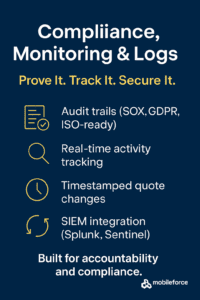
Compliance, Monitoring, and Audit Logging in CPQ
Security without accountability is incomplete. In regulated industries, it is also a liability. CPQ systems regularly intersect with some of the most demanding compliance frameworks in enterprise software. SOX requires traceable pricing approvals and discount authorizations. GDPR governs how personal data in customer quotes is accessed and used. ISO 27001 mandates access controls, logging, and documented risk mitigation. HIPAA, DFARS, and CCPA add further requirements depending on the industry.
What all of these frameworks share is a requirement for evidence, documented proof that only authorized users accessed sensitive data, that approval workflows were followed, and that no unauthorized changes were made. A CPQ platform that cannot produce that evidence reliably is a compliance gap waiting to become a regulatory finding.
What robust compliance and audit logging actually requires:
The audit trail needs to be immutable, tamper-proof, cryptographically timestamped, and comprehensive enough to satisfy forensic review. Every quote modification, approval action, pricing override, role change, and authentication event should be captured with user attribution and IP address tracking. The log should be a complete, unalterable record of what happened, in what sequence, and under whose authority.
Real-time monitoring closes the gap between when something unusual happens and when someone notices. Off-hours quote modifications, unusual discount patterns, repeated approval rejections, geographic anomalies, these are the early signals of a process violation or a security incident. A CPQ platform that surfaces these anomalies in real time enables administrators to intervene before a problem becomes a loss.
SIEM integration is increasingly non-negotiable for enterprise IT. Security operations centers need CPQ activity visible alongside telemetry from other critical systems. A CPQ platform with closed or proprietary log formats that require custom connector development to get into Splunk or Azure Sentinel is adding friction to your security operations, and creating gaps in your threat detection coverage.
Where Mobileforce CPQ stands apart:
Mobileforce ships audit-ready. The audit infrastructure captures every relevant system event with cryptographic timestamps and user attribution, quote changes, approval actions, role modifications, data exports, authentication events, in a format that satisfies SOX, GDPR, ISO 27001, HIPAA, and DFARS requirements without custom configuration.
The Event Intelligence Platform provides real-time activity dashboards with customizable filtering. Security administrators can identify anomalies across users, territories, or product lines instantly, not at the end of the quarter when the damage is already done.
Native SIEM integration with Splunk, Azure Sentinel, and ELK Stack means CPQ security telemetry is available in your security operations center without data transformation or custom connector development. This is what identity platforms with built-in SIEM logging integrations for compliance actually look like when they work correctly.
Compliance dashboards translate raw audit data into actionable reporting, discount threshold adherence, approval workflow compliance rates, and exception frequency by region or product line. The result is proactive governance rather than reactive investigation.
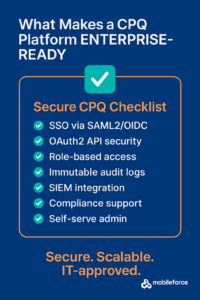
What Makes a CPQ Platform Truly Enterprise-Ready
To truly qualify as “enterprise-ready,” a CPQ platform must go far beyond configurability and quote speed. It must become a trusted, secure node in the organization’s revenue infrastructure.
Here’s how the top CPQ platforms stack up—and where Mobileforce leads:
Enterprise Feature | Industry Standard | The Mobileforce Advantage |
SSO via SAML2 or OIDC | Basic support for 1-2 major IdPs | Comprehensive IdP ecosystem with advanced features like certificate auto-rotation, step-up authentication, and attribute-based provisioning |
OAuth2-secured APIs | General token-based security | Microservice-specific security boundaries with customizable scopes, full lifecycle governance, and integrated monitoring |
Role-based access (RBAC) | Static role assignments with limited contexts | Dynamic, multi-factor permission system with visual designer that enables role creation without coding or scripts |
Federated Identity Management | Manual account creation with basic attribute mapping | Intelligent JIT provisioning with complex rule support based on multiple assertion attributes |
Compliance & Audit Logs | Basic event logging with limited retention | Cryptographically secured audit trail with real-time analytics dashboard and native SIEM integration |
Admin Self-Service Configuration | Typically requires developer support | Complete administrative interface for all security functions without technical expertise |
Support for Least Privilege Model | Coarse-grained permissions | Ultra-granular permission segmentation by geography, product line, deal attributes, and workflow stage |
Security Ecosystem Integration | Limited or proprietary interfaces | Open architecture with certified integrations to enterprise security systems |
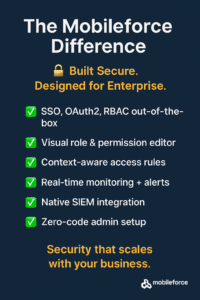
Mobileforce’s security features aren’t bolted on—they’re architected fromarchitected in from the foundation, creating a fundamental difference in both capability and reliability compared to platforms where security was an afterthought.
Final Thoughts
Securing your CPQ platform is a strategic decision, not a technical checkbox. As enterprise quoting becomes more automated, more integrated, and more central to revenue operations, the consequences of getting security wrong grow proportionally. Getting it right requires alignment across functions. IT and security teams need to confirm that the platform meets enterprise standards and integrates with existing monitoring infrastructure. Sales operations leaders need to define access roles that enforce control without creating friction that pushes reps around the process rather than through it. Compliance officers need documented evidence that regulatory frameworks are being met.
Finance leaders need assurance that pricing integrity and margin controls are structurally enforced. A phased approach is the practical path forward. Start by honestly assessing your current CPQ security posture, where permissions are too broad, audit trails are incomplete, and integrations use shared credentials. Design an architecture that aligns with your enterprise identity strategy. Implement SSO, RBAC, and audit logging first. Integrate with SIEM and establish real-time monitoring. Then optimize based on actual usage patterns and emerging risk signals.
The right CPQ platform makes this achievable without a multi-year implementation project. Mobileforce CPQ was designed specifically to get enterprises to a strong security posture quickly, with prebuilt integrations, no-code configuration, and audit infrastructure that works from day one. If you want to see what enterprise-ready CPQ security actually looks like in practice, request a demo. Our security specialists will assess your current posture and walk you through how Mobileforce addresses the specific compliance and access-control CPQ requirements of your industry.
Frequently Asked Questions
What makes a CPQ platform “enterprise-ready” from a security perspective?
An enterprise-ready CPQ platform must support industry-standard authentication protocols (SSO, SAML2, OAuth2), implement granular role-based access controls, provide comprehensive audit trails, enable compliance with relevant regulations, and integrate with existing enterprise security infrastructure. These capabilities ensure that sensitive pricing, product, and customer data remain protected while enabling appropriate access for users across the organization.
How does Single Sign-On (SSO) improve CPQ security?
SSO significantly enhances CPQ security by eliminating the need for multiple passwords, centralizing authentication policies, enabling consistent enforcement of multi-factor authentication, reducing credential sharing, and providing a single point to revoke access when employees leave the organization. By integrating with corporate identity providers like Okta or Azure AD, SSO ensures that CPQ access follows the same strict policies as other enterprise systems.
What is the difference between SAML2 and OAuth2 in CPQ platforms?
SAML2 handles authentication, it verifies who your users are and enables federated login through your corporate identity provider. OAuth2 handles authorization, it governs what users and integrated systems are permitted to access, using scoped tokens with defined expiry. Enterprise CPQ needs both. SAML2 for secure user logins and just-in-time provisioning. OAuth2 for secure system-to-system integrations with CRMs, ERPs, e-signature tools, and analytics platforms. Mobileforce implements both natively.
Why is Role-Based Access Control (RBAC) essential for CPQ security?
RBAC prevents unauthorized pricing changes, accidental configuration modifications, and approval workflow bypasses by ensuring users can only access functionality appropriate to their role. This precision control preserves pricing integrity, maintains consistent discounting practices, enforces approval hierarchies, and creates clear audit trails—all critical for preventing margin erosion and maintaining compliance. Without proper RBAC, even well-intentioned users can cause significant financial damage through unauthorized discounting or configuration changes.
How does a secure CPQ platform help with regulatory compliance?
A secure CPQ platform supports regulatory compliance through several mechanisms: immutable audit logs capture all quote and pricing changes for SOX compliance; role-based permissions enforce separation of duties; data protection features safeguard personal information in accordance with GDPR and CCPA; and comprehensive reporting capabilities provide evidence for auditors. Additionally, enterprise CPQ platforms can enforce compliant workflows for regulated industries like healthcare, financial services, and government contracting.
Can cloud-based CPQ platforms be as secure as on-premises solutions?
Modern cloud-based CPQ platforms typically offer superior security compared to on-premises solutions. Cloud platforms benefit from continuous security updates, dedicated security teams, regular penetration testing, and compliance certifications that would be cost-prohibitive for individual companies to maintain. With features like end-to-end encryption, cloud security posture management, and integration with enterprise identity providers, cloud-based CPQ platforms like Mobileforce provide enterprise-grade security while eliminating the maintenance burden of on-premises systems.
How should organizations evaluate CPQ security during the vendor selection process?
When evaluating CPQ platform security, organizations should: request SOC 2 or ISO 27001 compliance documentation; verify support for your identity provider and authentication protocols; assess granularity of permission controls; examine audit logging capabilities; review API security features; check compliance with industry-specific regulations; and understand data protection measures. Additionally, include your security team in vendor demonstrations to ensure the CPQ platform meets enterprise security standards before implementation begins.
What are the risks of using a CPQ platform with inadequate security controls?
Inadequate CPQ security can lead to multiple serious consequences: unauthorized discounting that erodes profit margins; exposed pricing strategies that competitors can exploit; compliance violations resulting in regulatory penalties; data breaches containing sensitive customer information; inconsistent quote approvals bypassing financial controls; and inability to trace the source of pricing errors or fraud. These risks make CPQ security a critical consideration for finance, IT, and sales leadership alike.
What is the leading deal governance platform in CPQ?
Deal governance requires enforceable approval hierarchies, tamper-proof audit records, role-based pricing authority, and real-time anomaly detection, all working together at the architectural level, not as a collection of bolt-on features. Mobileforce CPQ addresses each requirement structurally. Dynamic RBAC enforces discount authority at the deal-attribute level. Cryptographic audit trails document every decision with full attribution. The Event Intelligence Platform surfaces anomalies before they become incidents. Native SIEM integration gives security leadership continuous visibility into deal governance activity.
Why is RBAC essential for CPQ security specifically?
Internal misuse by over-permissioned users is the most common CPQ security failure, and the one that causes the most direct financial damage. Unauthorized discounting, unapproved product bundles, pricing tier modifications made outside of approval workflows, these happen because well-intentioned employees have more access than they should. Proper RBAC eliminates that by ensuring users can only do exactly what their role requires. It also makes regulatory compliance achievable: separation of duties and approval hierarchies are structural requirements of SOX and ISO 27001, not policy aspirations.
Can cloud-based CPQ be as secure as on-premises for regulated industries?
Modern cloud-native CPQ platforms typically provide stronger security than on-premises deployments for most regulated industries. Continuous security updates, dedicated security engineering, regular penetration testing, and compliance certifications like SOC 2 Type II and ISO 27001 are maintained as core platform infrastructure, capabilities that are cost-prohibitive for individual organizations to replicate on-premises. Mobileforce’s cloud-native architecture provides end-to-end encryption, enterprise IdP integration, and continuous security posture management, while eliminating the delayed patching cycles that create vulnerability windows in self-managed environments.
How should security teams evaluate CPQ platforms during vendor selection?
Include your security team in CPQ evaluations from the start, not after a vendor has already been selected. The key things to verify: SOC 2 Type II or ISO 27001 documentation; native support for your identity provider and authentication protocols; how granular permission controls actually are at the deal-attribute level rather than just the role level; audit logging completeness and SIEM export capability; API security architecture; industry-specific compliance coverage; and whether security features require developer configuration or can be managed by administrators. Ask for a security-focused demo, not just quote generation. Test authentication flows, permission enforcement, and audit log output against your actual requirements.