
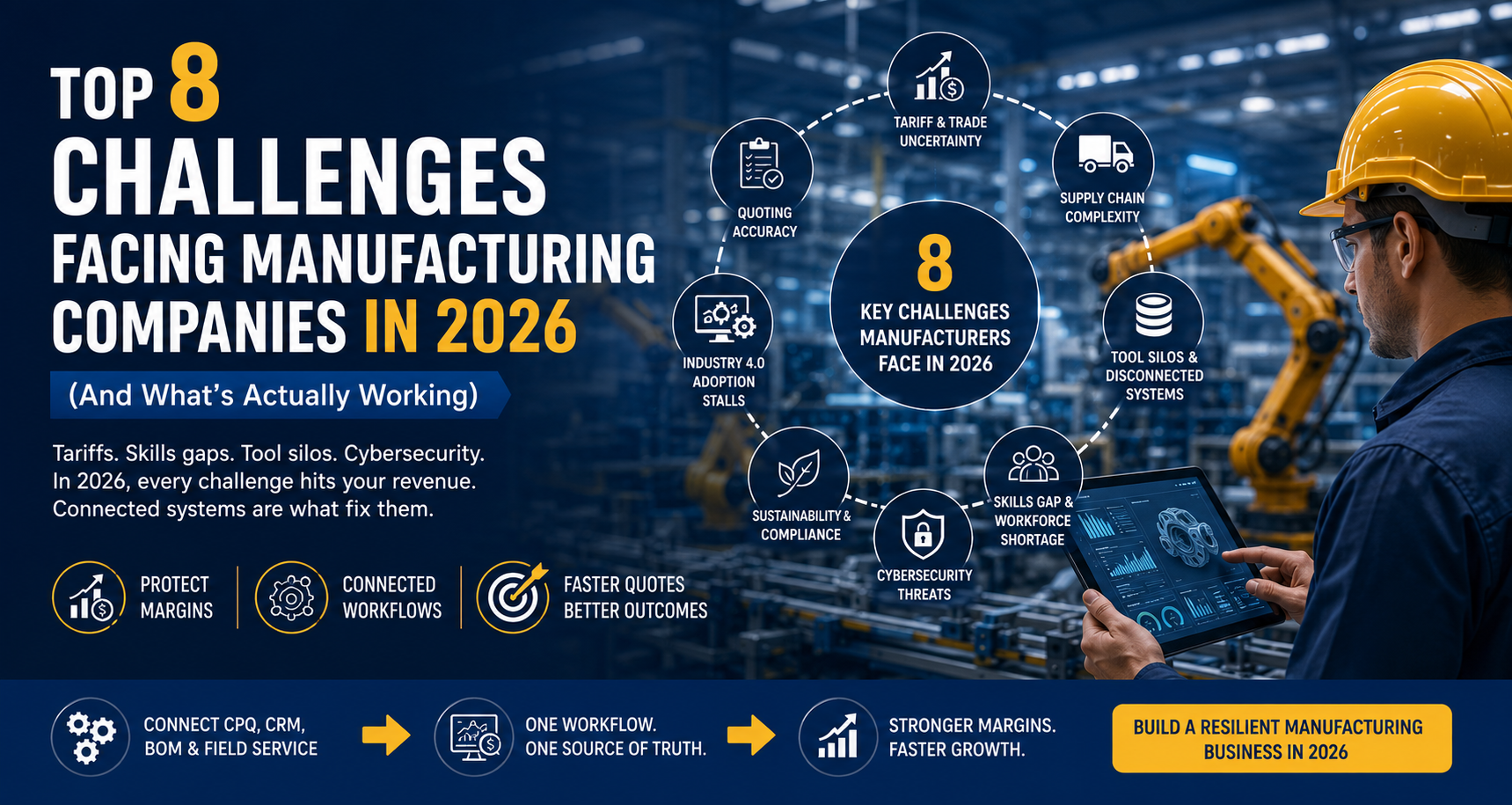
TL;DR: The top challenges facing manufacturing companies in 2026 are tariffs, supply chain visibility, tool silos, skills shortages, quoting accuracy, stalled Industry 4.0 rollouts, cybersecurity, and sustainability compliance. None of these sit in isolation, they all hit the quote. Manufacturers connecting CPQ to CRM, BOM, and field service are the ones absorbing these pressures instead of getting squeezed by them.
67% of manufacturing executives now name operational complexity as their top barrier to growth, up from 51% in 2023. That jump tells you something changed. It’s not one new problem. It’s three old ones colliding at once.
A sales engineer at a mid-size equipment manufacturer put it simply on a call last month: he can price a machine correctly today and lose money on it in 60 days, because the steel tariff shifted twice in between. That’s not a hypothetical. That’s this year.
Tariffs, AI adoption, and a shrinking skilled workforce are converging on the same departments at the same time. Manufacturers who treat these as separate line items are losing quotes to the ones who don’t. Here’s where the pressure is actually showing up.
Three forces are hitting manufacturers simultaneously this year: trade disruption, faster AI adoption, and a widening skills gap. Companies solving these one at a time are falling behind companies solving them through one connected system.
64% of manufacturers rank tariffs as their top concern for 2026. US manufacturers now face an average effective tariff rate of 17.4% on imported inputs, the highest since 1943.
Here’s the mechanism. Fixed-price quotes are dangerous right now. A quote accurate on Monday can be loss-making by the time the customer signs, because input costs moved underneath it. Leading manufacturers are handling this with dynamic pricing rules built into their configure price quote manufacturing systems, so quotes auto-update when supplier costs shift. No spreadsheet recalculation. No margin quietly eaten by a tariff nobody caught.
60% of manufacturers dealt with weekly material delivery delays through 2025, and that carried straight into 2026. Global supply chains have more single-source dependencies than most procurement teams want to admit.
The part nobody talks about: a wrong line item on the bill of materials doesn’t just slow production. It triggers the wrong procurement order before anyone even notices the delay coming. By the time it surfaces, the quote is already out the door. Manufacturers connecting BOM data directly to their quoting system catch substitution needs before the customer ever sees a number. Why BOM accuracy is now a sales problem, not just a production problem covers this gap in more detail.
Manufacturers don’t lack smart tools. 73% report their operational tools don’t share data in real time across departments. That’s the actual bottleneck.
A shop floor sensor system that can’t talk to the quoting tool isn’t smart, it’s isolated. Disconnected systems create process latency, and competitors without that lag win on turnaround time even when their pricing isn’t better. Connecting CPQ to CRM and ERP closes that gap directly.
2.1 million manufacturing jobs will sit unfilled by 2030. That’s the headline number, and it’s real. But there’s a second gap hiding behind it: the sales engineers who know how to configure and price complex products are retiring faster than anyone is replacing them.
This is where guided selling earns its place. It encodes what a 20-year applications engineer knows into a workflow a first-year rep can actually run. The knowledge doesn’t walk out the door with retirement.
This is the one competitors’ listicles skip, and it’s the one buyers actually search for. Manufacturers selling configurable or engineered-to-order products face a quoting problem that’s structural, not occasional. Every configuration is unique. Pricing rules stack on top of each other. Manual quoting introduces errors that either cost the deal or quietly kill the margin.
Speed and accuracy aren’t separate problems here, they’re the same problem. The average complex manufacturing quote takes 4.3 days to generate manually. Manufacturers running cpq for manufacturing companies cut that to under 4 hours, a 26x improvement that shows up directly in win rate. Read more in the CPQ for Manufacturing Guide on how cpq for manufacturing companies reduces quote errors.
Awareness isn’t the issue. 58% of manufacturers are stuck in what people are calling pilot purgatory, digital projects that never make it past the pilot stage. Legacy system integration, internal resistance, and unclear ROI all stall momentum at the same point.
What actually breaks the stall: starting with revenue-facing tools before touching the backend ERP. Manufacturers who deploy CPQ and CRM integration first see faster returns, and that early win builds the case for the bigger overhaul later.
Manufacturing has been the most-attacked industry for three straight years now. Ransomware accounts for 71% of those attacks, with average recovery costs of $4.73 million per incident.
Legacy systems, connected shop floor equipment, and supply chain access points create a wide attack surface, and pricing data sitting in unsecured spreadsheets and inboxes is an easy entry point. Moving quoting onto a cloud-based, governed platform removes one of the biggest unmonitored exposures in the commercial stack.
Two pressures are converging here: voluntary sustainability commitments and mandatory ones. The EU’s Carbon Border Adjustment Mechanism is now fully in effect, and it adds real compliance cost for anyone exporting into Europe.
The upside: manufacturers who build sustainability data into their product and quoting systems can show compliance before a customer even asks. In regulated markets, that’s a pricing edge, not just a checkbox.
Here’s the pattern across all eight: most manufacturers are solving them with eight different tools. That fragmentation is the real ninth challenge.
Mobileforce works as the connective layer across quoting, CRM, and field service, not another point solution stacked on top of the others.
Outcome | What it solves |
Quote faster under tariff pressure | Dynamic pricing rules update quotes automatically when input costs shift. No manual repricing. |
Capture institutional knowledge before it retires | CPQ configuration logic turns expert pricing knowledge into guided flows any rep can run. |
Connect the full revenue cycle | CPQ links to Salesforce, HubSpot, Creatio, SugarCRM, and Microsoft, plus field service and BOM data, so a closed deal triggers production scheduling automatically. |
Operate on one secure data layer | Removing spreadsheet-based quoting closes the biggest cybersecurity gap in most manufacturers’ commercial process. |
See how manufacturers running on Salesforce, HubSpot, and Microsoft use Mobileforce to connect CPQ, quoting, and field service into one revenue workflow — explore the platform
What are the top challenges in manufacturing right now?
Tariff volatility, supply chain delays, disconnected tools, workforce shortages, and slow quoting are the five that show up most in 2026 buyer conversations. All five affect the quote, whether directly or through margin pressure.
How is tariff impact on manufacturing 2026 different from prior years?
Effective tariff rates on imported inputs have hit 17.4%, the highest since 1943. That volatility makes fixed-price quoting risky in a way it wasn’t three years ago.
What are the top challenges in manufacturing supply chains specifically?
Single-source dependencies and BOM inaccuracy top the list. A wrong BOM line triggers a bad procurement order before the delay even shows up downstream.
Is manufacturing skills shortage 2026 mainly a shop floor problem?
No. It hits the commercial side too. Experienced applications engineers who know how to price complex configurations are retiring faster than they’re being replaced.
What should we look for in a CPQ built for manufacturing revenue operations?
Dynamic pricing rules, BOM integration, native CRM connections (Salesforce, HubSpot, Microsoft, Creatio, SugarCRM), and guided configuration logic that doesn’t require a developer to maintain.
2026’s manufacturing challenges don’t sit in separate lanes. Tariff pressure changes the quote. A skills gap changes who can quote accurately. A disconnected tool stack slows all of it down. Solving each in isolation just means solving the same problem eight times.
If your team is still quoting off spreadsheets while tariffs shift weekly, talk to Mobileforce about connecting your quote-to-cash process to your CRM, BOM, and field service in one system.