
Most CPQ implementations fail because they force unfamiliar user interfaces on sales teams, triggering silent rejection and reversion to Excel. Research shows 18-70% of CPQ projects underperform due to poor user adoption, not technical issues. Mobileforce solves this by allowing organizations to replicate their existing quoting workflows within a powerful CPQ platform, ensuring immediate adoption and measurable ROI.
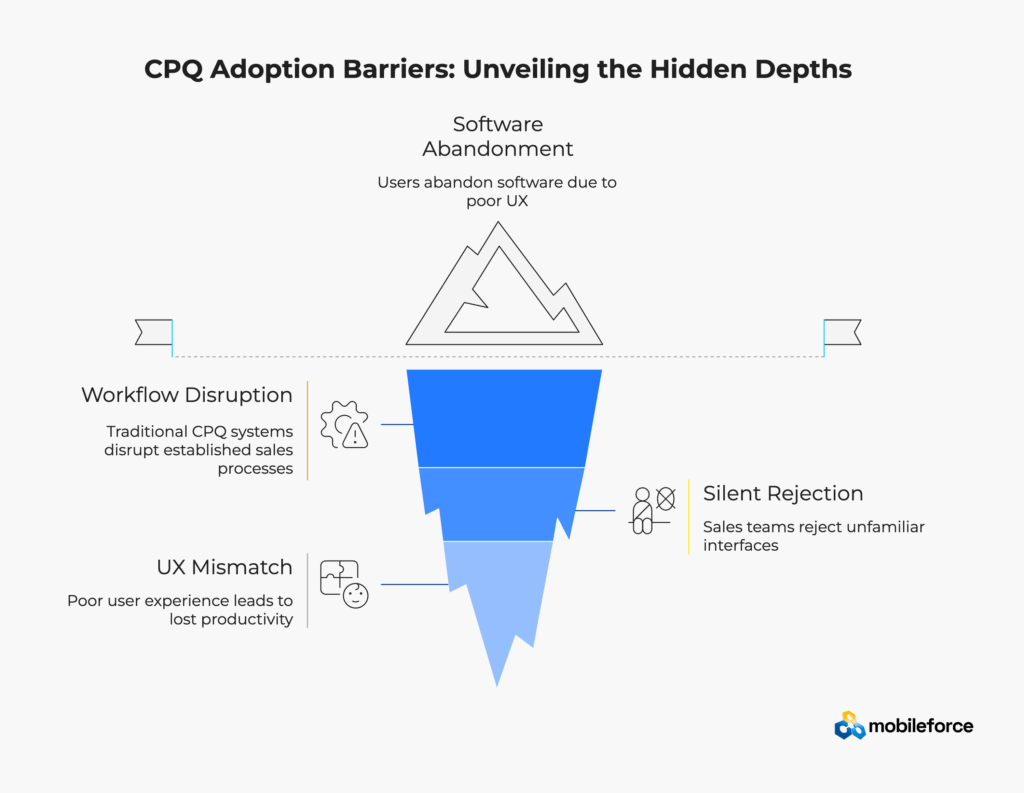
Picture this scenario: Your company just invested six figures in enterprise CPQ software. Training sessions concluded with enthusiastic participation from your sales enablement team. Management issued clear adoption mandates. But three months later, half your revenue team quietly returned to building quotes in Excel spreadsheets.
This represents what sales operations consultants call “silent software rejection” — when pricing configuration tools get abandoned not due to functionality gaps, but because of workflow disruption that makes daily tasks more difficult rather than easier.
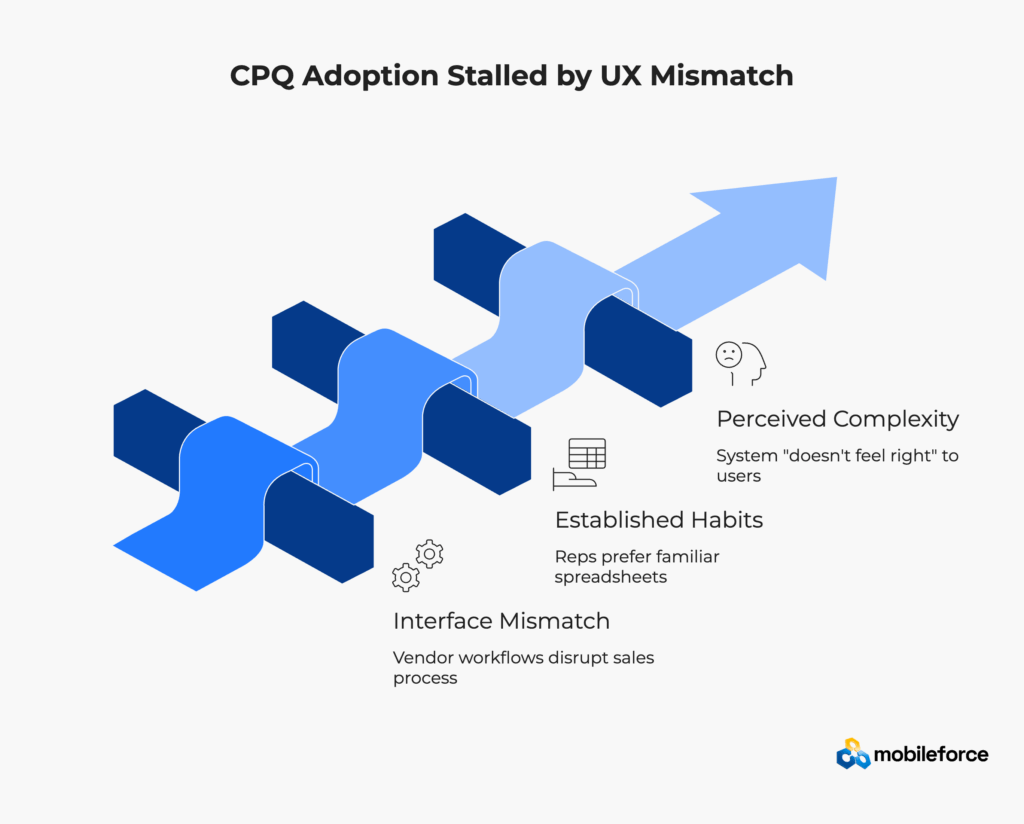
Sarah, a veteran sales manager at a mid-sized manufacturing company, watched her team’s productivity decline after their new CPQ platform rollout. Despite comprehensive training and executive support, her top performers kept finding reasons to avoid the system. “It just doesn’t feel right,” became the common response during team meetings.
Six months and $200,000 later, the configure price quote system sat largely unused while deals continued flowing through familiar spreadsheet templates that sales representatives had refined over years of customer interactions.
Sarah’s experience reflects widespread challenges in sales enablement technology adoption. According to research from Gartner, AMR Research, and Butler Group, between 18% and 70% of CRM and CPQ transformation projects fail to meet performance expectations. More concerning, Harvard Business Review analysis suggests failure rates approach 90% when measured by organizations reporting their systems exceed business objectives.
However, these statistics miss the fundamental issue: the problem isn’t technology complexity, insufficient user training, or inadequate change management. The real culprit is user interface mismatch between vendor-designed workflows and established sales processes that drive revenue performance.
Ready to solve CPQ adoption challenges with familiar workflows? Schedule a demo with Mobileforce to see how interface customization transforms user adoption.
Sales professionals operate in high-pressure environments where every minute directly impacts quota achievement and revenue generation. In this context, workflow efficiency becomes a competitive advantage that separates high performers from average contributors.
When experienced sales representatives have invested months or years perfecting their quoting methodologies — understanding exactly where to locate pricing information, how to structure compelling proposals, and which shortcuts maximize customer response time — any workflow disruption feels counterproductive to their success.
Research from the Nielsen Norman Group demonstrates that users form lasting opinions about software interfaces within 50 milliseconds of initial interaction. This rapid judgment process often determines whether quote generation tools become integrated into daily routines or get mentally categorized as “systems I’ll use only when required by management.”
Consider how accomplished sales professionals approach quote configuration and proposal development. They’ve developed sophisticated cognitive frameworks for product selection, competitive pricing strategies, and customer communication patterns. These mental models become deeply embedded in their professional expertise — almost unconscious — allowing them to allocate cognitive resources toward relationship building and strategic thinking rather than navigating unfamiliar software interfaces.
When traditional CPQ systems demand completely new interaction patterns, they’re essentially requesting that sales teams rebuild years of refined expertise. This cognitive burden doesn’t merely slow individual transactions; it fundamentally disrupts the flow state that distinguishes high-performing revenue generators.
According to Capgemini enterprise software research, poor user experience in sales technology implementations slows revenue activities and makes software acceptance nearly impossible. The most successful deployments recognize that workflow familiarity drives adoption more effectively than feature complexity.
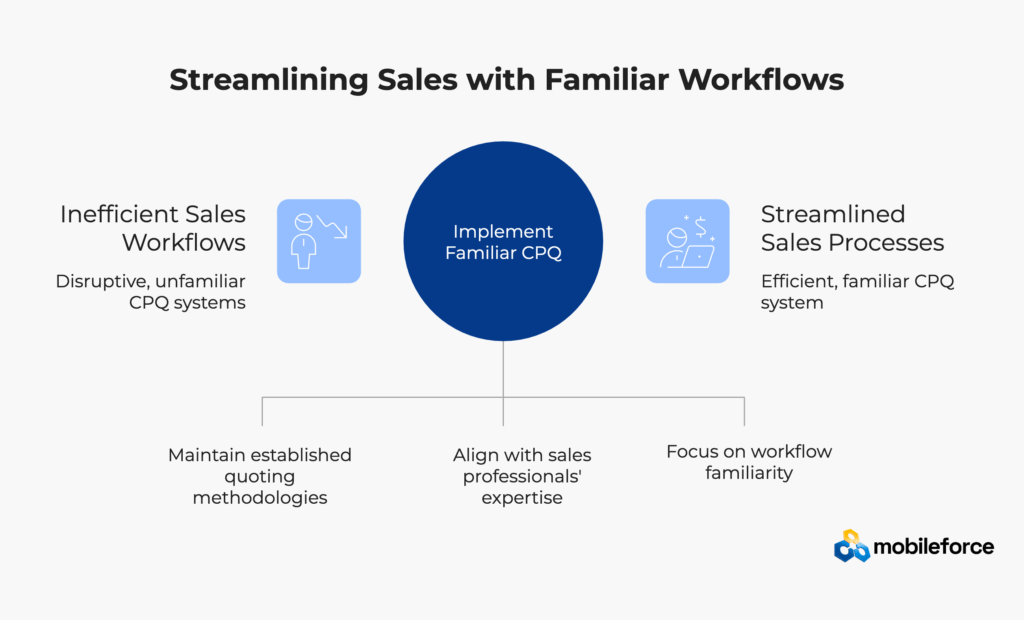
Most CPQ vendors adopt what industry analysts call the “Henry Ford approach” to user experience: organizations can configure any interface they want, provided it matches the vendor’s predetermined design philosophy. This standardization might optimize software development costs, but it proves problematic for sales operations where workflow diversity represents competitive differentiation.
Traditional configure price quote systems ship with vendor-designed interfaces optimized for hypothetical “average users.” While these platforms allow field relabeling and basic layout adjustments, the fundamental interaction model remains rigidly fixed. Sales teams must adapt their proven processes to accommodate the tool rather than technology supporting their optimized workflows.
The financial impact extends significantly beyond initial software licensing investments:
Training Overhead: Organizations spend 250-300% more on user training when interfaces feel unfamiliar to sales professionals. Extended training cycles delay revenue realization by 3-6 months compared to intuitive systems.
Productivity Loss: Studies demonstrate that poor user experience reduces sales team productivity by 30% or more during critical adoption periods. Quote generation time increases by 40-60% when representatives must navigate unfamiliar interface patterns.
Support Burden: Unfamiliar interfaces generate 400-500% more help desk requests compared to intuitive systems. IT support costs escalate as users require ongoing assistance with basic operations.
Excel Fallback: When CPQ feels cumbersome or inefficient, sales teams quietly revert to familiar spreadsheet tools that support their optimized workflows. This creates data quality degradation and process compliance failures.
Revenue Impact: Complex interfaces slow quote turnaround times, potentially affecting competitive positioning and deal closure rates in time-sensitive sales cycles.
Traditional CPQ Challenges | Business Impact |
Vendor-designed workflows | 250% higher training costs |
Fixed interface patterns | 30% productivity reduction |
Limited customization | 500% more support tickets |
One-size-fits-all approach | 40% longer quote cycles |
Don’t let interface complexity undermine your CPQ investment. Explore Mobileforce’s customizable platform that adapts to your proven sales workflows.

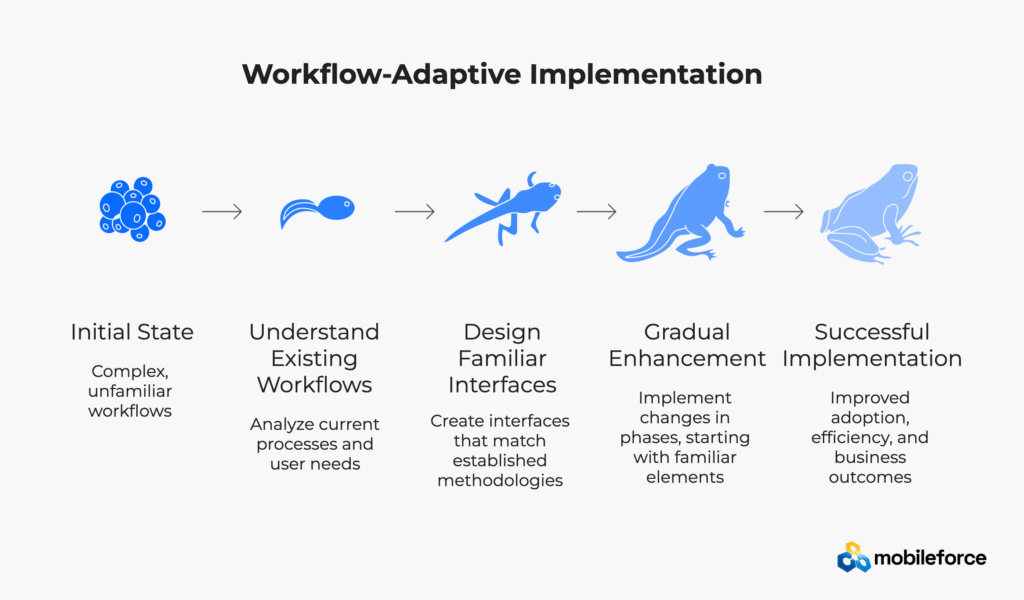
Mobileforce takes a fundamentally different approach to configure price quote software design. Instead of forcing sales teams to learn new interaction patterns, the platform enables organizations to replicate their existing quoting workflows within a modern, enterprise-grade framework.
Imagine your top performer’s spreadsheet template — the one with perfectly organized sections, custom calculation logic, and intuitive information flow — transformed into a dynamic, integrated system. Same visual hierarchy. Same sequence of steps. Same terminology and data organization. But now enhanced with real-time pricing engines, automated approval workflows, and comprehensive CRM integration.
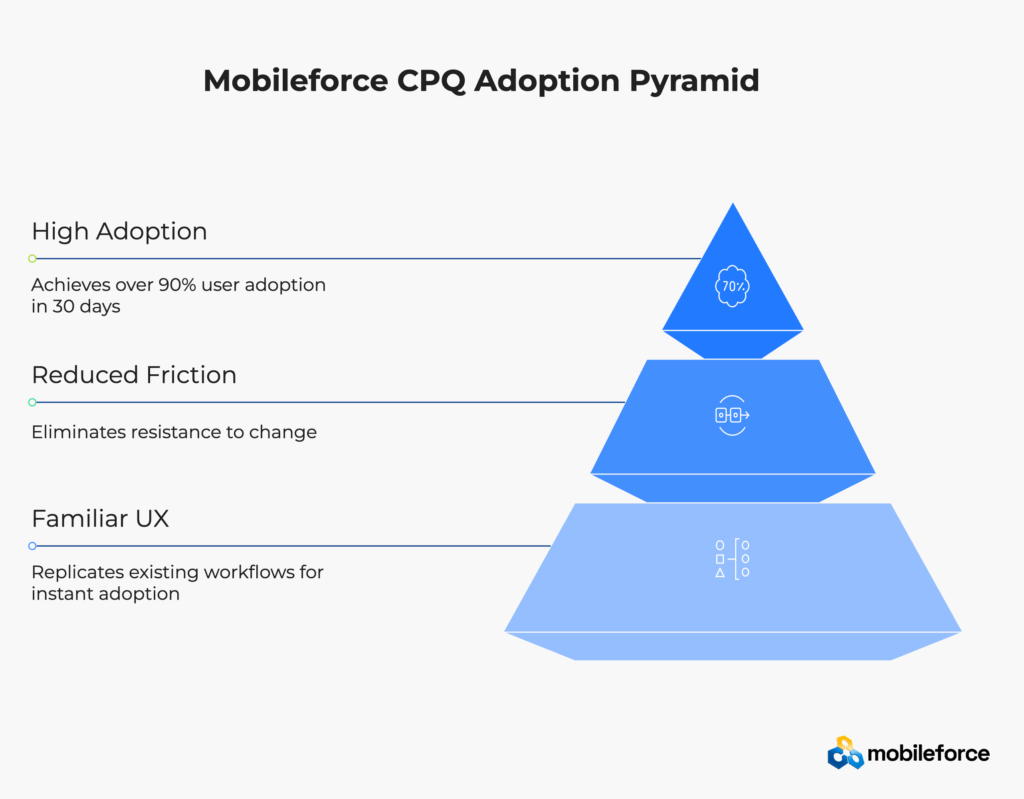
This familiarity-first approach eliminates the cognitive friction that destroys user adoption rates. Sales representatives experience using an enhanced version of their proven tools rather than learning completely new systems. The psychological impact proves significant: when pricing configuration software feels familiar and intuitive, adoption becomes natural rather than mandated.
Change management experts consistently identify resistance to change as the primary challenge in 54% of enterprise technology implementations. However, what happens when the implementation process eliminates the need for resistance?
When Mobileforce replicates existing workflow patterns, the perceived “change” becomes purely additive: enhanced capabilities within familiar interfaces. Sales teams gain powerful automation features without sacrificing the efficiency they’ve invested years optimizing.
Organizations implementing this approach report user adoption rates exceeding 90% within the first 30 days — a dramatic contrast to industry averages where meaningful adoption typically requires 6-18 months of sustained effort and ongoing training reinforcement.
Mobileforce’s no-code configuration platform empowers revenue operations teams and business analysts to create sophisticated user interfaces without IT dependency. Every element of the user experience can be customized:
This comprehensive customization capability means organizations can recreate their existing quoting processes with pixel-perfect accuracy while adding enterprise CPQ functionality that scales across large sales organizations.
Rather than forcing sales teams into predetermined vendor workflows, Mobileforce enables technology to adapt to proven business processes:
Mobileforce Advantages | Traditional CPQ Limitations |
Complete UX replication | Fixed vendor-designed interface |
No-code customization | Development resource requirements |
Gradual capability addition | All-or-nothing implementation |
Business-led evolution | IT-dependent modifications |
Experience workflow-adaptive CPQ in action. Start your free trial and see how familiar interfaces drive immediate adoption.
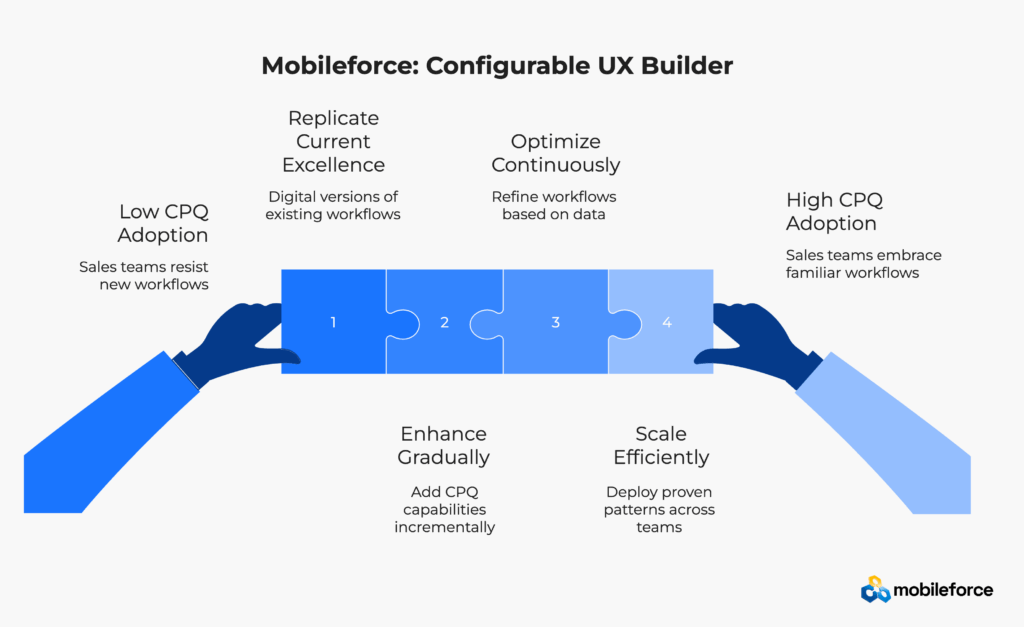
Recognizing that every industry has established quoting patterns, Mobileforce provides pre-built interface templates optimized for specific business verticals:
SaaS & Technology: Subscription pricing models with usage tiers, feature matrices, and multi-year commitment calculations
Manufacturing: Complex product configurations with technical specifications, bill of materials integration, and compliance tracking
Professional Services: Time and materials billing with resource allocation, project phases, and value-based pricing options
Healthcare: Regulatory compliance workflows with approval chains, insurance verification, and documentation requirements
Channel Sales: Partner-specific pricing controls with territory management, margin protection, and commission calculations
These templates serve as implementation accelerators, not rigid constraints. Organizations begin with industry-proven patterns and customize them to match unique competitive advantages and process optimizations.
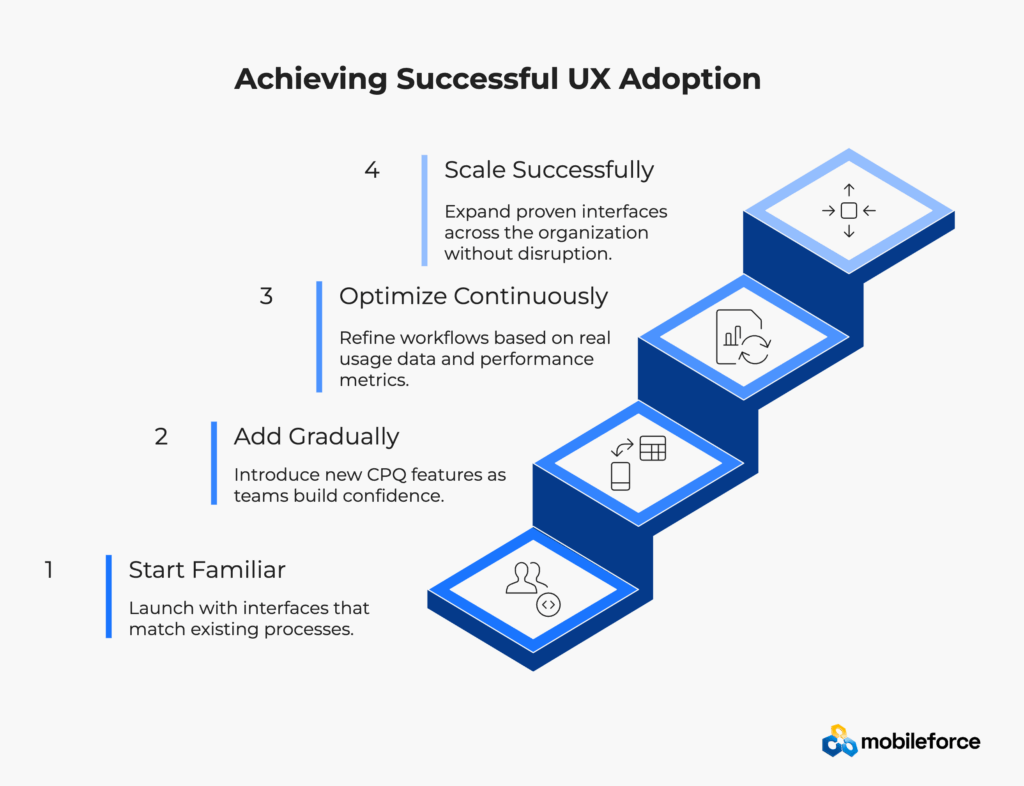
The strategic advantage of Mobileforce’s approach lies in evolutionary capability that respects organizational change dynamics:
This gradual enhancement approach acknowledges the natural pace of organizational change while ensuring continuous value delivery and sustained user engagement.
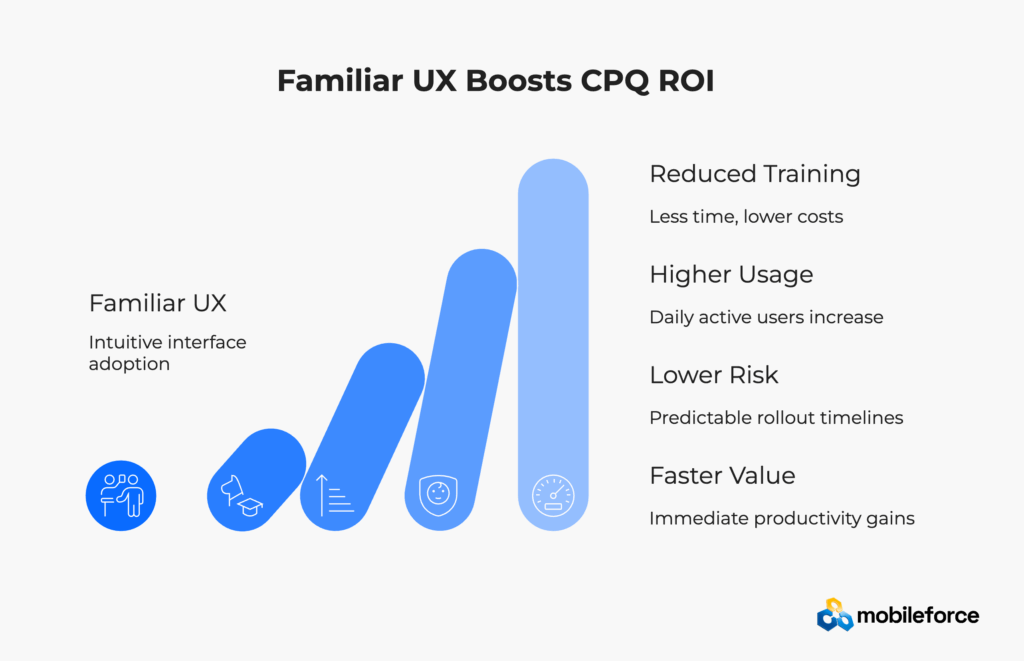
When interfaces feel familiar and intuitive, training requirements decrease dramatically across multiple organizational dimensions:
Familiar interfaces remove psychological adoption barriers that commonly plague enterprise software implementations:
By eliminating user experience adoption barriers, organizations significantly reduce project risks:
Familiar user experience accelerates business impact realization:
Transform your CPQ ROI through familiar user experience. Request a personalized consultation to discuss your specific workflow requirements.
Smart organizations have begun adding user experience adaptability to their configure price quote software evaluation criteria. Consider these essential questions when assessing potential solutions:
How adaptable is the UX to our existing sales process? Traditional CPQ vendors offer limited interface customization options. Workflow-adaptive platforms provide complete user experience control that preserves competitive advantages built through process optimization.
Can we make the CPQ feel familiar to our reps on Day 1? Most systems require significant workflow modifications and extended training periods. Advanced platforms enable exact replication of existing interaction patterns and information hierarchies.
Can non-developers adjust the UX as workflows evolve? Legacy platforms require IT involvement for basic modifications. Modern solutions empower business users with visual configuration tools and no-code customization capabilities.
How much training will be needed to onboard reps? Complex interfaces demand extensive training programs and ongoing reinforcement. Familiar user experiences minimize learning requirements while accelerating productive usage.
Does the tool prioritize our workflow or force us to change it? Vendor-centric systems impose predetermined processes that may conflict with competitive advantages. User-centric platforms adapt to support proven methodologies while adding enterprise capabilities.
These evaluation criteria shift procurement focus from feature comparison to adoption prediction, helping organizations select configure price quote platforms that deliver sustained business value rather than impressive demonstration capabilities.

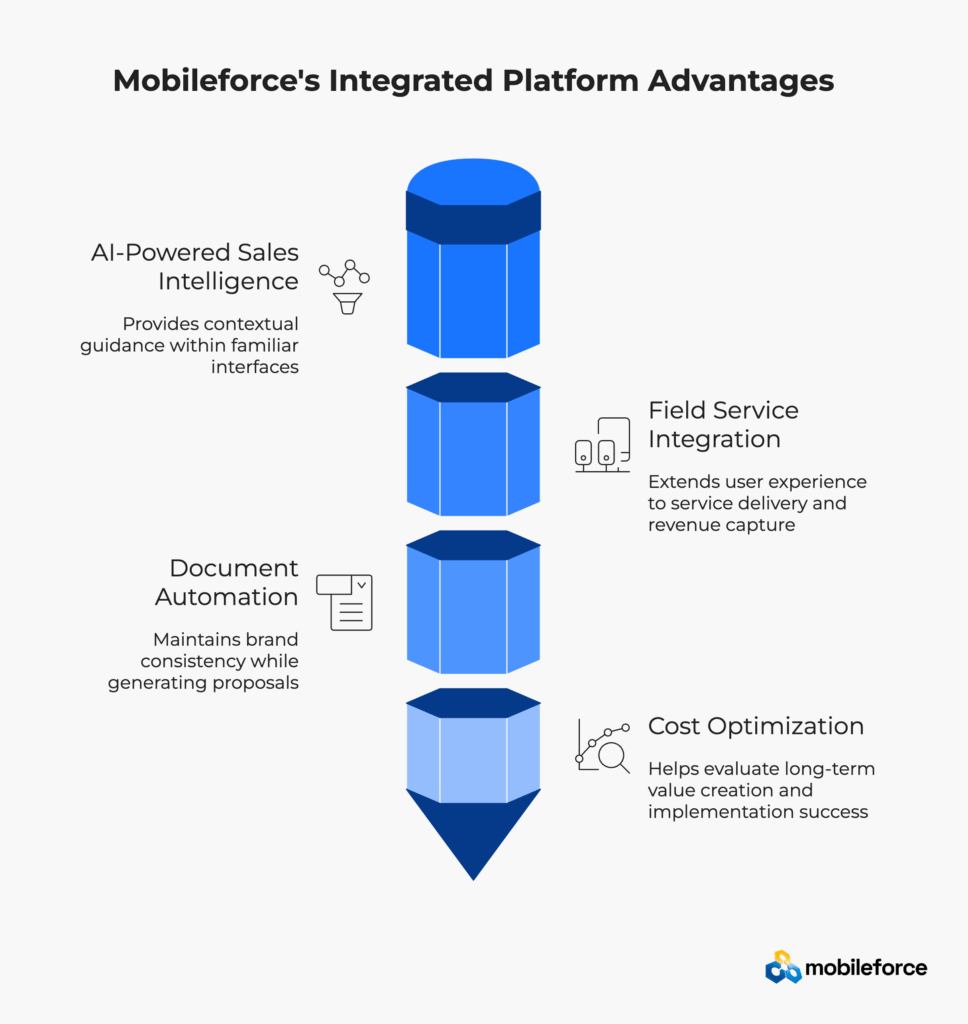
While user experience customization solves immediate adoption challenges, Mobileforce delivers additional value through comprehensive revenue operations integration:
Mobileforce’s AI assistants provide contextual guidance within familiar interfaces, offering intelligent recommendations without disrupting established workflows or requiring new interaction patterns.
For organizations with service operations, Mobileforce’s field service management capabilities extend the familiar user experience approach to service delivery and revenue capture processes.
Automated document creation maintains brand consistency while generating proposals that match existing templates, formatting preferences, and approval workflows.
Understanding comprehensive financial impact requires analysis beyond licensing fees. Our CPQ total cost of ownership guide helps organizations evaluate long-term value creation and implementation success probability.
While maintaining customer confidentiality, analysis of Mobileforce deployments reveals consistent success patterns when workflow familiarity drives implementation strategy:
Complex Manufacturing Configuration
SaaS Subscription Pricing
Professional Services Resource Planning
These examples demonstrate that workflow-adaptive implementations achieve superior business outcomes when user experience familiarity becomes the primary design criterion.
Ready to join successful organizations prioritizing adoption over complexity? Schedule your implementation consultation today.
As the configure price quote market evolves toward $5.8 billion by 2026 with 16% annual growth, successful organizations differentiate themselves through superior user adoption rather than feature complexity.
Leading companies understand a fundamental truth: the best CPQ system is the one your sales team enthusiastically uses every day. Enthusiasm emerges from familiarity, efficiency, and confidence that technology enhances rather than disrupts proven revenue-generating processes.
Mobileforce represents this evolution — moving beyond outdated assumptions that sales teams should adapt to software, and instead creating software that adapts to sales teams while providing enterprise capabilities that scale with organizational growth.
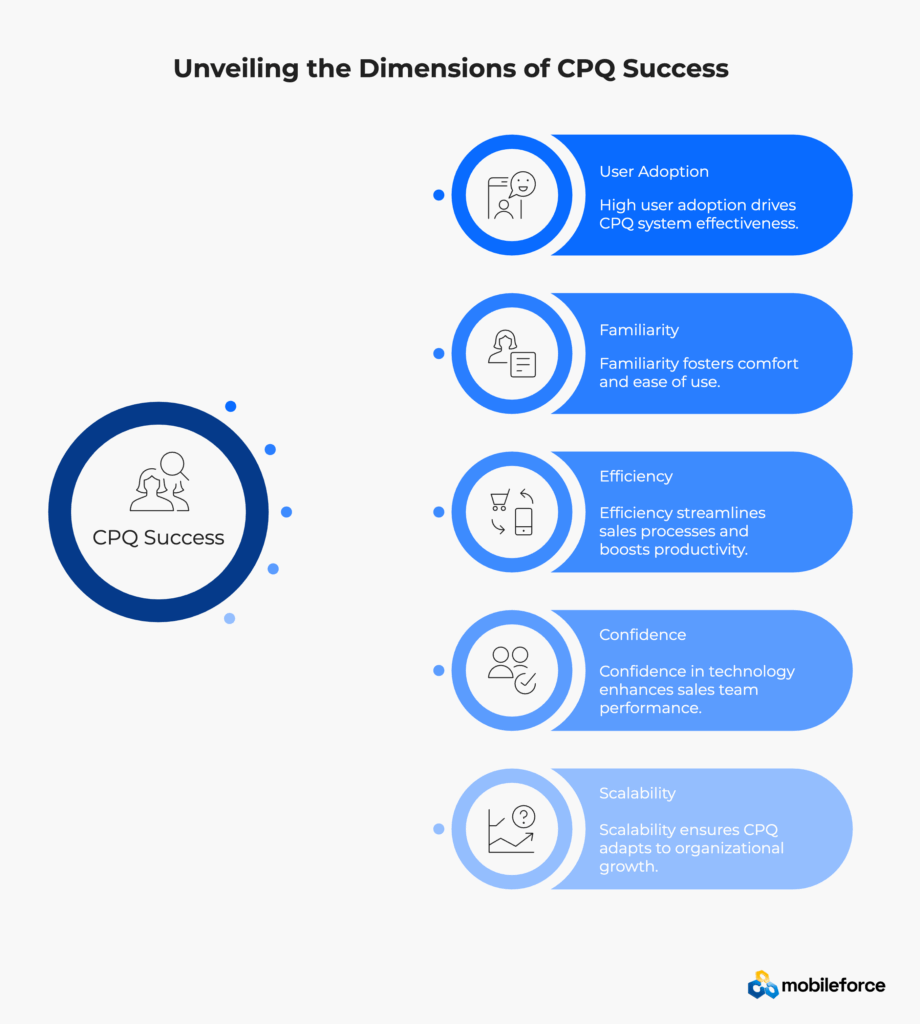
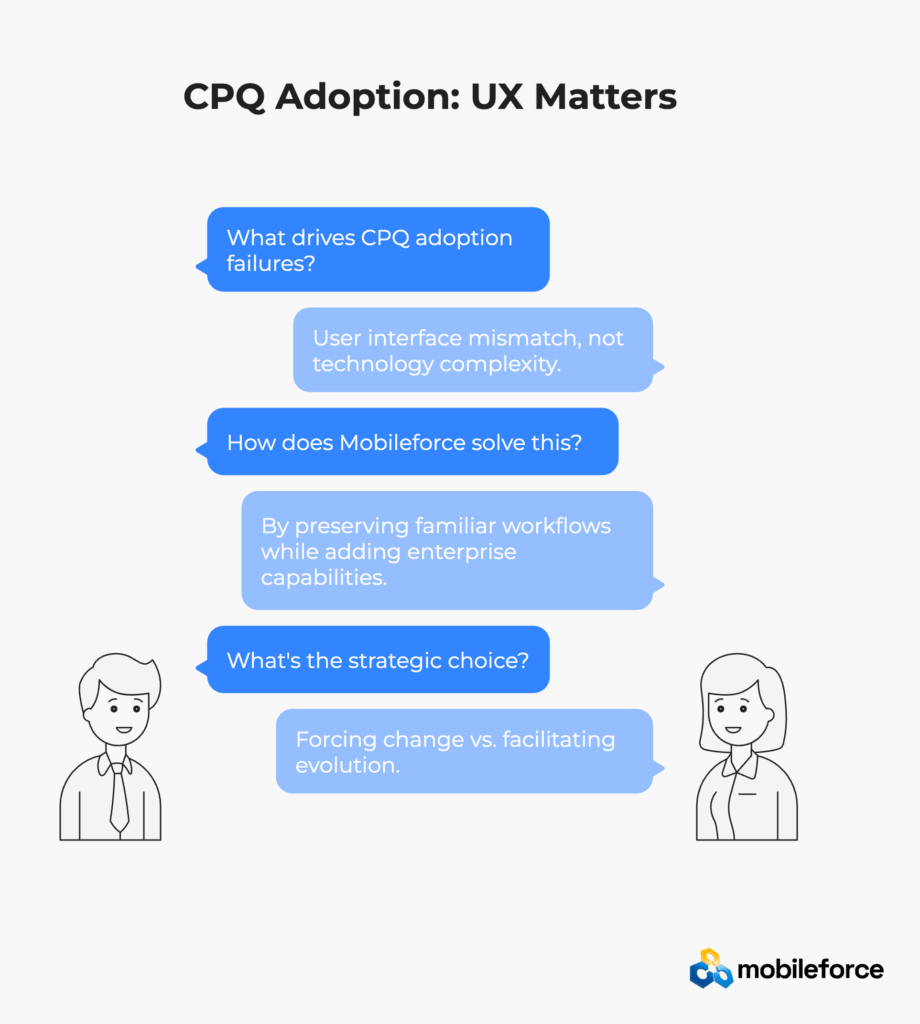
The evidence overwhelmingly demonstrates that user interface mismatch, not technology complexity, drives the majority of configure price quote adoption failures. Sales teams don’t resist powerful automation tools — they resist unfamiliar interfaces that threaten their productivity and confidence.
Mobileforce eliminates this friction by recognizing a fundamental principle: the fastest path to CPQ success preserves familiar territory while adding enterprise capabilities. By replicating existing workflows within a powerful framework, organizations achieve immediate adoption, reduce implementation risk, and accelerate measurable business value.
The strategic choice facing revenue operations leaders isn’t between different CPQ vendors — it’s between forcing organizational change and facilitating technological evolution. Progressive companies choose evolution because it respects existing excellence while enabling future growth.
Transform your CPQ implementation approach with workflow-adaptive technology. Request your customized demonstration and discover how Mobileforce converts implementation risk into competitive advantage.
How quickly can we customize the user interface to match our existing workflows?
User interface customization typically takes 2-4 weeks using Mobileforce’s no-code configuration tools. Complex enterprise requirements may extend to 6-8 weeks, but most organizations achieve familiar interfaces within the first month of implementation.
Can we add new CPQ features gradually without disrupting current workflows?
Yes, Mobileforce supports incremental feature rollouts that introduce complexity over time. Organizations start with familiar interfaces and add pricing automation, approval workflows, and integration capabilities as teams gain confidence and expertise.
What if our sales processes are highly specialized or industry-specific?
Mobileforce’s platform accommodates specialized workflows through comprehensive customization capabilities. Even unique industry requirements can be supported using flexible configuration tools and industry-specific template libraries.
How does interface customization affect system performance and reliability?
Customization operates at the configuration layer rather than code level, ensuring no impact on system performance. All interface modifications preserve platform stability and security while maintaining enterprise-grade reliability standards.
Can different teams use different interface configurations within the same organization?
Absolutely. Mobileforce supports multiple interface configurations, allowing different departments, geographic regions, or product lines to maintain their preferred workflows while sharing common data and reporting infrastructure.
What happens to our customizations during platform updates?
All interface customizations are preserved during routine platform updates. The configuration layer remains separate from core system functionality, ensuring continuous operation without customization loss or disruption.
How much training is required for business users to modify interface configurations?
Most revenue operations professionals learn basic interface modifications in 4-8 hours of training. Advanced configuration techniques require additional education, but no programming skills are necessary for ongoing customization management.
Can we integrate our corporate branding and visual identity into the customized interface?
Yes, Mobileforce supports complete visual customization including corporate logos, color schemes, typography, and layout styles. Organizations maintain brand consistency throughout the quote generation and proposal creation process.
What implementation support is available during interface design and workflow replication?
Mobileforce provides dedicated user experience consultants during implementation to analyze existing workflows and optimize interface configurations. This includes process documentation, workflow mapping, and adoption strategy development.
How do we measure the success of our interface customization and adoption efforts?
The platform includes comprehensive analytics showing user adoption rates, workflow completion times, feature utilization, and productivity metrics. These insights help optimize interface design and measure business impact over time.