
What is Professional Services CPQ?
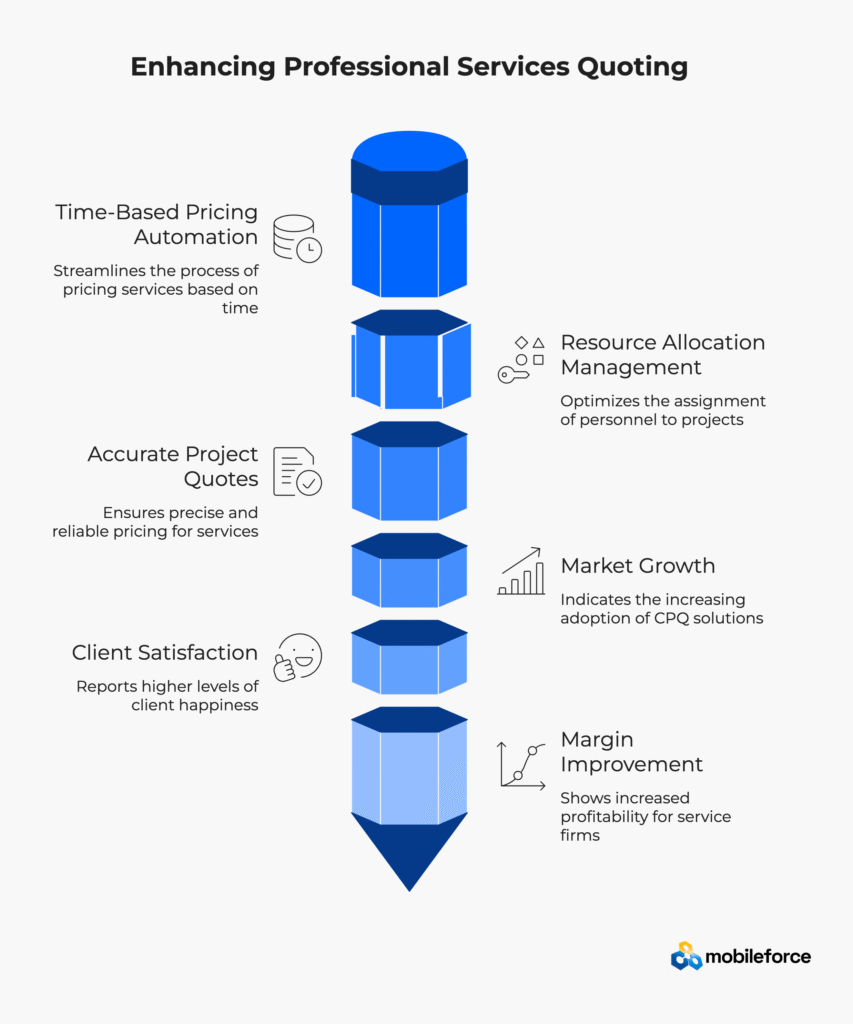
Professional Services Configure Price Quote (CPQ) software automates the complex process of pricing time-based services, managing resource allocation, and generating accurate project quotes for consulting firms, accounting practices, legal services, and other knowledge-based businesses.
While many professional services firms still rely on spreadsheets for quoting, leading companies are embracing specialized CPQ solutions that cut quote times by 50% and eliminate pricing errors. As the CPQ market grows from $2.58 billion in 2024 to a projected $7.96 billion by 2032, services firms using AI-powered platforms like Mobileforce’s Revenue Operations Cloud report 20% higher client satisfaction and dramatically improved margins through intelligent time-based pricing automation tools.
At 3:47 PM on a Friday, Sarah from the digital transformation consulting practice receives an urgent RFP from a Fortune 500 prospect. They need a comprehensive consulting quote by Monday morning for a six-month organizational change management project spanning three business units. Sarah opens her laptop and faces the familiar professional services quoting challenge: calculating blended hourly rates for senior consultants versus junior business analysts, factoring in travel expenses for each geographic location, estimating workshop facilitation time requirements, and building contingencies for inevitable scope modifications.
Four hours later, Sarah’s still adjusting complex spreadsheet formulas and second-guessing her resource allocation assumptions. Meanwhile, the prospect has already received a professional, detailed project quote from a competing firm using modern quote automation software that delivered accurate pricing in 20 minutes.
This scenario costs consulting and professional services firms millions in lost revenue opportunities every quarter. Many services companies still rely on manual spreadsheets and Word documents for quote generation, creating systematic competitive disadvantages that extend far beyond just slow response times. According to research from Deloitte on professional services, firms face mounting pressure to modernize their quote-to-cash processes to remain competitive.
How much does manual quoting cost professional services firms? Inefficient quote processes create substantial costs through lost opportunities, margin erosion, and resource misallocation. Manual quoting isn’t just slow—it systematically destroys profitability and competitive positioning through measurable business impacts that modern revenue operations can solve.
When different team members apply different logic to similar consulting projects, pricing becomes a guessing game that destroys profitability. A senior partner might price a digital transformation project at $850/hour for strategic advisory work, while a practice manager quotes $650/hour for identical services to a different client. Without centralized rate logic and pricing consistency tools, firms leak substantial revenue through inconsistent pricing decisions.
Professional services firms consistently fall into critical traps that drain profitability: quoting before scope is finalized, underselling long-term retainers, and using hourly billing for clients requiring high-touch collaboration. These mistakes compound over time, creating delivery strain that stretches resources across multiple projects without clear profitability targets.
Multiple team members editing the same quote spreadsheet creates version control nightmares that damage professional credibility. The quote that goes to the client might include outdated hourly rates, incorrect resource assumptions, or calculations from an earlier project iteration. When prospects receive quotes with obvious errors or internal inconsistencies, they question the firm’s attention to detail and project management capabilities.
Professional services firms report that a significant percentage of quote revisions contain errors that require client clarification, extending sales cycles and creating negative first impressions that impact win rates.
Manual approval processes break down when stakeholders can’t easily review complex pricing logic and resource allocation decisions. A managing director trying to approve a $2.3 million digital transformation quote needs to understand resource allocation, phase dependencies, and risk factors—not decipher spreadsheet formulas. Delayed approvals mean missed deadlines, frustrated prospects, and lost competitive positioning in time-sensitive procurement processes.

How do scope changes impact professional services profitability? Uncontrolled scope changes represent one of the biggest profitability killers in professional services, with firms reporting substantial margin erosion when scope modifications aren’t properly priced and managed through the quote process.
Scope changes occur in the majority of professional services engagements, but manual processes make it nearly impossible to quickly calculate pricing impacts when clients request additional deliverables or timeline modifications. Teams either absorb unexpected costs to maintain client relationships or enter lengthy renegotiation processes that damage trust and project momentum.
Common scope change scenarios that destroy margins:
Is manual quoting limiting your firm’s growth potential? Explore how Mobileforce’s CPQ automation eliminates scope change chaos and protects project profitability through intelligent pricing workflows.
The difference between manual and automated professional services quoting extends far beyond speed. The operational, financial, and strategic impacts create compounding competitive advantages for consulting firms using specialized CPQ platforms designed for time-based billing and project complexity.
Challenge Area | Manual Process Reality | Automated CPQ Reality | Business Impact |
Quote Speed | 3-8 hours for complex consulting projects | 15-30 minutes with guided workflows | 75% faster response to procurement opportunities |
Pricing Consistency | Varies by who creates the quote | Standardized rate cards applied automatically | Significant reduction in margin leakage across engagements |
Version Control | Multiple spreadsheets, unclear “latest” version | Single source of truth with audit trails | Eliminates embarrassing client errors and credibility damage |
Approval Workflow | Email chains with unclear approval status | Automated routing with real-time visibility | 60% faster stakeholder approvals and decision cycles |
Scope Changes | Hours of recalculation, manual errors | Instant scenario modeling and repricing | Maintains profitability during client negotiations |
Resource Planning | Best guesses, often oversell capacity | Real-time availability integration | Realistic timelines, improved project delivery success |

Why This Comparison Matters for Professional Services Firms: This analysis illustrates that CPQ transformation isn’t just about technology—it’s about competitive positioning in the professional services marketplace. While competitors struggle with manual quote processes, automated CPQ creates systematic advantages that compound over time. The 75% speed improvement alone can determine which consulting firm wins time-sensitive opportunities, but the consistency and accuracy benefits protect long-term profitability and client relationships.
According to NetSuite professional services automation research, firms using integrated quote-to-cash automation report higher win rates and improved client satisfaction scores compared to manual processes. Additionally, McKinsey research on professional services indicates that digitization is becoming crucial for competitive advantage.
Ready to eliminate manual quoting bottlenecks and pricing inconsistency? Discover how Mobileforce’s Revenue Operations Cloud transforms professional services quoting with AI-powered workflows designed for complex time-based pricing automation.
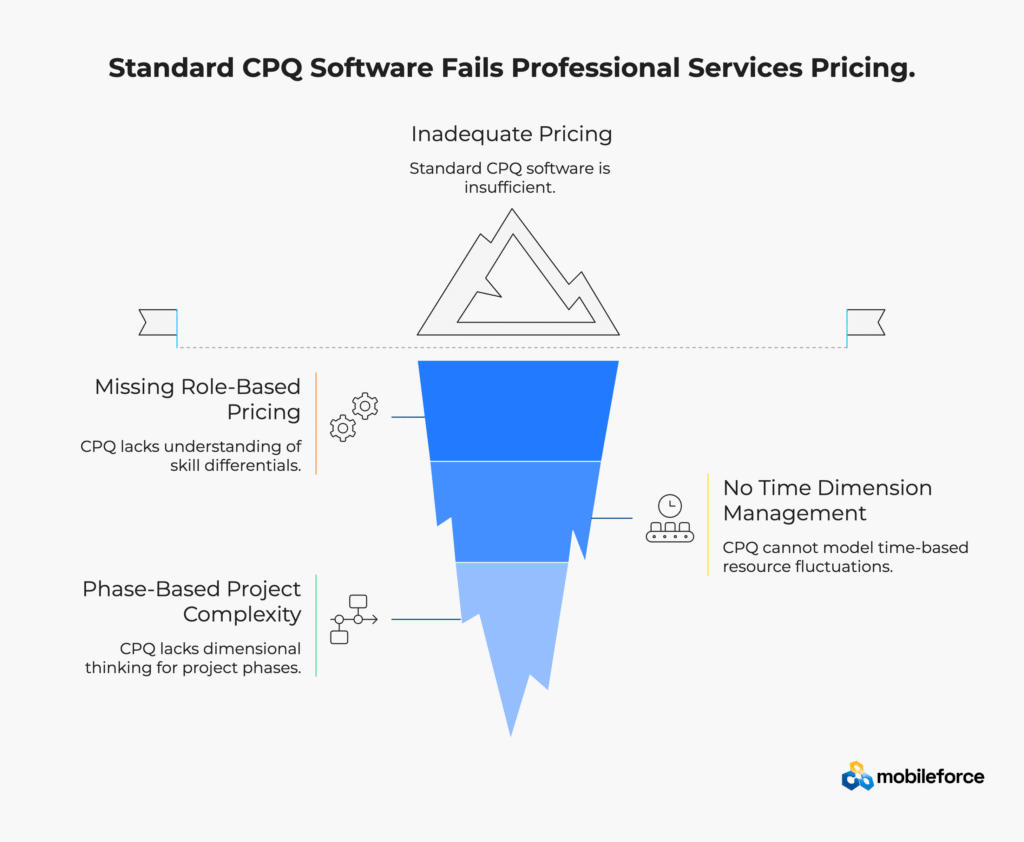
Can standard CPQ software handle professional services pricing? Traditional product-based CPQ systems are designed for physical goods with fixed pricing, not the dynamic, relationship-based pricing models that professional services firms require for consulting engagements, time and materials projects, and complex service delivery scenarios.
Most CPQ platforms were built for manufacturers configuring tangible products with fixed components, established pricing tiers, and predictable delivery costs. Professional services operate in a fundamentally different reality that requires specialized capabilities for human capital pricing, time-based billing, and project complexity management.
Product CPQ systems understand SKUs, bundles, and product configurations. They don’t comprehend that a senior SAP consultant commands different hourly rates than a junior business analyst, or that specialized skills like change management facilitation justify premium pricing structures. Product-centric CPQ solutions don’t have concepts like skills, roles, or rate cards that are essential for services firms.
Professional services pricing requires understanding of:
Services delivery happens over time with varying resource intensity throughout project lifecycles. A six-month digital transformation project might require heavy senior consultant involvement during months 1-2 (discovery and strategy), mixed teams during months 3-5 (implementation), and junior resources during month 6 (training and handoff). Traditional CPQ systems can’t model these time-based resource fluctuations that determine actual project costs and profitability margins.
Professional services projects rarely follow linear progression patterns. Discovery phases need different consulting resources than implementation phases. Risk assessment requires senior expertise, while documentation might use junior resources efficiently. Change management workshops demand specialized facilitators with specific industry experience. Traditional CPQ systems lack the dimensional thinking required to properly price these interconnected but distinct project components.
What features should professional services firms look for in CPQ software? Effective CPQ for professional services requires capabilities that go far beyond traditional product configuration. The platform must understand human resources as configurable elements, time as a pricing dimension, and project phases as interconnected components with varying profitability profiles.
Professional services quote automation demands sophisticated functionality that addresses the unique challenges of consulting engagements, knowledge work pricing, and relationship-based business models.
Professional services rate management requires dynamic pricing intelligence that considers multiple variables simultaneously. The system must understand that a Salesforce implementation specialist might command $275/hour for technical configuration work but $350/hour for executive strategy sessions. Geographic location, client relationship history, and project complexity all influence appropriate rate selection.
Mobileforce’s AskCPQ AI agent analyzes historical project data to recommend rates that balance competitiveness with profitability. The AI considers factors like project complexity, client industry, resource requirements, and market conditions. When a consulting firm quotes a similar digital transformation project, the AI suggests pricing strategies based on successful past engagements, helping teams avoid common underpricing pitfalls.
Resource Allocation and Timeline Modeling
Unlike product CPQ that deals with static inventory, services CPQ must model dynamic resource availability across time periods. If a project requires three senior SAP consultants during Q4 (historically peak demand), the system needs to factor availability constraints into pricing and timeline calculations.
Mobileforce’s Revenue Operations Cloud provides real-time visibility into resource allocation across all active projects. Sales teams can see consultant availability, skill-set matching, and capacity constraints while building quotes. If senior resources are fully allocated, the system suggests alternative staffing models or adjusted timelines that maintain project profitability.
Phase-Based Project Intelligence
Professional services projects demand sophisticated phase management that traditional CPQ platforms can’t handle. A digital transformation might include discovery (senior consultants), system selection (technical specialists), implementation (mixed teams), training (subject matter experts), and ongoing support (junior resources). Each phase has different resource requirements, risk profiles, and profitability targets.
Mobileforce’s no-code configuration capabilities allow business users to create complex project phase structures without IT involvement. Operations managers can establish phase templates for common engagement types. Finance teams can adjust margin requirements for different project stages. Sales managers can create approval workflows for complex multi-phase proposals.
Dynamic Scope Change Management
Scope changes kill profitability when firms can’t quickly recalculate pricing impacts. When clients request additional stakeholder workshops or extended timeline requirements, the CPQ system must instantly model resource implications, cost adjustments, and timeline modifications.
Mobileforce’s platform includes scenario modeling that allows sales teams to demonstrate the cost impact of scope modifications in real-time. If a client wants to add change management workshops to a transformation engagement, the system immediately shows resource requirements, timeline implications, and pricing adjustments while maintaining overall project profitability targets.
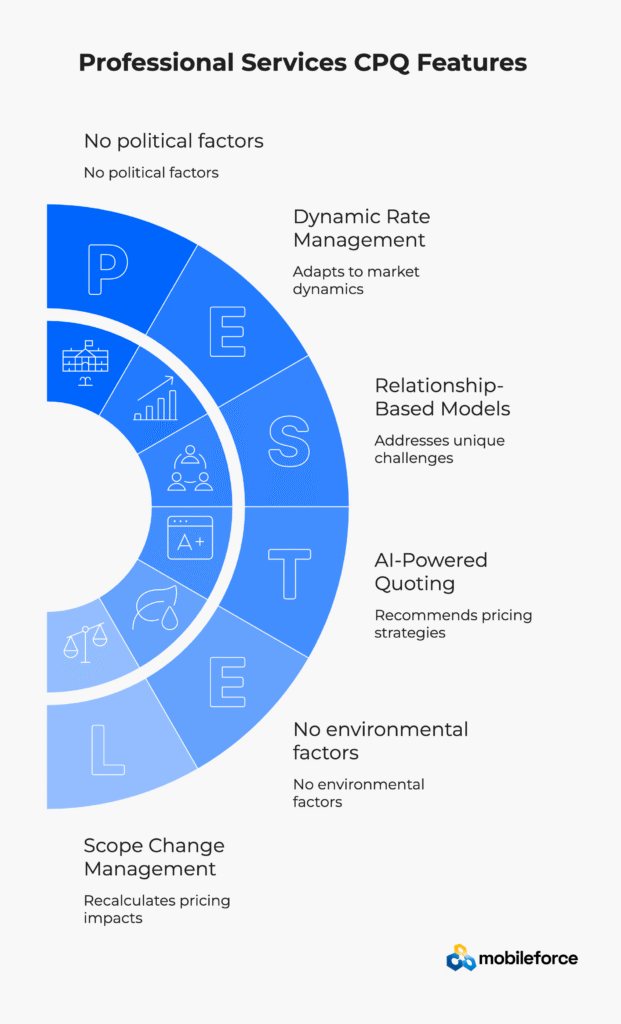
Understanding your firm’s current state helps identify which CPQ capabilities will deliver the most immediate value. This assessment framework reveals where you stand and what to prioritize during implementation.
Assessment Criteria | Basic (Manual) | Developing (Hybrid) | Advanced (Automated) | Priority Level |
Quote Generation Speed | 4-8 hours per complex quote | 2-4 hours with templates | 15-30 minutes automated | High |
Pricing Consistency | Varies by rep/partner | Some standardized rates | Fully automated rate cards | High |
Resource Visibility | Informal capacity planning | Basic resource tracking | Real-time allocation views | Medium |
Approval Workflows | Email-based, manual routing | Semi-structured processes | Automated rule-based routing | Medium |
Scope Change Management | Manual recalculation | Template modifications | Instant scenario modeling | High |
Integration Maturity | Disconnected systems | Basic CRM connection | Full ecosystem integration | Low-Medium |
Assessment Scoring: Count your “Basic” responses to identify pain points requiring immediate attention. “High Priority” gaps should drive your CPQ platform selection criteria. Most professional services firms score “Basic” in 3-4 areas, indicating significant automation opportunities.
Strategic Insight: Firms scoring “Basic” in Quote Generation Speed and Pricing Consistency should prioritize these capabilities during vendor selection. These improvements deliver immediate competitive advantages and margin protection. Resource Visibility and Integration Maturity can be addressed in later implementation phases once core quoting automation is established.
Different sized professional services firms have distinct CPQ requirements and implementation priorities. Understanding these differences helps select platforms that match your current scale while supporting future growth.
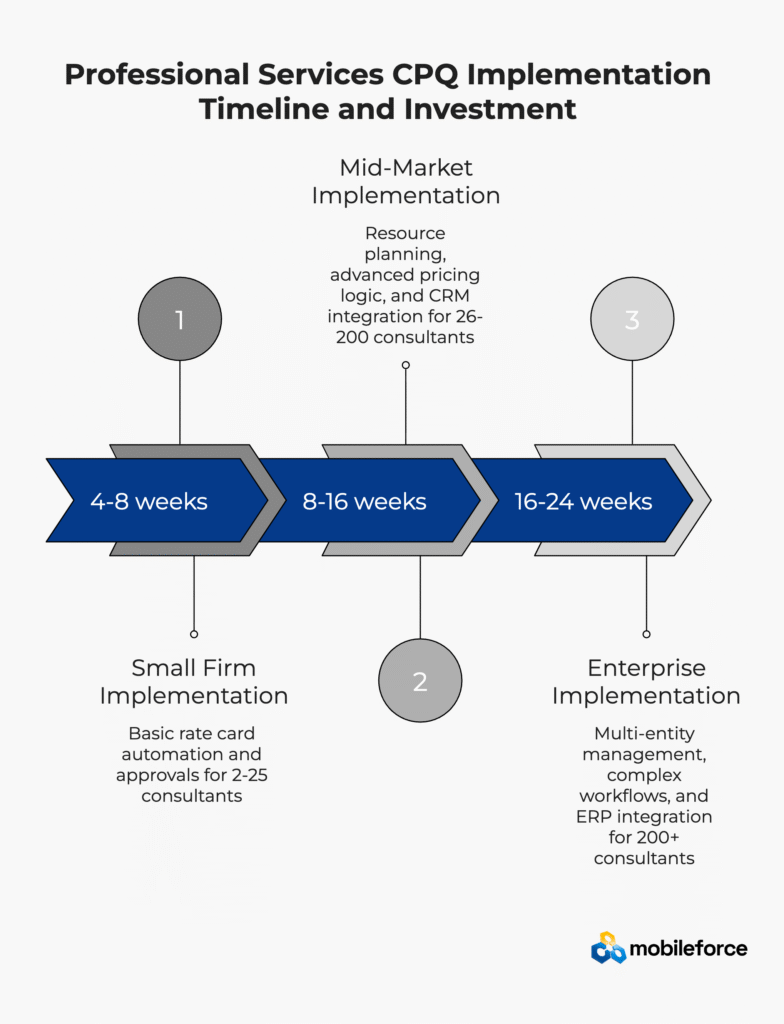
Firm Characteristics | Small (2-25 consultants) | Mid-Market (26-200 consultants) | Enterprise (200+ consultants) |
Primary Pain Points | Quote speed, pricing consistency | Resource allocation, margin protection | Process standardization, global coordination |
Essential CPQ Features | Rate card automation, basic approvals | Resource planning, advanced pricing logic | Multi-entity management, complex workflows |
Integration Priorities | CRM, basic time tracking | CRM, resource management, financial systems | Full ERP, advanced analytics, compliance |
Implementation Timeline | 4-8 weeks | 8-16 weeks | 16-24 weeks |
Investment Level | $50K-150K annually | $150K-500K annually | $500K+ annually |
Success Metrics Focus | Quote speed, win rates | Margin improvement, utilization | Process efficiency, global consistency |
Typical ROI Timeline | 3-6 months | 6-12 months | 12-18 months |
Change Management Needs | Minimal, direct training | Moderate, process documentation | Extensive, organizational transformation |
Firm Size Strategy Implications: Small firms should prioritize speed and simplicity—basic rate card automation delivers immediate competitive advantages without overwhelming limited administrative resources. Mid-market firms need sophisticated resource planning to optimize utilization across growing consultant teams. Enterprise firms require comprehensive process standardization to coordinate global operations effectively.
Growth Planning Insight: Select CPQ platforms that support your next growth stage, not just current requirements. A 15-person consulting firm expecting 50% annual growth needs mid-market capabilities from day one. Implementing basic solutions and migrating later creates expensive disruption and lost momentum.
Investment Guidance: CPQ ROI timelines correlate directly with organizational complexity, not technology sophistication. Small firms see faster returns because they can implement changes quickly, while enterprises require longer transformation periods but achieve greater absolute impact.
Transform your professional services quoting process with Mobileforce’s specialized CPQ platform designed specifically for time-based pricing and complex project requirements.
Why do professional services firms need mobile CPQ capabilities? Professional services teams increasingly work on-site with clients, making mobile quote generation essential for competitive positioning. Field consultants need to capture client requirements, adjust project scope parameters, and provide real-time pricing feedback without returning to the office for spreadsheet calculations.
Mobile CPQ functionality becomes crucial during client meetings where quick response times determine engagement outcomes. According to Gartner research on mobile business applications, firms with mobile quote capabilities report significantly higher close rates in competitive situations where multiple consulting firms are bidding.
Mobileforce’s mobile-first architecture ensures sales teams can generate accurate consulting quotes, modify project timelines, and secure approvals regardless of location. During client meetings, consultants can use mobile devices to model different engagement approaches, show pricing impacts of various service levels, and deliver professional quotes before leaving the conference room.
This mobile capability becomes a competitive differentiator when prospects are evaluating multiple consulting firms simultaneously. The firm that can provide accurate, professional quotes during initial meetings demonstrates both technological sophistication and client-focused responsiveness that influences vendor selection decisions.
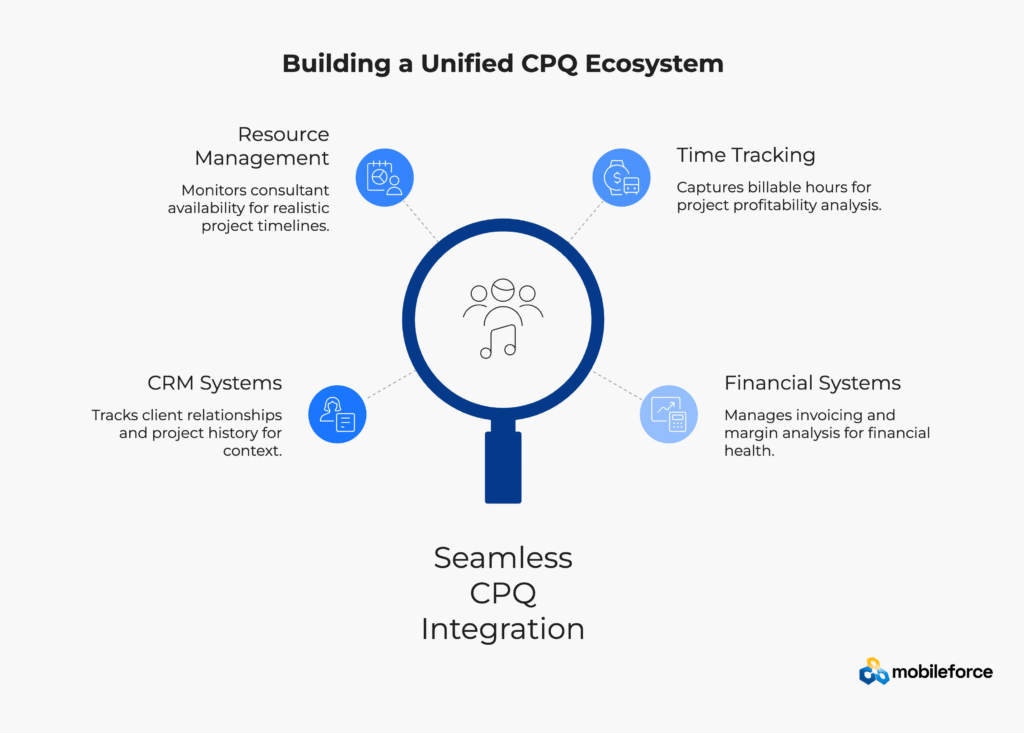
What systems should professional services CPQ integrate with? Professional services firms operate complex business ecosystems that CPQ platforms must integrate seamlessly. CRM systems track client relationships and project history. Resource management platforms monitor consultant availability and utilization rates. Time tracking tools capture billable hours and project profitability. Financial systems manage invoicing workflows and margin analysis.
CRM integration provides critical client relationship context during quote development processes. Historical project data, preferred pricing structures, and past profitability metrics inform current consulting proposals. If a client consistently requests fixed-fee arrangements, the CPQ system automatically suggests appropriate pricing models based on past successful engagements and relationship history.
Professional services firms report that CRM-integrated quote processes improve win rates significantly because sales teams can access complete client context during proposal development. Understanding past project challenges, budget constraints, and stakeholder preferences enables more targeted and persuasive quote positioning. Research from Salesforce on professional services indicates that integrated platforms significantly improve sales effectiveness.
Mobileforce’s native integration with HubSpot, Salesforce, and SugarCRM ensures seamless data flow between relationship management and quoting processes. Sales teams can access complete client history, past project outcomes, and relationship dynamics while building consulting quotes.
Services firms need real-time visibility into consultant availability when creating realistic project timelines and resource allocation plans. If a proposal requires senior change management consultants during Q4 peak season, the system should identify capacity constraints and suggest alternative approaches or adjusted timelines that maintain project quality.
Resource integration prevents overselling capacity and ensures realistic project schedules that can be delivered profitably. The CPQ platform can suggest alternative staffing models, recommend timeline adjustments, or identify skill development opportunities based on current resource allocation across all active client engagements.
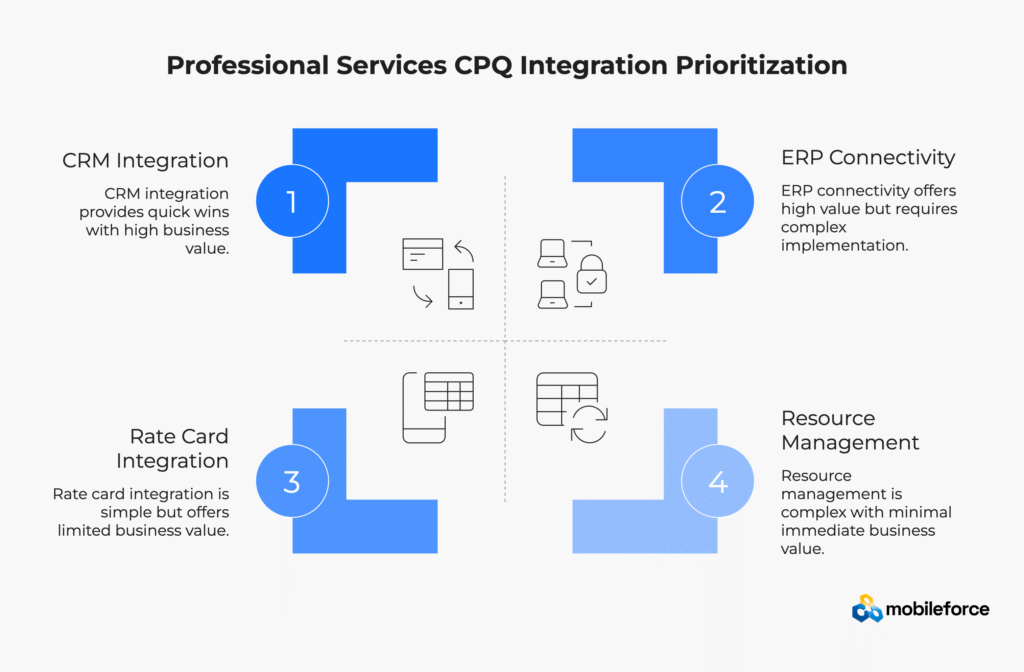
Different integrations deliver varying levels of business value and require different implementation efforts. This matrix helps prioritize integration decisions based on impact and complexity.
Integration Type | Business Value | Implementation Complexity | Priority Ranking | Timeline |
CRM (Client Data) | Very High | Low-Medium | 1st Priority | Weeks 1-2 |
Rate Card/Pricing | Very High | Low | 1st Priority | Week 1 |
Approval Workflows | High | Low | 2nd Priority | Weeks 2-3 |
Time Tracking Systems | High | Medium | 2nd Priority | Weeks 3-4 |
Resource Management | Medium-High | Medium-High | 3rd Priority | Weeks 4-6 |
Financial/ERP Systems | High | High | 3rd Priority | Weeks 4-8 |
Project Management Tools | Medium | Medium | 4th Priority | Weeks 6-8 |
Document Generation | Medium | Low | 4th Priority | Weeks 2-4 |
Business Intelligence/Reporting | Medium | Medium-High | 5th Priority | Weeks 8-12 |
Integration Strategy Insights: Start with high-value, low-complexity integrations to demonstrate quick wins and build organizational confidence. CRM and rate card integrations should be operational before addressing more complex resource management or ERP connectivity.
Implementation Wisdom: Many firms make the mistake of attempting comprehensive integration simultaneously. This approach creates project complexity that delays basic CPQ functionality. Focus on getting core quoting automation working first, then add integration layers progressively.
Resource Allocation Recommendation: Assign your strongest technical resources to CRM and financial system integrations. These connections handle the most critical business data and require careful attention to data accuracy and security protocols.
Ready to streamline your entire quote-to-cash process? Discover how Mobileforce integrates with your existing business systems for seamless professional services operations.
How long does professional services CPQ implementation take? Most consulting firms achieve basic quote automation within 8-12 weeks, with full platform optimization requiring 16-24 weeks depending on organizational complexity and integration requirements. Successful implementations follow structured phases that prioritize quick wins while building comprehensive capabilities.
Successful CPQ implementation requires addressing both technical integration and organizational change management challenges. Professional services firms face unique implementation considerations that demand specialized approaches different from product-based CPQ deployments.
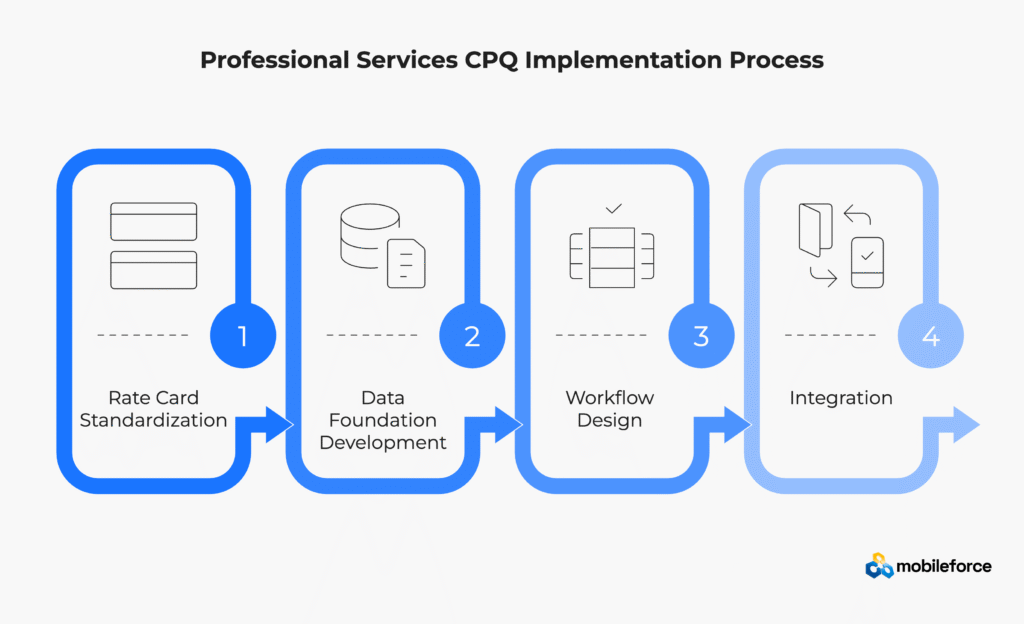
Before implementing any CPQ technology, establish standardized rate cards that reflect actual delivery costs and competitive market positioning. Many consulting firms discover their informal pricing approaches have created unsustainable margin pressure when they begin analyzing historical project data systematically.
Rate card development requires input from multiple stakeholders across the professional services organization. Delivery managers understand resource requirements for different project types and complexity levels. Finance teams provide accurate cost allocation models and margin targets. Sales teams contribute market intelligence about competitive pricing and client-specific preferences. This collaborative approach ensures rate cards reflect operational reality while maintaining competitive positioning.
Use historical project data to identify profitable engagement patterns and pricing models. If digital transformation projects consistently achieve strong margins when scoped with specific deliverable frameworks, build those patterns into standardized rate cards and approval workflows.
Professional services quotes often require multiple approval layers, especially for large consulting engagements or non-standard pricing structures. Design approval workflows that balance control requirements with sales cycle speed and client responsiveness expectations. Routine projects within established parameters should flow through automated approval processes, while strategic engagements require appropriate executive review and risk assessment.
Configure automatic approval for quotes meeting predefined criteria and risk thresholds. If a cybersecurity assessment project falls within standard scope and pricing guidelines, the system can approve it instantly. Complex multi-million-dollar transformation projects require additional review stages that include resource availability verification, margin analysis, and strategic risk assessment.
Effective CPQ implementation requires seamless integration with CRM platforms, resource management systems, and financial applications. Poor integration creates data silos that force manual workarounds, defeating the automation benefits CPQ should provide for professional services operations.
Mobileforce’s Revenue Operations Cloud provides pre-built integration capabilities for common professional services software while supporting custom integration requirements. The platform connects with existing business applications through established APIs while maintaining data accuracy and security protocols across all connected systems.
Planning your professional services CPQ implementation? Schedule a consultation with Mobileforce to discuss your specific requirements and timeline expectations.
Successful CPQ deployments follow a structured approach that balances speed with thorough preparation. This timeline framework helps set realistic expectations and ensures critical success factors aren’t overlooked.
Phase | Duration | Key Activities | Success Metrics | Critical Dependencies |
Foundation (Weeks 1-4) | 4 weeks | Rate card standardization, data cleanup, stakeholder alignment | Standardized pricing approved, clean historical data | Executive sponsorship, finance team involvement |
Core Configuration (Weeks 5-8) | 4 weeks | Basic quoting workflows, approval processes, user training | First automated quotes generated | IT integration support, user acceptance testing |
Integration Phase (Weeks 9-12) | 4 weeks | CRM connectivity, resource systems, financial integration | Real-time data flow established | API access, system administrator availability |
Advanced Features (Weeks 13-16) | 4 weeks | AI pricing recommendations, mobile optimization, advanced reporting | Full feature utilization | User adoption, feedback incorporation |
Optimization (Weeks 17-20) | 4 weeks | Performance tuning, additional integrations, scaling preparation | ROI targets achieved | Business process refinement |
Timeline Insights: Most professional services firms can achieve basic CPQ functionality within 8 weeks, but full platform optimization requires 16-20 weeks. The Foundation phase determines overall success—rushing rate card standardization creates ongoing problems. Integration complexity varies significantly based on existing system architecture.
Critical Success Factor: Executive sponsorship during the Foundation phase ensures rate card standardization doesn’t get derailed by individual practice preferences. Without clear leadership support, CPQ implementations often stall during stakeholder negotiations about pricing consistency.
Risk Mitigation: Plan for 25% additional time in the Integration phase if your firm operates legacy systems. Complex ERP or custom time-tracking systems may require additional development work that extends timelines but doesn’t compromise final outcomes.
How do you measure CPQ ROI for professional services firms? Track metrics that reflect services-specific value creation rather than generic CPQ performance indicators. Professional services firms should focus on measurements that directly correlate with business outcomes, competitive positioning, and long-term profitability rather than just operational efficiency metrics.
Effective ROI tracking requires monitoring different metrics at different implementation stages. This framework ensures you capture both immediate efficiency gains and long-term strategic benefits.
Measurement Category | Month 1-3 (Early Wins) | Month 4-6 (Operational) | Month 7-12 (Strategic) | Industry Benchmark |
Quote Efficiency | Quote generation time, error reduction | Quote volume increase, revision cycles | Win rate improvement, competitive positioning | 50-75% time reduction |
Pricing Accuracy | Margin variance reduction, approval speed | Pricing consistency scores, discount patterns | Client retention, repeat business rates | Significant margin improvement |
Resource Optimization | Utilization visibility, capacity planning | Resource allocation efficiency, project profitability | Strategic capacity planning, skill development | 20-30% utilization gains |
Sales Performance | Sales cycle reduction, team productivity | Pipeline velocity, opportunity conversion | Revenue growth, client satisfaction scores | 40-60% cycle acceleration |
Process Maturity | Manual task elimination, workflow automation | Integration completeness, user adoption | Strategic decision support, predictive insights | 70-90% process automation |
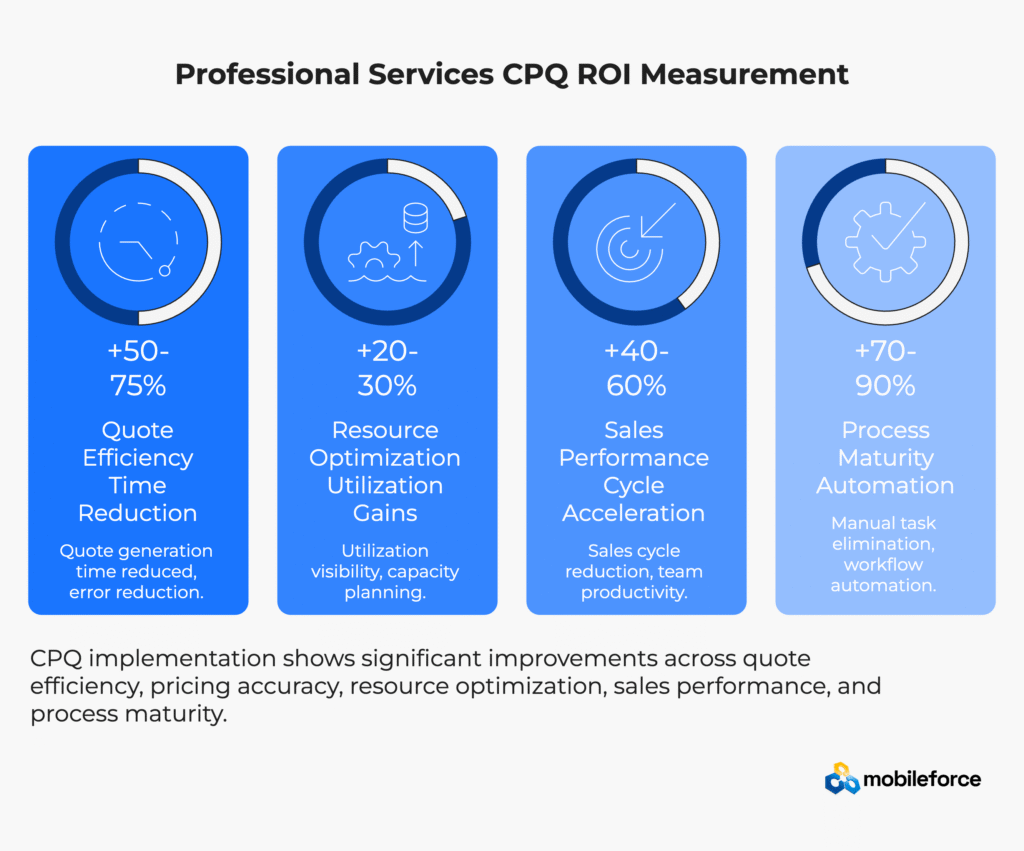
ROI Measurement Strategy: Focus on Quote Efficiency and Pricing Accuracy metrics during early implementation phases. These deliver immediate, measurable benefits that justify continued investment. Resource Optimization and Strategic metrics become relevant after 6 months when process maturity enables more sophisticated analysis.
Benchmark Context: Top-performing professional services firms using specialized CPQ platforms report substantial quote time reduction, margin improvements, and sales cycle acceleration within 12 months. However, results vary significantly based on implementation quality and organizational change management effectiveness. According to IBM’s research on professional services automation, firms that implement comprehensive automation see the most significant improvements.
Critical Success Indicators: If you’re not seeing significant quote time reduction within 60 days, implementation likely needs adjustment. Poor early metrics usually indicate insufficient rate card standardization or inadequate user training rather than platform limitations. Consider reviewing your change management strategy if adoption is lagging.
Monitor the percentage of consulting projects delivered within quoted budgets and timelines to assess CPQ effectiveness. Poor quote accuracy creates delivery pressure that reduces profitability regardless of initial pricing strategies. Companies implementing professional services CPQ systems report substantial increases in quote accuracy and improvements in deal closure rates compared to manual processes.
Compare actual project margins to quoted margins across different service types and client segments. Significant variances indicate either pricing accuracy issues or delivery execution problems that require process improvements in scope management or resource allocation.
Track time from initial client inquiry to signed contract across different engagement types. Professional services sales cycles traditionally extend longer than product sales due to customization discussions and stakeholder alignment requirements. Effective CPQ should reduce this timeline through faster quote generation, improved pricing accuracy, and streamlined approval workflows.
Companies using specialized services CPQ report significantly faster quote generation while eliminating calculation errors and version control issues. This acceleration compounds throughout the sales process by reducing revision cycles and approval delays that extend competitive procurement processes.
Use CPQ data to analyze resource allocation patterns and identify optimization opportunities across different practice areas. Track utilization rates for different skill levels and monitor projects for staffing efficiency improvements. Senior consultants spending significant time on routine documentation tasks represent margin optimization opportunities.
Analyze project timelines to identify resource availability bottlenecks and capacity constraints. If business development teams frequently quote unrealistic delivery schedules due to resource constraints, adjust capacity planning approaches or pricing strategies to reflect operational reality and improve client satisfaction.
Ready to implement professional services CPQ that delivers measurable results? Schedule a demo to see how Mobileforce’s Revenue Operations Cloud transforms time-based pricing and project quoting.
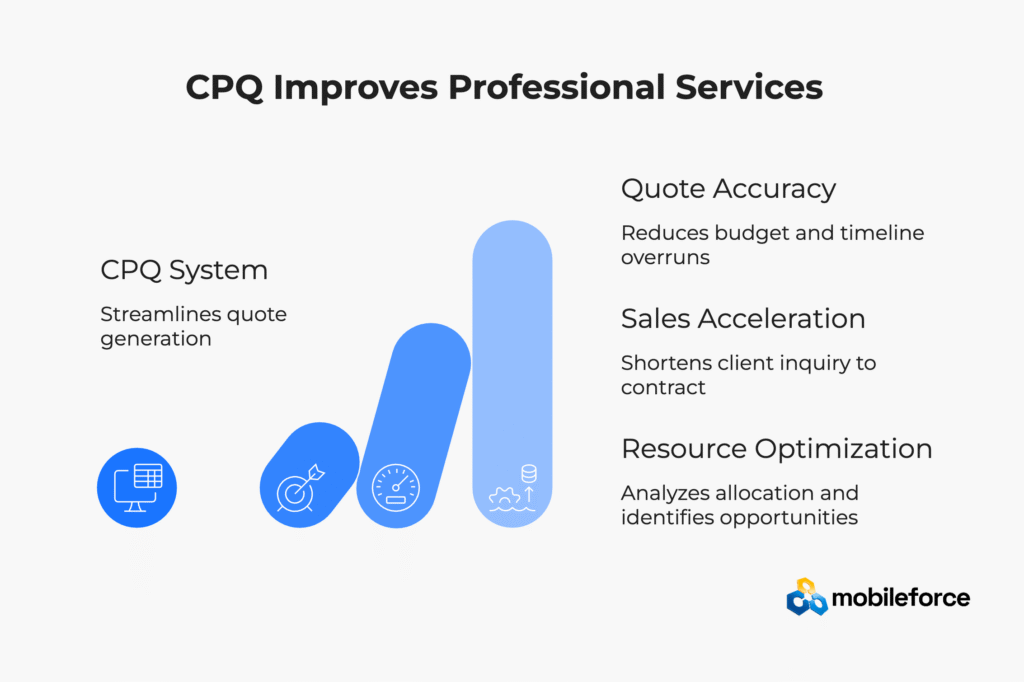
Different pricing models require specific CPQ capabilities. Understanding these requirements helps firms select platforms that support their current approaches while enabling evolution toward more profitable pricing strategies.
Pricing Model | Best Use Cases | CPQ Requirements | Margin Predictability |
Hourly/Time-based | Well-defined scope, routine consulting services | Rate card automation, time tracking integration | Medium |
Fixed Project Fee | Clearly scoped deliverables, standardized processes | Scope modeling, risk factor calculation | High |
Value-based | Measurable business outcomes, strategic consulting | ROI modeling, outcome tracking | Very High |
Retainer/Subscription | Ongoing advisory, maintenance services | Recurring billing, service level management | High |
Hybrid Models | Complex engagements, multiple service types | Flexible pricing logic, component bundling | Variable |
Understanding pricing model requirements helps consulting firms implement CPQ systems that support current approaches while enabling evolution toward more profitable strategies over time. Many successful consulting firms start with time-based pricing automation and gradually introduce value-based components as they develop outcome measurement capabilities and client relationships mature.
The key insight: different pricing models aren’t mutually exclusive in professional services. A single client engagement might include fixed-fee discovery work, hourly implementation services, and subscription-based ongoing support. Effective CPQ platforms handle these combinations while maintaining overall engagement profitability and clear client communication.
What should professional services firms evaluate when selecting CPQ software? Different vendors offer varying levels of specialization for consulting and professional services requirements. This evaluation framework helps assess platform capabilities against services-specific needs.

Evaluation Criteria | Essential Capability | Questions to Ask Vendors | Red Flags to Avoid |
Time-Based Pricing | Role-based rate cards, skill premiums, geographic adjustments | How does the system handle different hourly rates by role and experience level? | Product-focused vendors without services experience |
Project Complexity | Phase management, dependency tracking, resource allocation | Can it model multi-phase projects with varying resource requirements? | Simple product configurators marketed as services CPQ |
Scope Management | Change order workflows, impact analysis, repricing automation | How quickly can we recalculate pricing for scope changes? | Manual recalculation requirements |
Integration Depth | Native CRM connectivity, resource management, financial systems | What pre-built integrations exist for professional services tools? | Vendors requiring extensive custom development |
Mobile Capabilities | Field quoting, offline functionality, approval workflows | Can consultants generate quotes during client meetings? | Desktop-only solutions |
AI/Automation | Intelligent pricing recommendations, historical analysis | How does AI improve pricing accuracy and win rates? | Basic automation without learning capabilities |
Vendor Selection Strategy: Prioritize vendors with demonstrated professional services experience and existing client references in consulting, accounting, legal services, or similar knowledge-based industries. Product-focused CPQ vendors often underestimate the complexity of time-based pricing and resource allocation requirements.
Transform your professional services business with Mobileforce’s Revenue Operations Cloud—the only platform designed specifically for the complexity of time-based pricing and project quoting that actually works.

Professional services firms face a critical decision point in their technology evolution. Manual quoting processes that lose time-sensitive opportunities create systematic competitive disadvantages that compound over time. While traditional product CPQ platforms promise automation, they lack the specialized capabilities that consulting engagements demand.
Successful professional services CPQ implementation requires platforms specifically designed for time-based billing, resource allocation complexity, and project phase management. Firms using specialized solutions like Mobileforce’s Revenue Operations Cloud report dramatic improvements in competitive positioning, margin protection, and client satisfaction through intelligent quote automation.
The professional services automation market continues growing as consulting firms recognize that quote automation directly impacts revenue growth and competitive differentiation. Leading firms are establishing systematic advantages through faster response times, pricing consistency, and professional presentation that manual processes simply cannot match.
What makes professional services CPQ different from product CPQ?
Professional services CPQ must handle time-based pricing models, resource allocation across projects, project phases with varying complexity, and skill-based rate variations that product CPQ systems aren’t designed to manage effectively. Services firms need capabilities like role-based pricing engines, project timeline modeling, and scope change management that traditional manufacturing-focused CPQ platforms lack.
How does CPQ handle different billing models for professional services?
Modern professional services CPQ platforms support multiple billing models within single client engagements. A comprehensive consulting project might include fixed-fee discovery phases, hourly implementation work, and subscription-based ongoing support services. The system calculates accurate pricing for each component while maintaining overall project profitability targets and client budget requirements.
Can professional services CPQ integrate with existing time tracking and project management tools?
Yes, professional services CPQ platforms provide robust integration capabilities with common business tools like time tracking systems, project management platforms, and resource planning applications. These integrations enable realistic timeline planning, accurate resource cost calculations during quote development, and seamless data flow across the entire services delivery ecosystem.
What ROI can professional services firms expect from CPQ implementation?
Consulting firms typically see 40-75% faster quote generation, significant improvements in pricing accuracy, and 20-30% increases in sales team productivity within 6-12 months of implementation. Companies report quote turnaround time reductions exceeding 50% after specialized CPQ implementation.
How does AI enhance professional services CPQ capabilities?
AI analyzes historical project data to recommend optimal pricing strategies based on project complexity factors, client industry requirements, and current market conditions. AI-powered systems can suggest appropriate resource allocation, identify cross-selling and upselling opportunities, and predict project profitability based on similar past engagements and delivery patterns.
What training do teams need for services-specific CPQ platforms?
Training should cover rate card management for different roles and skills, project phase configuration for complex engagements, scope change workflows for client negotiations, and integration with existing business processes. Unlike product CPQ training, services teams need comprehensive understanding of resource allocation modeling, time-based pricing logic, and professional services delivery methodologies.