Dreamforce 2026 ran September 15–17 in San Francisco, and the main stage belonged to AI. AIforce put Salesforce inside Claude and Slack. Koa, a CRM-tuned reasoning model built with NVIDIA, got its own launch. If you only watched the main keynotes, you could have left without hearing the letters C, P and Q.
Quoting lived in one session: the September 16 Revenue keynote, titled Beyond CPQ: One Engine, Every Experience. The title tells you most of the story. Salesforce isn’t selling a better CPQ. It is selling Revenue Cloud, now branded Agentforce Revenue Management, as the platform underneath your whole revenue process. Legacy CPQ is the thing you move off of.
We went through the keynote and the partner recaps so you don’t have to. Here is what was said, what wasn’t, and what it means if you still run Salesforce CPQ.
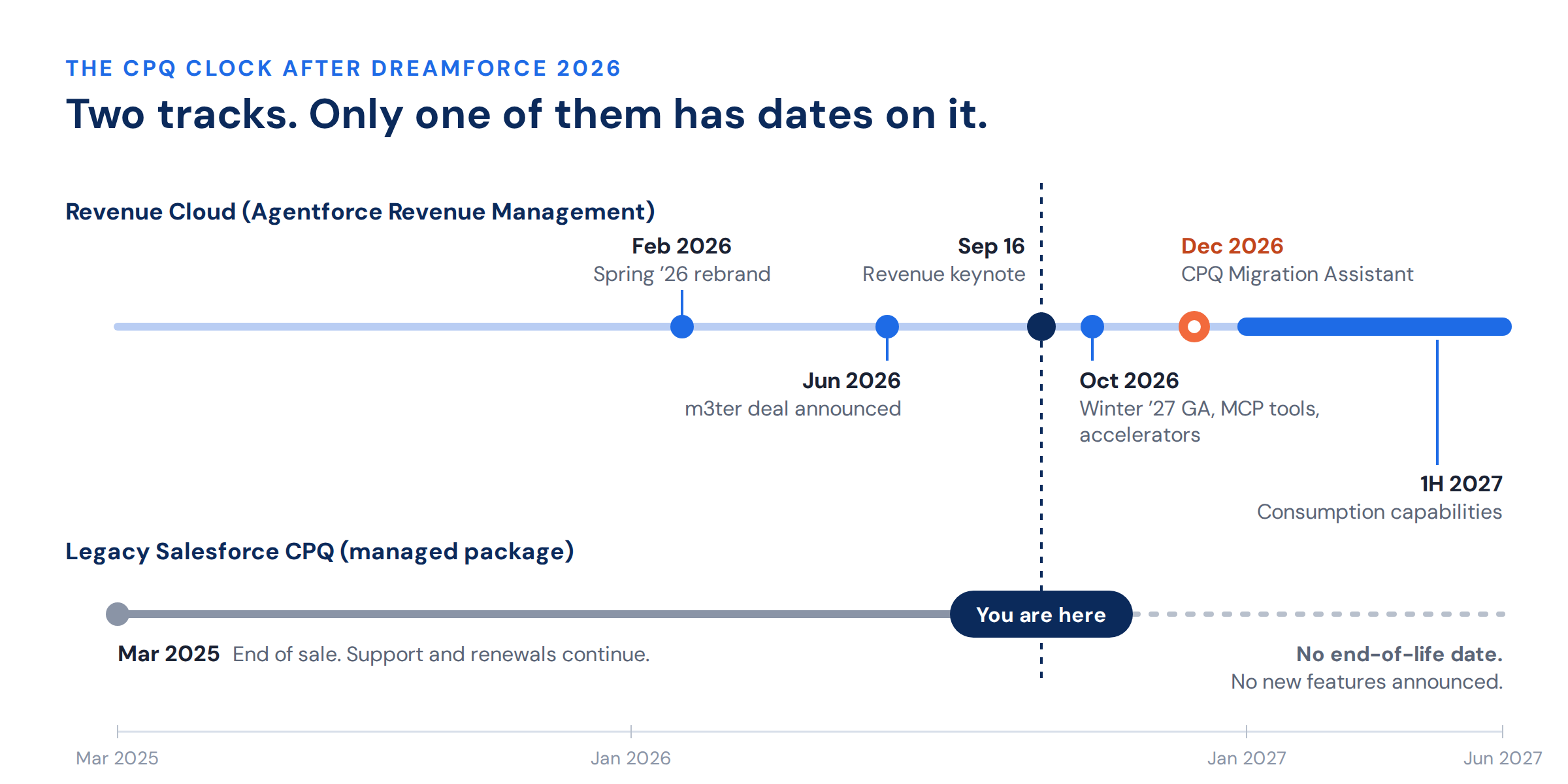
Bottom line: Salesforce announced a CPQ Migration Assistant for December 2026 and a long list of Revenue Cloud features. It did not announce an end-of-life date, a single new feature for legacy CPQ, or what a migration will cost.
What changed: the decision in front of CPQ customers is the same one it was in August. You now have one more tool, and a much clearer view of where Salesforce is spending.
What Salesforce said · What it didn’t say · What it means · Questions for your AE · Your three options · FAQ
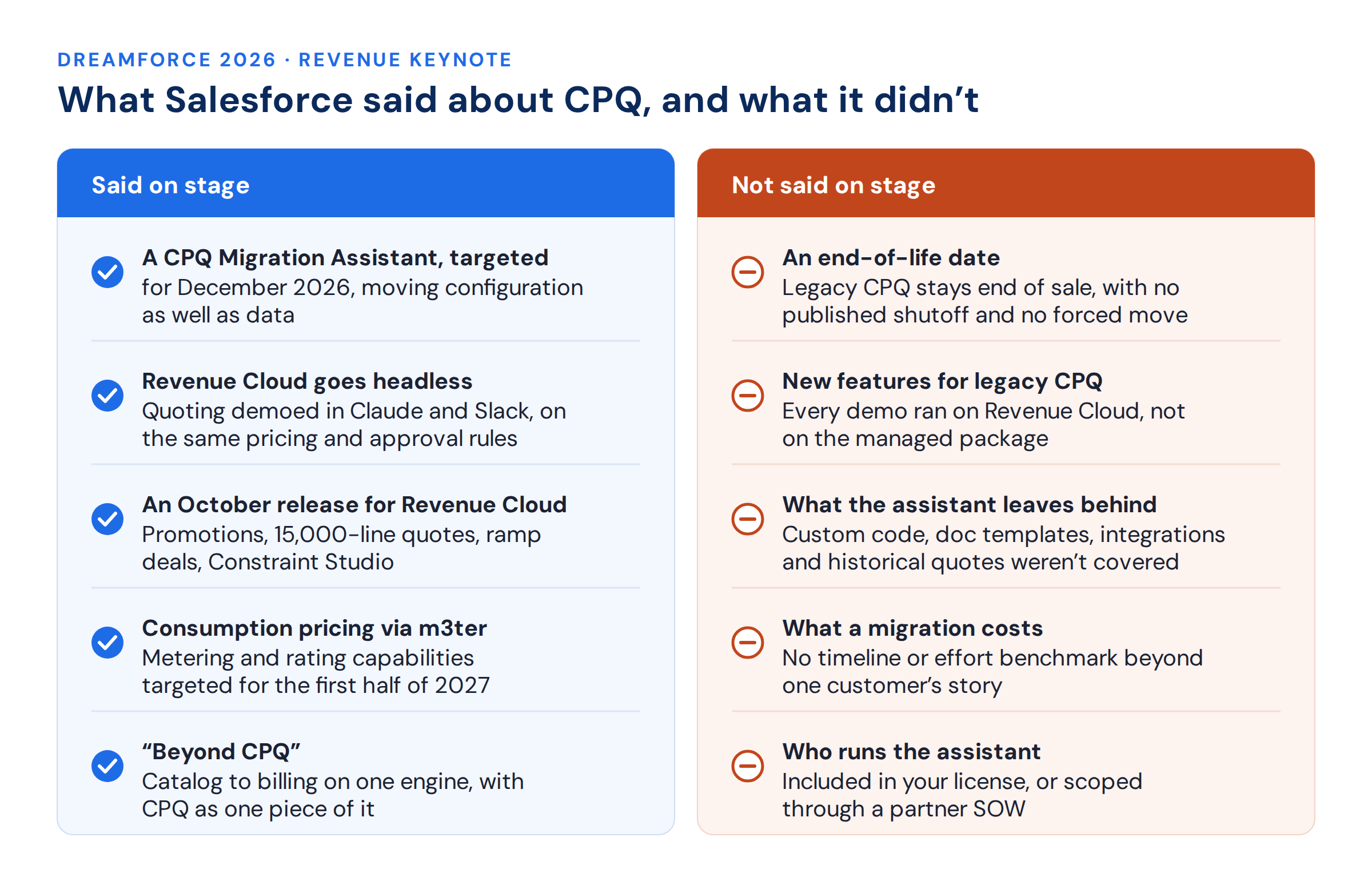
Salesforce framed Revenue Cloud as one engine for the full commercial process: catalog and pricing, quotes and contracts, orders, assets, metering and rating, billing and collections. CPQ is now one piece of that engine rather than the product.
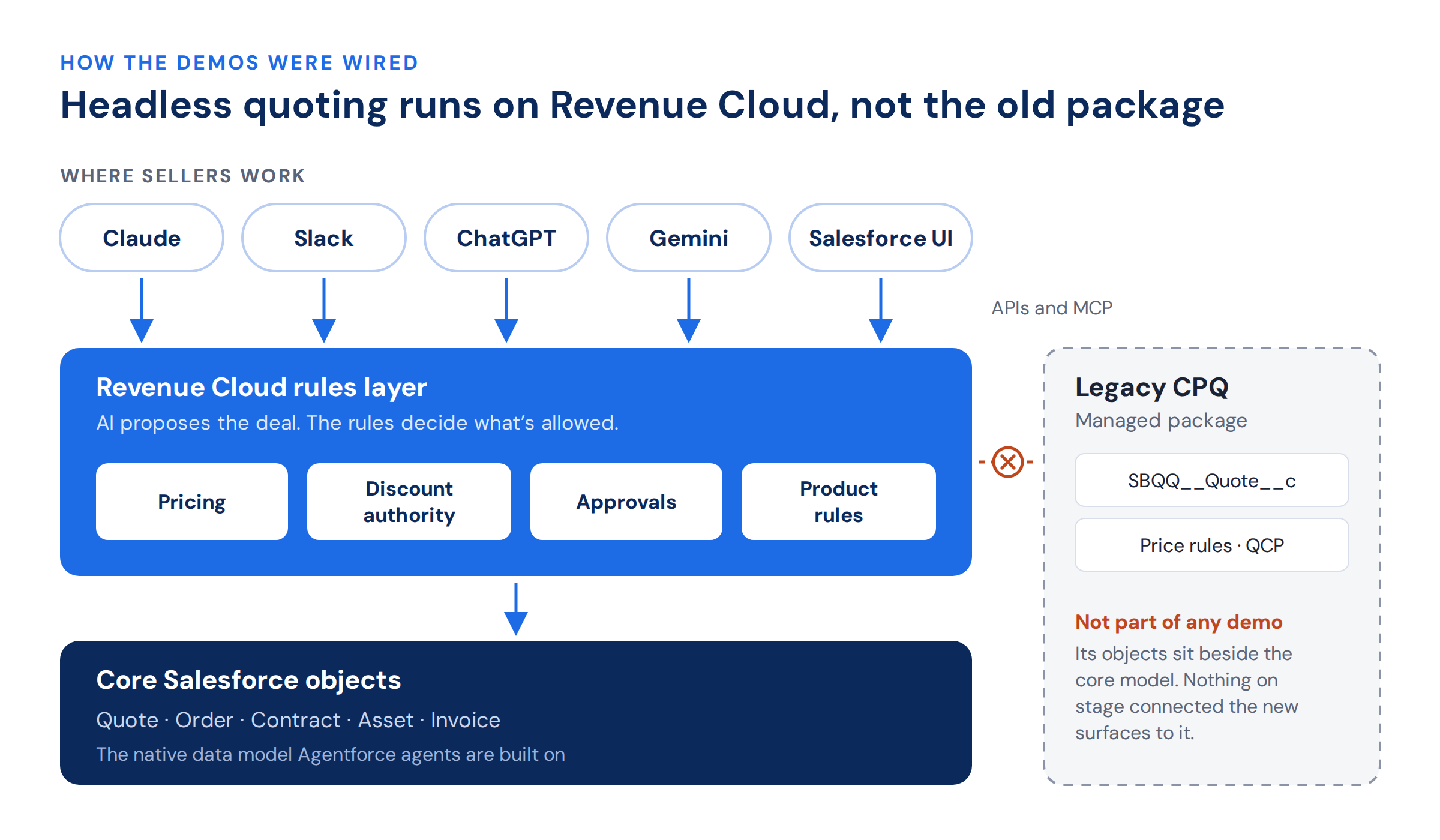
The line that stuck: you can’t have “probably right” revenue. AI can recommend an 18% discount. Revenue Cloud is the deterministic layer that checks whether the rep is allowed to give it.
Revenue Cloud’s pricing, quoting and approval logic is exposed through APIs and MCP, so sellers can work in Claude, Slack, ChatGPT or Gemini while the rules still run in Salesforce. The demos made it concrete. A seller built alternative proposals in Claude from call notes, then asked for a discount beyond their authority. The rules blocked it and offered a path forward. In Slack, the deal channel acted as a teammate that flagged weak deal structure and generated a branded proposal. An AI-built renewal factored in usage, support history and a negotiated cap on price increases.
The October release brings promotions (coupons and automated discounts), quotes up to 15,000 lines, ramp deal enhancements, and Constraint Studio for solver-guided configuration. Winter ’27 reaches general availability October 12. Revenue Cloud tools and skills through Salesforce MCP and accelerators through Salesforce Go are also targeted for October. A Revenue Cloud Skills Library is available now.
This is the one announcement aimed squarely at legacy CPQ customers. The assistant is meant to move you from the Salesforce CPQ managed package to Revenue Cloud, including configuration and not only data. That is a meaningful step up from data-migration scripts. It is also a roadmap date, not a shipped product.
Salesforce announced its acquisition of m3ter in June. On stage, it laid out metering, mediation, aggregation, and richer usage pricing and billing, with first capabilities targeted for the first half of 2027.
Workday CIO Rani Johnson described moving from a heavily customized environment to a Salesforce reimplementation on Revenue Cloud. Salesforce’s own session summary cited a 300% increase in Revenue Cloud customers and more than 80 million quotes created in the past year.
The gaps matter as much as the announcements, especially if you are building a 2027 budget around them.
Salesforce CPQ has been end of sale since March 2025. It is still supported, still renewable, and still without a published shutoff date. Dreamforce didn’t change any of that. There is no forced migration, which means the timing of a move is still your call.
Every demo ran on Revenue Cloud. The Claude quoting, the Slack deal room and the AI renewal were shown on Revenue Cloud’s native objects, not on the managed package. Nothing on stage suggested the new surfaces would connect to legacy CPQ. If you stay on the package, the gap between what your reps have and what Salesforce demos will keep growing every release.
“Including configuration” is a real claim. The keynote didn’t say how the assistant handles custom Apex and quote calculator plugin scripts, quote document templates, integrations to ERP, billing, CLM, e-sign and tax, or historical quotes and reporting. Those are usually where migration effort lives.
Workday’s story is Workday’s. The keynote offered no timeline or effort benchmark. Salesforce’s own end-of-sale guidance puts a typical migration at three to six months, with complex orgs taking longer.
Nobody said whether the assistant is part of your license or something a partner scopes into a statement of work. That one detail can change a budget by six figures.
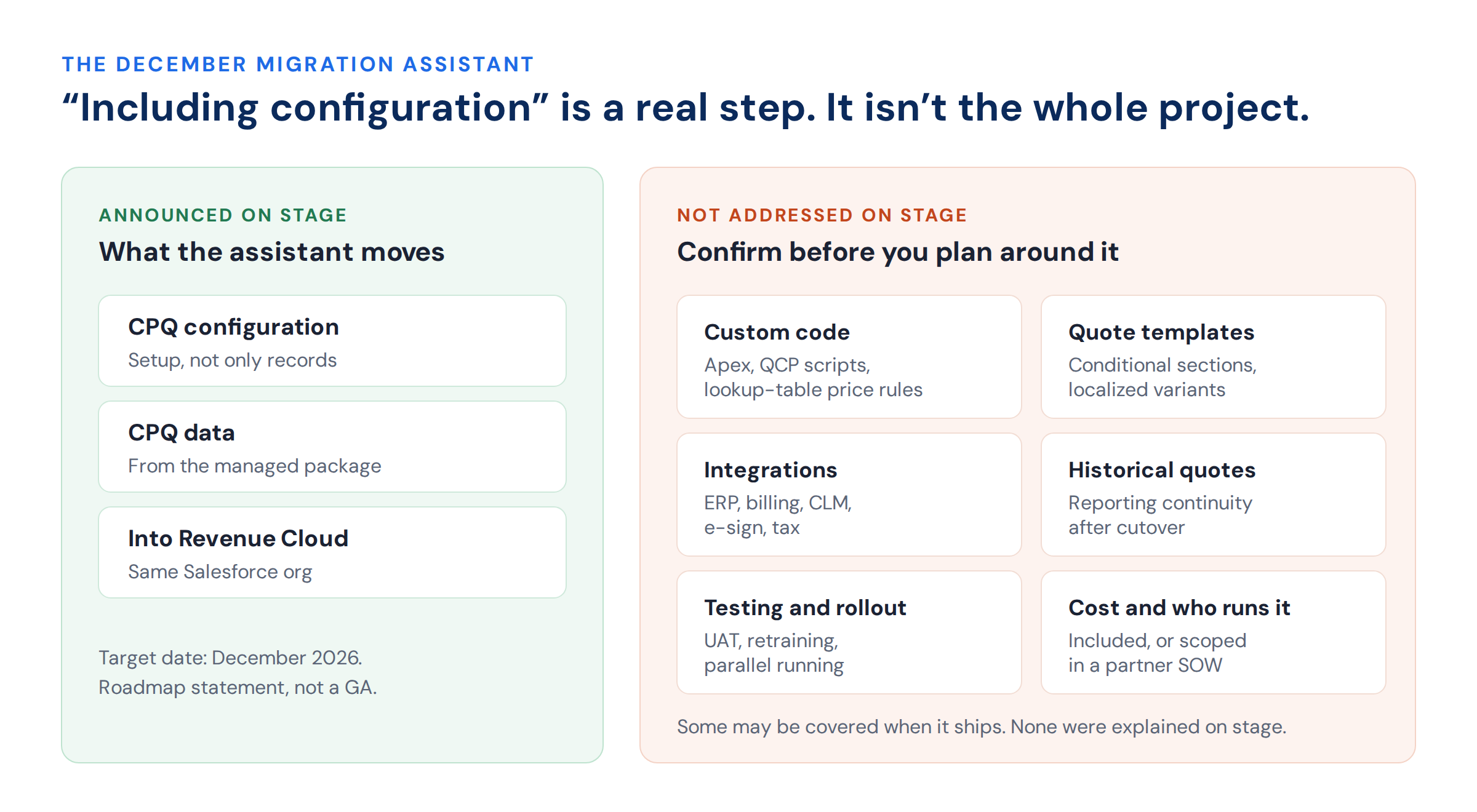
The Migration Assistant makes the move to Revenue Cloud easier. It doesn’t make it smaller.
Nothing announced forces your hand. But each Revenue Cloud release widens the feature gap, and each customization you add to legacy CPQ adds to the list of things you’ll rebuild later. Standing still costs more every quarter, even with no deadline.
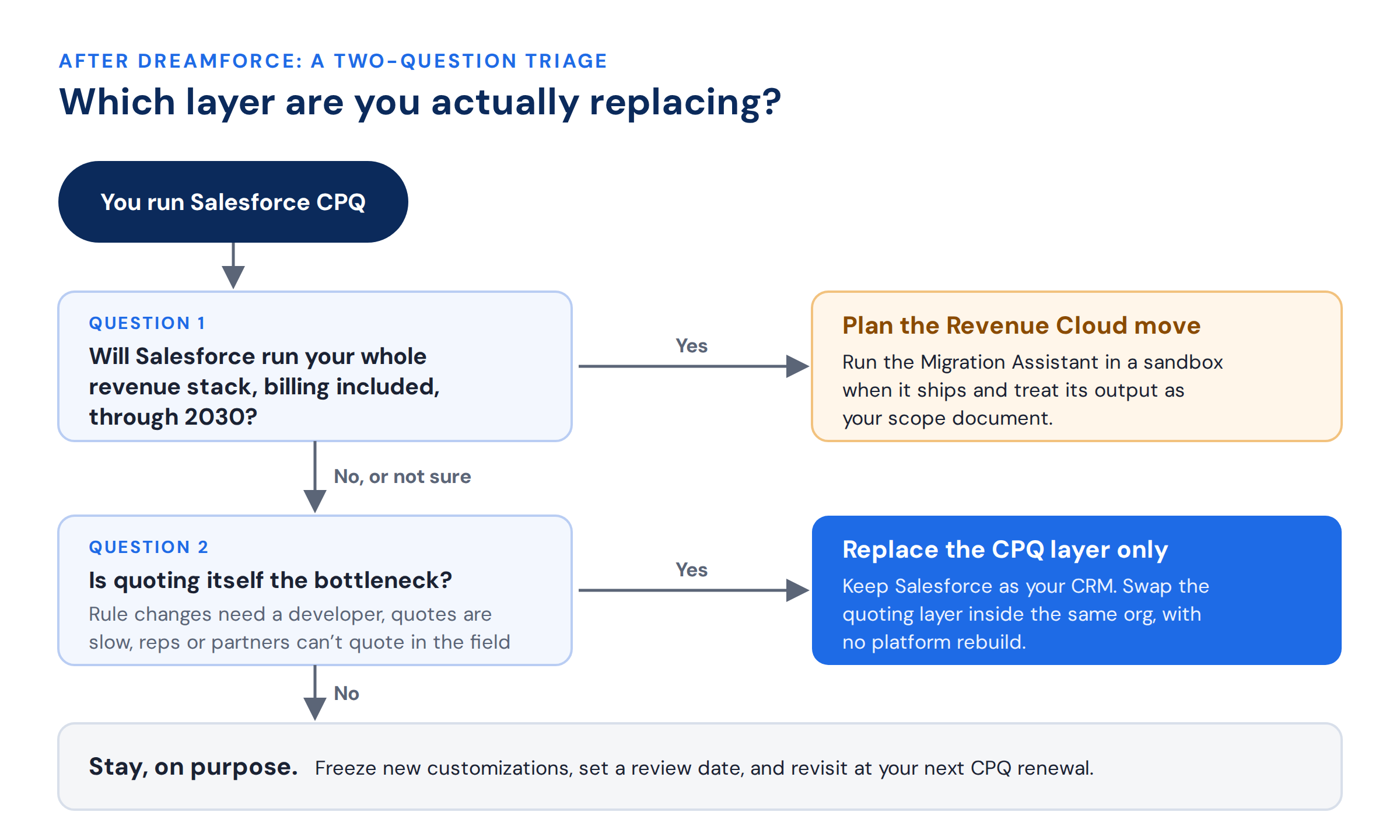
If you plan to move to Revenue Cloud, waiting for the assistant is reasonable. Plan to run it against a sandbox in early 2027 and read its output as a scope document. Whatever it can’t convert is your real project.
The keynote presented one direction: move your revenue stack onto Revenue Cloud. That is the right answer for some teams. For others, Salesforce is the CRM they want to keep, and quoting is the only part that’s broken. Those are different projects with different price tags.
Take these to your account team or implementation partner before you commit budget.
Stay, migrate to Revenue Cloud, or replace only the CPQ layer. Dreamforce made the second option better defined. It didn’t make the other two go away.
Choose Revenue Cloud if…
Choose Mobileforce if…
Mobileforce CPQ runs natively inside your existing Salesforce org, priced per seat. Your CRM stays, your users keep their logins and roles, and the layer that configures, prices and documents the quote is the only thing that changes. If Dreamforce convinced you that Revenue Cloud is where your whole revenue stack belongs, the Migration Assistant is good news. If it confirmed you’d rather keep Salesforce without a platform rebuild, that’s the option we built for.
Did Salesforce announce a CPQ end-of-life date at Dreamforce 2026?
No. Salesforce CPQ remains end of sale, as it has been since March 2025. It is still supported and renewable, with no published shutoff date and no forced migration.
When is the Salesforce CPQ Migration Assistant available?
Salesforce targeted December 2026. Treat that as a roadmap date until it ships, and confirm packaging and eligibility with your account team.
Is Revenue Cloud the same as Agentforce Revenue Management?
Yes. The Spring ’26 release rebranded Revenue Cloud as Agentforce Revenue Management, and you will see both names used. Neither is the same product as legacy Salesforce CPQ.
Will the Claude and Slack quoting demos work with legacy CPQ?
Salesforce didn’t show that. Every demo ran on Revenue Cloud’s native objects, and nothing on stage connected the new experiences to the CPQ managed package.
Can we keep Salesforce CRM and replace only CPQ?
Yes. Mobileforce CPQ runs natively inside your existing Salesforce org. Your accounts, contacts, opportunities, users and reporting stay where they are.
Keep your Salesforce org. Skip the rebuild.
Book a 30-minute call. We’ll show you how Mobileforce CPQ runs inside your existing Salesforce org, and scope what moving would actually involve for your configuration.
Mobileforce is an enterprise CPQ and field service platform that runs natively inside Salesforce, HubSpot, Dynamics 365, Sugar and Creatio. Dreamforce details in this post reflect Salesforce’s September 16, 2026 Revenue keynote and published roadmap statements, which may change.