ISG Software Research projects that more than half of enterprises will still rely on manual quote-and-contract processes through 2026, a gap that revenue lifecycle management platforms are specifically built to close. That gap starts with a basic mix-up: teams use CPQ and quote-to-cash interchangeably, and they’re not the same thing.
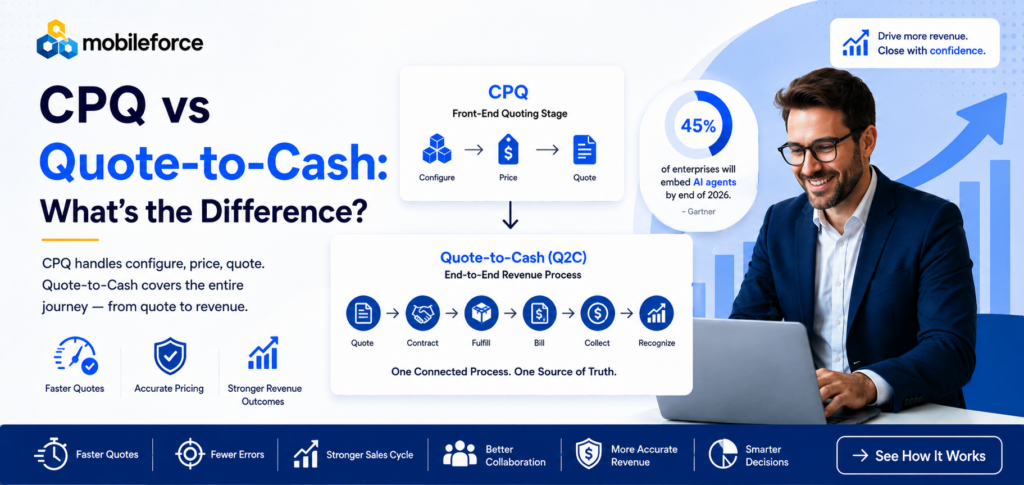
CPQ is the front-end quoting stage. Quote-to-cash is the full lifecycle, from that first quote through contracting, billing, and revenue recognition. CPQ sits inside Q2C, not next to it. The core distinction is ownership: CPQ is sales-owned, while Q2C needs sales, finance, and legal working off the same data. Both are increasingly being absorbed into a broader category, revenue lifecycle management, as revenue operations teams look for one connected system instead of a relay race between departments.
What is quote-to-cash?
It’s the end-to-end process that runs from a customer’s initial price inquiry through contracting, fulfillment, billing, and revenue recognition. The quote to cash process explained in plain terms comes down to five or six linked stages: quote, contract, fulfill, bill, collect, and recognize.
Each stage hands off to the next. A quote becomes a contract. A contract triggers fulfillment. Fulfillment triggers billing. Billing triggers collection and, eventually, recognized revenue on the books. When one stage runs on a different system than the next, the handoff is where things break.
CPQ stands for Configure, Price, Quote. It automates product configuration, pricing rules, and quote generation at the front end of a sale. Think of it as the tool that stops a rep from quoting a configuration that can’t actually be built, or a discount that was never approved.
CPQ is a subset of Q2C, not a replacement for it. Understanding the cpq stages explained helps here too: configure the product, apply pricing logic, generate the quote. That’s it. Everything after approval, the contract, the invoice, the revenue entry, belongs to the rest of the Q2C lifecycle.
Dimension | CPQ | Quote to Cash (Q2C) |
Scope | Sales-focused tool | End-to-end revenue process |
Lifecycle Coverage | Pre-sale, quoting stage only | Quote through revenue recognition |
Primary Users | Sales reps, sales ops | Sales, finance, legal, RevOps |
Business Problems Solved | Faster, accurate quoting | Revenue accuracy, compliance, cash flow |
Systems & Integrations | Primarily CRM-centric | CRM, CLM, billing, and ERP |
Output | Approved, accurate quotes | Invoiced, collected, recognized revenue |
Ownership | Sales-led | Cross-functional |
Impact When It Breaks | Slower deals, quoting errors | Revenue leakage, billing rework |
Implementation Effort | Lower, CRM and pricing rules | Higher, spans billing, ERP, contracts |
Best Used When | Quoting is slow or error-prone | Billing, renewals, or recognition are breaking down |
That’s the difference between cpq and q2c in one view. CPQ fixes a narrow, visible problem. Q2C fixes what happens after the deal closes, which is harder to see until revenue goes missing.
As of 2025 and 2026, both Salesforce and Conga have launched Revenue Lifecycle Management (RLM) platforms. ISG Software Research frames RLM as succeeding what it calls the outdated linear quote-to-cash process, combining CPQ, contract management, billing, and revenue recognition into one connected system instead of separate handoffs between tools.
That reframes revenue lifecycle management vs cpq and revenue lifecycle management vs quote to cash as the wrong fight to pick. CPQ and Q2C aren’t competitors. They’re components getting absorbed into a bigger category. The q2c vs rlm question matters less than whether your systems talk to each other at all.
Understanding the CPQ and Q2C distinction still matters for buying decisions today. But the direction of the market is toward unifying them, not keeping them separate.
CPQ covers the first three stages, configure, price, quote, out of the five or six total stages in Q2C. It’s the front door.
That’s why cpq quote to cash integration matters more than picking one tool over the other. CPQ quality determines downstream Q2C accuracy. A bad quote becomes a bad contract, a bad invoice, and eventually revenue leakage that finance finds months later. Fixing quoting after the fact costs far more than getting it right at the source.
Mobileforce is a unified quote-to-service platform built for Salesforce, HubSpot, Creatio, SugarCRM, and Microsoft. It’s not billing software and it doesn’t handle revenue recognition. What it does is close the gap between the CPQ stage and what happens right after it, fulfillment and field service, which sit immediately downstream in the Q2C chain.
Keeping CPQ, selling, and field service on one data layer removes the handoff errors that typically cause Q2C breakdowns between the sales-owned stages and the operations-owned ones that follow. If your team’s quoting and fulfillment already feel disconnected, that gap is worth a closer look at how Mobileforce’s CPQ platform connects the two.
CPQ and Q2C aren’t competing terms. CPQ is the front-end quoting stage inside the much larger Q2C lifecycle. Confusing the two leads teams to underinvest in one or the other, usually the parts they can’t see.
The market is moving past the CPQ-versus-Q2C question entirely, toward unified revenue lifecycle management platforms that treat quoting, contracting, billing, and recognition as one connected system rather than a handoff between departments.
Mobileforce builds toward that same idea from the quoting side out, connecting CPQ to selling and field service across Salesforce, HubSpot, Microsoft, Creatio, and SugarCRM, so quote-to-service runs on one data layer instead of five disconnected ones. See how it works.
Is CPQ part of quote-to-cash software?
Yes. CPQ is the quoting stage inside quote-to-cash software, not a separate category. Some vendors sell CPQ alone; others build it into a broader Q2C platform.
Do I need CPQ if I already have quote-to-cash software?
Most Q2C platforms include CPQ functionality already. The real question is whether that CPQ module handles your product complexity well, not whether you need a second tool.
What’s the difference between CPQ and configure price quote?
Nothing. CPQ is just the acronym for configure, price, quote. Same process, shorter name.
Does revenue lifecycle management replace CPQ entirely?
No. RLM absorbs CPQ as one of its components, alongside contracting and billing. You still need strong CPQ functionality inside an RLM platform, it just isn’t sold as a standalone tool anymore.