
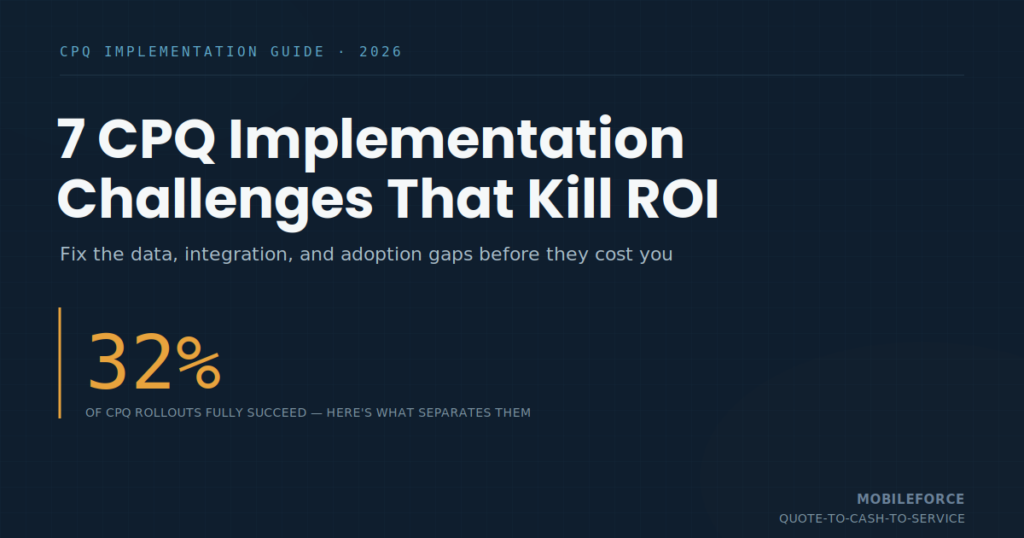
TL;DR: Only 32% of CPQ implementations succeed, and the failure mode is almost never the software. The seven cpq implementation challenges that kill ROI are dirty data, weak integrations, misconfigured pricing, underfunded change management, workflows built for theory instead of reality, scope creep, and platform governance gaps. Fix these before go-live, not after.
Only 32% of CPQ implementations are considered fully successful by the teams that deployed them. That’s not a rounding error, that’s two out of three projects underdelivering on what they promised the business.
The failure mode is rarely technical. It’s operational: misaligned processes, weak data foundations, and change resistance that shows up weeks after go-live, once the project team has already moved on.
The cost doesn’t stop at delay. A stalled CPQ rollout keeps leaking margin and losing deal velocity long after the “launch” date passes, because nobody budgeted for what happens after the ribbon cutting.
Most CPQ implementations don’t fail because the platform is wrong. They fail because the data, integrations, and people around it weren’t ready. These seven cpq challenges show up across failed and stalled projects, regardless of vendor or industry.
CPQ is only as accurate as the product and pricing data behind it. Most teams discover mid-implementation that their catalogue has duplicate SKUs, inconsistent naming, and pricing exceptions that live only in one rep’s head.
This is the number one cause of CPQ project delays. A pre-implementation data audit isn’t optional, it’s the first real milestone. Skip it, and you’re configuring a system on top of a mess you’ll clean up twice: once now, once after go-live.
Getting this right connects directly to how accurate quote configuration directly impacts sales team close rates and margin protection.
CPQ doesn’t sit alone. It pulls pricing from ERP, pushes quotes into CRM, and in field service environments, triggers dispatch workflows downstream.
Integration failures are the second biggest cause of stalled rollouts. The hard part isn’t the first connection, it’s keeping data in sync once any connected system updates on its own schedule. Point-to-point integrations break under that pressure. A unified platform doesn’t.
If you’re weighing a move off legacy tools, the data migration risks that come with moving from a legacy CPQ or Salesforce CPQ to a modern platform are worth reading before you sign anything.
B2B manufacturing pricing isn’t simple math. Volume discounts, customer contracts, regional pricing, tariff adjustments, and promotional overrides all stack on top of each other.
Get one rule wrong and quotes go out at the wrong price. Nobody catches it until a deal closes at margin nobody wanted. And these cpq accuracy challenges don’t end at launch. A misconfigured rule from month one can quietly leak margin for months before an audit finds it, which is exactly why challenges in maintaining accuracy in cpq systems are an ongoing job, not a setup checklist.
A technically flawless CPQ implementation still fails if reps go back to spreadsheets because the new system feels slower.
Most companies spend 80% of the implementation budget on technology and 20% or less on training and adoption. That ratio is backwards. The 90 day window after launch is where implementations live or die, and cpq user adoption challenges that aren’t caught by day 90 rarely fix themselves without a deliberate re-engagement push.
The bar isn’t a CPQ that works in a demo. It’s one that reflects how your reps actually sell, how ops actually fulfills, and how customers actually buy.
Most implementations get configured around how leadership assumes the process works. Reality diverges fast. Reps find workarounds, exceptions pile up, and CPQ becomes a parallel system instead of the system of record. That’s the definition of a failed rollout, no matter what the go-live announcement said.
Every CPQ project starts with a manageable scope. Then a stakeholder adds “just one more” pricing rule, then a product line, then an integration nobody scoped for.
Scope creep is the primary reason implementations run 40 to 60% over timeline. It happens because there’s no single owner, no defined MVP, and no change control process. The fix is a phased rollout: ship a working core first, layer complexity in afterward. Trying to launch everything at once is how cpq go live challenges turn into cpq rollout challenges that drag into next year.
Salesforce CPQ is the most widely deployed platform in this category, and it comes with its own layer of risk. Bundle configuration, price waterfall management, quote template governance, SBQQ namespace management, these aren’t bugs. They’re features that need dedicated expertise to run correctly.
Without a named governance owner, salesforce cpq challenges compound as the catalogue and pricing rules grow. 67% of Salesforce CPQ deployments require major reconfiguration within 18 months, mostly because nobody owned the platform after the consultants left.
Mobileforce approaches CPQ implementation as a structural problem, not a software problem, which is exactly where most of these seven challenges start and end.
Challenge | How Mobileforce addresses it |
Data quality & config complexity | Pre-built catalogue templates and guided configuration wizards cut data prep time by up to 60% |
CRM/ERP integration | Native connectors for Salesforce, HubSpot, Creatio, SugarCRM, and Microsoft, no middleware, no sync lag |
Pricing rule accuracy | Rules engine with approval workflows, override audit trails, and real-time margin visibility on every quote |
Change management & adoption | Role-based guided selling flows matched to how your team already sells |
Workflow alignment | Configured to your actual sales motion, with field service dispatch on the same platform |
Scope creep & timeline | Phased deployment, core CPQ live in weeks with complexity layered in afterward |
Salesforce CPQ governance | Operates as a unified layer across CRMs, removing single-platform dependency |
See how manufacturing and field service teams running on Salesforce, HubSpot, and Microsoft use Mobileforce to implement CPQ without the typical failure modes — explore how it works
CPQ implementation challenges aren’t random. Data problems, integration gaps, change resistance, and scope creep show up in nearly every stalled project, regardless of platform or industry.
The companies that get this right treat CPQ as a business transformation, not a software deployment. They audit data before go-live, build configuration around actual workflows, and fund adoption as seriously as they fund integration.
If your team is weighing a b2b cpq implementation and wants to avoid these failure modes from day one, talk to Mobileforce about Quote-to-Cash-to-Service on Salesforce, HubSpot, Microsoft, Creatio, or SugarCRM.
What are the most common cpq implementation challenges?
Dirty product data, weak CRM/ERP integration, misconfigured pricing rules, and underfunded change management. These four account for most stalled or failed rollouts.
CPQ solves which of the following challenges: slow quoting, pricing errors, or configuration mistakes?
All three. A properly implemented CPQ automates configuration logic, applies pricing rules consistently, and cuts quote turnaround from days to hours, but only if the underlying data and workflows were set up correctly first.
What causes compliance challenges for cpq in regulated industries?
Missing audit trails on price overrides and approval workflows. Without a documented approval chain, discounted or non-standard quotes can’t be traced back to who approved them.
How long do sales challenges cpq related to adoption usually last after launch?
If adoption gaps aren’t addressed by day 90, they tend to persist. Reps who revert to spreadsheets in the first three months rarely come back without a structured re-engagement effort.
Are cpq system integration challenges worse for manufacturers specifically?
Yes. Manufacturers and field service companies see 2.3x more integration failures than pure SaaS businesses, largely because CPQ has to connect to ERP and field service dispatch, not just CRM.