Most companies believe CPQ modernization requires abandoning their existing CRM system, creating expensive “rip and replace” scenarios. Mobileforce’s native CRM integrations eliminate this false choice by preserving current CRM investments while delivering modern quote capabilities. With pre-built connectors for HubSpot, Salesforce, Microsoft Dynamics 365, SugarCRM, and Creatio, organizations can complete CPQ migrations in 25-47 days instead of 6+ months, avoiding $50K-$200K in custom integration costs while maintaining familiar workflows that accelerate user adoption significantly.
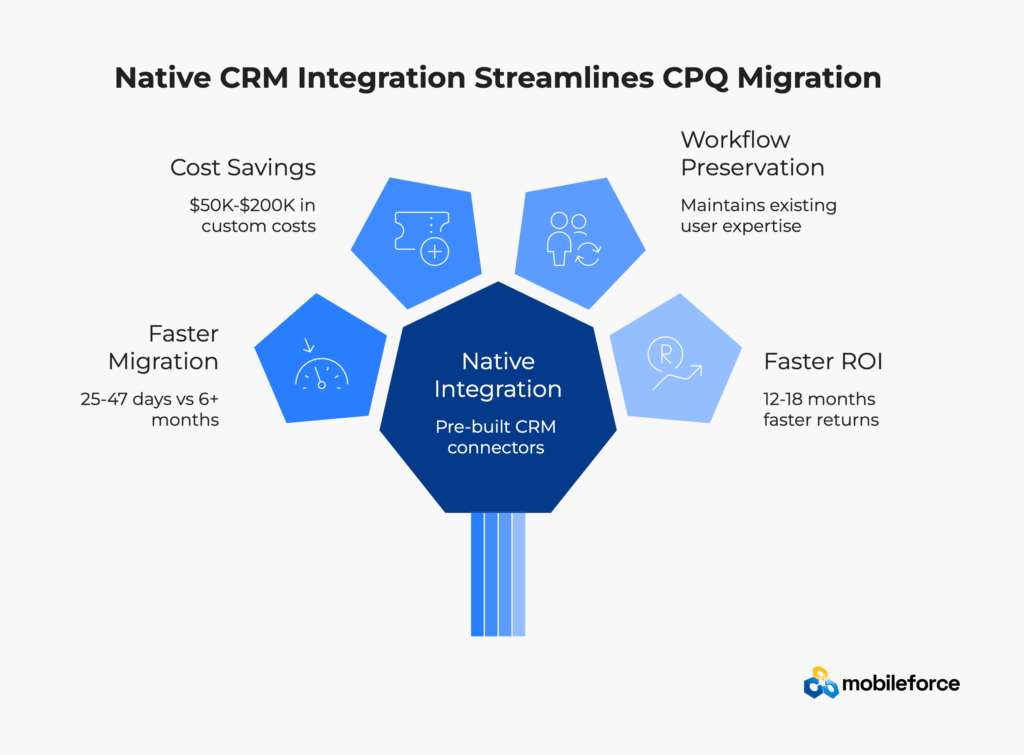
When manufacturing executives discuss their failed CPQ implementations, they rarely blame the data migration. The real culprit? Integration nightmares that turn 6-week projects into 6-month ordeals.
According to McKinsey research, 70% of transformation projects fail due to execution challenges, with integration complexity being a primary factor. This statistic becomes particularly relevant in CPQ migrations, where companies often face an impossible choice: keep their existing CRM investment or modernize their quoting processes.
Most CPQ vendors approach migration with a platform-centric mindset. They’ve built powerful quoting engines, but integration feels like an afterthought. The result? Companies find themselves forced into comprehensive system overhauls that impact every aspect of their sales operations.
According to Gartner research, the CPQ applications market grew by 15.5% to $1.42 billion in 2019, demonstrating continued demand for sophisticated quoting solutions that can seamlessly integrate with existing business systems. However, this growth is hampered by integration complexity that turns promising implementations into expensive failures.
Traditional migration challenges create a cascade of costs and complications. Custom integration development typically requires $50K-$200K in consulting fees, plus ongoing middleware licensing costs of $2K-$10K monthly just to maintain connectivity. The technical maintenance burden alone demands specialized expertise that most organizations don’t have in-house.
Timeline extensions compound these costs significantly. Custom API development can stretch implementation schedules by 3-6 months, followed by extended testing periods for complex integration scenarios. Meanwhile, teams struggle with learning new workflows across multiple systems simultaneously, creating productivity drains that persist long after go-live.
Perhaps most painfully, companies risk losing substantial previous investments. CRM customizations representing $100K+ in development time often can’t transfer to new systems, while months of user training investments become stranded when familiar workflows disappear. Historical data integration challenges across disconnected systems further complicate the transition, making what should be a straightforward modernization project into an enterprise-wide disruption.
Ready to explore how native integration can eliminate these migration risks? Schedule a demo to see how Mobileforce preserves your CRM investment while delivering modern CPQ capabilities.
Recent industry research indicates that digital transformation initiatives often fail to meet ROI expectations, with integration complexity being the primary culprit. For CPQ migrations specifically, integration failures create cascading business impacts:
When CPQ migrations fail due to integration challenges, the financial impact extends far beyond the initial project budget:
Direct Financial Impact:
Hidden Opportunity Costs:
Transform your quoting capabilities while preserving existing CRM investments. Schedule a demo to discover how Mobileforce’s integration-first approach eliminates traditional migration risks.
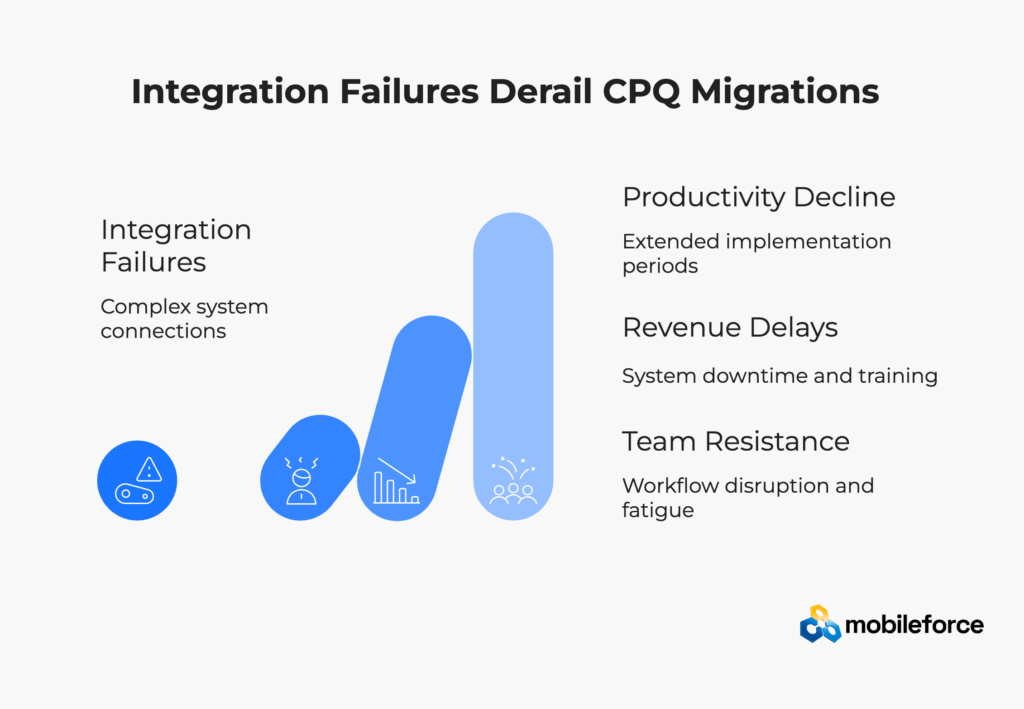
Mobileforce takes a fundamentally different approach to CPQ migration. Instead of forcing companies to choose between their CRM investment and modern quoting capabilities, Mobileforce’s native connectors preserve existing workflows while extending functionality.
As a HubSpot Platinum Partner, Mobileforce provides more than connectivity – it delivers true platform extension that maintains familiar user experiences while adding sophisticated quote generation capabilities.
Enterprise-Grade HubSpot Integration Features: Real-time deal synchronization triggers automated quote generation while native workflow integration maintains existing approval processes. Unified reporting combines CRM activity with quote performance metrics, and mobile-optimized experiences stay consistent across HubSpot and CPQ interfaces.
Research shows that CPQ software enables sales teams to achieve 10x faster quotation production and 95% shorter approval times, but these benefits only materialize when the system integrates seamlessly within existing CRM workflows. The Platinum partnership status demonstrates Mobileforce’s commitment to deep platform expertise, ensuring that integrations evolve with HubSpot platform updates and new feature releases.
Beyond HubSpot, Mobileforce supports diverse CRM environments through purpose-built connectors that preserve existing investments while adding modern CPQ capabilities. Salesforce integration maintains opportunity management processes and complex territory structures without requiring modifications to current workflows. Microsoft Dynamics 365 integration provides native connectivity with Sales and Customer Service modules, supporting Power Automate workflow automation and Power BI reporting while preserving existing customizations.
The SugarCRM partnership delivers joint solution development with shared customer success resources, ensuring optimal performance across unified quote-to-cash processes. Creatio native connectivity leverages no-code platform synergy, enabling rapid customization through visual workflow builders without creating technical debt.
Additional platform support extends to service-focused organizations through Zendesk integration for quote-to-case workflows, Zoho CRM connectivity for mid-market scenarios, and extensible architecture enabling integration with virtually any CRM platform.
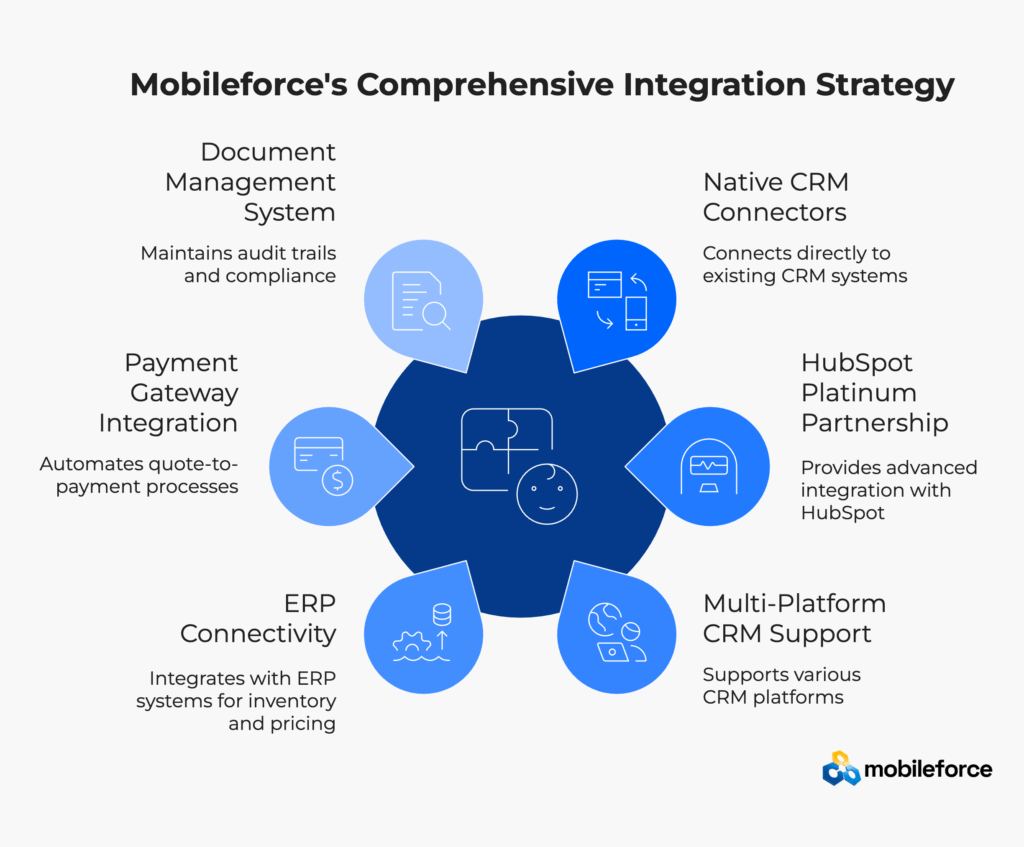
Mobileforce’s integration capabilities extend far beyond CRM connectivity to encompass complete enterprise ecosystems. ERP connectivity provides real-time inventory visibility within CRM quote workflows while ensuring accurate pricing and credit limit validation. Order management synchronization maintains consistency between quote approval and fulfillment, with multi-currency and multi-subsidiary support for global operations.
The platform seamlessly connects with payment gateways for quote-to-payment automation, billing systems for subscription models, and accounts receivable systems for credit history visibility. Real-time inventory checking prevents overselling situations while warehouse management integration provides accurate delivery timeframes. Supply chain disruption alerts keep quote commitments realistic and customer communications current.
Document management system connectivity maintains complete audit trails while email marketing integration supports follow-up campaigns directly from quote data. Compliance and audit system integration ensures regulatory requirements are met throughout the quote lifecycle.
|
Migration Approach |
Timeline |
Integration Cost |
User Training |
Risk Level |
|
Traditional Custom Integration |
6-12 months |
$50K-$200K |
2-3 months |
High |
|
Middleware Platform |
4-8 months |
$25K-$100K + licensing |
1-2 months |
Medium |
|
Mobileforce Native Connectors |
25-47 days |
$0 custom development |
2-3 weeks |
Low |
Discover how native integration can accelerate your CPQ implementation timeline. Get a demo to see the difference pre-built connectors make in migration speed and cost.
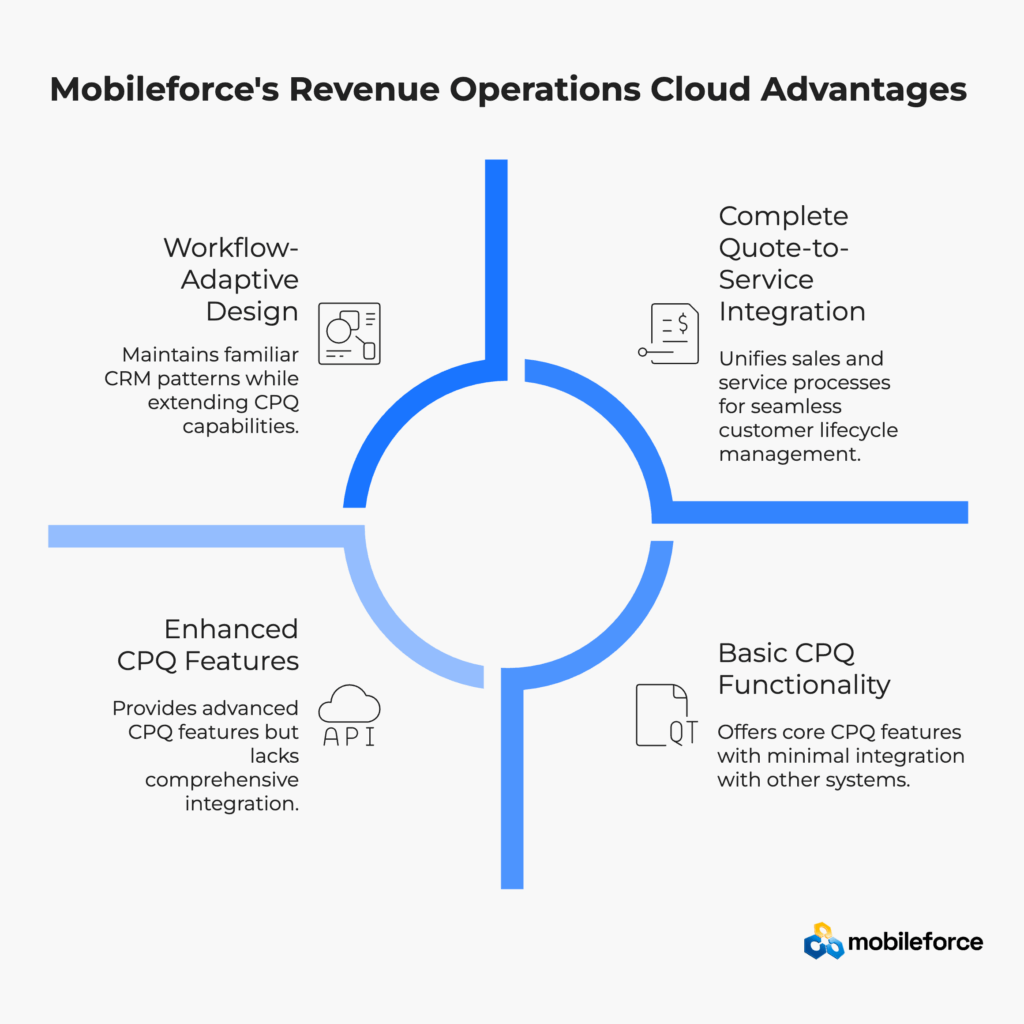
Mobileforce positions itself not just as a CPQ solution, but as a comprehensive Revenue Operations Cloud that unifies quote-to-cash-to-service processes. This broader platform approach provides additional migration advantages:
Complete Quote-to-Service Integration: Mobileforce’s Revenue Operations Cloud extends CPQ functionality through Field Service Management (FSM) capabilities that generate service contracts and manage renewals within familiar CRM workflows. This unified approach optimizes revenue across both sales and service touchpoints while maintaining consistent customer lifecycle management from initial quote through ongoing service delivery.
Contract lifecycle management automates generation from approved quotes within existing CRM processes, while contract renewal workflows leverage existing opportunity and relationship data. The platform includes SOC 2 Type II certification, GDPR compliance, and ISO 22301:2019 Business Continuity Management certification, ensuring enterprise-grade security that leverages existing CRM authentication and permission structures.
Traditional CPQ systems force users to learn entirely new interfaces and processes. Mobileforce’s workflow-adaptive approach maintains familiar patterns while extending capabilities, making quote generation feel like a natural CRM workflow extension. Mobile experiences stay consistent across integrated systems while approval processes leverage existing CRM authorization frameworks and reporting builds upon familiar dashboard patterns.
Enhanced capabilities work within these familiar workflows through AI-powered product recommendations using CRM customer history, automated pricing calculations integrated with opportunity stages, and no-code configuration enabling rapid customization. The mobile-first architecture provides full CPQ functionality on mobile devices with offline quote generation capabilities, automatic synchronization when connectivity resumes, and hybrid cloud architecture supporting both online and offline workflows seamlessly.
When CPQ solutions integrate natively with existing CRMs, data migration becomes significantly simpler and more reliable. Rather than moving data between disconnected systems, companies can leverage existing CRM data structures while extending functionality.
Native integration maintains the data context that sales teams rely on for effective customer relationship management:
Customer Hierarchy Preservation:
Opportunity Integration Benefits:
Industry research consistently shows that companies with integrated sales processes achieve significantly faster sales cycles compared to organizations using disconnected systems.
Mobileforce’s integration approach enables sophisticated legacy data handling while preserving business continuity. Historical quotes import as CRM activity records, maintaining complete sales history while pricing patterns and customer preferences transfer directly to new quote templates. Contract terms maintain continuity for renewal processes, and performance analytics incorporate historical data for accurate trend identification.
Business rule translation ensures that existing CRM approval workflows extend seamlessly to enhanced quote processes. Sales methodology automation maintains familiar stages and milestone tracking while territory-based pricing rules preserve existing governance structures and commission calculations stay consistent across quote and opportunity data.
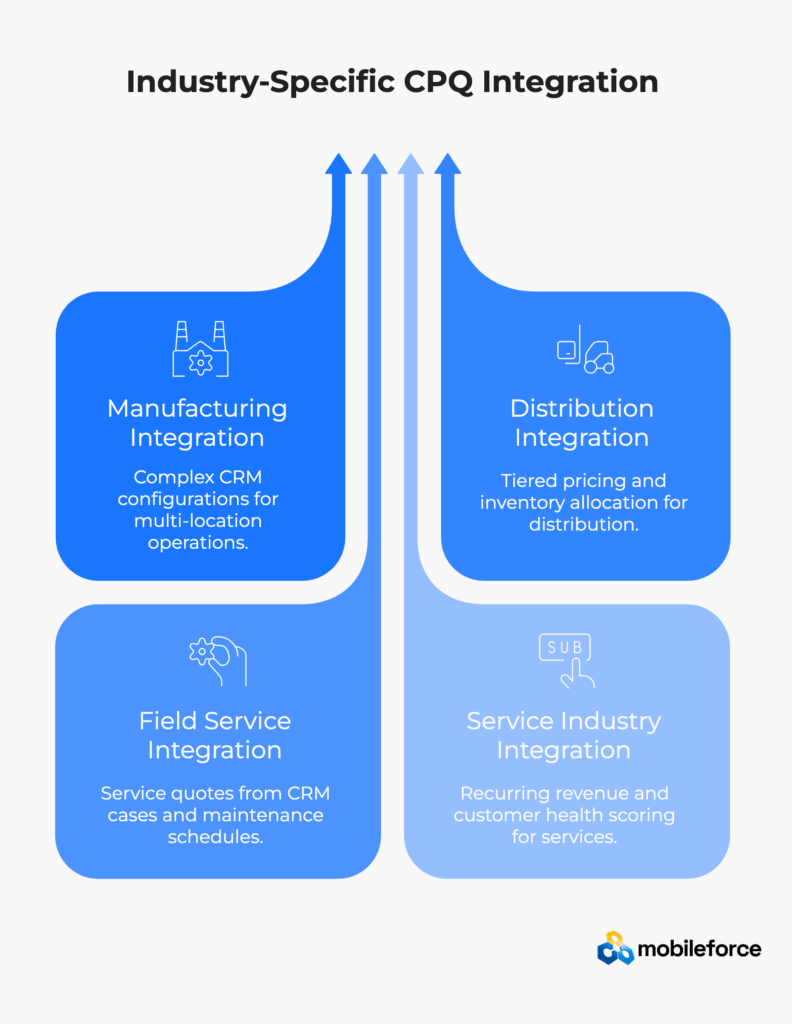
Different industries face unique challenges when migrating CPQ systems. Mobileforce’s native CRM integrations address sector-specific requirements while preserving industry workflow expertise.
Manufacturing companies often have complex CRM configurations supporting multi-location operations, channel partner management, and inventory integration requirements. Real-time inventory visibility from ERP systems works within familiar CRM quote workflows while multi-currency pricing calculations integrate with global customer management processes.
Channel partner pricing structures maintain CRM territory and relationship management, while supply chain disruption alerts keep quote delivery commitments realistic. Distribution channel integration leverages existing CRM partner management workflows with tiered pricing structures that maintain territory and account hierarchy logic. Inventory allocation integration supports CRM opportunity and forecast management while commission calculations maintain existing ownership structures.
Field Service Management integration generates service quotes directly from CRM service cases and maintenance schedules, incorporating equipment history and warranty information for accurate pricing. Field technicians access customer data and service history through familiar CRM interfaces while service contract renewals and upselling opportunities appear through integrated analytics.
See how manufacturing companies accelerate quote processes while preserving CRM investments. Schedule a consultation to explore industry-specific integration capabilities.
Service organizations often have sophisticated CRM configurations supporting customer lifecycle management, recurring revenue tracking, and service delivery coordination.
Service Industry Integration Benefits:
|
Implementation Phase |
Custom Integration |
Native Connector |
|
Planning and Design |
4-6 weeks |
1-2 weeks |
|
Development and Testing |
12-16 weeks |
2-3 weeks |
|
User Training |
6-8 weeks |
2-3 weeks |
|
Go-Live and Optimization |
4-6 weeks |
1-2 weeks |
|
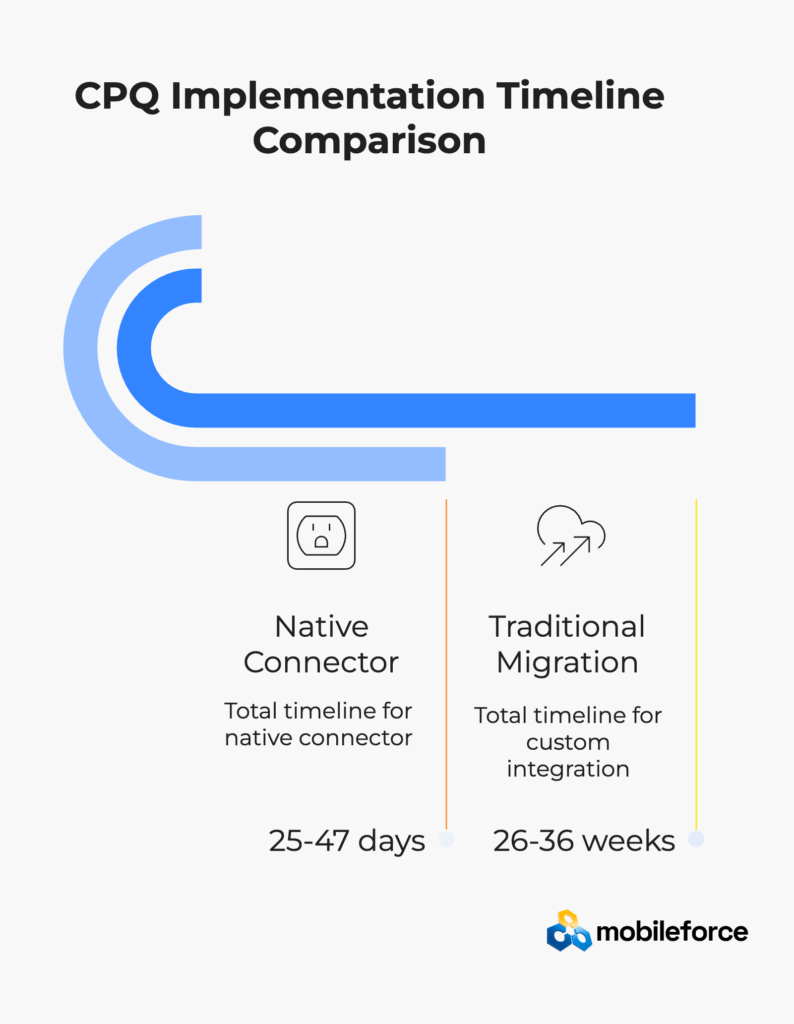
Total Timeline |
26-36 weeks |
25-47 days |
Weeks 1-2: Foundation Setup Native connector installation and initial configuration establishes secure authentication while basic data synchronization testing validates connectivity. User permission mapping ensures seamless transition from CRM to CPQ environments.
Weeks 3-4: Product Catalog Integration Product hierarchy mapping maintains familiar CRM relationships while pricing rule configuration integrates with existing CRM approval processes. Quote template setup preserves brand requirements and guided selling workflows leverage established CRM customer data.
Weeks 5-6: User Training and Rollout Super user training focuses on enhanced capabilities within familiar CRM workflows while pilot testing validates real customer scenarios. Full team deployment happens through phased enablement by territory or product line, with performance monitoring guiding optimization based on actual usage patterns.
Weeks 7-8: Advanced Feature Enablement AI-powered quote recommendations activate using integrated customer data while advanced reporting spans both CRM and CPQ information. Mobile optimization supports field sales teams with unified data access, and integration expands to additional systems using established connectivity patterns.
Unlike traditional CPQ implementations that often experience scope creep and extended timelines, Mobileforce provides guaranteed implementation within 25-47 days through their structured deployment methodology. This contractual commitment eliminates project uncertainty while dedicated implementation specialists ensure consistent progress and milestone achievement. Pre-built integration templates reduce configuration time and deployment risk, supported by standardized onboarding methodology proven across numerous successful implementations.
Rapid deployment becomes possible through no-code configuration that eliminates custom development delays, pre-tested native connectors that reduce integration validation requirements, automated data migration tools that minimize manual configuration efforts, and template-based setup procedures that accelerate initial system configuration.
Companies considering CPQ migration often underestimate the total cost of system replacement. Native integration preserves existing investments while delivering comparable functionality improvements.
Traditional Migration Total Costs:
Native Integration Approach:
Harvard Business Review research emphasizes that successful digital transformation requires coordinated integration of technology across the enterprise rather than piecemeal implementations. Similarly, Deloitte’s 2020 digital transformation survey found that higher-maturity organizations were three times more likely to significantly outperform their industry average on key financial metrics compared to lower-maturity companies.
For CPQ implementations specifically:
Traditional Migration Timeline to ROI:
Native Integration Timeline to ROI:
Calculate your specific ROI potential with native CRM integration. Contact Mobileforce for a customized analysis based on your current CRM investment and migration requirements.
Ready to explore how no-code CPQ implementation can accelerate your quote-to-cash processes? Request a demo to see native CRM integration in action.
Beyond basic connectivity, Mobileforce provides sophisticated integration features that enhance both CRM and CPQ functionality through unified data and workflow management.
Mobileforce’s AskCPQ AI agent leverages integrated CRM data to provide intelligent recommendations and automation within familiar user workflows.
The AI-enhanced CRM integration analyzes customer history to inform product configuration recommendations while pricing optimization draws from historical deal patterns and market data. Upsell and cross-sell opportunities surface automatically using integrated customer and product data, and automated follow-up scheduling responds to quote status and CRM engagement tracking.
Predictive analytics integration enables sophisticated deal risk assessment by combining quote complexity with CRM opportunity data. Sales coaching recommendations emerge from integrated activity and performance metrics while forecast accuracy improves through unified CRM and quote data analysis. Performance optimization suggestions target both territories and individual representatives based on comprehensive data integration.
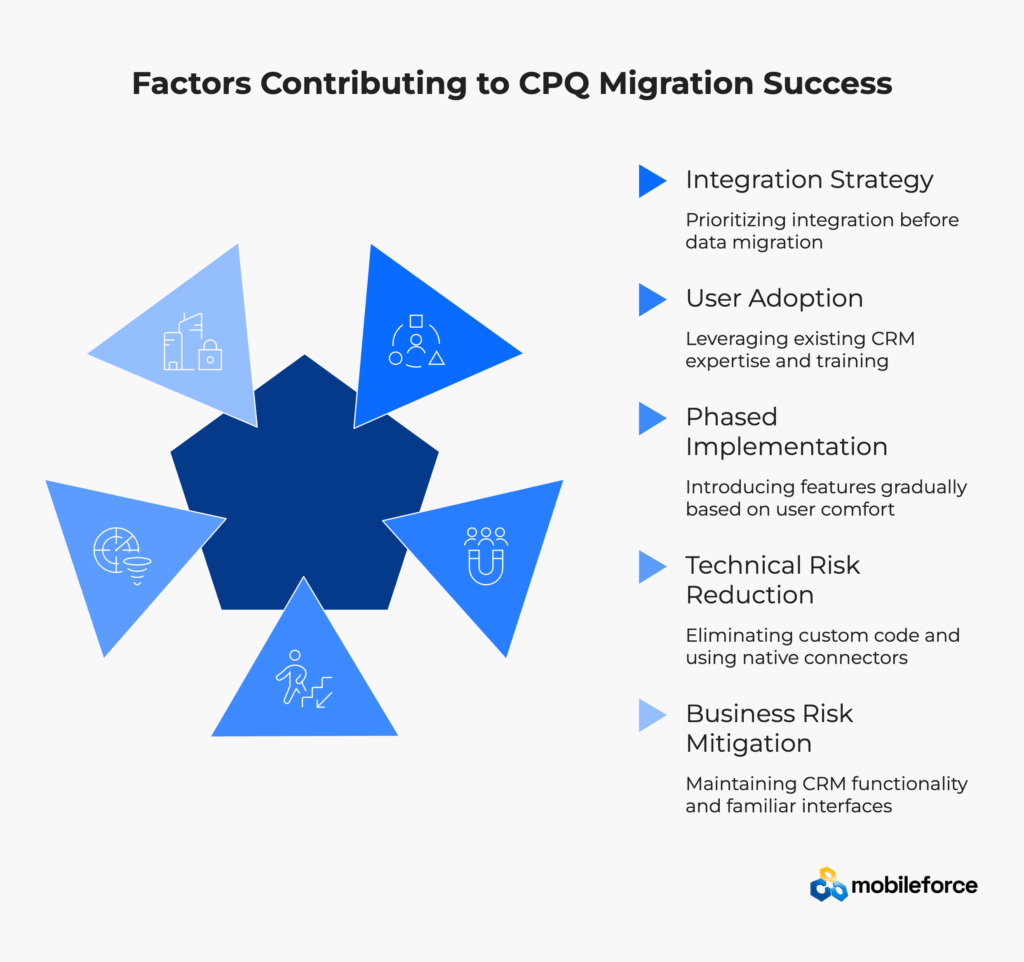
Companies achieve the highest migration success rates when they focus on integration strategy before addressing data migration complexity. Mobileforce’s approach prioritizes workflow preservation while delivering capability enhancement.
Integration Strategy Before Data Migration Success begins with evaluating native connector capabilities before committing to custom development. Testing workflow preservation through pilot implementations using real user scenarios validates approaches, while sandbox testing with actual data volumes confirms performance expectations meet business requirements.
User Adoption Through Familiarity
The most successful implementations leverage existing CRM expertise and training investments rather than starting from scratch. New capabilities should be introduced gradually within familiar workflow patterns, with enhancement training building upon existing knowledge rather than requiring complete system retraining.
Technical Risk Reduction:
Business Risk Mitigation Preserved CRM functionality maintains business continuity during transition while familiar user interfaces reduce training requirements and adoption resistance. Gradual feature introduction allows teams to build comfort and confidence at their own pace, minimizing disruption to daily operations.
Ensure your CPQ migration success with proven integration strategies. Schedule a demo to see how native connectors reduce implementation risk while accelerating time-to-value.
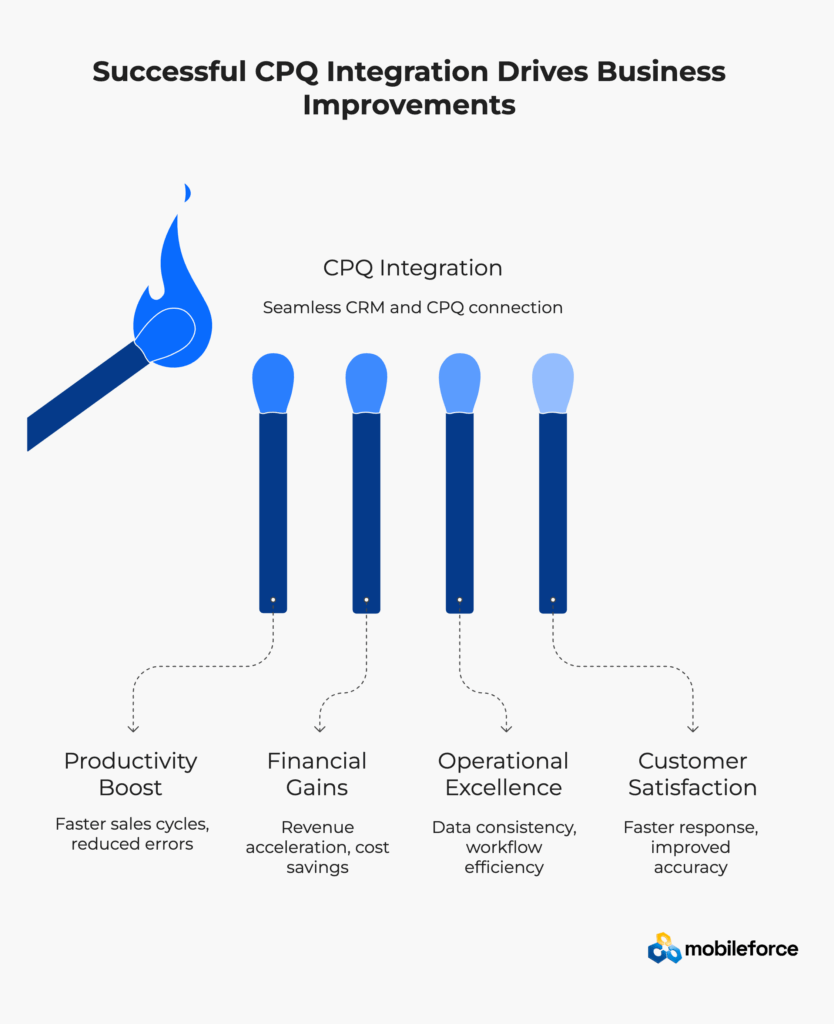
Successful CPQ migration extends beyond basic functionality to deliver measurable business improvements through enhanced productivity and preserved user expertise.
Productivity and Financial Impact Quote generation time reduction within existing CRM workflows directly accelerates sales cycles through integrated data and automated processes. Error rate reduction through automated pricing and configuration validation combines with higher user adoption rates to demonstrate both transition success and training effectiveness.
Revenue acceleration happens through faster quote-to-close cycles while cost savings emerge from eliminated manual processes and reduced error correction needs. Perhaps most importantly, preserved investment value maintains CRM functionality and customizations, while integration cost avoidance through native connectors eliminates the expensive custom development alternative.
Operational Excellence
Data consistency accuracy between CRM and CPQ systems improves dramatically while workflow efficiency gains come from automated integration processes. Customer satisfaction enhancement results from faster response times and improved accuracy, supported by team satisfaction metrics that reflect reduced friction and maintained workflow familiarity.
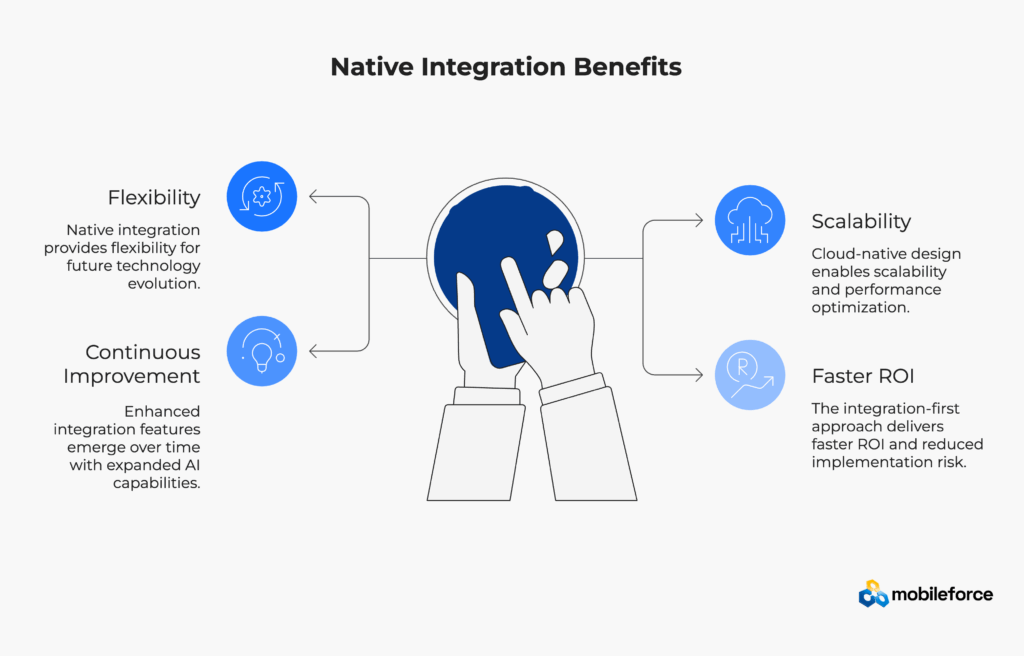
Native CRM integration provides flexibility for future technology evolution while protecting current investment and user expertise. Multi-platform connector support enables future CRM migration if needed, with standardized integration patterns reducing switching costs between supported platforms. Meanwhile, preserved CPQ functionality maintains business continuity during any future CRM changes.
The API-first architecture supports additional system integration as business requirements expand, while cloud-native design enables scalability and performance optimization. Regular platform updates ensure compatibility with evolving CRM capabilities, creating a foundation that grows with business needs rather than constraining them.
Enhanced integration features emerge over time as expanded AI capabilities leverage larger integrated data sets for more sophisticated recommendations. Advanced analytics using combined CRM and CPQ historical information reveal patterns and opportunities previously hidden in disconnected systems. Workflow automation opportunities surface through usage pattern analysis, while integration expansion to additional business systems builds naturally upon established connectivity patterns.
CPQ migration doesn’t require abandoning your CRM investment. Mobileforce’s native integration approach preserves existing workflows while delivering modern quote capabilities, eliminating the false choice between technological advancement and operational continuity. Through pre-built connectors for HubSpot, Salesforce, SugarCRM, and Creatio, companies can modernize their quoting processes in weeks rather than months while maintaining the user expertise and system customizations that drive their business success.
The integration-first approach delivers faster ROI, reduced implementation risk, and higher user adoption rates compared to traditional migration strategies. By preserving familiar workflows while extending capabilities, organizations can achieve their CPQ modernization goals without the disruption and expense of comprehensive system replacement.
Q: Can we really preserve our CRM investment while getting modern CPQ capabilities? A: Yes. Mobileforce’s native connectors maintain your existing CRM configuration and workflows while adding sophisticated quote generation capabilities. Users continue working in familiar environments with enhanced functionality rather than learning entirely new systems.
Q: How much can we save by avoiding custom CRM integration development? A: Custom integration projects typically cost $50K-$200K with 3-6 month timelines. Native connectors eliminate these development costs entirely while providing enterprise-grade reliability and ongoing platform support.
Q: What happens to our CRM customizations during CPQ migration? A: All CRM customizations remain unchanged. Mobileforce integrates with your CRM as currently configured, preserving custom fields, workflows, approval processes, and business logic while extending capabilities through connected quote functionality.
Q: How quickly can we implement CPQ with native CRM integration? A: Most implementations complete within 25-47 days compared to 6+ months for traditional migrations requiring custom integration. The native connector approach eliminates development complexity and accelerates deployment through pre-built, tested connectivity.
Q: Will our sales team need extensive retraining with native integration? A: Training focuses on new capabilities rather than new systems. Users continue working within familiar CRM environments with enhanced quote generation features, significantly reducing learning curves and adoption resistance.
Q: What if we decide to change CRMs in the future? A: Mobileforce supports multiple CRM platforms with native connectors including HubSpot, Salesforce, Microsoft Dynamics 365, SugarCRM, Creatio, Zendesk, and Zoho CRM. Future CRM changes become simpler because CPQ processes remain independent while maintaining integration capabilities across supported platforms.
Q: How does native integration affect our data security and compliance requirements? A: Native integrations leverage your existing CRM security framework, often providing better security than custom development. Mobileforce maintains SOC 2 Type II certification, GDPR compliance, and ISO 22301:2019 standards, ensuring enterprise-grade security across all integrations.
Q: Can we integrate additional systems beyond CRM with this approach? A: Yes. Mobileforce’s Revenue Operations Cloud extends beyond CRM integration to include ERP, billing, service management, field service operations, contract management, and subscription billing systems. The platform supports quote-to-cash-to-service workflows with comprehensive ecosystem integration capabilities.
Q: What ongoing support is provided for CRM-CPQ integration? A: Mobileforce provides comprehensive integration support including setup assistance, user training, platform updates, and ongoing maintenance. Native connectors receive continuous enhancement and compatibility updates.
Q: How do we measure success with integrated CRM-CPQ workflows? A: Success metrics include quote generation speed within CRM workflows, user adoption rates, data accuracy between systems, sales cycle acceleration, and productivity improvement while maintaining familiar CRM functionality.
Q: Does the solution work for field sales teams without reliable internet connectivity? A: Yes. Mobileforce provides industry-leading offline capabilities, allowing field teams to generate quotes and update CRM data without internet connectivity. Changes automatically synchronize when connectivity resumes.
Q: Beyond CPQ and CRM integration, what other business functions does the platform support? A: Mobileforce offers a comprehensive Revenue Operations Cloud including Field Service Management, Connected Portal, Contract Lifecycle Management, subscription billing, and extensive ERP and back-office integrations. This unified approach eliminates multiple point solutions while maintaining seamless CRM integration.