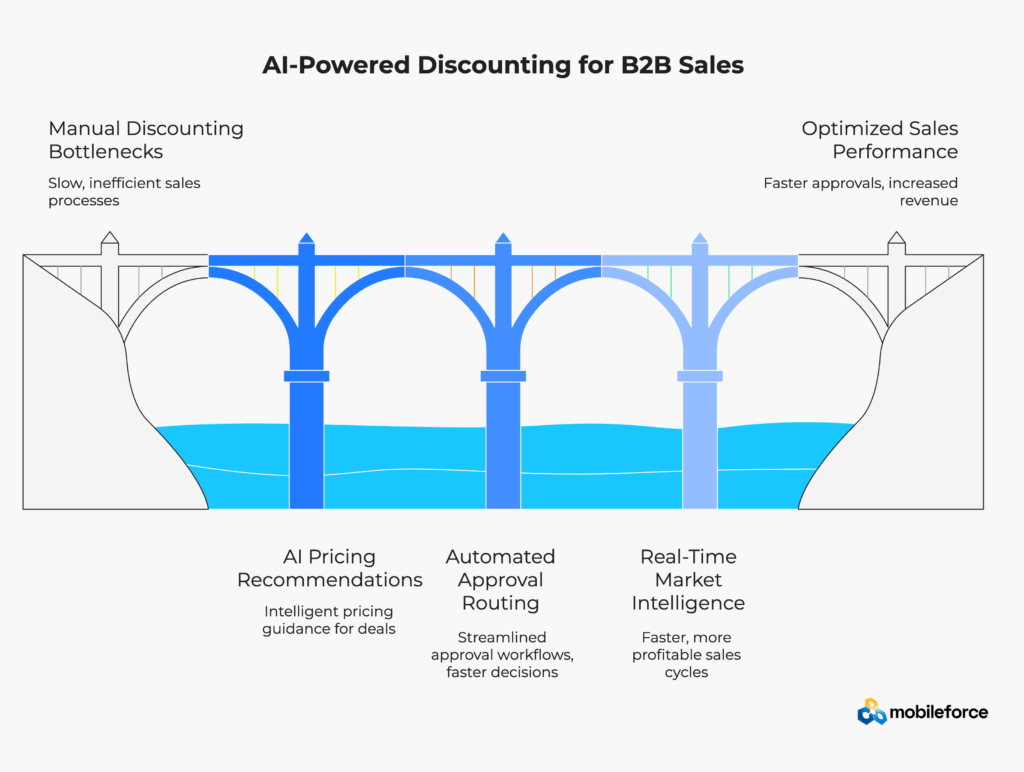
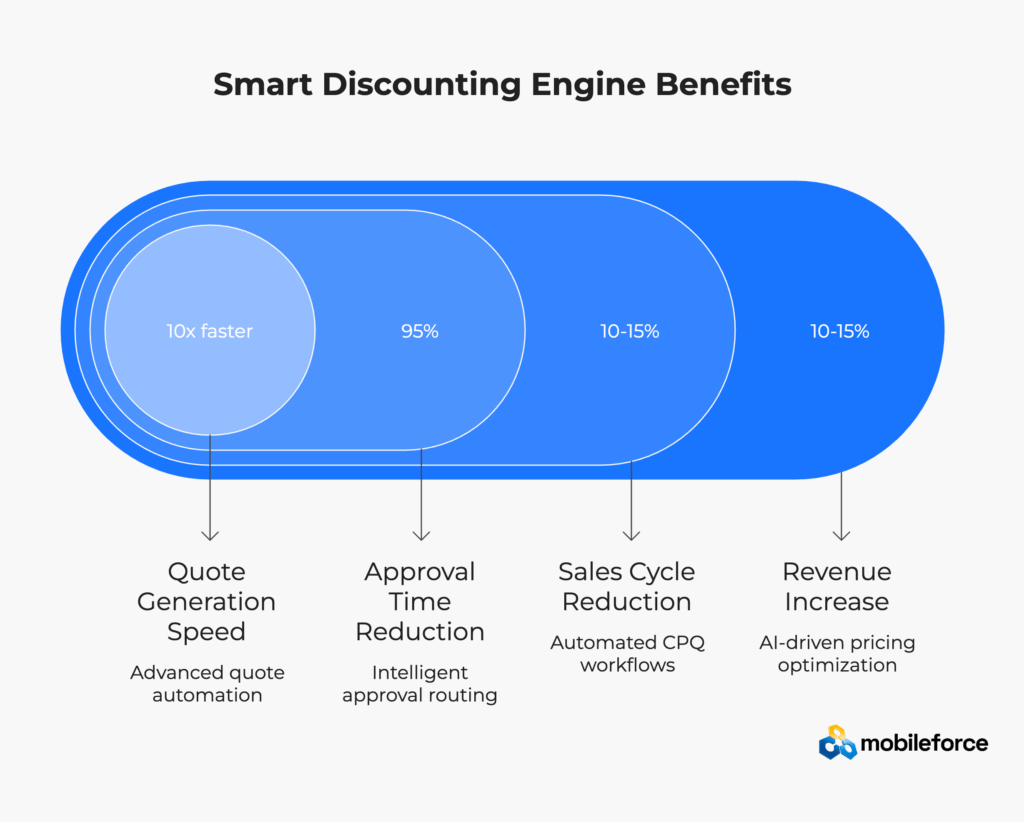
Smart discounting engines use AI to automatically optimize pricing decisions, streamline approval workflows, and eliminate manual bottlenecks in B2B sales processes. Companies implementing these systems see 10-15% revenue increases, 95% faster approvals, and 10x quicker quote generation while maintaining margin protection and compliance. The technology transforms deal desk operations through intelligent pricing recommendations, automated approval routing, and real-time market intelligence that enables faster, more profitable sales cycles.
“We used to spend 40% of our sales cycle just creating quotes. Now our AI CPQ handles complex configurations in minutes while I focus on actually selling.” – VP of Sales at Technology Company
Smart discounting engines represent the next evolution in B2B sales technology, combining artificial intelligence with automated pricing workflows to transform how companies manage quotes, approvals, and revenue optimization. These intelligent systems eliminate manual bottlenecks in deal desk operations while delivering measurable improvements in sales velocity, margin protection, and competitive positioning.
Modern enterprises implementing AI-powered pricing automation report significant operational improvements across multiple dimensions. From accelerated quote generation to streamlined approval processes, smart discounting platforms address the core challenges that have traditionally slowed B2B sales cycles and reduced profitability.
Ready to see how AI can transform your deal desk? Schedule a demo with Mobileforce.ai
“We used to spend 40% of our sales cycle just creating quotes. Now our AI CPQ handles complex configurations in minutes while I focus on actually selling.” – Sarah Chen, VP of Sales at TechFlow Solutions
Picture this common B2B sales scenario: Your sales representative just completed a promising discovery call with a Fortune 500 prospect. The deal appears solid, budget confirmed, decision makers identified. But then operational reality hits hard. Three weeks of back-and-forth emails for discount approvals. Multiple spreadsheet versions floating around different departments. Pricing inconsistencies compared to last month’s similar opportunity. And while your team scrambles with manual quote generation processes, your competitor leverages AI-powered pricing intelligence and sends an optimized proposal in 15 minutes, ultimately winning the business.
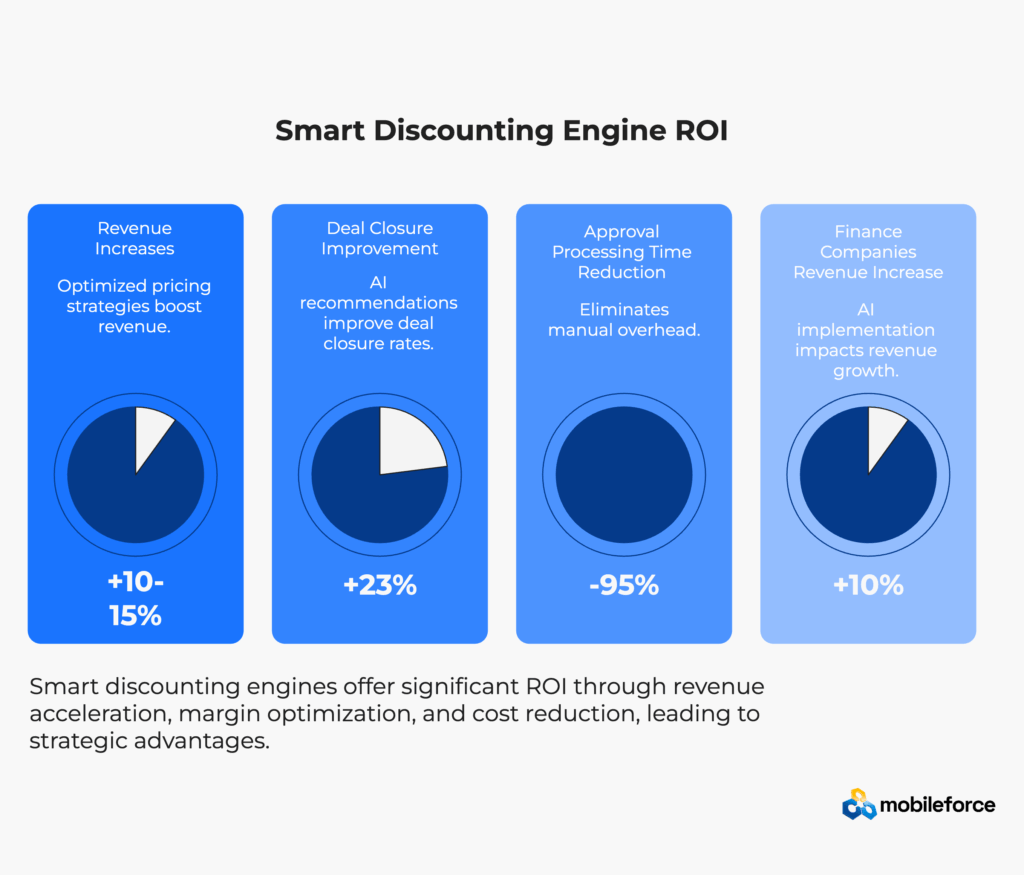
This scenario plays out thousands of times daily across B2B sales organizations worldwide. However, here’s what’s fundamentally changing everything: AI-driven smart discounting engines are systematically eliminating these operational bottlenecks and transforming how companies approach comprehensive deal desk optimization. McKinsey research demonstrates that companies implementing dynamic pricing optimization strategies see 10-15% revenue increases, while MIT studies indicate organizations using AI pricing solutions expect 10% profit boosts and 13% sales increases across various industry verticals.
The traditional deal desk operates like a traffic control system at a broken intersection. Every discount request creates operational bottlenecks. Sales representatives wait for approvals. Customers experience frustration during extended buying processes. Deals stall in approval queues. Meanwhile, intelligent competitors leverage AI-powered pricing engines to make split-second pricing decisions that simultaneously maximize win rates and preserve profitability.
However, this transformation isn’t merely about operational speed improvements – it’s fundamentally about implementing pricing intelligence that drives revenue optimization.
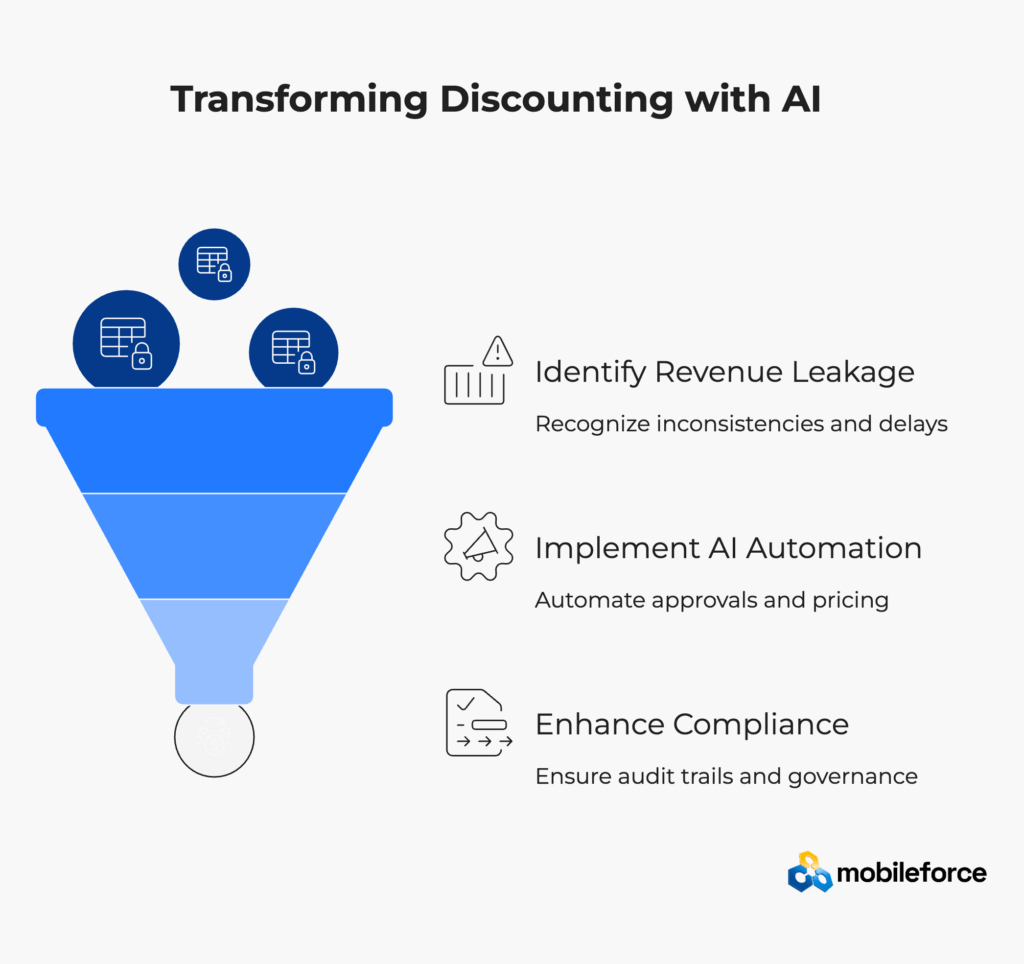
Most organizations experience significant revenue leakage through three critical operational gaps that impact their competitive positioning and financial performance:
Harvard Business Review research demonstrates that 71% of companies are actively implementing AI-powered pricing solutions to address these operational challenges. When your pricing strategy operates without intelligent automation, you’re essentially navigating complex deal scenarios without critical market visibility.
Consider this real-world scenario illustrating pricing inconsistency: One sales representative provides a 15% discount for a $50,000 opportunity while another offers 20% for a remarkably similar deal scenario. The inevitable result? Margin erosion across the business and confused market positioning that undermines brand value.
Traditional approval workflows create unnecessary operational friction that systematically kills deals and reduces sales team productivity:
Average Approval Processing Delays: Typically 3–5 business days for standard discount requests.
Manual Routing Inefficiencies: Deals often stall in approval queues due to non-automated workflows.
Limited Real-Time Visibility: Lack of transparency into approval status and decision-making rationale.
Inconsistent Approval Criteria: Variability across managers and organizational hierarchies leads to delays and confusion.
Smart discounting engines fundamentally flip this operational equation. They pre-approve discounting parameters based on comprehensive analysis of historical win rates, competitive intelligence data, and customer value profiles. Gartner studies demonstrate that businesses achieve 95% reduction in approval processing time through intelligent automation systems.
Transform your approval workflows with intelligent automation technology. See Mobileforce.ai’s CPQ solution in action
Smart discounting engines don’t merely accelerate deal progression – they automatically create comprehensive audit trails that enhance governance and regulatory compliance:
This transparency becomes invaluable during financial audits, contract reviews, and strategic planning sessions. Learn how Mobileforce.ai ensures compliance while accelerating your sales processes and maintaining audit readiness.
Summary: Traditional vs. Smart Discounting
Challenge Area | Traditional Approach | Smart Discounting Engine |
Approval Speed | 3-5 days average | Real-time to 2 hours |
Consistency | Manual, inconsistent | AI-driven, standardized |
Audit Trail | Limited documentation | Comprehensive logging |
Market Intelligence | Outdated, reactive | Real-time, predictive |
Error Rate | High (manual process) | Near-zero (automated) |
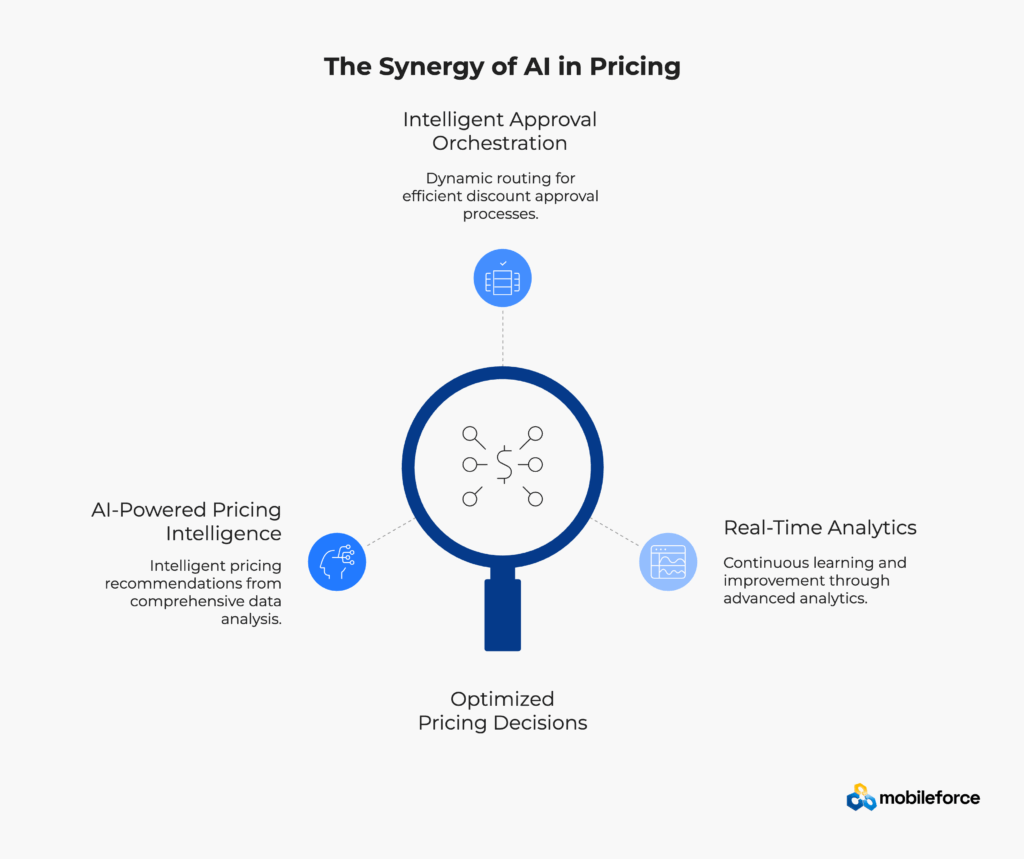
Modern smart discounting platforms integrate multiple AI-powered components that work synergistically to optimize pricing decisions and accelerate deal cycles across complex B2B sales environments.
Advanced pricing engines analyze multiple data streams simultaneously to deliver intelligent pricing recommendations:
According to Stanford Research Institute, AI pricing systems analyze individual customer behavior patterns in real-time to offer personalized discount recommendations based on statistical purchase likelihood models. Think about Amazon’s sophisticated pricing algorithms, but specifically applied to complex B2B sales scenarios with multiple stakeholders and longer decision cycles.
These intelligent systems learn that enterprise customers in financial services sectors respond differently to bundling strategies compared to mid-market manufacturing prospects. This granular market intelligence drives more effective pricing decisions across diverse customer segments and industry verticals.
Gone are the traditional days of linear approval chains that create unnecessary delays. Smart engines route discount requests dynamically based on comprehensive business rules:
Advanced systems reduce approval processing delays by 95% through this intelligent routing methodology. Sales velocity increases dramatically while maintaining proper governance controls and compliance requirements.
Ready to automate your approval workflows and eliminate bottlenecks? Explore Mobileforce.ai’s intelligent routing capabilities
The most effective discounting engines don’t merely execute pricing decisions – they continuously learn and improve through advanced analytics and machine learning algorithms:
For example, if analytical data reveals that 18% discount levels in Q3 software deals close 40% faster without significantly impacting gross margins, the system automatically adjusts its recommendations accordingly. This optimization happens continuously and automatically, without requiring manual intervention from sales management.
Discover Mobileforce.ai’s analytics capabilities for comprehensive revenue operations teams seeking data-driven insights.
Core Components Comparison
Component | Traditional Systems | AI-Powered Systems |
Pricing Logic | Static rules | Dynamic, learning algorithms |
Approval Routing | Linear workflows | Context-aware, intelligent routing |
Market Intelligence | Manual research | Real-time automated analysis |
Optimization | Periodic manual review | Continuous AI-driven improvement |
Decision Speed | Hours to days | Seconds to minutes |
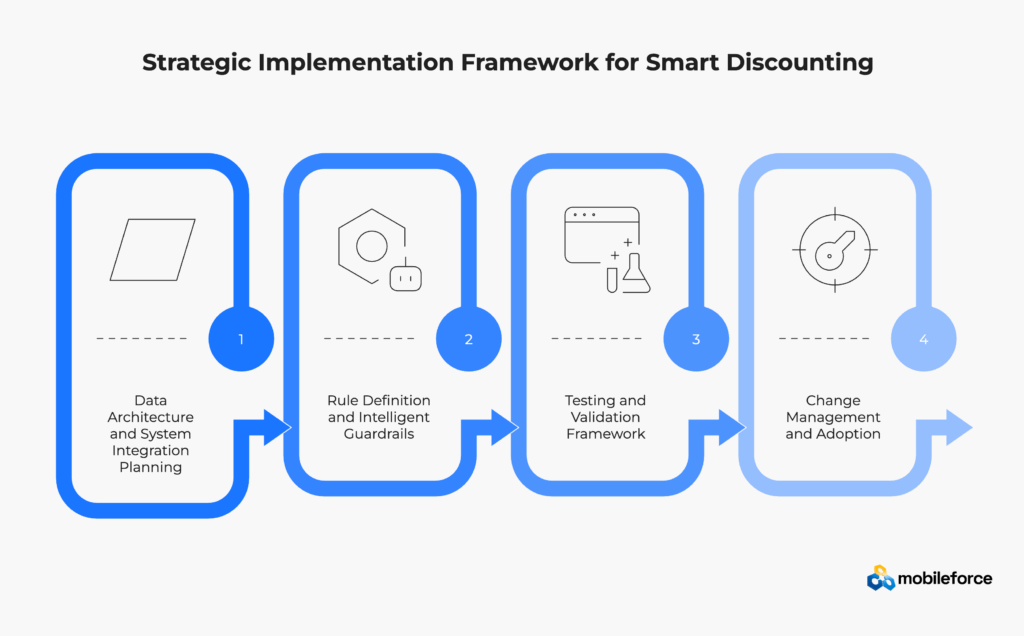
Successful smart discounting implementation requires a systematic approach that carefully balances advanced technical capabilities with comprehensive organizational change management strategies for maximum ROI and user adoption.
Implementation success begins with clean, integrated data architecture. Your discounting engine requires seamless access to multiple business-critical data sources:
According to MIT Technology Review, data quality serves as the foundational element of effective AI pricing systems. Modern CPQ systems integrate seamlessly with CRM platforms, ERP systems, and billing platforms to ensure data consistency and real-time synchronization.
The integration challenge often surprises organizations during implementation planning. You’re not merely connecting disparate systems – you’re harmonizing different data models, approval hierarchies, and complex business rules. This is precisely why choosing a platform like Mobileforce.ai makes strategic sense. The no-code configuration approach significantly reduces integration complexity and accelerates time-to-value.
Even the most sophisticated AI requires clearly defined boundaries and governance. Successful implementations establish comprehensive guardrails that protect business interests:
Consider a software company selling enterprise licenses implementing these intelligent rules:
Ready to define intelligent pricing rules tailored to your business requirements? Explore Mobileforce.ai’s no-code configuration
Smart discounting engines improve through continuous testing:
Research from Harvard Business School shows AI systems conduct A/B tests to determine optimal price points and refine elasticity models. The testing approach should be systematic: start with low-risk scenarios, measure impact on key metrics, and gradually expand automation scope.
Technology alone doesn’t drive adoption – people do. Sales teams need training on:
The most successful implementations involve sales teams in rule development and feedback loops. Discover how other companies handle change management during CPQ implementations.
Implementation Success Factors
Success Factor | Low Maturity | High Maturity |
Data Quality | Siloed, inconsistent | Unified, validated |
Rule Definition | Basic thresholds | Sophisticated logic |
Testing Approach | Ad-hoc validation | Systematic experimentation |
Change Management | Technology-focused | People-centered adoption |
Governance | Manual oversight | Automated with human oversight |
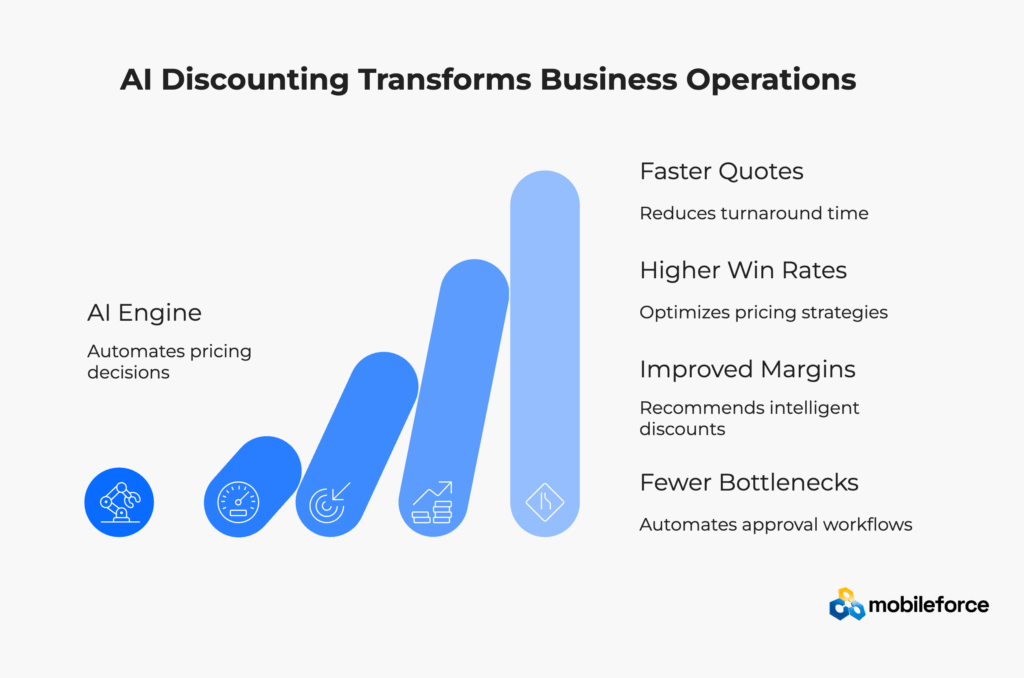
Smart discounting engines deliver measurable business results across diverse industries, from complex manufacturing equipment to professional services organizations seeking operational efficiency and revenue optimization.
A mid-market industrial equipment manufacturer faced classic operational challenges that were limiting their competitive positioning and profitability:
After implementing an AI-driven discounting engine integrated with their field service management system, they achieved complete transformation of their entire quoting process and customer experience.
This represents a hypothetical scenario for illustrative purposes.
The transformation extended far beyond efficiency gains. Sales representatives became significantly more confident in customer conversations because they could provide instant pricing for complex configurations. Customer satisfaction improved dramatically as proposals arrived faster and appeared more professional and accurate.
A growing SaaS platform struggled with subscription pricing complexity across different customer segments and usage tiers, limiting their ability to scale effectively.
The AI-powered system analyzed usage patterns, customer lifecycle stages, and competitive positioning to recommend optimal subscription packages and upgrade paths.
This represents a hypothetical scenario for illustrative purposes.
Ready to achieve similar business transformation results? Schedule your Mobileforce.ai demo today
Results Summary: Before vs. After Implementation
Metric | Traditional Process | AI-Powered Process | Improvement |
Quote Turnaround Time | 5-7 days | 1.5 days | 67% reduction |
Win Rate | Baseline | +23% increase | 23% improvement |
Gross Margin | Baseline | +15% increase | 15% improvement |
Approval Bottlenecks | Daily occurrence | 40% reduction | Significant decrease |
Pricing Errors | Weekly issues | 90% reduction | Near elimination |
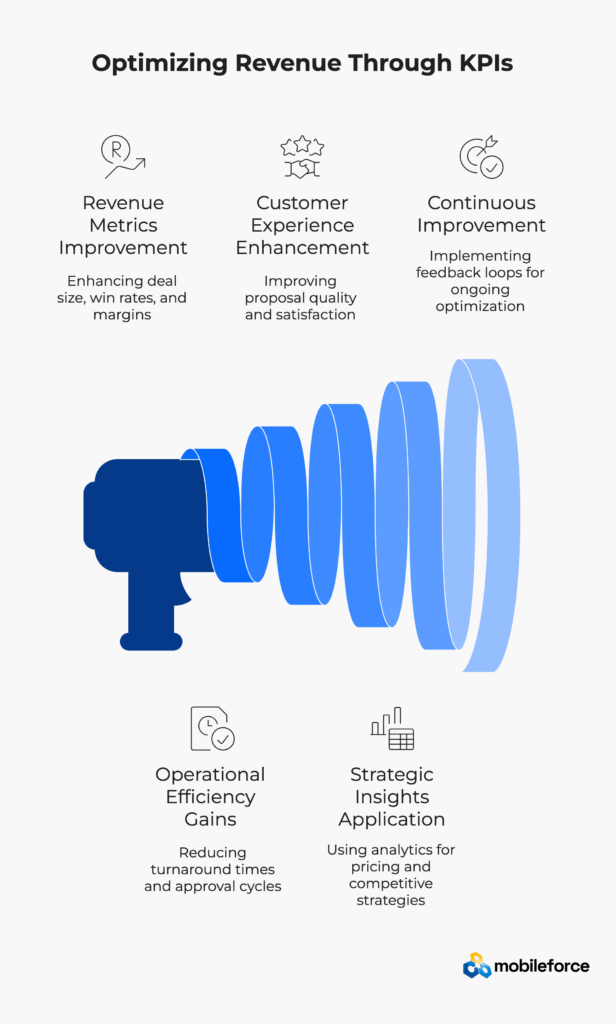
Smart discounting engines generate measurable business impact across multiple performance dimensions, providing clear ROI validation and continuous optimization opportunities for revenue teams.
Revenue Metrics and Financial Performance:
Average Deal Size Improvement: Track increases in deal value through intelligent bundling and upselling automation.
Win Rate Increases: Monitor improved close rates driven by optimized pricing strategies and stronger competitive positioning.
Margin Preservation Rates: Measure profitability protection enabled by smart discounting algorithms and automated guardrails.
Revenue per Sales Representative: Calculate productivity gains achieved through automation and process optimization.
Operational Efficiency and Process Improvement:
Quote Turnaround Time Reduction: Forrester research demonstrates up to 10× faster quote generation through intelligent automation.
Approval Cycle Acceleration: Monitor a 95% reduction in approval processing delays and bottlenecks.
Error Rate Elimination: Track accuracy improvements in pricing calculations and product configuration.
Sales Velocity Improvement: Measure overall deal progression speed and cycle time optimization.
Customer Experience and Satisfaction Metrics:
Proposal Quality Scores: Monitor customer feedback on quote professionalism and accuracy.
Customer Satisfaction Ratings: Track improvements in buying experience and vendor relationships.
Competitive Win Rates: Measure success against specific competitors in head-to-head scenarios.
Deal Cycle Predictability: Monitor consistency in sales process timing and forecast accuracy.
Modern platforms provide sophisticated analytics that reveal pricing optimization opportunities and competitive intelligence:
According to research from PwC, AI-powered price optimization through offer management platforms increases revenue by 1-5% on average across B2B organizations.
Learn more about Mobileforce.ai’s analytics capabilities for comprehensive revenue operations teams seeking data-driven insights and competitive advantages.
The best discounting engines evolve through structured feedback loops:
This continuous improvement approach ensures your competitive advantage compounds over time rather than becoming static.
Transform your deal desk operations with intelligent automation. Schedule your demo today
KPI Benchmark Comparison
KPI Category | Industry Average | AI-Powered Best Practice | Improvement Potential |
Quote Generation Time | 3-5 days | 4-6 hours | 80-90% reduction |
Win Rate | 20-25% | 30-35% | 40-50% improvement |
Approval Cycle | 2-4 days | 2-4 hours | 90-95% reduction |
Pricing Accuracy | 75-85% | 95-99% | 15-25% improvement |
Deal Velocity | Baseline | 25-40% faster | Significant acceleration |
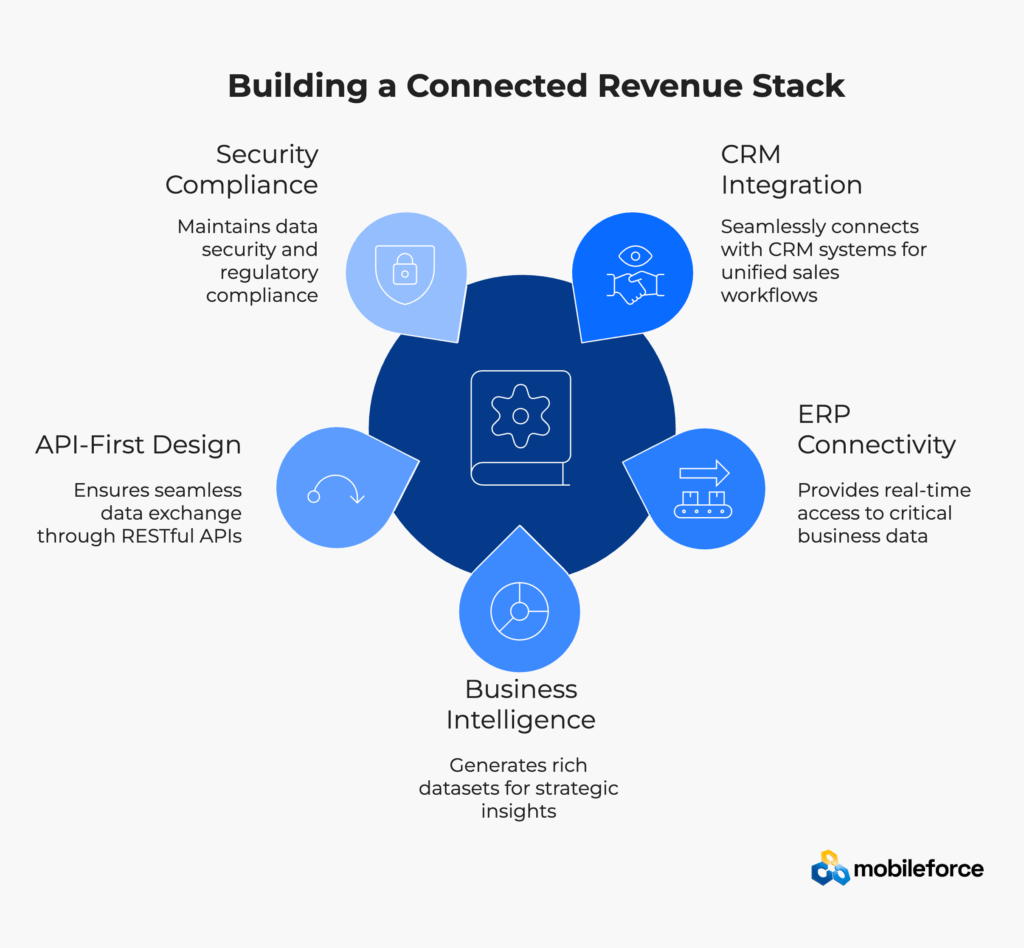
Smart discounting engines deliver maximum value when integrated seamlessly with existing business systems and workflows.
Smart discounting engines work best when integrated seamlessly with existing CRM systems:
Mobileforce.ai’s CPQ solution integrates natively with major CRM platforms, ensuring sales teams can access AI-powered pricing recommendations within their familiar workflow. This reduces adoption friction while maximizing efficiency gains.
Effective discounting engines need real-time access to critical business data:
For manufacturers, this means pricing engines can automatically adjust recommendations based on raw material costs or production capacity. For service companies, integration enables dynamic pricing based on resource availability and project timelines.
Modern discounting engines generate rich datasets that feed broader business intelligence initiatives:
Understanding which pricing strategies drive optimal outcomes helps inform product development, marketing positioning, and strategic planning decisions.
API-First Design:
Security and Compliance:
Explore Mobileforce.ai’s integration capabilities and security features. Ready to integrate AI-powered discounting with your existing systems? Schedule a technical consultation
Integration Complexity Matrix
Integration Type | Complexity Level | Implementation Time | Business Impact |
CRM Integration | Low | 1-2 weeks | High – Daily workflow |
ERP Connection | Medium | 2-4 weeks | High – Real-time costs |
BI/Analytics | Medium | 3-4 weeks | Medium – Strategic insights |
External APIs | High | 4-6 weeks | Variable – Use case dependent |
Legacy Systems | High | 6-12 weeks | High – Historical data |
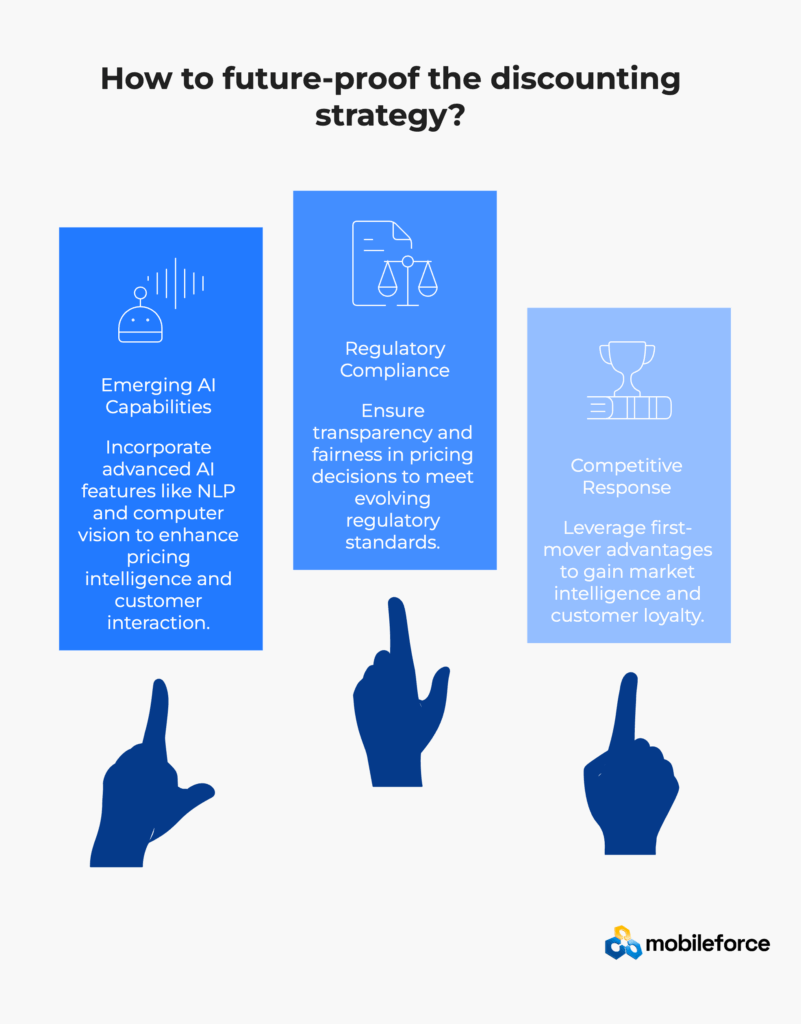
The smart discounting landscape continues evolving rapidly, driven by advances in AI, changing buyer expectations, and competitive pressures.
The next generation of discounting engines will incorporate even more sophisticated AI capabilities:
Natural Language Processing:
Computer Vision Integration:
Predictive Modeling Advances:
With the AI market projected to reach $180 billion by 2031 with a 26.95% CAGR, these capabilities will become standard rather than premium features.
As AI becomes more prevalent in pricing decisions, regulatory frameworks will evolve:
Transparency Requirements:
Fairness and Anti-Discrimination:
Smart discounting engines need built-in compliance capabilities that adapt to changing regulations automatically.
As more organizations adopt AI-driven pricing, competitive dynamics will shift:
First-Mover Advantages:
Sustained Competitive Edge:
The companies that build learning organizations around pricing intelligence will maintain competitive edges as the market matures.
Stay ahead of market evolution with Mobileforce.ai’s cutting-edge platform. Explore our AI assistants
Future Capability Timeline
Timeframe | Emerging Capabilities | Business Impact | Adoption Level |
2025-2026 | Advanced NLP, Real-time optimization | High efficiency gains | Early adopters |
2026-2027 | Computer vision, Predictive forecasting | Strategic advantages | Market leaders |
2027-2028 | Autonomous pricing, Market simulation | Competitive necessity | Mainstream |
2028+ | Quantum-enhanced modeling, AGI integration | Transformative | Industry standard |
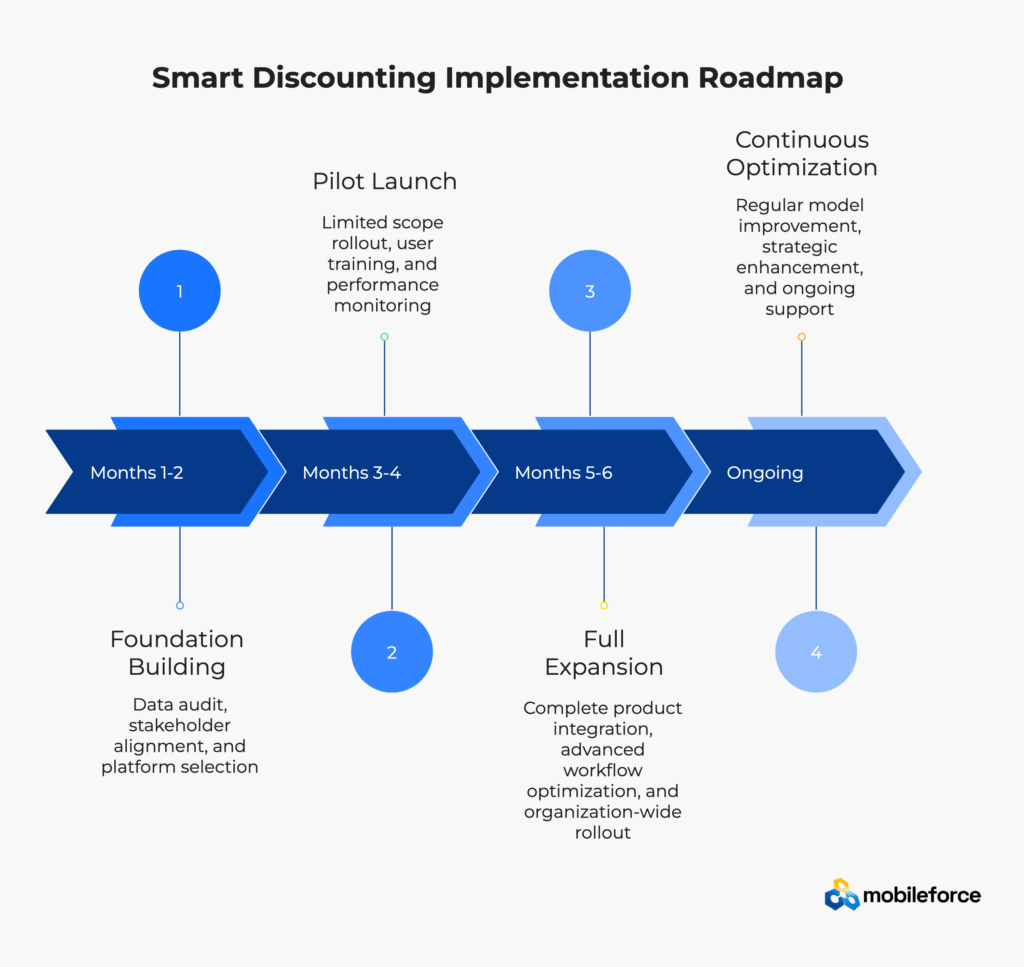
Successful smart discounting implementation follows a structured approach that minimizes risk while maximizing early wins.
Data Audit and Integration Planning:
Stakeholder Alignment:
Platform Selection and Configuration:
Limited Scope Implementation:
Training and Change Management:
Performance Monitoring:
Complete Product Catalog Integration:
Advanced Workflow Optimization:
Organization-Wide Rollout:
Model Improvement:
Strategic Enhancement:
Get started with your implementation today. Schedule a consultation with Mobileforce.ai
Implementation Success Checklist
Phase | Critical Success Factors | Key Deliverables | Risk Mitigation |
Foundation | Executive buy-in, Data quality | Requirements, Architecture | Stakeholder alignment |
Pilot | User adoption, Process fit | Working system, Training | Limited scope, Feedback loops |
Expansion | Change management, Integration | Full deployment, Documentation | Gradual rollout, Support |
Optimization | Continuous improvement, ROI measurement | Enhanced capabilities, Analytics | Regular reviews, Updates |
Smart discounting engines deliver compelling ROI through both immediate efficiency gains and long-term competitive advantages.
Smart discounting engines deliver measurable ROI through multiple channels:
Revenue Acceleration:
Margin Optimization:
Cost Reduction:
Beyond immediate ROI, these systems create lasting competitive advantages:
Market Responsiveness:
Customer Experience Enhancement:
Organizational Learning:
Implementation Costs:
Payback Timeline:
According to industry research from Deloitte, 51% of finance companies see revenue increases of at least 10% due to AI implementation, demonstrating significant impact on revenue growth.
ROI Calculation Framework:
Benefit Category | Annual Value | Calculation Method |
Revenue Increase | $500K – $2M+ | 10-15% of current revenue |
Margin Improvement | $200K – $800K | 2-5% gross margin increase |
Efficiency Gains | $100K – $400K | Sales rep productivity × hourly rate |
Error Reduction | $50K – $200K | Rework costs × error frequency |
Total Annual Benefit | $850K – $3.4M+ | Varies by organization size |
Ready to build your business case? Download Mobileforce.ai’s ROI calculator
Technical Risks:
Organizational Risks:
Business Risks:
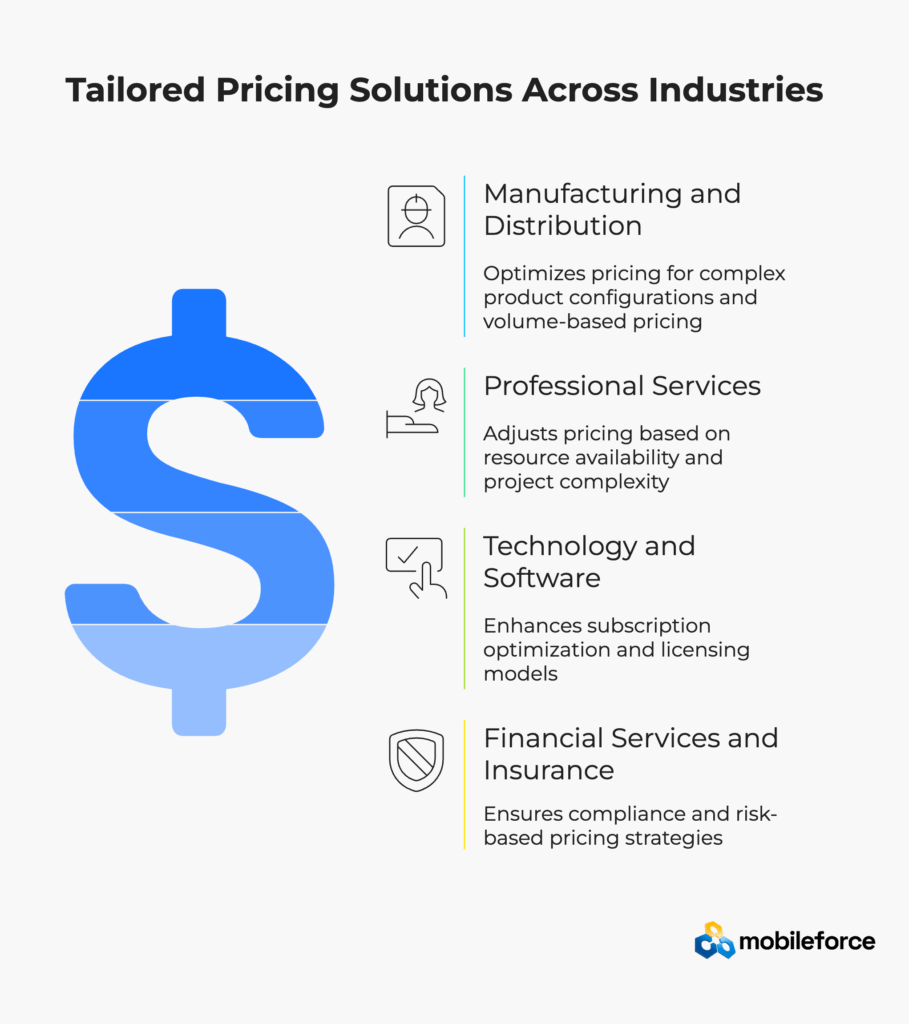
Smart discounting engines deliver tailored value across different industries, addressing unique pricing challenges and requirements.
Complex product configurations and volume-based pricing make manufacturing ideal for smart discounting engines:
Unique Challenges:
AI-Powered Solutions:
The ability to automatically calculate pricing for custom configurations while maintaining margin requirements transforms the quoting process. Learn how Mobileforce.ai serves manufacturing clients with specialized CPQ capabilities.
Service-based businesses benefit from dynamic pricing that accounts for resource availability and project complexity:
Service Industry Challenges:
Intelligent Solutions:
Smart engines recommend optimal pricing for different service packages while maintaining profitability and competitive positioning.
SaaS and technology companies leverage discounting engines for subscription optimization and complex licensing:
Tech Industry Requirements:
Advanced Capabilities:
The ability to model different pricing strategies helps optimize customer lifetime value and reduce churn rates.
Complex product portfolios and regulatory requirements create unique discounting challenges:
Industry-Specific Needs:
Specialized Solutions:
Discover how your industry can benefit from smart discounting. Schedule an industry-specific demo
Industry Adoption Maturity
Industry | Adoption Level | Primary Use Cases | ROI Timeline |
Manufacturing | High | Complex configurations, Volume pricing | 6-9 months |
Technology/SaaS | Very High | Subscription optimization, Licensing | 3-6 months |
Professional Services | Medium | Resource-based pricing, Project scoping | 9-12 months |
Financial Services | Medium | Risk-based pricing, Cross-selling | 6-12 months |
Healthcare | Low-Medium | Service bundling, Insurance negotiations | 12-18 months |
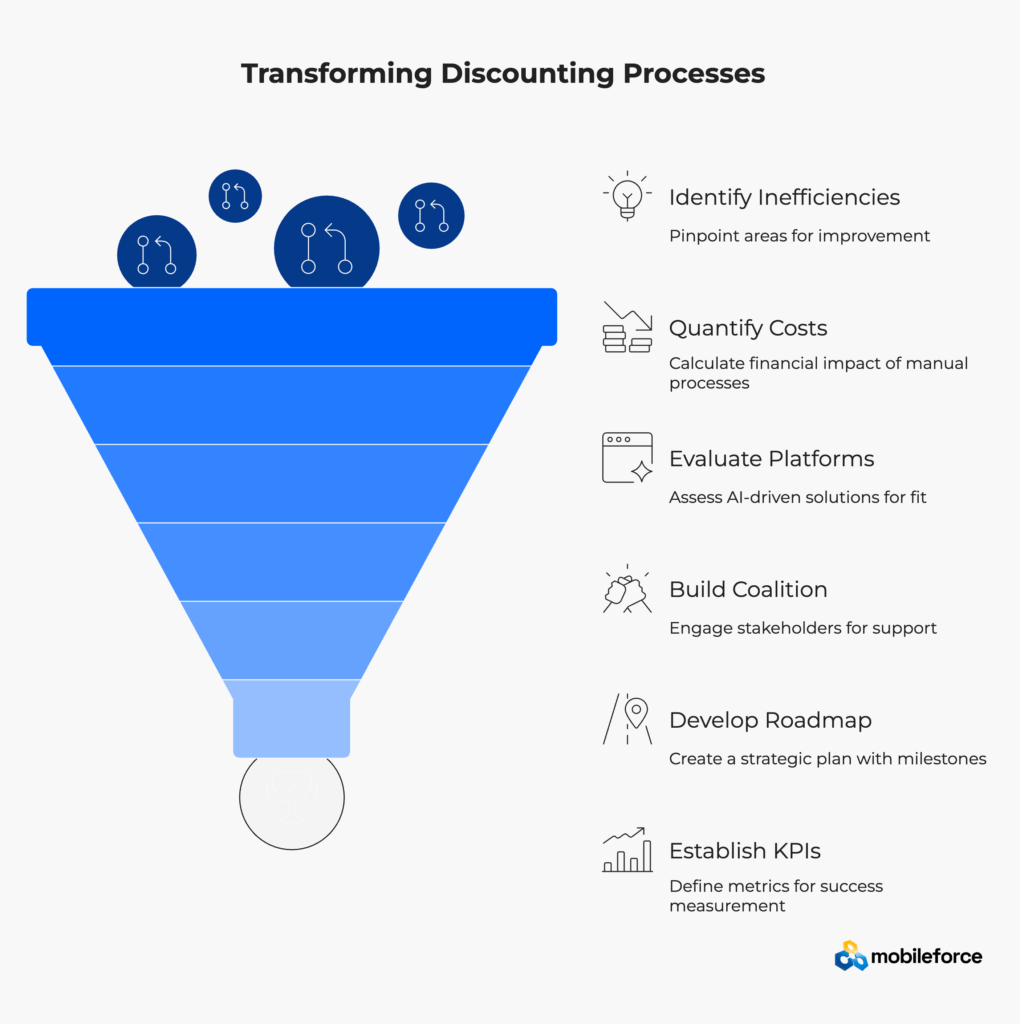
The time for incremental process improvements has definitively passed. Today’s competitive market demands intelligent automation that delivers both immediate ROI and long-term competitive advantage.
Assess Current Discounting Process Maturity: Identify operational inefficiencies in existing workflows.
Quantify Costs and Missed Opportunities: Calculate the total cost of manual processes and estimate revenue losses.
Evaluate Smart Discounting Platforms: Ensure technical fit and alignment with business requirements.
Build Stakeholder Coalition: Engage internal teams to support transformation initiatives and change management.
Develop Implementation Roadmap: Create a comprehensive plan with clear milestones and success metrics.
Establish KPI Framework: Define metrics for measuring success, ROI, and overall business impact.
Design Change Management Program: Enable organizational adoption and provide user training.
Create Governance Framework: Ensure ongoing optimization and continuous improvement of processes.
The companies that act decisively today will establish market advantages that competitors struggle to match. Organizations that delay implementation will find themselves playing catch-up in an increasingly AI-driven marketplace.
Don’t let manual processes cost you deals and competitive market position. Schedule your demo today and discover how AI-driven discounting can transform your revenue operations and business performance.
Frequently Asked Questions About Smart Discounting Engines
A smart discounting engine uses artificial intelligence and machine learning algorithms to automatically optimize discount recommendations, approval workflows, and pricing strategies based on comprehensive analysis of historical data, real-time market conditions, and customer behavior patterns. Unlike static discount rules that remain fixed, these intelligent systems continuously adapt and learn to maximize both win rates and profitability through dynamic pricing optimization.
AI improves deal desk efficiency by automating approval routing processes, providing real-time pricing recommendations, eliminating manual calculations, and creating intelligent guardrails that prevent pricing errors. Research studies demonstrate 95% reduction in approval processing time and 10x faster quote generation with AI-powered systems, enabling sales teams to focus on relationship building and revenue generation rather than administrative tasks.
Yes, modern smart discounting engines integrate seamlessly with popular CRM platforms including Salesforce, HubSpot, Microsoft Dynamics, and other business applications. Mobileforce.ai’s platform offers native integrations that ensure pricing intelligence flows directly into existing sales workflows without disrupting established processes or requiring extensive retraining of sales teams.
Organizations typically experience 6-12 month payback periods with measurable benefits including 10-15% revenue increases, 10-15% sales cycle reductions, and significant margin improvements through optimized pricing strategies. The exact ROI depends on implementation scope, current process efficiency, and organizational commitment to change management and user adoption.
Smart discounting engines maintain regulatory compliance through automated audit trails, predefined approval hierarchies, and intelligent guardrails that prevent unauthorized discounting. They automatically document all pricing decisions with complete context including market conditions, customer factors, competitive analysis, and approval reasoning for comprehensive compliance reporting and audit readiness.
Industries with complex pricing structures benefit most significantly, including manufacturing, technology services, industrial equipment, professional services, and healthcare organizations. Any industry relying on customized quoting, multi-tiered pricing models, or complex approval processes gains efficiency and accuracy improvements from CPQ automation and intelligent discounting.
Implementation timelines vary based on organizational complexity and integration requirements, but typical deployments range from 4-12 weeks. Mobileforce.ai’s no-code platform often reduces implementation time significantly through simplified configuration, pre-built integrations, and automated workflow setup that eliminates custom development requirements.
Yes, advanced systems support multi-level approval hierarchies, conditional routing based on deal characteristics, exception handling for unusual scenarios, and dynamic business rule implementation. Modern platforms can reduce approval processing delays by 95% while maintaining proper governance controls, compliance requirements, and risk management through intelligent workflow automation and real-time monitoring.